
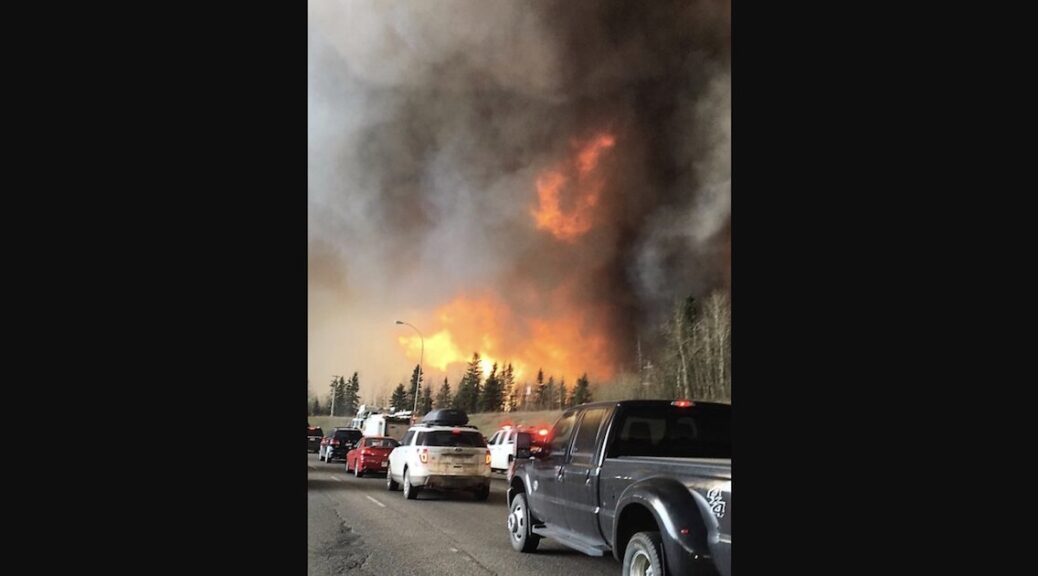
John Vaillant’s book, Fire Weather: The Making of a Beast (Vintage
Canada, 2024) begins by describing the fire that consumed the Alberta town of Fort McMurray in May, 2016. In a matter of hours, the conflagration that became known as “The Beast”, destroyed more than 2,500 buildings and homes, thousands more were damaged, 6,000 square kilometres were burned, and nearly 100,000 people had to flee for their lives.
“In the spring of 2016,” writes Vaillant, “halfway through the hottest year of the hottest decade in recorded history, a new kind of fire introduced itself to the world.” The year, in northern Alberta, should have been ordinary, but it wasn’t. Snowfall had been well below average for two years, the spring was unseasonably dry, and the unprecedented heat had dried out everything that was combustible. This was becoming the new normal—a new kind of year with a new kind of threat.
But this threat is not particular to northern Alberta and to other provinces in Canada. Indeed, it is happening all over the planet—America, Greece, Portugal, Spain, France, Russia, Australia—almost everywhere that has forest, brush, grass or any burnable landscape. Places that were once safe to live are no longer so. Recent statistics identify Europe as a continent that is heating faster than most. And the cause is not a mystery.
In a tragic irony, Fort McMurray was an Alberta oil town that was conceived, nourished and sustained by the fossil fuel industry, the same industry that provides the petroleum which is the source of the carbon dioxide emissions that are heating the planet to unprecedented levels. Plot global petroleum consumption against the global rise in temperature and the correlation is perfect. The fuel that energizes our modern civilization has bound us to a pact with a holocaust. We are subjecting ourselves to a Trial By Fire.
“Trial” has two meanings. One pertains to a court of judgment where evidence is considered and a decision is rendered. The other meaning pertains to a test of adversity, requiring a special endurance for success or survival. Both meanings apply to our relationship with fossil fuels. History will judge the intelligence, the foresight and the wisdom that we have used to employ such an energy to power our civilization, particularly since we have known for more than half a century what the ultimate results will be. And we are now beginning to sample the burning consequences that will test us in ways that we never imagined. Guilty of unmitigated folly will be the judgment in the first meaning. As for the second, we do not know exactly how we will respond to the rising temperatures, the cooked crops, the weather extremes, the rising oceans, and the masses of climate refugees as we confront the consequences of our collective behaviour.
John Vaillant in Fire Weather gives us a hint of what will happen to a
culture that moment-by-moment lives, flourishes and now suffers with
its addiction to some form of fire. “A single four-cylinder car engine turning at 2,400 rpm—driving to work speed,” he writes, “will generate around 10,000 combustions per minute—more than half a million per hour. There are well over a billion cars on the road today, along with a quarter billion trucks, buses, and vans, and 200 million motorcycles. Add to this a conservative estimate of 25,000 passenger and cargo jets, more than 50,000 cargo ships, and the unknown but certainly huge number of construction and earth-moving machines, tractors, lawnmowers, motorboats, private planes, helicopters and weapons. If you ran all of these engines for just one minute, the number of combustions occurring inside them would number in the tens of trillions—each one an individual fire generating heat, energy and exhaust.”
Such enormous numbers begin to define our new relationship with the place in the universe where we live. We are not as innocuous and
insignificantly small as we once thought. The total effect of all our little and seemingly innocent dalliances with combustion is becoming more than consequential. We are literally playing with fire.
Vaillant quotes some appropriate lines from Robert Frost’s poem, “Fire and Ice”:
- Some say the world will end in fire,
- Some say ice.
- From what I’ve tasted of desire,
- I hold with those who favour fire.
But, perhaps his most powerful quote comes from the Russian dissident,
Alexandr Solzhenitsyn, who was commenting on the value system that
eventually collapsed the Soviet Union. “In our country the lie has become not just a moral category, but a pillar of the state.” As long as fossil fuel remains the primary source of our global civilization’s energy, then the pillar that is holding up the entire system could well be consumed by fire.
Ray Grigg for Sierra Quadra
Postscript: As of Saturday, July 18, 2026, a total of 955 forest fires
were burning across Canada, with 191 in Ontario and 103 in British
Columbia.
Top image credit: Wildfires closing in on Highway 63 near Fort McMurray in 2016 – Photo by DarrenRD via Wikimedia (CC By SA 4.0)