
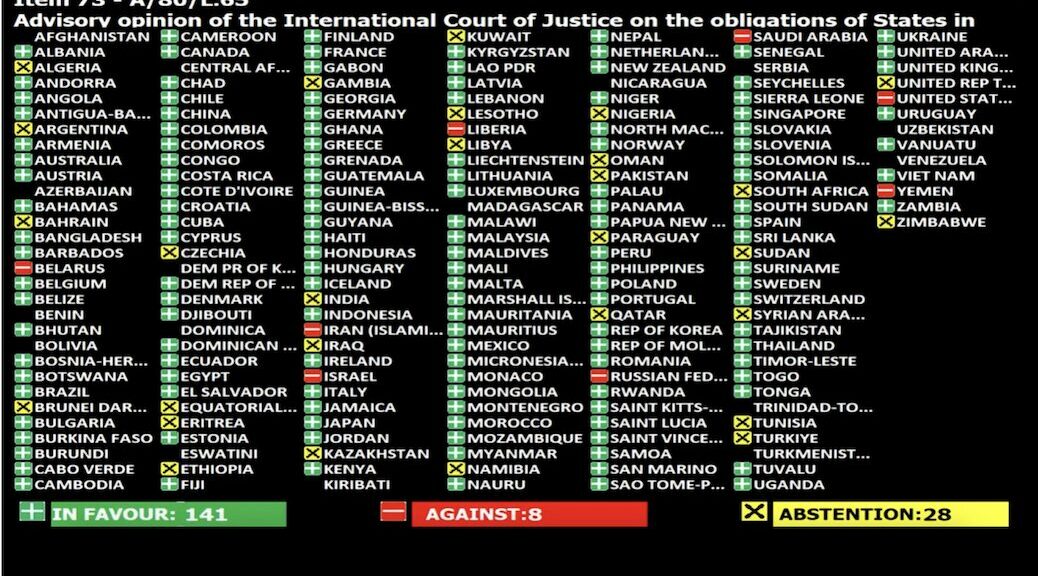

The UN backed a world court opinion stating that countries have a legal obligation to address climate change. Canada, China and every EU country except Czechia were among the 141 nations that supported the resolution. The United States, Russia, Saudi Arabia and Iran were among the eight that voted in opposition. Twenty-eight countries abstained.
UN Secretary-General António Guterres tweeted, “I welcome the adoption of the General Assembly resolution on the @CIJ_ICJ’s (International World Court) advisory opinion on climate change – a powerful affirmation of international law, climate justice, science & the responsibility of states to protect people from the escalating climate crisis. Those least responsible for climate change are paying the highest price. That injustice must end.”

Vanuatu
The motion originated with the low lying Pacific island nation of Vanuatu, which has been hit by more extreme weather events than any other country on the planet, despite contributing less than 0.01% of global carbon dioxide emissions.
Joses Togase, a project manager at Santo Sunset Environment Network explained, “Rising sea levels are damaging the coastal zones and eroding valuable local resources that people depend upon to support their livelihoods.”
He also spoke of unpredictable changing weather: heavy rainfalls, droughts, and more frequent tropical cyclones. In 2015, 90% of all the buildings in Vanuatu were damaged by Hurricane Pam. As the gobal temperatures move closer to 2.0°C, Vanuatu is expected to lose 20% of its GDP a year.
MULTIMEDIA: Photos and videos of the reading of the #ICJ Advisory Opinion on States Obligations in Respect of Climate Change are available here: https://t.co/Ah5eUsMbk9 pic.twitter.com/wslE8AJ1MT
— CIJ_ICJ (@CIJ_ICJ) July 23, 2025
A Legal Obligation
Three years ago, Vanatu requested an advisory opinion from the International World Court on two questions:
- “What are the obligations of States under international law to ensure the protection of the environment? and
- “What are the legal consequences for States under these obligations when they cause harm to the environment?”
Last July, the World Court ruled that states do have an obligation to protect the planet from their greenhouse emissions. “If States breach these obligations, they incur legal responsibility and may be required to cease the wrongful conduct, offer guarantees of non-repetition and make full reparation depending on the circumstances.”
Following the UN vote backing the World Court ruling, Guterres said, “The world’s highest court has spoken. Today, the General Assembly has answered.”
Trump Responds
Tammy Bruce, the Unites States Amassador to the UN, called the resolution, ‘highly problematic.’
On January 7, 2026, President Trump issued an executive order “withdrawing the United States from International Organizations, Conventions, and Treaties that Are Contrary to the Interests of the United States.” Thirty-two UN organizations, including the Intergovernental Panel on Climate Change (IPCC), are among them.”
When it became apparent that he would not be able to block the UN vote, Trump seized upon the fact most climate scientists have lowered their worst case scenario for climate change in recent years.
Many think it is still possible to hold the rise to 1.5°C IF nations take stronger actions. The 2025 Un Emissions Gap Report stated the planet appears to be currently on a trajectory to reach 2.8°C by 2100. A paper published at the beginning of April dismissed worst case scenarios like 8.5°C as implausible.
— Rapid Response 47 (@RapidResponse47) May 16, 2026
On May 15 Trump tweeted, “GOOD RIDDANCE! After 15 years of Dumocrats promising that ‘Climate Change’ is going to destroy the Planet, the United Nations TOP Climate Committee just admitted that its own projections (RCP8.5) were WRONG! WRONG! WRONG! For far too long Climate Activism has been used by Dumocrats to scare Americans, push horrible Energy Polices, and fund BILLIONS into their bogus research programs.”
IPCC Clarifies its position
The IPCC responded, “Some of the recent media and social media reporting has focused on the scenario known as SSP5-8.5, previously referred to as RCP8.5. This was one of five illustrative scenarios (the most extreme in emissions until 2100) assessed in the IPCC’s Sixth Assessment Report (2021-2023) …”
RCP8.5 was not produced by the United Nations TOP Climate Committee: “The IPCC does not conduct its own research, run models or make measurements. It does not own the scenarios described in the mentioned paper, nor does it own any of the scenarios assessed in the Sixth Assessment Report (AR6). The IPCC’s role is to assess the available scientific, peer-reviewed literature relevant to climate change, currently running at approximately 50,000 papers and studies per year.”
This week, more than 200 authors are gathered in Nassau, The Bahamas, to advance work on the Working Group II contributions to IPCC’s Seventh Assessment Report. Over the next fivedays, they will participate in trainings, workshops & chapter discussions.https://t.co/30XyEt03SN pic.twitter.com/rvTg7Py4gH
— IPCC (@IPCC_CH) May 19, 2026
Most of the world takes climate change seriously and have now agreed that nations have a moral and legal obligation to clean up their emissions.
Michael Gort, Canada’s Ambassador to the UN explained, “Climate change is one of the greatest challenges of our time, and Canada is firmly committed to the global effort to address it. Canada is a strong supporter of the international climate change regime and welcomes the growing momentum to clarify States’ obligations in this area.”
He qualified this by stating, “ Canada is of the view that customary international law is not yet fully developed in the context of climate change. The Resolution’s reference to compliance with obligations under international law must be understood as limited to obligations that have crystallized under international law.
Top image credit: Results of the UN Climate vote – Screenshot from United Nations X