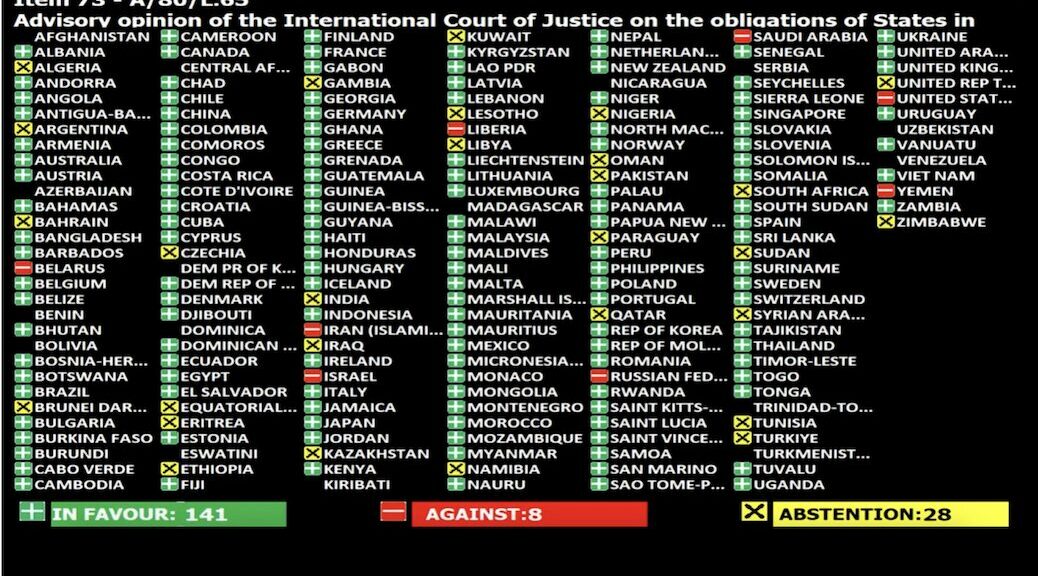
The UN backed a world court opinion stating that countries have a legal obligation to address climate change. Canada, China and every EU country except Czechia were among the 141 nations that supported the resolution. The United States, Russia, Saudi Arabia and Iran were among the eight that voted in opposition. Twenty-eight countries abstained.
UN Secretary-General António Guterres tweeted, “I welcome the adoption of the General Assembly resolution on the @CIJ_ICJ’s (International World Court) advisory opinion on climate change – a powerful affirmation of international law, climate justice, science & the responsibility of states to protect people from the escalating climate crisis. Those least responsible for climate change are paying the highest price. That injustice must end.”
Driving a gasoline powered car is getting more expensive these days as a consequence of the war with Iran and the closure to most oil tankers of the Strait of Hormuz. Our industrial and consumer world is still largely energized and sustained by oil, and about 20% of the global consumption of about 100 million barrels per day must pass unimpeded through that narrow gap in the Persian Gulf. Limit supplies and the price goes up. So, while the subject of oil is current and the price of gasoline has our attention, this is an opportunity to consider the environmental implications of what we are doing as consumers of these fossil fuels.
By Zahra Mahdi, New Canadian Media, Local Journalism Initiative Reporter
While Canada has opened one dedicated stream for all Ukrainians escaping Russia’s invasion, it only made room for 40,000 Afghans escaping the Taliban’s rule under four cumbersome emergency response streams.