

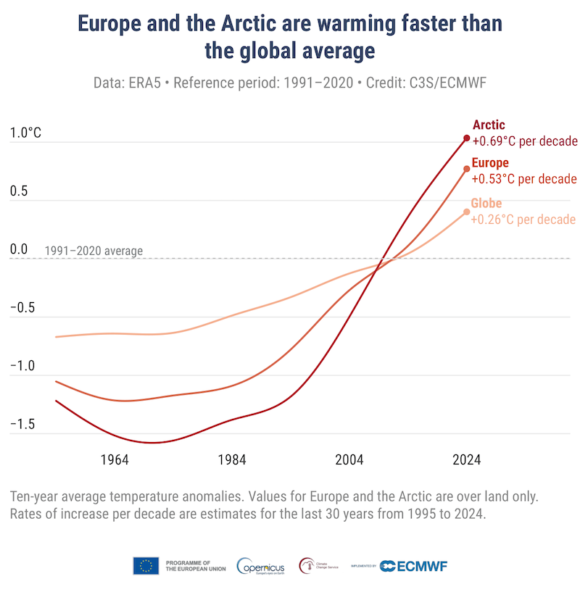
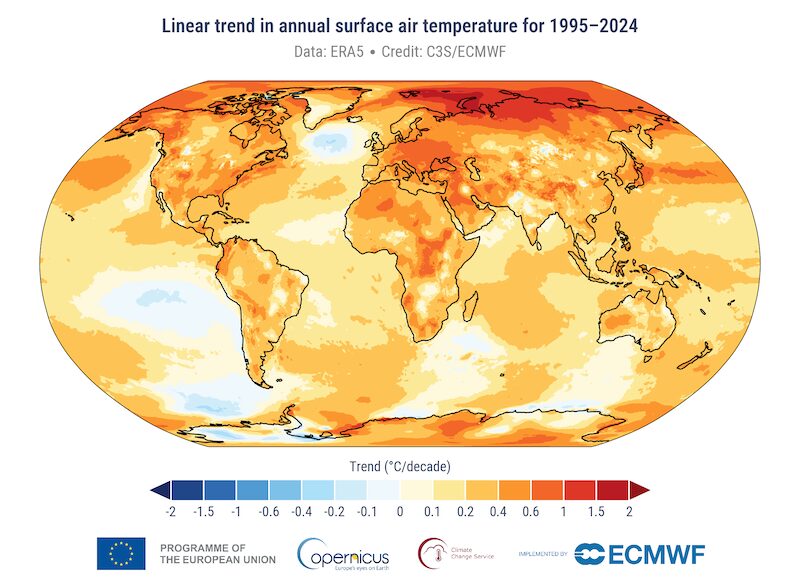
Europe leads the world in the struggle to reduce emissions – and the rise of average global temperatures. According to Copernicus, the European Union’s Earth Observation Programme, Europe is warming at double the average rate, 0.4°C per decade as opposed to 0.2°C. Only the Arctic is warming up faster. While the world is on the threshold of 1.5°C, in Europe the number “is around 2.4°C, and in the Arctic, it’s even higher at 3.3°C.”
Right-wing parties across Europe are raging against Green initiatives. In Spain, the Vox leader, Santiago Abascal asked the government if they are going to “ban the propaganda of climate religion.” Italian MP Claudio Borghi declared, “Climate change has always existed, the causes are anything but clear, and the solutions are contrary to what … is correct.” Bruno Retailleau, France’s Interior Minister, suggests the government should stop supporting renewable energy and instead expand the nation’s nuclear energy sector.
His comment on renewables seems unfair in that their potential to replace fossil fuels has not been realized. The global demand for energy, from developing nations (seeking better living conditions) and developed nations (who want more), continues to outpace the deployment of wind, solar and other ‘clean’ energy sources. The world’s fastest expanding sector may be renewables, but it is using more coal, gas and oil than ever before.
Ben Clarke, a researcher in extreme weather and climate change at Imperial College London, told the European news agency AFP, “Almost all of this heat is driven by the human-induced greenhouse effect from fossil fuel emissions, with the actual distribution of this excess heat determined by (several) factors.”
Rebecca Hersher, from NPR’s Climate Desk, explained, “One reason Europe is heating up so quickly is that it’s very close to the Arctic, and the polar regions feel the effects of climate change more intensely. Another reason is that the ocean and atmospheric currents around Europe are warmer in general than those at similar latitudes in other parts of the world. That’s why London’s winters are so much more temperate than Chicago’s, even though London is farther north. And it means that as the oceans and atmosphere heat up, Europe feels it in a big way.”
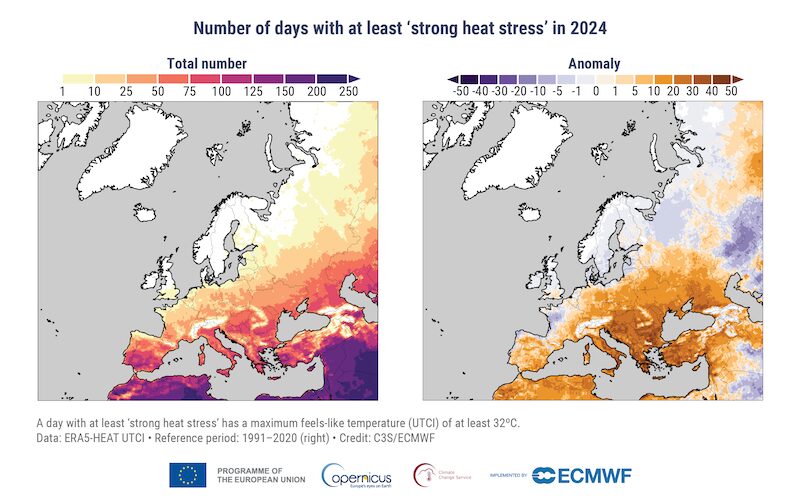
Many European heatwaves originate in North Africa, which is also warming up much faster than most of the planet. “Very warm and dry air is transported northwards from North Africa across the Iberian Peninsula into western and central Europe, and in some situations further east. Once this air arrives beneath a persistent high-pressure system, continuous sunshine allows temperatures to rise even further.”

Copernicus also pointed to Europe’s stricter air-quality regulations. While this brought relief to people with respiratory problems, it also reduced many types of particulate matter that deflect sunlight and make clouds more reflective. “As a result, more solar radiation is reaching the surface, and cloud cover is also reduced, both contributing to faster regional warming.”
Links of Interest:
- Why are Europe and the Arctic heating up faster than the rest of the world? – Copernicus
- Why Europe is the fastest-warming continent on Earth – NPR
- Humanity consuming more than ever; Increased emissions negate Renewable growth – Cortes Currents
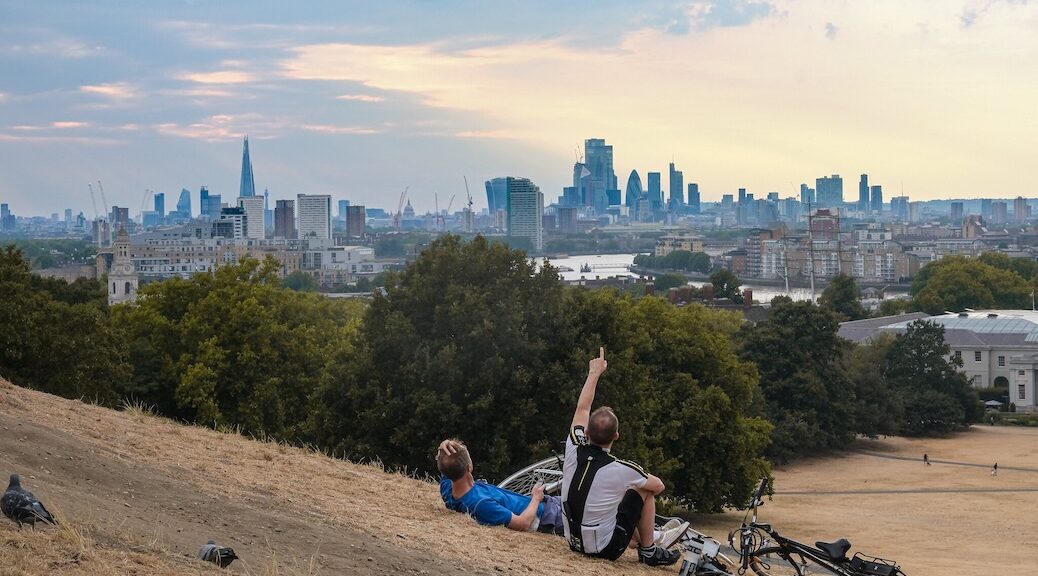
Top image credit: Looking from a sun bleached Greenwich Park towards London during the 2022 drought – photo by Alisdare Hickson via Flickr (CC BY-SA 2.0)
Sign-up for Cortes Currents email-out:
To receive an emailed catalogue of articles on Cortes Currents, send a (blank) email to subscribe to your desired frequency:
- Daily, (articles posted during the last 24 hours) – [email protected]
- Weekly Digest cortescurrents – [email protected]