
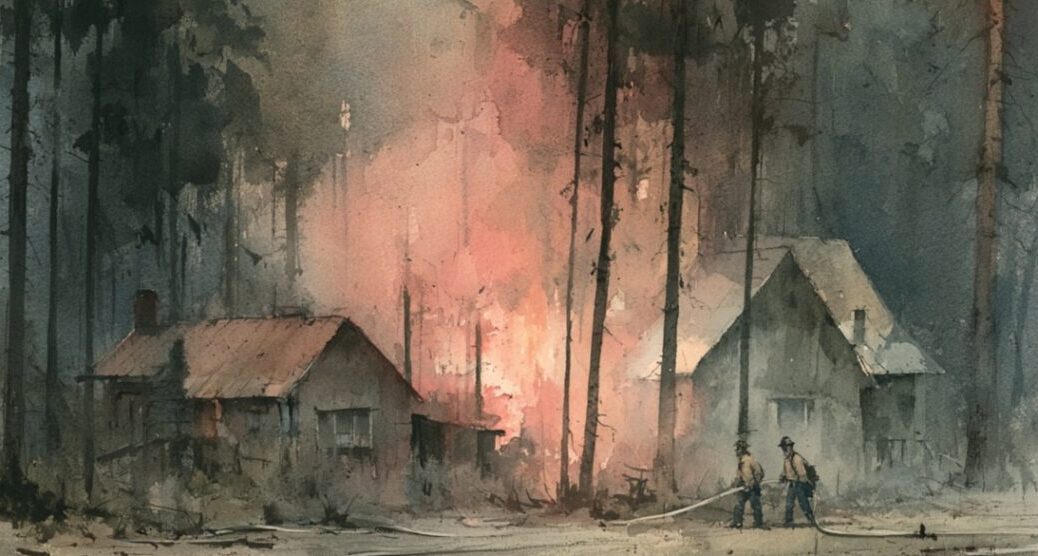
My assumption is that we will, at some point in time, see a fire on Cortes of a severity that will flabbergast the population. It may not happen this year, and it may not happen in 10 years, but the conditions are getting very, very bad.

That is what Mike Brown, volunteer fire fighter and long time Cortes resident, had to say at the May 3rd meeting on Emergency Preparedness in the Pioneer Room.
At that thinly-attended meeting, SRD emergency services staffer Sarah Rosen gave a presentation on emergency preparedness for individuals and households. As part of her presentation she reviewed potential emergencies in our local area.
Cortes Island is fortunate to be sheltered from tsunamis; earthquakes are rare in BC; the island has no rivers to flood or dams to burst (unlike Campbell River, where the hydro power dam is currently undergoing seismic safety renovations). The island has no hazardous chemical plants or huge fuel dumps. The one serious disaster-grade risk to the Cortes community is wildfire.
Wildfire: how serious a risk is it?
In the course of discussion at the May 3rd meeting, local fire fighters weighed in on exactly how serious that risk is. Their informed opinion: very serious, and not being taken seriously enough.
Even the way that official risk thresholds are measured came in for some critique from fire chief Eli McKenty.
The way that risk assessment works, is they take a thirty-year historical average, and in their danger class ratings they discount the top fifth percentile. So they’re looking at a historical average that has the worst conditions removed from it already.
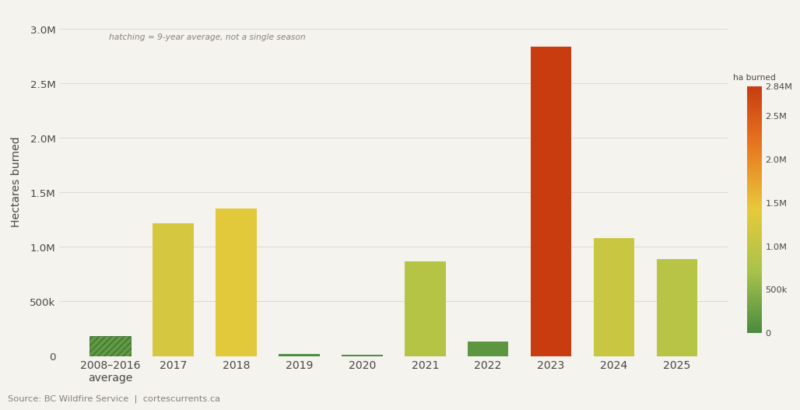
The problem that our fire fighters see with the traditional discounting of the top fifth percentile or “unusual” events, is that extreme fire events are not as unusual as they used to be. As John Vaillant documents in his book Fire Weather, both the intensity and size of wildfires have been increasing over the last decade and more, as climate change makes itself felt in the northern hemisphere. While there are still “quiet years” when wildfire incidence is low, the active years see intensity and size on an unprecedented scale.
Vaillant tells in detail the story of the Fort MacMurray fire, one specific incident whose scale and destructiveness shocked all of Canada. Of particular interest are the first-hand accounts by firefighters on the scene, who were appalled by the intensity and speed of the blaze they were fighting. Wildfires are not playing by the same rules they used to. Eli mentions his concern that coastal fires have started to behave more like those in the interior.
Mount Underwood and Wesley Ridge — those two fires both exhibited fire behavior that is not supposed to happen in the coastal fire center. Those were interior-style fires. It’s not supposed to happen in coastal.
Mike Brown concurs: the experts are worried.
My singular concern is wildfire. I think the island’s at extremely high risk. I was just at an assembly [of fire fighting professionals] in Victoria, and basically the word on the street from BC Wildfire — is that BC Wildfire personnel are being surprised by fires they’re seeing.
So , if we’re trying to stay ahead of it, we should be imagining how to expect the unexpected. The Mount Underwood fire on Vancouver Island last year behaved in a way that professionals didn’t expect. So what that tells me is that if the perception is that Cortes is at moderate risk, that means it’s at high risk. And if the perception is that it’s high, it’s at severe risk.
Forests have changed since the 1930s
At least one skeptical voice in the small gathering was raised to question how justified all this alarm really is. Cortes Island hasn’t experienced a major fire since the 1930s, and also doesn’t feature the kind of massive clearcuts that are strongly associated with catastrophic wildfire.
Eli responded that conditions are not what they were in the 1930s:
The virgin forests at that point were not nearly as easily flammable as the second and third growth forests that we have on Cortes now, which have higher light fuel loading than there’s likely ever been before, and it’s drier than ever.
By “light fuel loading” Eli means the understory herbage, young trees and small fallen branches which when dried out by summer weather, make perfect tinder for a major blaze. The BC government recognises this increasing risk: logging crews leave the woods in the summer when required to do so by the Industrial Wildfire Prevention and Mitigation program. [The specific metric is the Fine Fuel Moisture Code and the Drought Code; when conditions get dry enough, the BC Wildfire Service can issue a suspension order and all industrial activity in the affected area stops.]
The woods were much damper a century ago. Nowadays, even a stray spark from a chainsaw blade could start a wildfire.
Despite impressive television and social media footage plus the visible increase in summer smoke from disastrous blazes in the interior (and as far away as Russia), coastal residents remain slow to update their perceptions of fire risk in what used to be called the Raincoast. Too many people underestimate the risk, according to Eli and Mike.
Eli:
The biggest emergency preparedness risk on the island might be represented by the fact that only four people showed up — And three of us, I think, are here in the interest of promoting it to other people!
Mike again, explaining how it is that people can so easily remain unaware or complacent:
The contemporary citizen has a lot of things to think about and a lot of potential workshops to go to. There’s a lot of things going on, so people will attend- —yeah — 25 different things? I haven’t found any informed disinterest in wildfire. I’ve just found the kind of disinterest where it’s just not in their purview. They haven’t thought about it and then decided like, “I don’t think so.” They just don’t think about it. They think about other things. They’re busy, or they have other priorities. Homeowners here have other priorities, like when you say, “How about fire-smarting your property?” they would prioritize gardening over fire-smarting. So it’s just… The way they’re used to being, or just the things they attend to, or spending time on social media, the way their attention and time gets portioned — wildfire just doesn’t get to the top of the list.
Even homeowners who are paying attention may still feel fatalistic, as Sarah Rosen suggested, in face of disasters they imagine or conceptualise as huge and overwhelming. A wall of fire bearing down on your house seems unstoppable, and attempts to protect yourself may seem futile. But this is not the case.
FireSmart makes a real difference
Even in the Fort Mac fire, which was of unprecedented speed and intensity, a post-fire analysis indicated that 90 percent of the homes that survived had implemented FireSmart precautions and principles. Although the “wall of fire” does happen, what ignites most homes is the flying embers; and FireSmart offers strategies for protecting your home from that swarm of igniters.
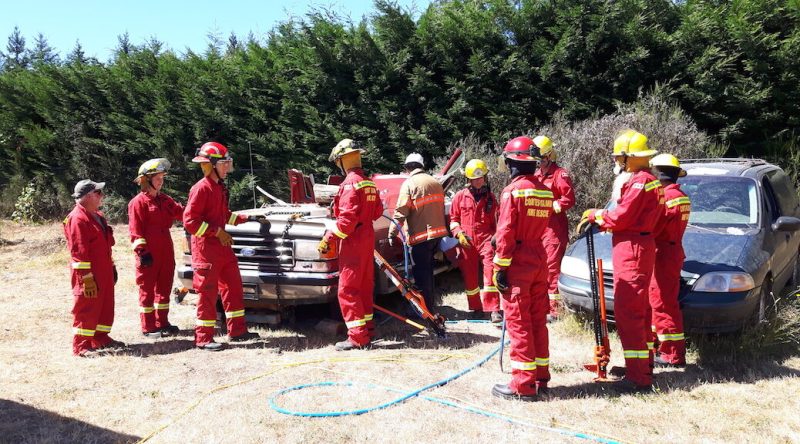
SRD began carrying out FireSmart assessments on Cortes in 2024. Since then, subsidies have been offered to seniors to have debrushing and tree trimming done on Cortes properties, and roof sprinklers have been offered at cost to Cortes residents through the fire department.
In the event of a major wildfire, FireSmarting ahead of time is really the biggest thing that people can do to protect their homes. That’s been demonstrated over and over again now in all of the major wildfire catastrophes we hear about. (Eli, 2025)
A FireSmarted property may also be easier for fire fighters to save and thus more likely to escape triage as “hopeless” in an actual emergency.
At the May 3 meeting our local firefighters expressed some doubts about how easily or expediently Cortes Island could be evacuated. Under the circumstances, saving as many structures as possible is even more important, as islanders may need to shelter in place rather than being able to flee.
I’m skeptical that we’d be able to pull off an evacuation with BC Ferries. So I wanna learn more about what shelter-in-place would look like… Because we can’t control the BC Ferries. But we can control how informed and prepared we are as a community, to be able to shelter in place during a wildfire. (Mike)
One asset Cortes Island does have that some communities lack, and that is the cohesive and self-organising quality of neighbourliness and civic engagement. As Sarah Rosen mentioned in her presentation:
There’s just more and more research showing that the communities that are connected to each other before disaster do so much better after — which seems like a pretty obvious thing for anybody who’s ever felt connected to community.
If you would like to participate in the FireSmart programme via SRD, contact them at [email protected] or 250-914-9234. Alex Bernier is their local contract worker but he can’t book appointments, that has to be done by SRD staff.
Contact the Fire Department if you’d like to know more about roof sprinklers which can significantly reduce risk from flying embers. They are easy to install (they simply clip onto your gutters and are connected to a regular garden hose).
Recommended reading:
- Fire Weather by John Vaillant
- BC Wildfire Service’s historical data analysis
- ClimateReadyBC’s analysis of fire patterns and risk
- CBC article summarising statistical data on wildfires and climate change, source of data for plot shown above.
Previous Currents coverage: