Tag Archives: WIldfire smoke

Cortes Island’s greatest risk: wildfire

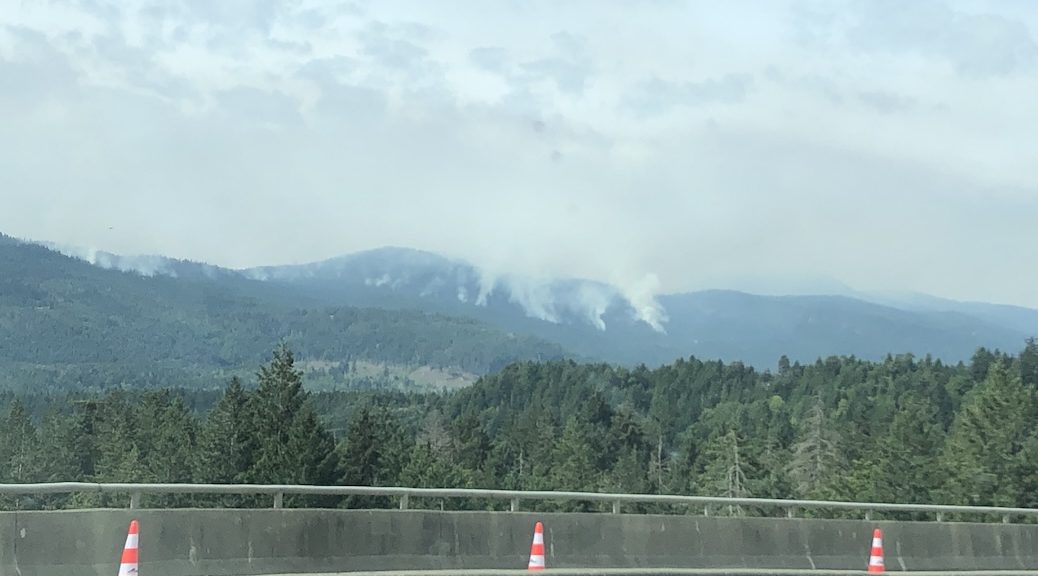
 My assumption is that we will, at some point in time, see a fire on Cortes of a severity that will flabbergast the population. It may not happen this year, and it may not happen in 10 years, but the conditions are getting very, very bad.

That is what Mike Brown, volunteer fire fighter and long time Cortes resident, had to say at the May 3rd meeting on Emergency Preparedness in the Pioneer Room.

At that thinly-attended meeting, SRD emergency services staffer Sarah Rosen gave a presentation on emergency preparedness for individuals and households. As part of her presentation she reviewed potential emergencies in our local area.

Cortes Island is fortunate to be sheltered from tsunamis; earthquakes are rare in BC; the island has no rivers to flood or dams to burst (unlike Campbell River, where the hydro power dam is currently undergoing seismic safety renovations). The island has no hazardous chemical plants or huge fuel dumps. The one serious disaster-grade risk to the Cortes community is wildfire.

Continue reading Cortes Island’s greatest risk: wildfire

Canada’s 2023 Wildfire Season Linked to 82,000 Deaths Worldwide

By Michelle Gamage, The Tyee, Local Journalism Initiative Reporter

Researchers have crunched data on excess deaths and calculated that Canada’s 2023 wildfire season shortened the lives of 82,000 people worldwide.

The smokiest days caused about 5,400 acute extra deaths across North America alone, according to the research published Wednesday in the journal Nature.

That means wildfire smoke is about as deadly as prostate cancer, Michael Brauer told The Tyee.

Continue reading Canada’s 2023 Wildfire Season Linked to 82,000 Deaths Worldwide

Driving through Canadian Wildfires: A Cross-Country Journey Amid the Smoke

As of August 7, the Canadian Interagency Forest Fire Centre reported that wildfires have consumed more than 7.1 million hectares. There is a broad belt of fires stretching from Northern Alberta to Western Ontario (image below). 

Driving across Canada in mid to late May, we played tag with the smoke and its acrid scent all the way from the Saskatchewan border to Newfoundland. It wasn’t as bad as the news sometimes made it sound. There were days of bright, clear skies, as well as others when a fog-like haze settled across the landscape. The flames may have come within three kilometres of the Trans-Canada Highway west of Kenora, but we didn’t see them. The road remained open, although several side roads were blocked. The smoke, however, spread much farther. We saw a pink sun as far east as Corner Brook, Newfoundland, on May 28.

Continue reading Driving through Canadian Wildfires: A Cross-Country Journey Amid the Smoke

Canada’s northern wildfires projected to slow global warming — at a high cost

Canada’s National Observer, Local Journalism Initiative Reporter

The climate-driven wildfires currently razing Canada’s northern forests and darkening skies across the continent may have an unexpected effect: according to a new study, the fires may reduce global warming and sea ice melt in the Arctic.

The rising impact of blazes in Canada and Siberia’s boreal regions over the next 35 years will slow warming by 12 per cent globally and 38 per cent in the Arctic, according to recent climate modelling research at the University of Washington (UW). But the study’s authors warn that while the study may sound positive, it’s just one part of a trend that overall spells major trouble for northern ecosystems. 

Continue reading Canada’s northern wildfires projected to slow global warming — at a high cost

Climate Adaptation workshop on Cortes Island

Around 60 representatives from social profits on Cortes, Quadra, and a number of the other islands recently gathered at Hollyhock. One of the breakout sessions was on climate adaption. Cortes Currents subsequently met with Max Thaysen, facilitator of that workshop, as well as Bruce Ellingsen, a participant.  

“I was asked to host a conversation about climate adaptation, which we expanded into climate mitigation, stopping the pollution that’s causing the damage and adjusting our systems and life ways to be able to tolerate the pollution and the damage,” explained Thaysen.

Continue reading Climate Adaptation workshop on Cortes Island