

As of August 7, the Canadian Interagency Forest Fire Centre reported that wildfires have consumed more than 7.1 million hectares. There is a broad belt of fires stretching from Northern Alberta to Western Ontario (image below).
Driving across Canada in mid to late May, we played tag with the smoke and its acrid scent all the way from the Saskatchewan border to Newfoundland. It wasn’t as bad as the news sometimes made it sound. There were days of bright, clear skies, as well as others when a fog-like haze settled across the landscape. The flames may have come within three kilometres of the Trans-Canada Highway west of Kenora, but we didn’t see them. The road remained open, although several side roads were blocked. The smoke, however, spread much farther. We saw a pink sun as far east as Corner Brook, Newfoundland, on May 28.

On Wednesday, June 3, NASA reported there were ‘four times as many fire hot spots across Canada than is typical for early June.’
James MacCarthy, wildfire research manager at Global Forest Watch, told AP News, “Climate change is creating the conditions that make it more likely that human-caused fires are going to spread, or even start. It might be a human starting it, but it’s going to spread quickly because now there’s hot and dry conditions that are occurring more frequently and more intensely than they have in the past.”
On June 15 the Washington Post added, “Scientists warn that increased fire frequency, driven by climate change, could outpace forests’ natural recovery processes, potentially transforming parts of the landscape into grasslands or savannahs.”
This was our third trip across Canada. We previously made the trip in 1980 and 1997, but this was the first time we encountered signs of active wildfires.

Driving through a fog-like haze south of Saskatoon, I had to wonder if this will be the future of tourism in Canada?
We had been playing tag with the smoke again, all the way from Eastern Quebec. The drive into Sudbury felt like something off the set of an Apocalyptical movie but, again, there were also days when we didn’t see or detect a whiff of smoke.
Up until we returned to British Columbia, the fires were always distant. That changed when we drove out of Hope on Highway #1. There was a plume of smoke rising from the hillside beside us. A helicopter rushed in to dump its load of water. (According to the Hope Standard, the Serpent’s Back wildfire had been smouldering for a month before it flared up again on August 2.)
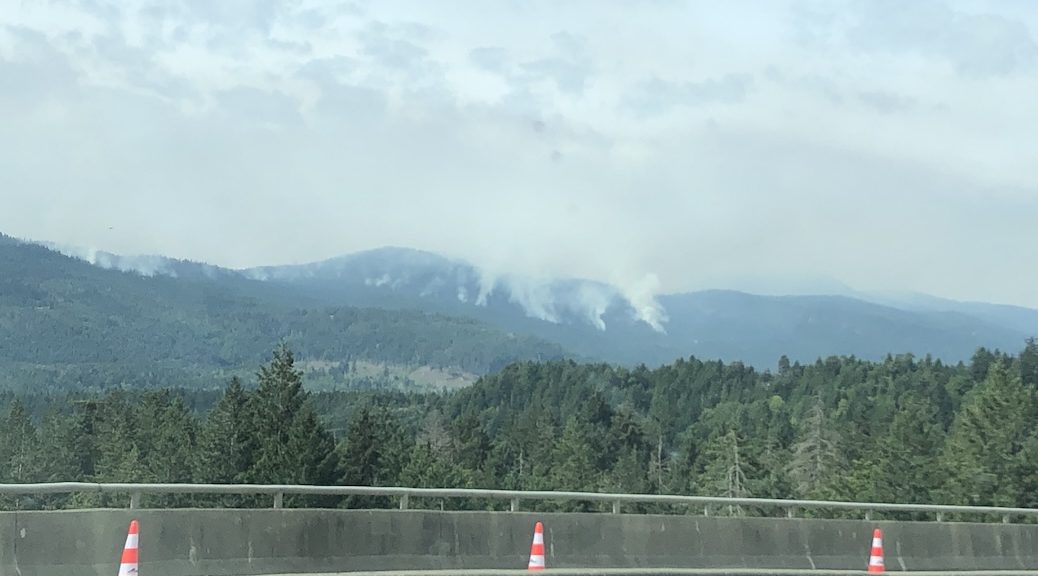
The Cameron Lake Fire is still out of control and, as of August 7, has spread to 1,408 acres. Smoke plumes are visible on the Inland Island Highway (photo at top of page). On August 6 an evacuation order went into effect for some rural parts of the Regional District of Nanaimo.
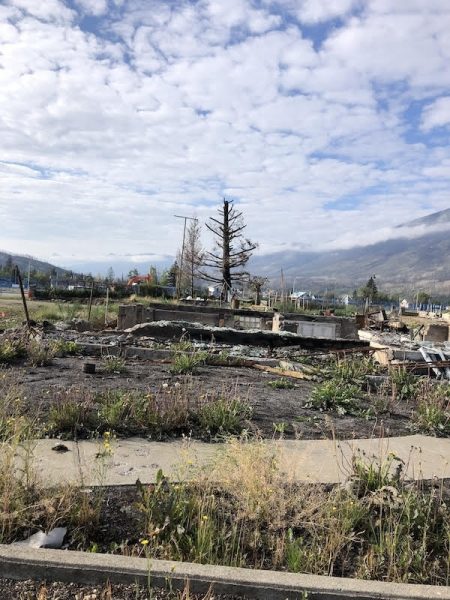

However the most disturbing sight we encountered was in Jasper. Driving into town from the east, the damage isn’t immediately visible, but 358 of the 1,113 buildings were destroyed. 25,000 people were evacuated. Now, hundreds of temporary trailers cluster at the west end of town. The charred remnants of trees stretch for miles, a haunting reminder of the fire’s scale.
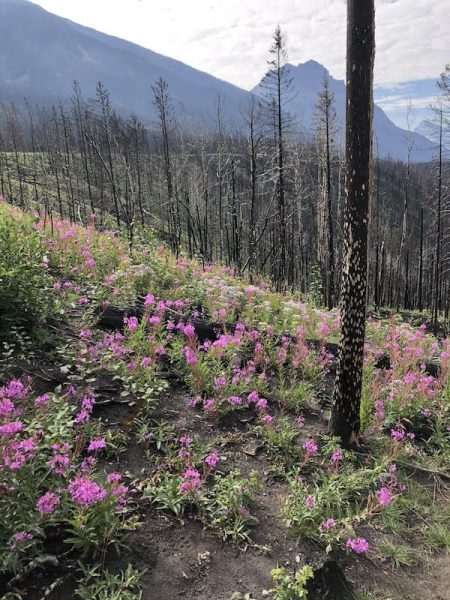
Jasper was not the only town to be impacted by wildfires in 2024.
A partial list for 2025 already includes:
- BC: Evacuation alerts for the Lytton First Nation, Thompson-Nicola Regional District and Siska First Nation (all now rescinded); Partial evacuations in Fort St John (rescinded); August 6 partial evacuation order for the Regional District of Nanaimo; Partial evacuations in Fort St John
- Alberta: Around 1,300 people evacuated in early June 2025, but specific town names weren’t detailed in that report
- Saskatchewan: La Loche, Clearwater River Dene Nation, Resort Subdivision of Lac La Plonge, La Plonge Reserve, Northern Hamlet of Jans Bay, Resort Subdivision of Ramsey Bay, Patuanak / English River First Nation, Northern Village of Pinehouse, Canoe Lake Cree First Nation / Canoe Narrows, Resort Subdivision of Little Amyot Lake, Priority individuals from Northern Village of Beauval, Northern Hamlet of Cole Bay, Île-à-la-Crosse
- Manitoba: Snow Lake, Garden Hill, Lynn Lake, Leaf Rapids, Split Lake, and Pukatawagan. Also: Flin Flon
- Ontario: the Sandy Lake First Nation
- Newfoundland and Labrador: Conception Bay and Kingston; Holyrood, Western Bay, Ochre Pit Cove

Links of Interest:
- Canadian Interagency Forest Fire Centre Website
- Should We Still Travel? Reflections from a Warming Canada – Cortes Currents
- Berkeley Earth website
Top image credit: Plumes of smoke from the Cameron Lake Wildfire seen from the Inland Island Highway; All undesignated photos courtesy Roy L Hales
Sign-up for Cortes Currents email-out:
To receive an emailed catalogue of articles on Cortes Currents, send a (blank) email to subscribe to your desired frequency:
- Daily, (articles posted during the last 24 hours) – cortescurrents-daily+subscribe@cortes.groups.io
- Weekly Digest cortescurrents – cortescurrents-weekly+subscribe@cortes.groups.io
I’m wondering if driving across Canada and writing an article about human-generated climate change isn’t a bit of a ‘what-the-f…’ situation, not unsimilar to climate-change activists flying about the world to attend their climate-change conferences.
If one cares at all about any of this – and I mean truly ‘cares’ – shouldn’t one put one’s own wants on hold and simply stay at home?
Good point and one I find myself reassessing every time I travel, but I still think it is over simplistic. (1) yes, the climate crisis is real, (2) I think we need to look at our personal emissions overall, not just whether we travel. For example, we have a single vehicle which normally has low mileage, a heat pump is our primary heat source, we have few appliances, no motorcycles or boats (other than a canoe), recycle, compost, and have virtually no food waste. There are exceptions (like our heat pump), but we tend to buy second-hand rather than new items. Using one of the calculators on the web, I found our normal annual emissions are less than 2 tonnes per capita. Now add the fact we have taken a long trip roughly every 5.5 years (since 1980) and divide the emissions from those trips between the 5.5 years. We are still below the global average of 4.7 tonnes and far below the Canadian average (14.2 tonnes). (3) There is the question of ‘want’ vs ‘need’ and how do you calculate that? On an emotional level, I periodically need to get off this rock and actually see the world outside. There are obvious benefits in terms of getting to know the world experientially rather than virtually, of gaining access to fresh perspectives, and – being of Canadian (since the late 1700s) and European descent – connecting with my ancestral roots. Is this a real need? (4) As regards your globe-trekking climate activist, I think you have to look at what they are doing versus the cost, THEN ask whether it is worth it. I would suggest that, in real terms, most of them help the planet far more than the vast majority of people who simply ‘stay at home.’ I do not have the data to compare their impact vs helpfulness to that of someone who stays at home and is also addressing climate issues. I would think both are needed.
Thanks, Roy, for your calm and reasoned response to my rather unfortunate rant which came at the end of a long, hot, personally frustrating day. I apologize for taking that out on you and your article. Your points are all well made and, given the world we are in, there is no real ‘right’ way to negotiate what is, after all, a seemingly un-negotiable path, given that our every move effects the planet in some (usually detrimental) way. Best practice may simply be simplicity and good will in all that we do. Thanks again for your response.
Thank you Ian, for your kind response and for all you do for the community.
Roy,
🙏
Ian