

At their June 11 meeting, the Electoral Areas Service Committee (EASC) heard a staff report on tiny home initiatives in the Regional District of Nanaimo. This followed an ongoing discussion that began with a motion from Regional Director Robyn Mawhinney, of Area C, last November.
Director Mawhinney:“I noticed that in other regional districts, temporary use permits are being used for a variety of purposes—potentially to permit tiny homes as long-term temporary accommodation, if you want to call it that.
Screenshot of Regional Director Robyn Mawhinney from SRD Video
No Policy Within The SRD
“I couldn’t find a policy, or even an application form, for a temporary use permit at the SRD. I’m wondering if we could have a report on our current policy on temporary use permits, and also how they’re used in other regional districts.”
John Rice (Regional Director of Area D):“I’m curious about the use of temporary use permits. My understanding is that the province is already moving toward new legislation for small-footprint homes. I believe that the Cowichan Valley is accepting them, so I’m not sure why we want to explore temporary use permits if the province is moving to make this more legal anyway. I could be wrong.”
Director Mawhinney:“Well, I haven’t heard that—that’s great news. The reason I was interested in temporary use permits as a potential solution for housing is because I’ve witnessed in my community that someone is willing to offer a place for a tiny home to be used as a home temporarily, and then they have to tell the tiny home owner they can’t live there because their home insurance won’t permit it on their property.
“I’ve been wondering whether a temporary use permit—typically available for up to three years, with the possibility of renewal—could provide more legal assurance for insurance companies. That, in turn, might expand the possibility of providing non-traditional housing options in our electoral areas.”
Gerald Whalley (Regional Director of Area A):“So, just to confirm—are these smaller than a typical mobile home?”
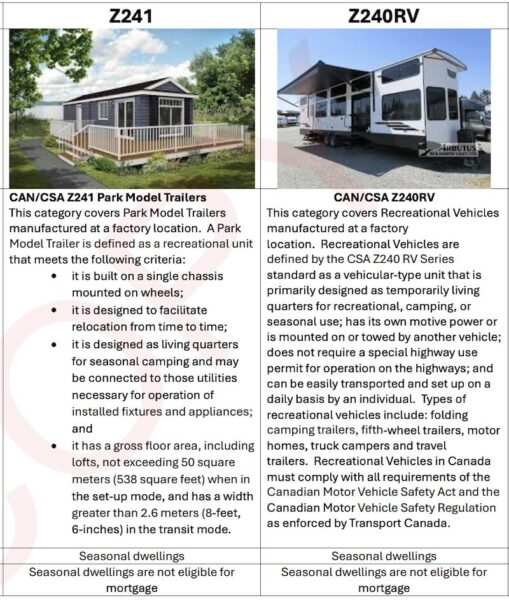
Director Mawhinney:“I think they often fall under the RV category because they’re on wheels. They aren’t always on wheels, but they often are. Mobile homes are on wheels—that’s why they’re mobile. But I think mobile homes are often moved and then the wheels are removed and the unit is anchored to the ground. It just seems like there are a lot of questions that staff could answer.”
Aniko Nelson (Senior Services Manager, SRD):“It would be really great if you could explain what you mean by your definition of a tiny home, because it’s used interchangeably with other terms. We need clear direction from this table about what information we’ll be providing and the level of detail required for the report.
“Right off the top: temporary use permits are used. They’re very similar to zoning amendment bylaws. They permit a temporary use that is legal—or permitted—within the bylaw, but not within the specific zone the property is in. For example, if someone has a residential parcel but wants to do something that doesn’t meet the residential criteria in the bylaw, a temporary use permit would be used to allow that use for a period of time.
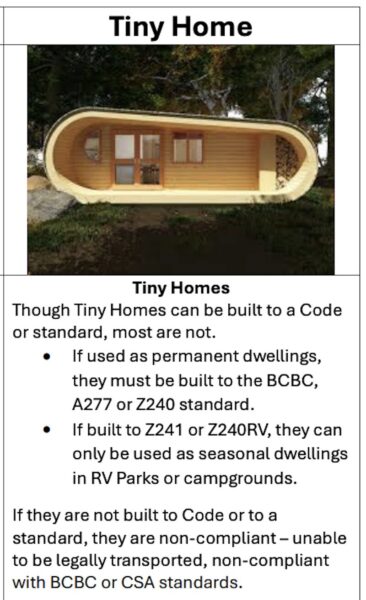
“The director is correct: three years can be renewed, but again the use still has to be permitted. In discussions at this table—through multiple staff reports—to date, long-term residential use of anything on wheels that doesn’t meet provincial requirements, and doesn’t have a CSA standard, could not be used for a temporary use permit.
“I just don’t want to spend an exorbitant amount of time on a staff report if this isn’t something we could actually contemplate.”
Director Whalley:“One other question: what about water? Vancouver Island Health doesn’t allow sharing water—how do people get around that?”
Director Mawhinney:“I think you can share water, but it has to be tested—every couple of weeks, something like that.”
Director Whalley: “I’m not sure.”
Director Rice:“Just to expand on what Aniko was saying—there may be changes. It might be more useful to get a report on what is currently permitted by the province before we go too far into temporary use permits.”
David Leitch (Chief Administrative Officer, SRD):“Based on a preview of the resolution, I think that’s what it intends—to get that information.”
Director Mawhinney:“We can workshop the resolution. The motion I have so far is for a staff report on temporary use permits, including how they are used in other regional districts to support tiny home and RV living accommodations. But I’d offer Director Rice the opportunity to add an amendment to include more information.”
Director Rice:“I’d prefer not to use the term ‘tiny home.’ I’d prefer a more appropriate term, and then explore what is permitted—what’s acceptable right now in terms of certification. Would that meet staff’s needs?”
CAO Leitch:“Does ‘secondary dwelling’ fit better than ‘tiny home’?”
We already Have Tiny Homes
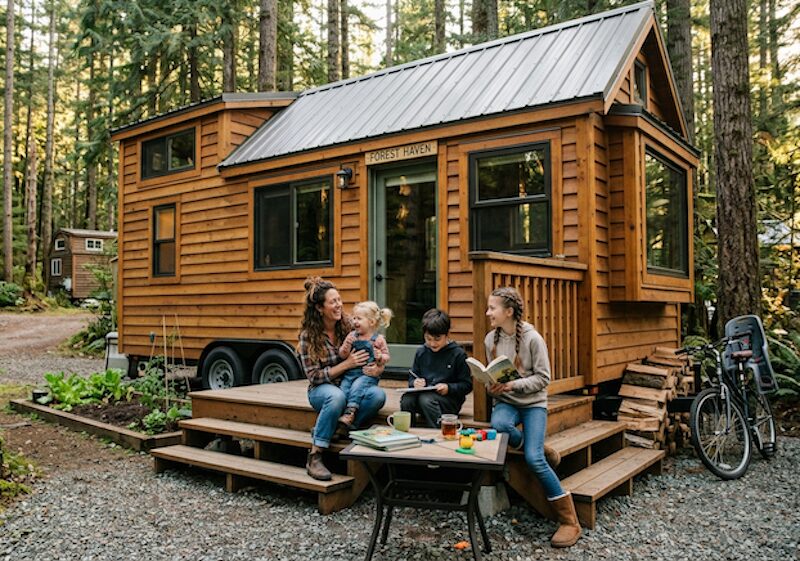
Mark Vonesch (Regional Director of Cortes Island):“I think we’re looking at the tiny homes on wheels idea, and it’s already happening in our communities.
“How do we provide more certainty for people who are on the lower end of needing housing? And I’ll note that the Regional District of Central Okanagan has gone through this process, and the City of Grand Forks amended their zoning bylaw to permit tiny homes on wheels through temporary use permits.
“It’s been used in regional districts, and we’re certainly interested in pursuing how we can do that here.”
Director Mawhinney:“I move that staff provide a report on temporary use permits and how they’re used in other regional districts—and possibly municipalities and local governments—to support tiny home and RV living accommodations. Is that more open-ended?”
Director Vonesch: “Yes.”
Director Mawhinney:“Okay—in local governments.”
The motion was carried, which led to the staff report about the Regional District of Nanaimo approaches last week.
Report on Nanaimo Initiatives
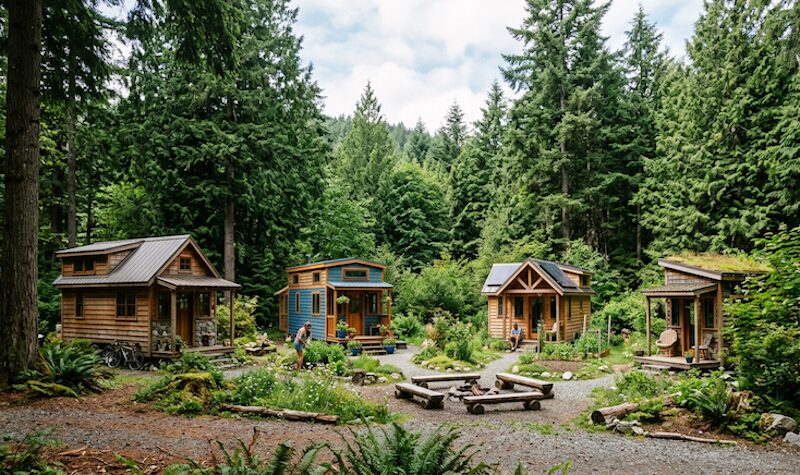
Annie Girdler (Land Use Planner, SRD):“This report provides follow-up information on current initiatives being undertaken by the Regional District of Nanaimo regarding residential use of tiny homes.
“From our discussion with RDN staff, the understanding around residential use of these structures aligns with the SRD’s stance, but there are some interesting projects being done at the RDN.
“The first is an RV living policy, which will be used by bylaw enforcement as a triage approach when evaluating appropriate actions, depending on the level of risk.
“RV living scenarios have a range in their level of risk. On one end of the spectrum, you might find a really large property with multiple RVs, unsafe servicing, difficult emergency access. On the other end, you might have one RV in someone’s driveway that’s occupied.
“So the actions related to a temporary use permit—or bylaw enforcement—will vary depending on things like fire risk, emergency access, and sanitation. That work is currently in the research stage.
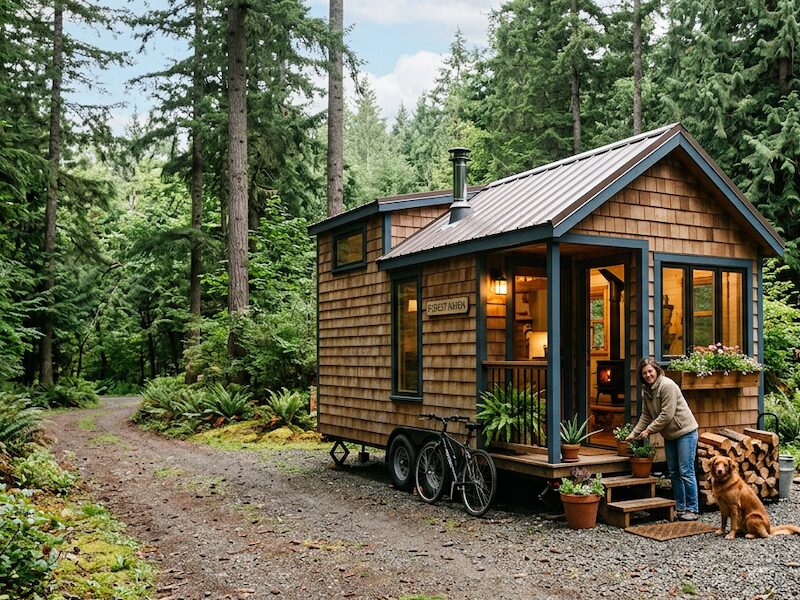
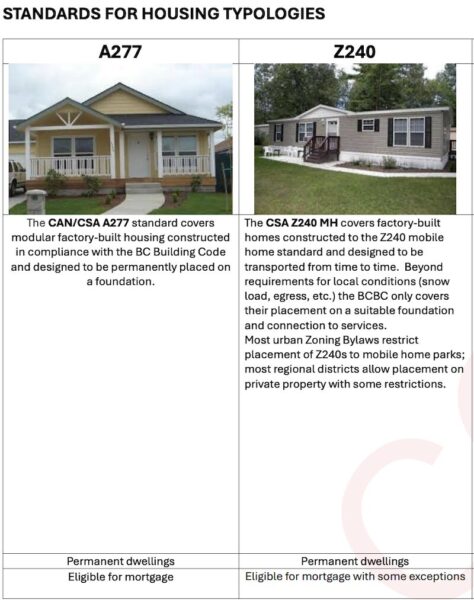
“The other project is the rural housing strategy, which is intended to include a specific way tiny homes can be built to meet the Z240 CSA standard—so they can be legally classified as residential dwellings. There are specific parameters, including requiring a building permit for a screw pile foundation and approved water and septic servicing for the unit.
“Both projects are currently in the research stage. They’re treated as separate issues, so the RDN hasn’t taken any action yet, but they’re certainly a positive step toward formalizing some of the shared challenges.”
Links of Interest:
- Consultation begins for Regional District of Nanaimo’s rural housing strategy – CBC
- June 5 SRD Staff Reports pertaining to TEMPORARY USE PERMITS (TUPS) FOR TINY HOMES ON WHEELS & RVS
- Articles about, or mentioning, Tiny Homes
All undesignated images produced by Gemini AI with prompts by Roy L Hales
Sign-up for Cortes Currents email-out:
To receive an emailed catalogue of articles on Cortes Currents, send a (blank) email to subscribe to your desired frequency:
Weekly Digest cortescurrents – [email protected]
Daily, (articles posted during the last 24 hours) – [email protected]