


Cortes Island will have a public meeting on its proposed Bylaw changes on Monday, Sept 8th, 5pm at Manson’s Hall.
“This is a chance for folks to weigh in on the proposed draft. We’re really looking at a ‘yes’ or ‘no’ decision on this zoning bylaw. There’s almost two years of community consultation and input, and this is what staff have produced and the best, happy medium for what folks are asking for,” explained Mark Vonesch, Regional Director for Cortes Island.
“The public hearing will be a chance for people to express their opinions and their thoughts. Those will get recorded and added to the public record. It’s important that folks show up whether you’re opposed to or in support of this new zoning bylaw. People who show up make the decisions, and this is an opportunity to have your voice heard. If you can’t make the meeting, you can email [email protected] and that will also be included in the public record.”
Sadhu Johnston, Executive Director of the Cortes Housing Society, added, “The OCP (Official Community Plan), which governs land use on Cortes was updated over a decade ago, I think in 2013, and this zoning bylaw is supposed to follow right behind that. So we are almost a decade late and so it’s really important that this bylaw be adopted and, in the near future the OCP be amended as well, so that it can stay current.”
Cortes Aquifers
Mark Vonesch: “One of the first questions I asked myself is what is the capacity of our aquifers? Can we even have any more density on this island?”
“There’s a lot of places where they’re trucking in water. I have friends and family in the Southern Gulf Islands. I was concerned that the calls for some increased density and allowing more things to happen in Cortes could have a negative impact.”
“So one of the first things I did was work with the Cortes Housing Society and support them in writing a grant to the Real Estate Foundation of BC to get funding for an aquifer study. The results of that study came out last week. It’s really good news for Cortes. Overall, we’re in really good shape.”
Cortes Currents interviewed one of the people who made that study, Sylvia Barrosso of GW Solutions, and she said:
“We did not find that any of the water management areas had greater than 5% of the available water being used. That suggests that there is room for growth, and it gives us an opportunity to strategically develop water sources and develop those in protected areas.”
Cortes Currents also asked her about the problems that some of the island’s shallow wells had during the recent drought. She described this as a separate issue related to surface water and most likely climate change. This will all be in an upcoming broadcast.
Mark Vonesch: “I’d take that information to say, look, we can have some more density. I wouldn’t want to turn Cortes into a city , but our aquifers are being recharged and discharged at a really good rate and we can handle some more density. Water is not going to be an issue for the vast majority.”
“I think it’s a base of how we look into the future of development of Cortes and understanding that obviously we have more work to do around aquifer monitoring and continued education. The report puts me in a better position to say, let’s get this zoning bylaw passed.”
What The Housing Society Wants

Sadhu Johnston: “The Housing Society took a number of positions that we were advocating for with the Regional District.”
“The first thing we were advocating for is larger cottages and additional dwelling units on existing properties. There are lots of people on Cortes have a second or third cabin on their land, and they’re out of compliance with the current zoning. That makes people uncertain in their living environments. If you’re renting a cabin from somebody and that cabin is technically illegal, that creates insecurity. Many people on Cortes rely on that type of housing.
“The Housing Society was encouraging what used to be called cottages in the zoning bylaw. They were only 60 square meters — about 500 square feet and really too small for a family to live in – as a second house on a property. We were encouraging for that to be bigger and the SRD has made that change. Now that secondary unit, the accessory dwelling unit (ADU), can be 110 square meters.”
“The new density rules allow for multiple dwelling units on a single lot. Depending on the zoning type, more than one ADU is now permitted. That can provide passive income for island property owners, and also create additional rental units. These can’t be subdivided or sold, so by nature they provide important rental housing. This proposed bylaw really addressed our concern about larger cottages and additional dwelling units on existing land.
“I think the best opportunity for us to get more housing on Cortes is not to build up in the northern part if the island or to develop new sites, but to use properties that already have houses, driveways, electricity, septic, and wells — and enable them to add one or more additional homes.
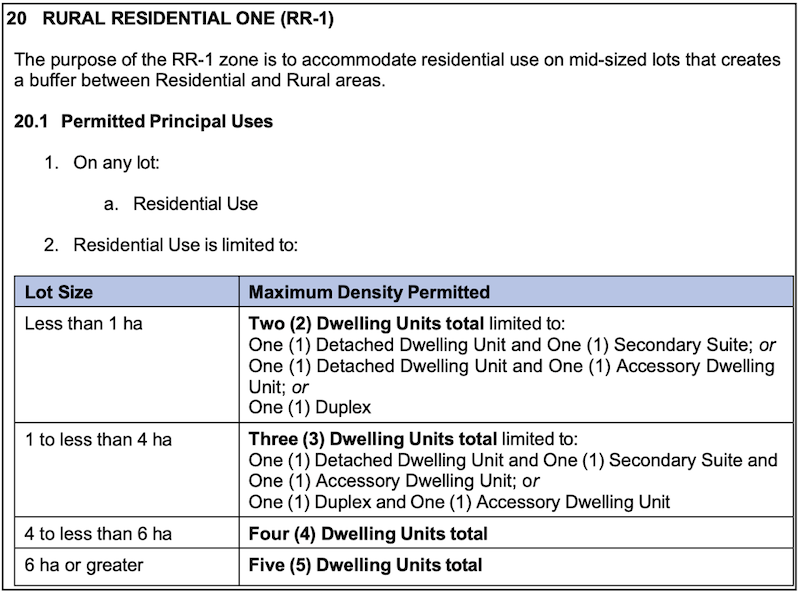
“The previous bylaw had a maximum of three dwellings per lot in the RR1 (Rural Residential 1) and R1 (Residential 1) zones, and they’ve removed that maximum. There’s a new tiered system that allows up to five dwellings in R1 and RR1, and up to six dwellings in RU1 (Rural 1), depending on lot size. Basically, this allows one or two additional houses on existing lots.

“They didn’t go as far as the Housing Society was thinking would be helpful, but they did go quite far in allowing additional houses on existing lots.
“We also asked for them to enable more affordable housing density on community-owned land. Previously there were community service zones — CS1 and CS2. These have been consolidated into Community Housing and Services 1 (CS1). The maximum density in that zone has been raised from 25 to 35 dwelling units per lot, depending on lot size. They are recommending that the entire Rainbow Ridge site be included in that CS1 zone, which is also helpful.
“We had been advocating for regulating short-term rentals, and that change was made.”
“We encouraged more clustering of housing in downtown areas and particular sites. So the bylaw does introduce a new section called Clustered housing, which formally defines the term and encourages clustering of homes on a lot to promote the preservation of open space and environmentally sensitive areas.”
“So we think that’s a win for us as a community. The bylaw is recognizing the importance of like if you have a 50 acre site, rather than having houses scattered on 10 acre chunks of it – with more driveways and more land clearing more space for power lines – really encouraging clustering of houses so you can have more areas that are preserved.”
Cortes Currents: The SRD emailed that an FI lot in Mansons Landing is split between agricultural land use, which is protected under provincial legislation and will not change, and F1 lots that are being converted to residential.
Sadhu Johnston: “There’s some questions about the forestry zone being converted to residential. From my understanding, that was already done in 2013 when the new OCP was adopted. This is really just codifying a change that was made a long time ago.”
“Overall, as the Housing Society, we had advocated for these particular things, and we’re happy to see that the zoning bylaw integrates most of what we asked for. Not everything, but they’ve done a good job balancing community concerns — environmental conservation, neighborhood development, and more housing on existing lots. We’re encouraging the public to attend the meeting at Manson’s Hall on September 8 at 5 p.m. to express their opinions.”
80% of New Units on Existing Properties – Less than 85 Units on New Properties
When Cortes Currents contacted the SRD planning department, they said the proposed zoning changes would allow for a potential of 427 additional units, 80% of which would be on existing properties. In reality this figure breaks down into three categories:
- a large number of existing houses, which are already occupied but currently ‘illegal,’ that can be made ‘compliant’ under the proposed bylaws.
- properties where there will be no development because this is not something the owner wishes.
- properties where new development will occur.
Note: These are rough estimates which could easily be out by 5 or more units, but 20% of 427 is 85 properties – some of which will not be developed and, at some point in the future, housing will be put up on the remainder.
Cortes Currents: Do you have a figure for the number of new housing units these bylaws are expected to produce?
Sadhu Johnston: “I don’t have anything more accurate than that. I think there are a lot of properties that are considerably underdeveloped, where they could allow a second home or cottage but haven’t. Others probably have more than they’re allowed, with extra cabins added over time. Bringing them into compliance is really important because it secures housing for the future.
“In terms of numbers, my gut says only a very small percentage of those 400 will be built immediately. This will have an impact over time, but the importance of bringing properties into compliance is significant, because it protects the people living in those homes now.”
Mark Vonesch: “I can understand people’s alarm when they hear 427 more potential units, but the reality of that is that only a small number of those will be realized. One of the things the zoning bylaw draft is doing is catching up to where we’re already at. A lot of those units have already been built. Most of the new units are people being allowed to add a basement suite. Some people will end up taking advantage of that, but lots of people don’t want another unit in their house and aren’t going to do that.”
“I think overall this new zoning bylaw is going to allow a little more density and create a little more opportunity for folks to live here.”
“We know we have a housing crisis. We need some more rental units. We need more places for workers to live and I think it is a happy medium that helps move Cortes forward in a way that I think represents the average of where people are at. I acknowledge that it’s not perfect for everybody and I think we’re at this place where we say yes or no to this.”
Cortes Currents: Let’s say that on Monday, most of the people who were in favor of these changes didn’t show up and what you had was a number of people who were opposed. What kind of impact would that have in terms of the zoning bylaw?
Sadhu Johnston: “I’ve been to hundreds of public hearings and it’s pretty common that people against something turn out more than the people in support of something. That’s pretty standard. It’s always disappointing that people in favor of something don’t show up. Typically if there’s a really strong voice against something and not a positive voice for it, the politicians would reconsider.”
“So I do really encourage everyone to come, whatever your perspective is, to share your voice. I do think this is not a done deal at this point, and it’s important that people come out and have their say. If they can’t come out and have their say, they can send an email to [email protected] and share your perspectives with the planning team.”
Links of Interest:
Sign-up for Cortes Currents email-out:
To receive an emailed catalogue of articles on Cortes Currents, send a (blank) email to subscribe to your desired frequency:
- Daily, (articles posted during the last 24 hours) – [email protected]
- Weekly Digest cortescurrents – [email protected]