
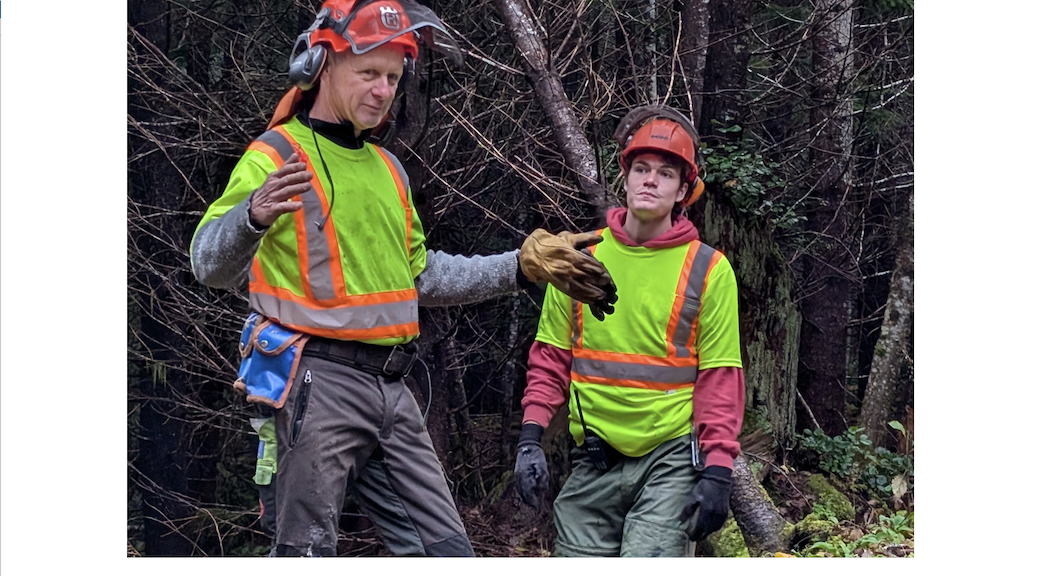

The Cortes Forestry General Partnership held its public meeting on October 9th, 2025. In today’s interview, Operations Manager Mark Lombard talks about leadership transitions, plans for selective logging, the Forest Stewardship Plan review, and other topics from the meeting. He also shares his personal opinion about how climate change is affecting our forest.
“We try to have a public meeting every year and we cover whatever topics are relevant at that point. There’s always the year in review, so what have we done in the last year since the last public meeting and what are we planning in the coming year,” explained Lombard.
“In this case, we had the Forest Stewardship Plan Review, which the Forest and Range Practices Act states must be updated every five years. We had a draft to present to the public and there was a 60 day public comment period, and we wanted to have the public meeting during that time. While the document is really thorough and detailed, and it wasn’t something that you could just put up in a PowerPoint slide, we had our registered professional Forester, Kate Roth there to answer questions and discuss the objectives and how it relates to how we operate in the community forest. That was the first and foremost part of the meeting.”
Cortes Currents: What were the most significant events this past year?
Mark Lombard: “There’s been some change in the leadership of the Community Forest Partnership.”
“The Klahoose have had chief council elections and they came out of a period of uncertainty with the change in chiefs midterm. Kevin Peacey, who has been the chief in the past, is now on the board of the Community Forest again.”
“We did an interview with Kevin. Bill Weaver is doing a mini documentary about the community forest for us.”
“There were some changes on the co-op side. David Shipway has stepped in to replace Aaron Ellingson.”
Cortes Currents: The United States slapped a new 10% tariff on top of the existing duties, which brings the combined total to 45%.
Mark Lombard: “So the outlook isn’t great for log markets. That’s probably one of the bigger challenges as it relates to the upcoming year.”
“We would like to do some logging. Our partners would really like to see some logging, and generate some opportunity for economic reconciliation and doing what we set out to do.”

“We have to set up the log dump. A storm had broken maybe one or two of the anchor chains, so there will need to be some divers that go and set new anchor chains and bring in some boom sticks, set up a dumping ground and then bring a machine in to push logs off the truck.”
“So there’s a pretty big upfront overall cost that needs to be amortized over a reasonable amount of volume. We’ve never had to pay to set up the log boom fully. It isn’t viable at today’s below-average prices, though it might work once prices return to normal. We probably can’t make it work for under 4,000-4,500 meters, and the goal is to log around 6,000 meters.
It’s going to be challenging to do that if prices don’t come up.”
“The community forest has plans to do some logging in multiple areas of the community forest, including west of Von Donnop. The west of Von Donop block area is contingent on the Klahoose building a road through the reserve that will provide access to the north part of the community forest.”
“We are planning on doing some more thinning in the Coulter Bay area, and that’ll be part of the wider wildfire risk reduction efforts in that area. Part of it was done with funding through the Force Enhancement Society of BC and it wasn’t commercially viable. In the areas that are commercially viable, from the community wildfire protection planning recommendations we are doing more selective logging, a light-touch approach, selecting individual trees, taking out dead understory hemlock and reducing the ladder fuels and reducing the crown closure and increasing the spacing of the leave trees. So that’s planned in Coulter Bay.”
“There’s a similar project planned in the Larsons Meadow area, and that is specifically to address an issue with the first harvest the community Forest ever did, which was 2015 in Larson’s Meadow.”
“The harvest strategy was a seed tree retention with 10 meter spacing on the trees. It looked really good, it was really expensive to do ’cause there were so many leave trees, but the planted trees aren’t growing fast enough. They simply don’t get enough light.”

“That’s very evident because the next year we logged in Squirrel Cove and the tree retention was 20 meter spacing. So only half the retention and the trees are growing way faster and way better.”
“We are languishing in Larson’s Meadow. Everything is starting to catch up, all the secondary species, all the bracken ferns. The trees are just not growing enough. So we’re going to do some logging to the south of each of the blocks to let more light into those blocks.”
“The community forest has to log a little bit everywhere, and we are trying to say to the community that we’ll work in one area and then we’ll work in other areas of the community forest for the next 8, 9, 10 years. So if we logged in 2025. It would be 10 years since we logged in 2015 in the Larsons Meadow area and those are sensible areas that are accessible from the existing road.”
“Those two blocks and the Von Donop block are the winter plans this year. They’re relatively small selective harvests that we believe to be appropriate for the residential neighborhoods they’re in. Also the forest there is suitable for selective logging.”
“They’re all selective logging and they’re all relatively small volumes because if you selectively log, you only get a quarter or a third or a half of the volume that you’d get if you clear cut. So you need to operate on more land to get the same volume.”
“I’m really excited to say that we’re going to hire a young Cortesian. There are two people who are getting second interviews to be field technicians, field assistants in the community forest, and they’re both people who grew up in Cortes have deep ties to Cortes and in their twenties. Hopefully by the end of next week we’ll know who it’s going to be and we’re going to have a new person helping with: the planning; and grant applications; and layout; and silviculture; lots of lots tending our trees and looking to the future harvest; how the operations work and how to supervise the operations.”
“We have a new Forester, Kate Roth, who’s really great to work with. She’s taken over from Ione Brown, who has been our forester for several years, and we’re really grateful to Ione for all of the professional advice and stewardship that she provided for the community forest on Cortes. I’m looking forward to working with Kate and the new young apprentice going forward.”
Cortes Currents: There was a problem with climate impacts on the forest, is that getting worse?
Mark Lombard: “That’s not an easy question to answer and there’s some political culture war stuff around that. Just speaking as myself, not necessarily representing any institution, but just as someone who’s been observing the forest for a while, we’re getting longer periods of drought and we’re getting drier springs and sometimes drier falls.”
“Two years ago, right until the end of October, it was almost summer weather. That makes the wildfire season more serious. It’s obvious all over Canada, Spain and Greece. There’s fires all the time now. The 2023 season in Canada was off the charts bad and we’re seeing more fires coming to places where there were fewer fires. Cortes could be part of that.”
“The other thing is some species like alder and hemlock that need it to be wet and cool, they are not thriving as much. The alders are dying younger and are dying sooner on sites that in past years would’ve been better growing sites for Alder.”

“The same with the Hemlock. If you go further north, you see large Hemlocks that are healthy and vigorous and grow much longer. On Cortes hemlock at 80 or 90 years old, they’re either on their way out or they just tend to be more vulnerable to disease like missile toe because of the droughts. They’re always stressed with the dry conditions.”
“So you’re probably seeing some things change to more of a Douglas Fir suitable climate. The community forest is still restricted by the requirements that the province has of what trees can be planted on crown land, and what they consider to be suitable. I think the province is looking into that. I’ve attended some workshops at conferences and otherwise where the government talks about what they’re doing with that. But they’re studying in the entire province, it’s not like we’re getting a whole new list of species that we can plant. It’s still a Western Red Cedar/ Douglas Fir, preferred species mixed for Cortes Island.”
Links of Interest:
- The Cortes Forestry General Partnership website
- Draft of Forest Stewardship Plan
- Wildfire Risk Reduction in Squirrel Cove Area – Cortes Currents
- Articles about, or mentioning, the Cortes Community Forest
Top image credits: Level 1 chainsaw training in the Community Forest – courtesy Mark Lombard; undesignated photos by Roy L Hales
Sign-up for Cortes Currents email-out:
To receive an emailed catalogue of articles on Cortes Currents, send a (blank) email to subscribe to your desired frequency:
- Daily, (articles posted during the last 24 hours) – cortescurrents-daily+subscribe@cortes.groups.io
- Weekly Digest cortescurrents – cortescurrents-weekly+subscribe@cortes.groups.io