
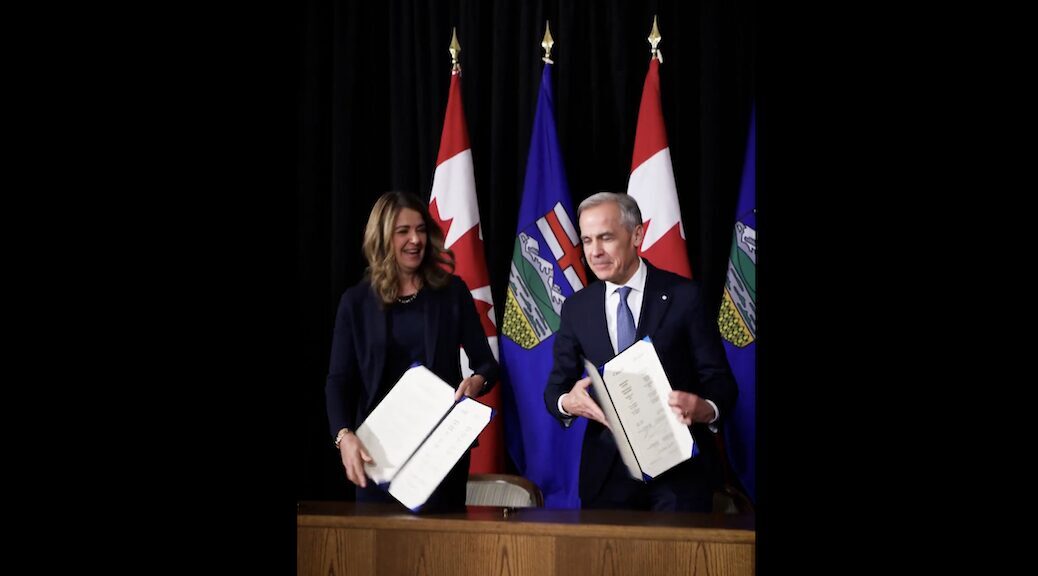

There have been a lot of concerns that the MOU with Alberta represents a step backward when it comes to reducing climate-change-causing emissions from big industry and advancing clean energy. In this morning’s interview, Jennifer Lash, who was both a senior adviser at Environment and Climate Change Canada and a Liberal candidate in the last election, shares her perspective on these issues.
Shortly after the radio version of this story first aired, Carrie Saxefrage from the Cortes Island Climate Action Network emailed, “Ten years ago, Bank of England Governor Mark Carney gave a speech in which he said the world must turn risk into opportunity by building new markets in climate transition and green finance. Last week, Prime Minister Carney just backed down before the oil industry bullies who are pushing our shared Earth further toward mass extinction. The new Mark Carney may survive to fight another day, but how much of our money will he have thrown away, or locked into climate destruction? What and who will be left to save? “
“Canada needs the Mark Carney of ten years ago, the leader who is eager to use his political capital to persuade Canada that our taxes and regulations must, with deliberate speed, transition our nation toward stability and away from fossil fuels.”
May Thaysen added, “The Cortes climate action network is here to build a home base for the people power we need to stop the pollution that is threatening our lives and livelihoods – that includes political pressure on the Prime Minister to force him to do the right things. Reach out at [email protected].”
Jennifer Lash explained, “I went through a bit of an existential crisis when the MOU was announced. That was a hard moment for me. I’ve spent many years arguing against pipelines and arguing for carbon pricing, but I had to step out of the old way I was looking at climate. I had to step into a new way of looking at it, one that took more into consideration the current global crisis we’re in and the political situation.”
2026: The Political Realities
“We’ve labelled what climate success looks like in one way, and we’re shifting now. I really encourage people to take the time to try to understand what it is this Prime Minister is doing and to see the value in it before jumping to the conclusion that it’s bad — and not just in terms of direct emissions reductions, but in terms of the long-term ability to work together as a country to address this very serious problem.”
“We’re pretty much down to a two-party system right now. If the Liberals were to lose an election, we would end up with something far worse under a Conservative government. I had to really look at how I want Canada to show up and how I want it to be a country that’s whole. When I did that, I was able to understand both the logic, the politics, and the rationale for the Prime Minister’s decisions, and that really helped me come to grips with the fact that I think what he’s doing is the right thing.”
“I found a lot more comfort than I thought I was going to find. I was reading the electricity strategy, and there’s all sorts of stuff in there about energy retrofits. We’re not celebrating the fact that the Prime Minister has committed to doing energy retrofits. That’s a big, big piece of getting us to decarbonize our economy.”
“Even though I wish it could be more, it’s not Mark Carney who’s holding back stronger action. It’s Trump, it’s global wars, it’s all these issues that we’re dealing with globally and domestically. There’s a lot of tension with Alberta right now, with their threat to separate.”
“I want to start by saying that we Canadians, and particularly those very active in the climate space, set a series of expectations, some of which were met to some degree under the leadership of Justin Trudeau. Those became symbolic of what climate action looks like, and I just want to acknowledge the fact that it’s very hard when those things start to change.”

When Justin Trudeau Was Prime Minister
“When Trudeau came into power, there was a lot of momentum, not just in Canada but globally, for very ambitious climate action. That resulted in the signing of the Paris Agreement and subsequent increases to climate targets in countries around the world. Countries were trying to race to the top instead of to the bottom. For climate activists, it was a really great time. We felt like people were finally listening to what we were saying and really taking serious action.”
“In Canada, some of the policies that symbolized that progress were the industrial carbon price, the consumer carbon price, the clean electricity regulations, and the emissions cap — some of these really big regulations that the Trudeau government was willing to put in place, advocate for, and push for.”
The Problems
“By the time Trudeau stepped down, those policies had become part of the problem. I’m not going to blame it all on climate, because it’s not all the fault of the climate movement, but it had resulted in an antagonism across the country that was threatening the integrity of our very country, and Alberta was threatening to quit. The fights were very real.”
“More than that, it had slowed down investment in the country to a point where people were really struggling with affordability. When you combine the impacts of COVID, the impacts of the Ukraine war, now the impacts of the war with Iran, and the fact that Canada was not perceived as a place that was really good for investment, our economy was struggling through these global hardships, and we weren’t able to kick-start things and really get the economy going.”
“Now, I know that sounds like a lot of economic theory, and not many people really get into economic theory, but the way it played out for individuals was that things got more expensive, wages weren’t increasing, jobs weren’t necessarily available, businesses weren’t thriving, and the economy slowed. People were really unhappy.”
How Mark Carney approached this
“When Mark Carney came into power, he recognized this, and he took a very different approach to climate. He prioritized keeping the country unified, because any pathway to a climate-safe future requires addressing the issues in Alberta.”
“Canada cannot get to a climate-safe future — we cannot be responsible for our emissions — if Alberta isn’t on board. The emissions from the production of oil and gas are one of the greatest sources of emissions, and they’re increasing. If we cannot work with Alberta, Canada cannot have a climate-safe future. If Alberta chooses to separate, we have no control over what they do or their emissions. We have no ability to influence that.”
“So Mark Carney put together a plan that was very much based on keeping the country unified while still keeping climate as an integral part of that. You can see that in the way he has not centred climate in his work, but integrated climate into all the different pieces. The auto sector has a very strong climate component to it. The electricity strategy is all about getting Canadians onto clean electricity.”
“He is working on climate without labelling it as one big climate plan. There were people in the climate movement who really liked the auto strategy. There were people in the climate movement who were very pleased with the electricity strategy. They noted the great work the Prime Minister was doing in those strategies.”
Carbon Pricing
“Putting the pipeline aside for now: with the MOU, the piece that’s really hard for people to handle is the carbon price, because industrial carbon pricing is, in fact, the anchor of our climate plan. It is the policy that delivers the most emissions reductions, but carbon pricing isn’t as simple as it seems.”
“Right now the carbon price is $95, but that’s not the actual price. Putting a price on carbon creates a carbon market, and people can then trade credits. In Alberta, they had flooded the market with credits. The credits were trading at $20 a tonne. Nobody was paying $95 a tonne. The top price — that $95 — is called the headline price, and the $20 is the effective price.”
“The new system sets the headline price at $140 by 2040, and that feels low and really far away, but it sets the effective price at $130, which is a dramatic increase from $20.”
“I know some people I respect immensely, like the Climate Institute and the Pembina Institute, have raised concerns that we’re not going to get as many emissions reductions from this approach, and I agree. I trust them and their models.”
“We probably won’t get as many emissions reductions from this, but Canada still has an effective industrial carbon price and other countries aren’t doing it.”
“It would have been very easy for the Prime Minister to say, ‘Look, no other G7 country is pursuing this. The United States has done an about-face on climate. We’re one of the few countries that’s putting this price on our industry. We have to get rid of it.’ He could have sided with the oil companies, and he didn’t. He didn’t side with the Premier of Alberta. He said, ‘No, this is an important part of Canada going forward,’ and so he negotiated the best carbon price he could get under these conditions.”
“It’s not perfect, but I’ve never seen a perfect policy in my entire life, and I’ve been working on federal policies for a long time. So I really value the work done on the carbon price and its focus on the effective carbon price as opposed to just the headline price, because that was a weakness in our old system.”
Carbon Capture
“I really like the fact that he tied the pipeline to the Pathways (carbon capture) project. I know there’s a lot of criticism of Pathways. A lot of people think it’s a waste of money, that it’ll never work. But industry has promised the emissions reductions they’re going to get from it, and if you look at the deal, it really talks about what those emissions reductions need to be and how they need to keep building. They don’t get a pipeline unless they have the Pathways project.”
“So it’s telling industry, ‘Put your money where your mouth is. You’ve been telling us for a long time that this was the solution. Have at it.’ We are not going to develop the technology to do carbon capture unless we start to explore some of these options.”
L’accord d’aujourd’hui entre le Canada et l’Alberta permettra de diversifier nos exportations, de réduire nos émissions et d’offrir aux investisseurs la certitude nécessaire pour bâtir.
— Mark Carney (@MarkJCarney) May 15, 2026
Ensemble, nous bâtissons un avenir plus fort, plus prospère et plus durable pour tous. pic.twitter.com/WByMW0VSgv
Why the Pipeline is Important
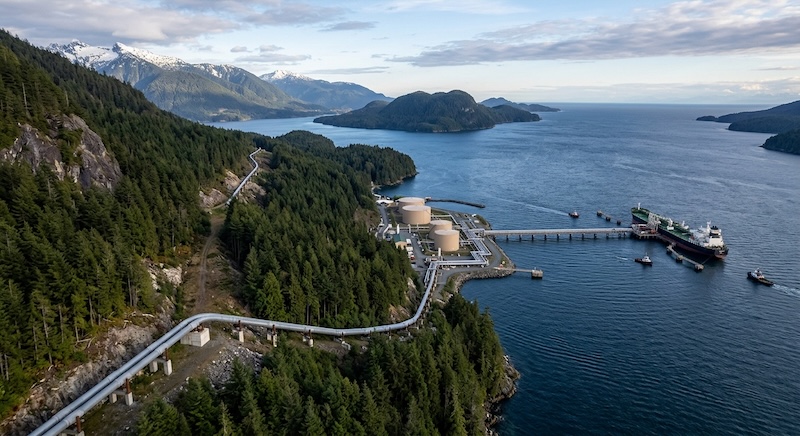
“Then, of course, we get to the pipeline to the coast here. I don’t want to see a pipeline. I do not want another pipeline to this coast. I particularly don’t want one through to the North Coast, but I understand the politics around it and the need to keep the country unified.”
“This pipeline has become so symbolic of Alberta being treated badly. I say symbolic — I use that word purposely — because I don’t think Alberta necessarily has been treated badly, but they feel that they have been. In order to keep the country unified, we have to agree to build that.”
Will they build a Pipeline?
“I’m not convinced we’re going to build a pipeline. It takes 10 years to build a pipeline, even if it’s approved in a year. Physically building it takes a long time, and I’m not too sure the companies feel there’s still going to be demand for oil at that time. To fill that pipeline, it’s my understanding they’d have to have greenfields, which means new exploration and new mines, and that’s much more expensive than taking oil out of existing places.”
“I’m not too sure the price will stay that high. I could be wrong. I’m not going to say that I’m an expert on oil markets, but I feel that in 10 years we’re going to be in a very, very different place when it comes to demand.”
“You have to remember, Canada has two systems.”
“We have the fossil fuels that we use to generate our electricity at home domestically. That means generating electricity, driving our cars, heating our buildings, and cooling our buildings. We have a plan to get away from that. It’s called the electricity strategy.”
“So the electricity strategy is looking at getting us off fossil fuels domestically, and it does look at natural gas as part of the pathway to get there. But the emphasis is really on clean electricity, building those interties, sharing electricity across provincial borders, and getting to clean electricity in Canada — not only to meet the demand right now, but to meet the demand we’re going to have in 2050 when we’re all using heat pumps, we’re all using EVs, and we’re all electrified. That plan is in place.”
“Another thing we do with oil is export it. It’s a huge part of our economy in Alberta, but also in BC, Saskatchewan, Newfoundland, and across Canada. That is going to be affected by global demand.”
“If you look globally at where things are at, in particular as a result of the war with Iran and the astronomical prices people are paying for fuel in Canada — but also in some countries that can’t even get it right now — the jump to renewable electricity has been dramatic. If that continues, you’re going to start to see demand for oil and gas drop. And if global demand for oil and gas drops, there’s a big question as to whether or not that pipeline is going to be filled.”
Alberta’s curtailment of wind and solar
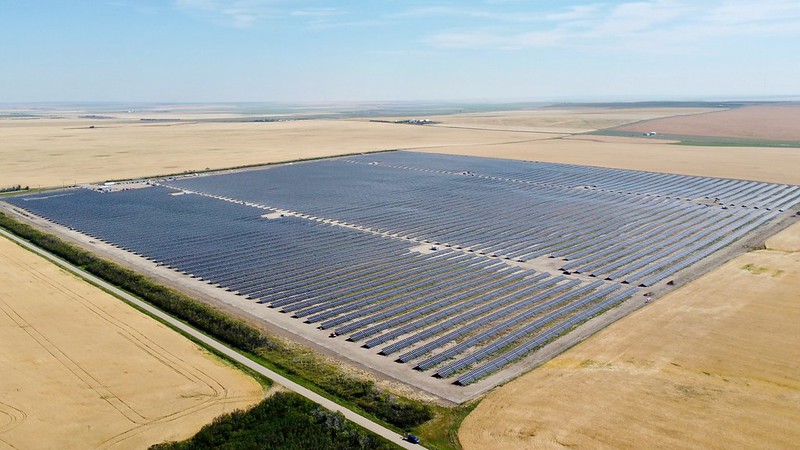
Cortes Currents: “I’m coming from a different perspective on a lot of the things you just mentioned. I have two questions. One of them is probably off-topic, but I know that Alberta has curtailed its renewables for a number of years now.”
Jennifer Lash: “It’s very true. Alberta has doubled down on oil and thwarted attempts to build renewable energy, even though it is one of the best places in Canada to build both wind and solar. It’s extremely frustrating, but you have to remember that the federal government can only do so much. We have a cooperative federalism.”
“We have one of the most cooperative federal systems in the world. The federal government cannot tell a province to do things that are squarely in provincial jurisdiction. So the federal government can’t say to Alberta, ‘You’re wrong for not allowing renewables. You must change.’ Alberta doesn’t have to do it. That’s how our government works.”
“That applies to every single province. They can’t come in here and tell us what to do in BC either, at least not on certain things. On some issues they can, but adopting wind and solar is a land-use planning issue. That’s provincial jurisdiction.”
“What the federal government can do is set up a system of collaboration, cooperation, and incentives to facilitate the movement toward clean electricity, and that requires good working relationships. You can’t be fighting with the Premier of Alberta and then go in and convince them to put more energy into renewable power. You have to have a strong working relationship with them, and this is what he’s doing with the MOU — he’s building that relationship.”
“He’s not abandoning carbon pricing. It’s not as strong as a lot of people think it should be, including myself, but it’s there.”
Building Interties
“He’s building that working relationship so we can now talk about interties between B.C. and Alberta. We can talk about interties between all the provinces and the territories, so we are able to more smoothly send energy across the country. Every single province has its own utility system for electricity. It’s very complex, and they don’t talk to each other, and we don’t have interties across provincial borders.”
“With the electricity strategy, the government has committed to helping facilitate that conversation and getting our electricity flowing so that we can have affordable electricity accessible all the time, when it’s needed, in an amount that will fuel where the country is going in 2050. They’re expecting electricity demand in this country to double, and that requires relationships.”
“It’s very easy to criticize a specific policy and a number, but that ignores the fact that relationships in Canada — and how the Prime Minister works with the premiers across the country — are fundamental to a good climate plan. They’re fundamental to a good health-care plan. They’re fundamental to a good jobs plan. They’re fundamental to everything.”
“So from a climate perspective, it is a fundamental piece, particularly with Alberta, because there is no path to a good climate plan without having Alberta involved in some way.”
No Canadian Taxpayer Dollars except
Cortes Currents: “One other question: Has there been any indication whether Canadian taxpayer dollars would be going into this pipeline?”
Jennifer Lash: “Minister Hodgson stood up in the House just two weeks ago, I think, and confirmed that the only federal dollars would be through the loan guarantee program for Indigenous nations. This was in the original MOU. This is not a new position. This has been there right from the beginning, and I have no problem with this.”
“So if an Indigenous nation chooses to partner on a new pipeline and they need to borrow money because they don’t often have the equity or the ability to secure that loan, the federal government will guarantee the loan. That means it’s a liability on our books, but it doesn’t necessarily mean we’re handing out cash. They could be forgivable loans. There could be a whole bunch of different things there, but that is about economic reconciliation.”
“I’m not opposed to that because I’m a firm believer that if a project goes through a nation’s territory, they should reap some of the benefits of that economically — not just the non-Indigenous companies that own them.”
“Aside from that, as far as I know, there’s no other federal money going into that pipeline.”
Cortes Currents also reached out to Green Party leader Elizabeth May, former NDP candidate Tanille Johnson, and Conservative MP Aaron Gunn, none of whom responded in time for this article.
Links of Interest:
- Canada and Alberta strike agreement to diversify our exports, reduce emissions, and build a stronger economy – Prime Minister of Canada
- MOU with Alberta puts Canada’s commitment to net zero emissions by 2050 firmly out of reach – The Climate Institute
- Weakened industrial carbon price harms Canada’s economic future, abandons international commitments – Pembina Institute
- Interviews with Jennifer Lash or mentioning her – Cortes Currents
Top image credit: Screenshot from twitter video – courtesy Mark Carney
Sign-up for Cortes Currents email-out:
To receive an emailed catalogue of articles on Cortes Currents, send a (blank) email to subscribe to your desired frequency:
- Daily, (articles posted during the last 24 hours) – [email protected]
- Weekly Digest cortescurrents – [email protected]