

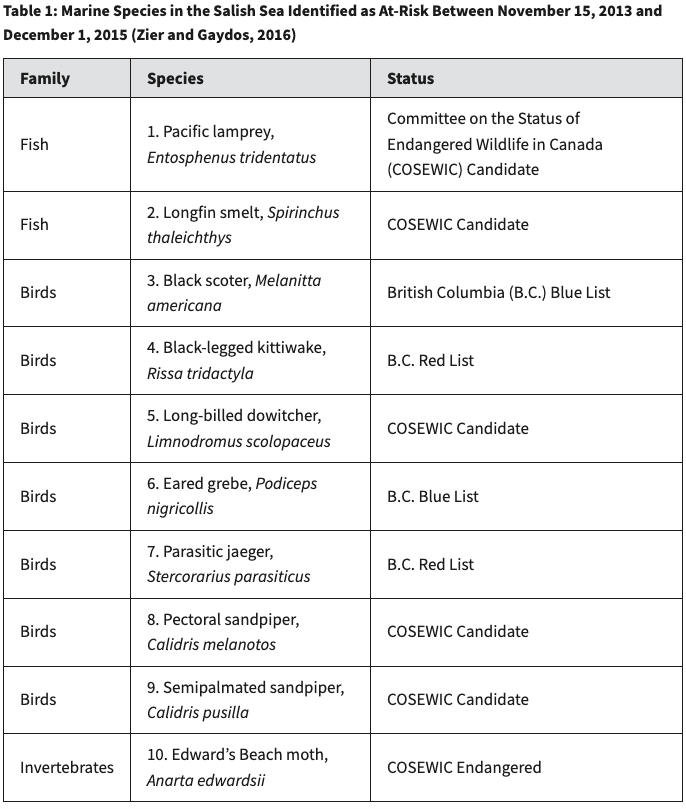
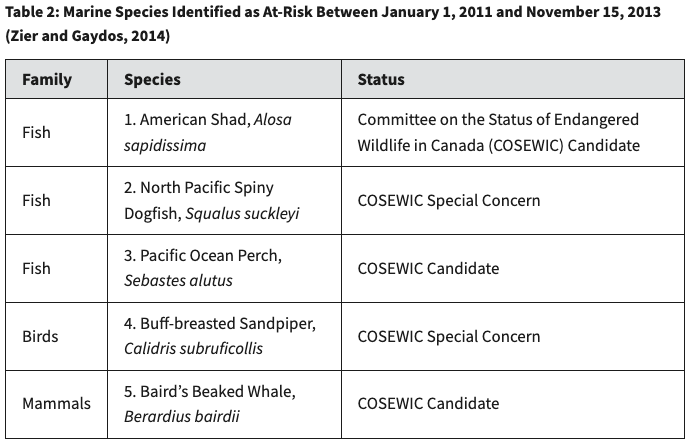
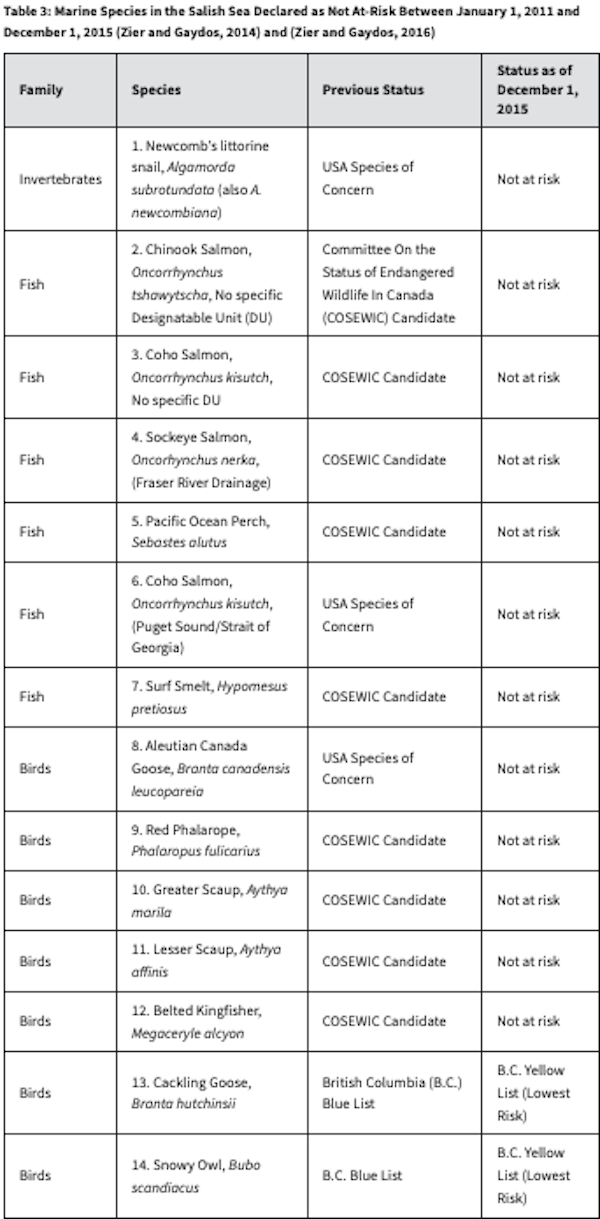
A recent report from the U.S. Environmental Protection Agency states “the total number of marine species at risk in the Salish Sea has doubled from 2002 to 2015.”
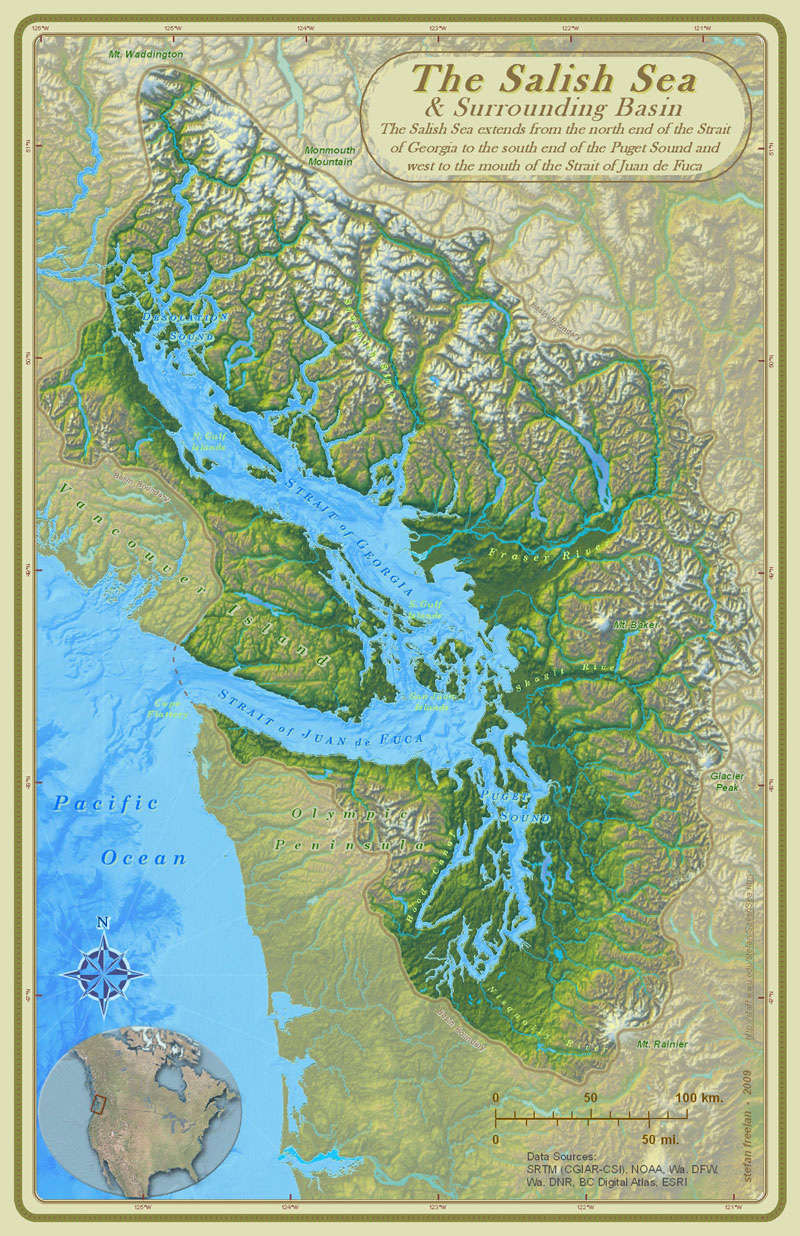
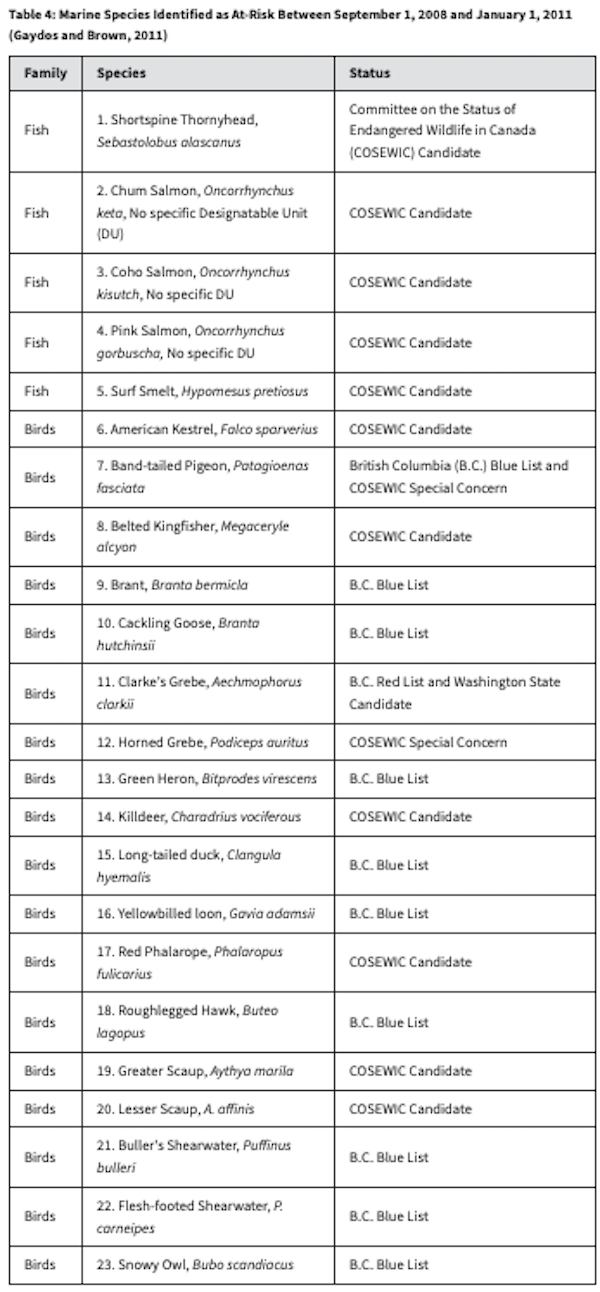
The accompanying map shows they are referring to an area that stretches from the Puget Sound to the Strait of Juan de Fuca and north beyond Cortes and Quadra Islands. Christianne Wilhelmsen executive director of the Georgia Strait Alliance, explained this is because the EPA thinks of the Salish Sea as whole entity, rather than dividing it between two nations. While a few of the entries are American, most of the species listed are accompanied by terms like ‘COSEWIC‘, ‘B.C.’ and ‘Canada,’ which shows they come from Canadian sources.
“As of December 2015, nearly 20% of all fish species in the Salish Sea ecosystem are designated as either threatened, endangered or have new data that suggest they may be at-risk. As well, approximately 34% of all birds and 43% of all mammals that use this ecosystem are threatened, endangered or are candidates for status assessments,” the report says.
“It’s really sad news, that came out this year,” said Wilhelmsen.
She claims we are seeing these numbers because Canada and the United States have failed to address urbanization and loss of habitat issues that were identified 30 years ago.
“Pollution remains a problem, even though we’re tackling some issues like wastewater. That’s getting better in our region, but we have other sources of pollution runoff from cities, stormwater, agricultural runoff. These are continuing as our population grows and of course, the lens, which is exacerbating the problem, is climate change,” said Wilhelmson.
“Animals are under stress because of pollution, habitat loss, then you add the stress of climate change with water temperatures rising, and you have species that are struggling because of it. It’s affecting their food sources; It’s affecting their ability to reproduce.”
She pointed to salmon as a specific example. For thousands of years their eggs have hatched when food sources become higher in concentration. The rising river temperatures have thrown this alignment out, and brought about a decline in the salmon population.
That is because of climate change.
Add acidification, which is literally changing the chemistry of our oceans, and shellfish are affected.
So the birds, marine and terrestrial animals that feed on fish and shellfish are impacted.
Southern resident killer whales have so many toxins in their system that their ability to fight off disease is reduced.
Wilhelmson compared the situation to a big ball of yarn that is unravelling and making things worse.
There are different issues in different communities, even though some affect the entire region.
In some areas fishing gear is becoming a problem to species.
“It’s interesting how in Washington state they’ve done a remarkable job, and it’s honestly an incredible investment of money and time, to collect derelict fishing gear and to recycle it wherever possible. But on the BC side, the Canadian side, we just simply have not gotten to the point where we’re investing in that,” said Wilhelmson.
She cited the comeback of the Humpback Whale as one of this area’s success stories
“Twenty or thirty 20 years ago, we just never saw them in the Strait. Seeing a humpback is still an amazing experience, but it’s no longer the rarity it used to be,” said Wilhemson.
“The humpback is just a wonderful story. It’s not recovered. There’s still some threats to humpbacks, in particularly from fishing gear and also from boating but it’s a wonderful story of recovery.”
Another success story is the Northern Resident Orca’s increase in population.
“They have access to more salmon and their waters are less polluted, which is kind of the lesson for us here in the Salish Sea. If we could tackle pollution in a more meaningful way, if we could protect Chinook so that they can live here and come back here, protect the rivers that they come from, that we might actually be able to see an increase in the Southern resident killer whales,” said Wilhelmson.
This story has a special meaning for many listeners on Cortes and Quadra Islands, which are close to the boundary between the Northern and Southern residents. Killer Whales from both pods visit our waters
Wilhelmson says the current plight of the Southern Resident Killer Whales, shows that you have to make really hard decisions if you’re serious about protecting a species. They were classified as endangered in 2003, but it wasn’t until the pipeline hearings were being held in 2018 (and environmental groups were considering a lawsuit) ) that the government finally took action.
“One of the problems we have sometimes in protecting species is the government itself and its desire to actually make change,” said Wilhelmson.
She commended some of their recent bold actions, but added, “We’re still losing Chinook; We still have pollution sources that aren’t being addressed in a bold enough fashion.” Though the plight of Southern Resident Killer Whales has improved, they are still threatened.
“The reason we focus on Southern Resident Killer Whales is because they are the harbinger. They’re an apex predator. They’re at the top of the food chain. So what happens to them is indicative of the health of the region,” said Wilhelmson.
She is the Executive Director of the Georgia Straight Alliance, which has its headquarters in the unceded territories of the Musqueam, Squamish and Tsleil-Waututh First Nations, in an area also known as Vancouver.
“We’re a marine conservation organization that for more than 30 years has been advocating for the protection of the Salish Sea, in particular,” explained Wilhelmson. “Our mission is also to promote the conservation of the adjoining waters of the Salish Sea, as well as its communities. So we take a very watershed approach to our work. We take a transboundary approach to our work. Just because you have the meridian line which is dividing Canada and the United States, you can’t work on protection of an ecosystem in that way. Long before I was with Georgia Straight Alliance, our founders had that approach. We worked with American partners to find solutions to the threats to this region. Then work with communities and anybody who had the same vision for this region – be they industry, government communities, individuals, or businesses – to try to find the solution and the longterm solutions.”
Three million people live in the Salish Sea region, which stretches between southern B.C. and northern Washington state.
Wilhelmson says, “We are interconnected in so many ways with this body of water, both in the ways we protect it, but also in the ways we harm it.”
Links of Interest:
- (EPA) – Marine Species at Risk (2021)
- (Western Washington U) – State of the Salish Sea by Kathryn Sobocinski (2021)
- Georgia Strait Alliance website
Sign-up for Cortes Currents email-out:
To receive an emailed catalogue of articles on Cortes Currents, send a (blank) email to subscribe to your desired frequency:
- Daily, (articles posted during the last 24 hours) – [email protected]
- Weekly Digest cortescurrents – [email protected]