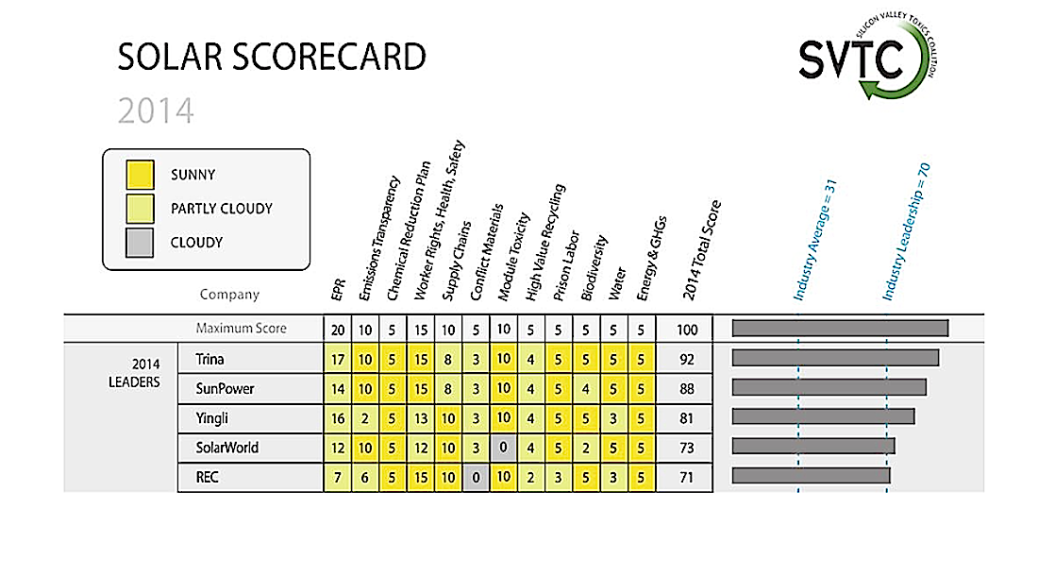
Every year, the Silicon Vally Toxic Coaltion (SVTC) sends out a survey to PV solar manufacturers. Though companies do not have to respond, this does not stop the SVTC from evaluating them. It simply means there is less information and, consequently, they receive lower marks. The “Industry Leaders” on SVTC’s 5th annual 2014 scorecard are: Trina Solar (92), SunPower (88), Yingli Green Energy (81), SolarWorld (73) and REC (71).
Germany’s renewable sector (RE) is flexing its muscles. Solar production was up 28% and wind 19% during the first half of 2014. As a result, the renewable sector accounted for 31% of the nation’s electricity. If this trend continues, this may be the third year in a row that Germany sets a record for energy exports. The increase in renewables has also been accompanied by a decrease in fossil fuel usage. Gas-fired power plant production is down 25%, compared to last year. Hard coal production fell 11%. Only Lignite power usage rose. So what does the expanding sector mean to Germany’s utilities?
Peter Varadi is one of the few people who could be said to personify the solar industry. He and his partner, Joseph Lindmayer helped develop this technology for space and founded the World’s first terrestrial solar company in 1973. It was the worlds largest, and possibly the only profitable, solar company when they sold out a decade later. That did not end Varadi’s involvement. He has continued to be at the center of developments, as a consultant to organizations like the European Commission, The World Bank and National Renewable Energy Laboratory. His recently published book, Sun Above the Horizon: Meteoric Rise of the Solar Industry, is and insider’s view of what has transpired since Bell laboratories discovered that silicon was a incredible conductor of electricity in 1953.
Last year Robert Lundahl and I co-wrote an article about a California PV solar factory that is not disposing of their solar panels once their lifespan expires. We could not name the company, as our source still works there, but they use a known carcinogenic called gallium arsenide. This is not believed to be a problem as long as the panels are intact. However if they end up in a landfill the panels will be broken and the toxins can leech into the soil. Environment California recently directed me to a study that puts the toxic Issue of solar panels in context and suggests areas where the industry can improve.
Amy Galland’s “Clean and Green” was inspired by companies that are not complying with environmental health and safety codes, but she found some PV manufacturers actually do more than what is required.