Category Archives: Indigenous Nations History

How the WE Wai Kai/ ICAN Water Security Team Partnership came into being

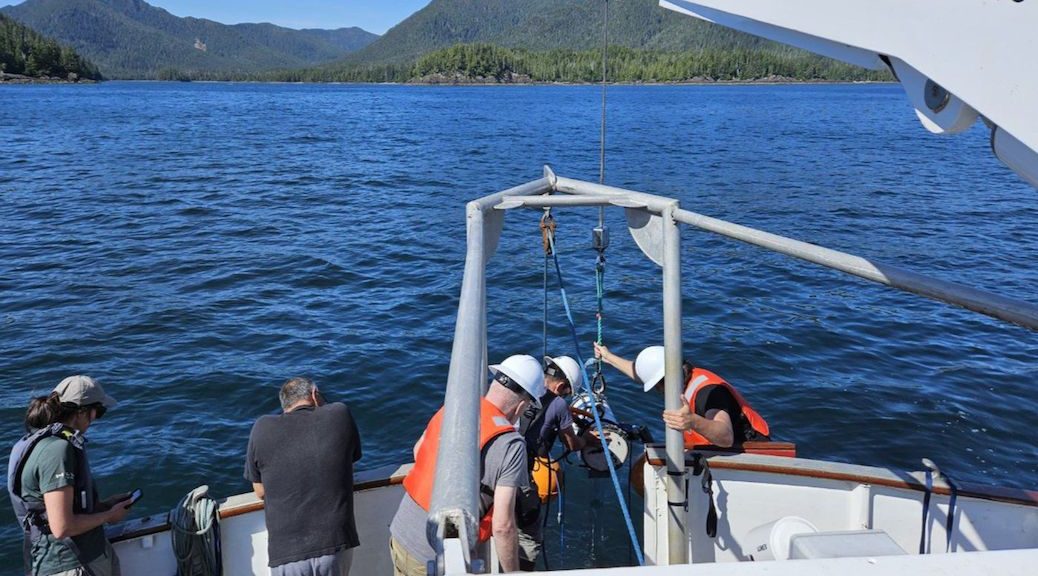
The We Wai Kai Nation wanted to find out more about their water resources on Quadra Island when the ICAN water security team approached them about a possible partnership. 

“I wanted to find out  how much water we have? Where is it coming from? We want to know if the water’s good on Quadra, and protect those watersheds. We want to map out where everything is and get educational pieces out there about our drinking water – ‘don’t be polluting this area!’” explained Jason Price, Director of Lands for the We Wai Kai First Nation.

Continue reading How the WE Wai Kai/ ICAN Water Security Team Partnership came into being

New study shows how industrial development decimated fish populations near Vancouver

Editor’s note: To what extent is modern infrastructure responsible for the crash of fish populations? The book cited below explores how a 3,000 year-old fishery was destroyed when the city of Vancouver came into existence, but this is not a purely urban phenomenon. In a 2016 interview, Cortes Island streamkeeper Cec Robinson described how there is very little gravel left in Cortes Island streams because of early logging practises. This makes it more difficult for salmon to find places to spawn. When Provincial biologist Sean Wong installed a new culvert in Basil Creek, he told Cortes Currents there are 140,000 culverts in BC that are barriers to fish trying to migrate to their spawning grounds. Prior to the erection of the first dam in 1911, Powell River was a major spawning ground for Sockeye Salmon.

By Mina Kerr-Lazenby, North Shore News, Local Journalism Initiative Reporter

A new study examining the historical decline of fish populations in Vancouver waters highlights the detrimental impacts urban development has had on the local environment, and way of life for First Nations communities.

The Rise of Vancouver and the Collapse of Forage Fish, published in December by Western Washington University, tracks the decrease in numbers of ocean forage fish like herring, smelt and eulachon between 1885 and 1920.

Continue reading New study shows how industrial development decimated fish populations near Vancouver

WLFN-owned company brings a decolonial lens to archaeology: ‘We need Indigenous knowledge’

By Dionne Phillips, The Wren, Local Journalism Initiative Reporter

On a recent archaeological exploration for the Cariboo Memorial Hospital project in Williams Lake, Demetrius George discovered a small, ancient rock tool in the dirt. 

The fine-grained volcanic artifact is very sharp, he explains, but doesn’t seem to be made for scraping deer hide — rather, for smaller jobs, such as cutting string. 

Continue reading WLFN-owned company brings a decolonial lens to archaeology: ‘We need Indigenous knowledge’

SFU researcher explores Haida Gwaii’s unique archeological history

Editor’s note: This research could throw some light on how the First Nations reached the Discovery Islands, where the earliest archaeological finds are currently from about 11,000 years ago at Yeatman Bay on Quadra Island. In an interview with Cortes Currents, an archaeologist from the Hakai Institute said he did not have any early dates for Cortes but “It really comes down to where people have done the research.”

By Seth Forward, Prince Rupert Northern View, Local Journalism Initiative Reporter

Groundbreaking research on Haida Gwaii could lend more clarity to unanswered questions about how the First Peoples of the Americas arrived after the last ice age. 

By testing marine core samples off the coast of Moresby Island, researchers from Simon Fraser University (SFU) and the University of Victoria (UVic) are attempting to understand the ancient paleo-landscape of the archipelago. 

Continue reading SFU researcher explores Haida Gwaii’s unique archeological history

Robert Bringhurst on local history, science, poetry, the ridge where he lives and much more

On Saturday Robert Bringhurst (RB) brings his own brand of literature, local history, science and humour to the stage of the Quadra Community Centre. He just gave Cortes Currents a taste in a rambling conversation that at one point went off topic to include remarks about Cortes Island, Campbell River and Whistler. Bringhurst started out by describing his intentions in the epic description of ‘the Ridge’ on Quadra Island where he lives.    

RB: “I wanted to make good poetry out of, among other things, good science. I wanted  to walk the ridge and relish it as one does without any thought of scientific measurement or accuracy, but I also wanted to think about it as a real place in historical time and to look at the species in relation to other species on the planet, and at the rocks in relation to other rocks. I began to wonder how much biology, geology, astronomy and climatology I could put in this poem without sinking it. The answer turned out to be quite a bit.” 

Continue reading Robert Bringhurst on local history, science, poetry, the ridge where he lives and much more