


A joint Cortes Community Housing & Folk U Forum; podcast & written version by Roy L Hales
Viewers from Cortes, Salt Spring and Galiano Islands down to the cities of Victoria and Vancouver logged in to the virtual Cortes Housing Forum on Friday June 14, 2024. The topic was ‘increasing rentals’ and host Sadhu Johnston invited two high profile guests.
David Hutniak has established himself as the voice of the rental housing industry in BC with the government, media, renter groups and other stakeholders that call upon him for input and advice. He is also the CEO of Landlord BC.
Lisa Helps is a former advisor to the Premier, as well as a former mayor of Victoria. Now she heads the BC Builds program.
Sadhu Johnston is a former City Manager of Vancouver, and wears many hats on Cortes Island in addition to being Executive Director of the Cortes Community Housing Society.
In his introduction to the program, Johnston pointed out, “Building in rural communities is even harder than building in urban communities. In many cases you’ve got to bring in materials, you have labor shortages. There are unique challenges that we face in our rural communities.”

This was followed by a short presentation in which Lisa Helps gave an overview of BC Builds.
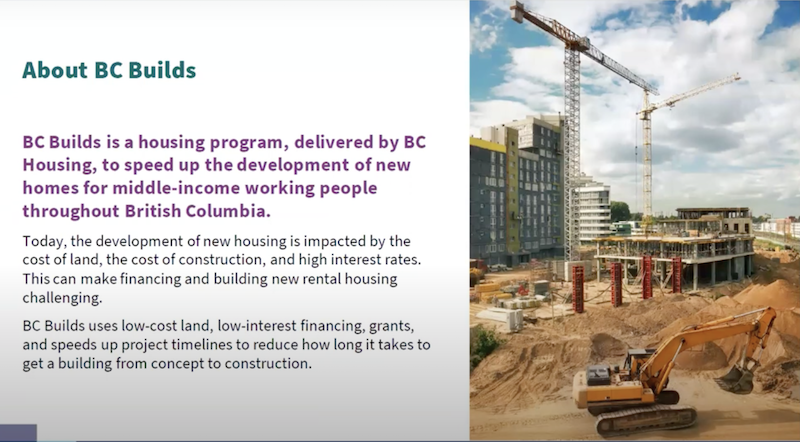
Lisa Helps: “The thrust of BC Builds is to overcome the challenges with building housing in this current environment: high construction costs, high interest rates, limited labour and so on and so forth. BC Builds is meant to be an intervention in this space by using low cost land, low interest financing grants and really accelerating the building of housing by working together with communities in a different way.”

“We have three elements to our program.”
“We identify low cost land for development. Often this is land owned by community partners or First Nations or local governments or anyone who may have land. who might not currently be in the housing business, either as a nonprofit or community entity, but is interested in putting your land forward for housing. That’s our first step, find land, and then bring together the landowners, residential developers and speed up development project timelines.”
“Obviously, you can’t build housing without money and we can provide both financing and grant funding to get projects built. The thrust of our program is really renters, which is why I’m here today, but very specifically the middle income renters.”
“BC Builds is not meant to be an affordable housing program. BC Housing has a lot of good housing programs that exist to serve very low and moderate income British Columbians. But what we found when I was working in the Premier’s office is there’s a real gap right now for people like nurses and teachers and transit operators, construction workers, small business owners, all of those people who keep our communities running. Even with half decent salaries, they just can’t find anywhere to rent because there simply isn’t anywhere.
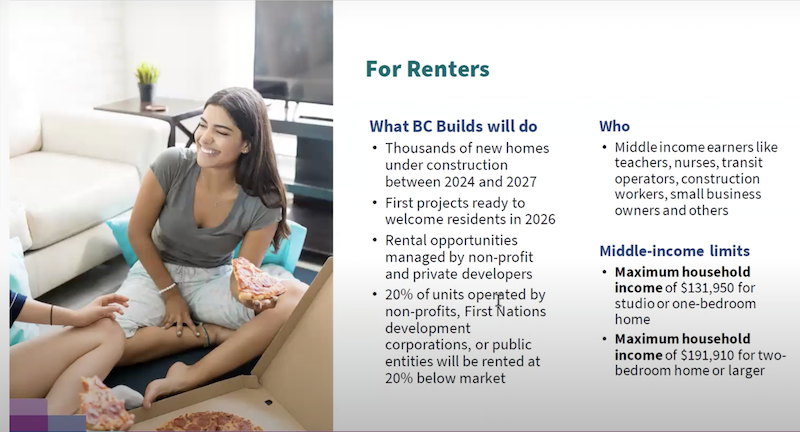
“That’s really the gap that BC Builds is meant to fill. We target at least 20 percent of the units to be 20 percent below market. By having most of our buildings in the hands of the community housing sector, so nonprofits, co ops, churches, First Nations, non market actors, even though these buildings start off at market and 20 percent of units at 20 percent below market, BC Builds is a long term investment in the community housing sector and in affordable housing of the future.”
“The best example to illustrate this is all of the co-ops that people talk about in Vancouver that are so affordable and co-ops elsewhere as well. The Vancouver ones really get a lot of play because that market was so expensive when those co-ops were built in the 60’s, 70’s and 80’s. They were rented at market prices for working people and now they’re affordable, 40 to 50 years down the road.”
“BC Builds is a dual intervention right now to get housing built for working people and by getting it into the hands of the community housing sector, it is long term affordable housing.”
“Renters are our first target. Second, I’ve already mentioned we work with government, non profit and community landowners to help unlock underutilized land and help develop a vision timeline.”
“We want to make sure that we’re setting timelines at the very 1st meeting. When are we going to have this building under construction?”

“We’re also looking for creative opportunities to add housing on top of just about anything, so that we’re getting the best use we can out of public and community held land. It could be housing with child care below, housing with a fire hall below, housing with the city hall below, housing with the First Nations Tribal Council headquarters below.”
“We’re really looking to maximize the use of public and community land and for those government, non profit and community landowners that may have no idea how to build housing or where do you even turn to find a development partner?”
“We have a platform to help match land with developer builders and owner operators if necessary. We can work with any nonprofit, government or community landowner.”
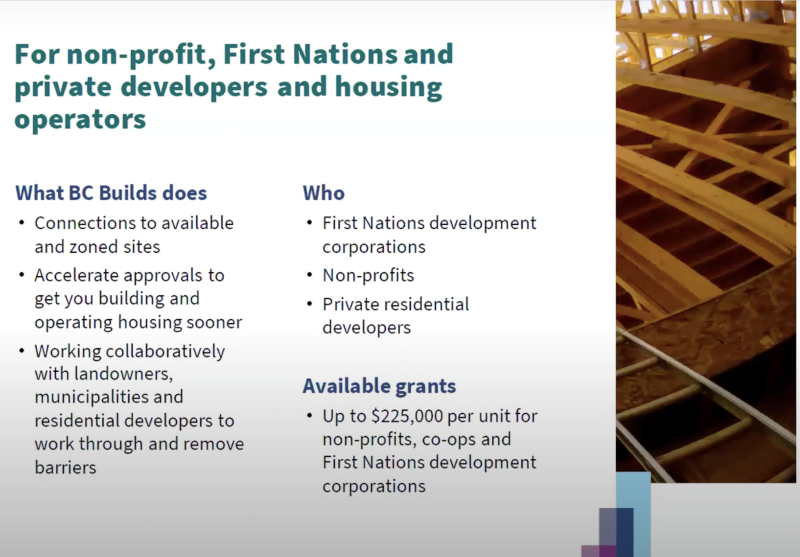
“The third target focus of BC Builds is the development community itself: nonprofits, First Nations, and also private developers, as well as housing operators. We connect these folks to available zoned land, help accelerate approvals to get building done faster, and then work collaboratively through the process and remove barriers. We are open to working with First Nations Development Corps, Nonprofit Development Corps and private residential developers as well.”
“When the building is going to be owned and operated by a First Nation, Nonprofit Co op, Municipal Housing Corp, etc there are grants available. We won’t have time to get into this in too much detail, but the grants are not $225,000 per unit. That’s a maximum figure. The grants are meant to get 20 percent of the unit’s price up to 20 percent below market. So whatever that amount is, the grant amount for the project ensures that each building has some below market units.”
“These are some sample projects.”
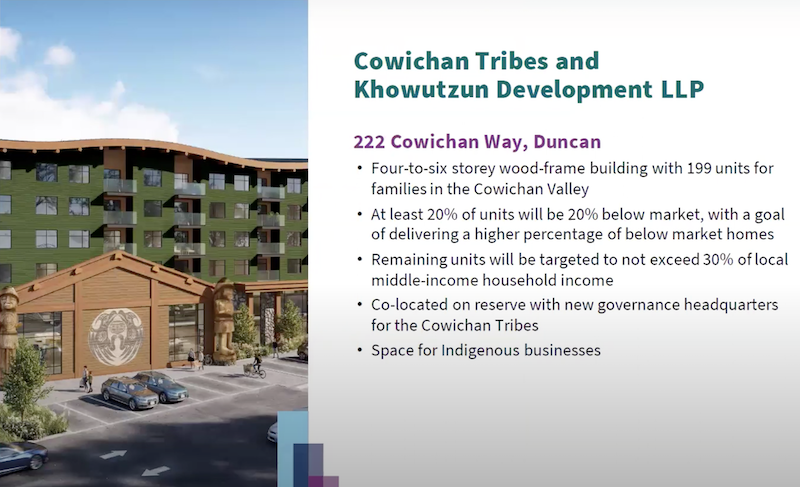
“This building is a partnership with the Cowichan Tribes and Khowutzun Development Corp on reserve land in downtown Duncan. It is a beautiful building and, again, maximizes the nation’s land by having tribal headquarters and Indigenous businesses on the ground floor and housing above. The thing that the Cowichan Tribes love about this project is it serves a dual purpose. It’s housing for their nation members, but also there’s a new hospital being built in Duncan and this housing will also serve as housing for hospital workers. They really see this as an act of reconciliation.”
“Smaller projects may be more relevant for your context. This is in Gibsons. They’ve got child care on the bottom floor and 33 units of housing on top.”
“People ask, how do you move so quickly on these projects?”
“The conventional approach to housing development takes three to five years from concept to construction, and works in a linear way. I’m not going to go through it. I’m sure anyone who’s been through a housing development process is very familiar with this plotting approach.”
“BC Builds is essentially a housing accelerator. We put everything in at the beginning. We bring the land, we work on the feasibility, we’re building the partnerships. We’re working through the approvals process because the municipalities are at the table with us and we’re getting the financing and the capital stock organized at the same time.”

“When I drew this up on my whiteboard, it didn’t look like a rocket ship, but the graphic designers made it into what I like to think of as the BC Builds rocket ship. So here’s the fuel. There’s a project team steering the ship and we spit out construct in 12 to 18 months. Arguably our program is new and only launched in February, but we’ve been working on projects since last summer, and we are set to hit that 12 to 18 month timeline on all the projects we’re working on.”
“This is the platform. If you go to BC Builds homes.ca, you can look at this. This is where we’re matching zoned land with development partners. So we’ve started off with 8 key priorities, and this is really critically important. For anyone here that wants to get their site up on this page, looking for a developer, builder, partner, owner, or operator, the land needs to be zoned.”
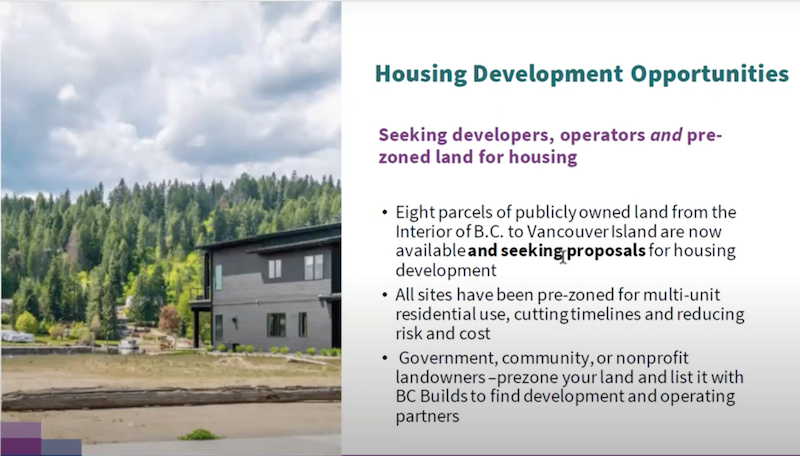
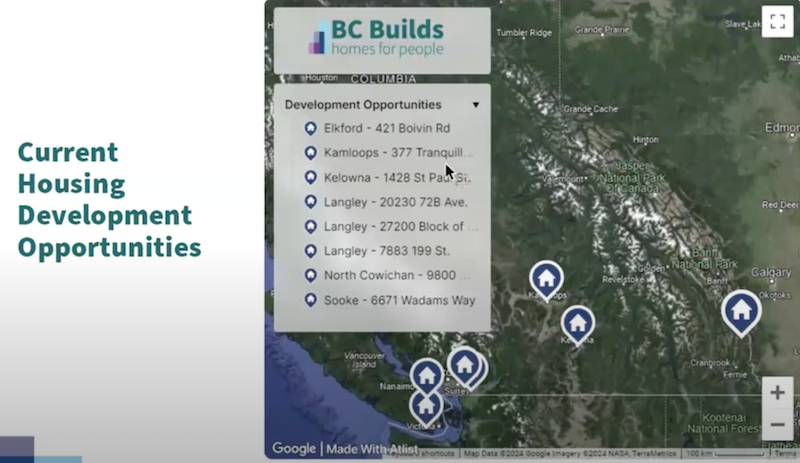
“Municipalities have been very supportive. All the land that we’re starting with is owned by them. In other conversations we’ve had with First Nations or nonprofits who own land in the middle of a city, we’re asking cities, towns and villages to help with city initiated rezonings to set the table for what they’d like to see.”
“The site can go up here on our housing development opportunities page. There’s a map of the province. Each site is tagged. Here’s the page with all the opportunities. We hold an info session. Property owners can come and make their pitch to the development community and say why they should submit their proposals. We record those so everyone can watch them afterwards. Each property has a property opportunity notice.”
“We have a template. It’s quite easy and here’s the process which I’m not going to walk you through because this is a 10 minute presentation, but do have a look on our website. Everything I’ve shared today is available on our website.”
The next presentation was given by David Hutniak, CEO of Landlord BC.
“We represent owners and managers of rental housing. We’re member driven and a big part of what we do in addition to trying to professionalize the industry is advocate on behalf of the sector with all levels of government. We care a great deal about renters and we’re housing advocates.”
“I’ve been really fortunate to be involved in the sector. I didn’t come from it. It’s going to be like 10 years that I’ve been doing this. I’ve met so many wonderful people, but I’ll have to admit, it is very, very frustrating work in the sense that we haven’t been building ‘purpose built rental,’ which is the traditional apartments. We didn’t build them for literally 40 years. We’re now in a place where all levels of government recognize that ‘purpose built rental’ is what we need to build most of but we missed the record low interest rates.”
“Now we’re in an environment here where interest rates are high. They’re not going to be coming down. We’re not going to see those low interest rates again. So, despite the great work that the province is doing, and certainly the federal government, we’re in a situation that is extremely challenging. It’s probably even more challenging in rural British Columbia.”
“In the overall context of the sector, it’s really, really difficult to be a renter and it’s really, really difficult to be a landlord. Obviously renters have very limited choice and rents are going up, in some areas to very scary levels. From a landlord perspective, the cost to operate rental housing, insurance, utilities, taxes, everything has reached a point where the annual increases that we’re allowed to advance (through increased rents) are woefully inadequate.”
“What we’re seeing is the secondary market – the small landlords of basement suites or industrial condos, what have you – is they’re actually leaving the sector because they’re underwater. Some of them, mostly in urban centers and the condo sector, probably over leveraged themselves with variable rate mortgages. Those weren’t good business decisions, but nevertheless it is really very concerning times right now from that perspective.”
“What we’re seeing, as I already mentioned, and Lisa covered so well in her 10 minutes, is really good moves by the province and the feds. The biggest challenges that we’re facing and have been facing for a period of time here is actually with local government. I’m sorry to be so critical if there’s any local government folks here on the call, but the reality is you control the land, the zoning and the permitting, etc. There’s numerous challenges that local governments have, but the reality is we’re in a crisis. We need to triage the situation here and we need to think outside the box and just get things moving. This is where myself and other stakeholders that I work with really closely have a great deal of frustration.”
“The province is there, the federal government is there, but a whole lot of municipalities are not. Some large municipalities are pushing back and undermining the very good measures that the province has advanced.”
“That’s where the work has to be done. You need to go after your local government. Their immediate response would be ‘we have no money.’ There’s an element of truth to that, but they have land, they have other creative solutions that they can use. They can partner with the private sector.”
“The continued demonization of developers, which we’ve seen for far too long needs to stop. As Lisa outlined, the provincial government has very much recognized and basically baked into their plan, partnering with the private sector to build housing.”
“Developers are just like car manufacturers. I think you need to look at them from that perspective. Ultimately, so much of what they do is dictated by pension funds and other investors. So, the notion that developers are greedy and looking for all sorts of big profits- well no investor, no pension fund is going to give a developer to build anything unless the project is going to be profitable. That’s really important and unfortunately, many municipalities have still not accepted that. Frankly, many people in the community like to oppose housing. One of their favourite targets is developers and I think that needs to change.”
“Finally, one of the greatest challenges that we have in creating new housing and ‘purpose built rental,’ in particular, is that municipalities demanding a ‘growth pay for growth.’”
“If there’s a new project, municipalities want to load on all sorts of costs and infrastructure costs, etc, etc. Basically they want that new development to pay for it. They think that the developer is paying for this, but the developer isn’t paying for this, it’s the end user – typically a young family who’s buying that home, or the new renter that’s moving into that new building. This is something you need to talk to your municipalities about. The infrastructure that’s being created will help the entire community. We just cannot continue to expect ‘growth to pay for growth,’ we need to spread it across the broader tax base. It’s critical, it’s just not sustainable.”
“Beyond that, we’re working as hard as we can to try and keep the existing sector viable. Our commitment as an association is to work very closely with the province in particular, but with all municipalities to try and ensure that renters have safe, secure and attainable rental housing affordability is extremely challenging, but attainability should not be.”
The next segment of the forum was question period.
Someone asked Lisa Helps how the government’s new ‘rent to own’ program will complement BC Build.
Lisa Helps: “I think what you’re referring to is, the BC United pitched a rent to own program, where the government would subsidize developers to build homeownership units. That’s not currently a program of government.”
“BC Housing used to have an affordable home ownership program. When we were developing BC Builds, we looked at the opportunity to do a home ownership program and a rental program. Because of interest rates and other stress tests right now, it is difficult to do an affordable home ownership program. So we thought we’d launch with rentals. What we’re proposing, probably early next year, is to work in partnership with communities and governments to develop what we’re calling a ‘Pathways To Home Ownership’ program. That could be rent to own or, that could be partnering with developers that could be shared equity co-ops: all manner of opportunities for homeownership.”
Sadhu Johnston: “Over the years, during my time in government, I often find neighbors are fighting against projects in their neighbourhoods. I’m wondering if you’re seeing a change to that, if there’s greater recognition in our communities that adding rental a little bit more density in communities is helpful. I’m interested to understand whether there’s a turn that’s happened amongst the public generally supporting additional housing.”
David Hutniak: “The public hearings in the last couple of years have probably been a little less confrontational in terms of nimbys (nimby = ‘not in my back yard’). Having said that, I think we’re entering a new phase of nimbyism. We were seeing some acknowledgement that we need to have density, but now in the view of some people the scale of density is over the top, which it’s not.”
Lisa Helps: “I think the tide has turned. Some larger municipalities are just unhappy with ‘being imposed on by the government,’ in their words, and that’s fine. They can be unhappy, but what I’m seeing as I work in small places and large places is a real desire to work differently and collaboratively to get rental housing built in communities. Everyone’s looking for teachers and nurses and paramedics. This is a really big problem that communities are trying to solve and I think we’ve hit a tipping point in most places. We’re not going to see as much backlash from communities or from neighbourhoods about having rental housing built.”
Sadhu Johnston: “One of the things we really struggle with in rural communities and cities as well, is just the infrastructure costs to support new units, whether it’s septic or wells or bringing in electricity. David was talking about those kinds of costs, not just falling on the developer. I’m curious , are there ways to address some of those servicing costs that doesn’t make that project unviable?”
Lisa Helps: “BC Builds has grants and financing for housing, not grants and financing for infrastructure. However, I think that there’s real potential with the way that both provincial and federal governments are starting to shift the way that they’re thinking about and funding infrastructure. So the $6 billion housing and infrastructure funds that the Liberals announced as part of their budget, I think is something to really dig into , particularly for rural communities. Pay attention to figure out how it works. They are funding infrastructure that supports housing full stop, and that is brand new. That’s something that’s never happened before. No one knows how it’s going to work yet. It was only announced in April, but I think that it shows that there is, at the highest level of government, an understanding that we can’t build housing without infrastructure.”
“I think the provincial government understands this as well. When there was that big budget surplus in 2023, $1 billion went to communities. This was unfettered money to spend on building what was necessary to support growth. I think we could anticipate if there’s another big federal or provincial surplus that we’d see that kind of spending again. Unfortunately, that’s not how things are looking right now, budget wise, but I think both of those examples show me that provincial and federal government understands that you can’t build housing without also investing in communities.”
Robyn Mawhinney, Regional Director for Area C, texted about the possibilities of releasing underutilized land from provincial holdings, like school districts or crown land for housing.
Lisa Helps: “Yes, absolutely. We can work directly with health authorities and school districts to look at building housing on their land. The provincial government itself is doing an inventory of all lands across the province that they think would be suitable for housing. However, obviously they’re not the ones on the ground in the community. So if there are sites that are provincially owned crown land, that would be good potential candidates for housing. You can, for now, send them to me and I can direct them to Bonnie Roshinsky at the Ministry of Housing, who’s working on that inventory project. With any land that’s owned by a provincial agency or the province itself, there’s consultation and engagement that needs to be done with the local First Nations. On any crown land, I think that’s an opportunity. Housing can also be about reconciliation. That’s the first stop with provincially owned lands. The province does consultation with the Nation, figures out what their interests could be, looks for housing partnerships. If it’s a school district or health authority, we can start that work directly.”
Sadhu Johnston: “One of the things that I’m finding, at least on Cortes, we were able to raise the funding to get 50 acres right next to the school and the health center and the fire department and haven’t been able to get BC Housing funding through their regular stream. In my discussions with many of the rural communities, I found they have land and they need the support. So your program is very important and we look forward to working with you and finding ways to provide some really good examples of very rural rental housing projects. We’ll be in touch.”
“Thanks for putting your email in the chat and spending a Saturday morning with us. Appreciate that very much. And David, if we can keep you for another 5 or 10 minutes, we’d love to continue the conversation. So Lisa, I know you need to run, but unless you have any closing thoughts, thanks for your time.”
Lisa Helps: “Thanks for having me here. We’re looking for specific sites and specific projects. It sounds like there are a couple on this call that would be good candidates, so please email me. I think it’s true not only will people from rural communities move into cities if there’s no housing, the societal stakes are worse than that because rural communities are places where people feel a sense of connection and belonging. The fabric of the community will be destroyed if we don’t build housing.”
Sadhu Johnston: “Lisa, maybe a small group of us could meet with you and just share a few of the sites that we have. We can have a little working group with three or four of us just to say, Hey, here’s some land how would it work?”
Lisa Helps: “Sounds awesome.”
Sadhu Johnston: “David, you and I have worked together over the years and have seen projects confront a lot of challenges. The infrastructure being loaded on them, those costs are up to $100,000 dollars per unit and then you have a developer who is now facing a lot of uphill battles with the community. It’s not a very attractive effort to try to build rental units.”
David Hutniak: “We reached a point, probably 10 years ago, where we had 25-30 years of municipalities basically building condos and the condo market was, frankly, a cash cow for all levels of government for developers as well. Municipalities in urban centers realized that they could pass on whatever costs they wish in terms of developing costs, levies, etc. The developers didn’t care because they were just passing those costs on to investors and investors were prepared to pay whatever it costs to purchase those units. Well everything changed in the last decade and more critically in the past few years. We’ve reached a point where there’s just no capacity for all those costs to be absorbed and passed on to the occupiers of those homes, ie- renters.”
“We’re fully respectful of the fact that cities have costs and they have limited access to revenue (through taxes, etc).”
We’re definitely seeing this recognition that they need to be more responsive in terms of looking at those fees, looking at density bonusing to help reduce costs and looking at ways to expedite proposals that come to them.
“It’s not just infrastructure, all those additional costs for a typical purpose built rental unit in Vancouver actually totalled in excess of $200,000 per unit, which is ridiculous. People wonder why they’re not affordable!”
“We’re definitely in a much better place in terms of the recognition of this. The province deserves a lot of credit for that. The premier and Minister Kahion are really doing a good job working with municipalities to really look at ways to reduce these costs, to extract these costs. Certainly our friends at Urban Development Institute really are the leaders of the development industry. They too have been doing a really good job in terms of having folks and political leaders understand what it costs to build rental housing.”
“When we look at the broader rental population, there is definitely a significant cohort of renters who really struggled to pay rent and they need supportive housing. They need nonprofit housing, et cetera, et cetera. The other reality is that, particularly in urban centers, because of such a shortage of rental units, building for the rental market has a huge uptake. There are a lot of renters who can afford to pay market rent.”
“Part of the challenge that we continue to have is finding the perfect project, with all sorts of demands for inclusionary zoning and (some units) 20 percent below the market price, etc, etc. All of this has a cost attached to it. The opportunity we’re missing is actually building pure market rental housing. What we know is that there’s a huge core cohort of renters who, as soon as that new rental housing is built, they are occupying it. What that does is it frees up the units in those older buildings that have more affordable rental. This is totally proven. Many economists looked at this and the reality is that we just need to build rental housing and we should not be opposing pure market rental housing.”
Sadhu Johnston: “Thanks, David, for your perspectives and your work over time. I’m curious, and putting you on the spot here. You’ve been working a lot on urban projects where there’s huge headwinds. Most of us on the call are in rural communities and there’s different kinds of headwinds. Do you have a sense of how the lessons learned in our urban communities might be applied to rural communities? There’s been a lot of rental over time built in urban communities. When I look at the rural communities, the rentals are mostly cabins in the back, or a yurt not a lot of purpose built rental. It’s really the leftovers or a home that somebody is not occupying at any given time.”
David Hutniak: “You’re absolutely right, rural communities are very heavily dependent upon what’s called the secondary market, the basement suites, etc. The other harsh reality is because we were building condos for 25 years and not purpose built rental, across the whole province, we are still very heavily dependent upon the secondary market for rental housing.”
“It’s great that we have the secondary market. We continue to encourage it, but the reality is, from a policy perspective, what governments need to be doing is working more aggressively towards building ‘purpose built rental,’ because that provides security of tenure that unfortunately you don’t experience in the secondary market, not to the same level in any event.”
“It’s very expensive to build ‘purpose built rental’ anywhere and certainly those costs aren’t mitigated because it’s certainly a rural project. Talking to some of our members who are developers, who do have rental properties across the province, they would like to do rural projects but the reality is that for them to build, say, a three story or four story purpose built rental building in a smaller rural centre, the economics simply do not work. You cannot justify building a 40, 50, 60 unit building. It’s just not economically feasible.”
“There’s still opportunities here to look at multi unit housing and this is where it gets to the municipalities. What we’re seeing in the urban centers and the province is driving this, is looking at densifying existing city lots. What that does is leverage the existing infrastructure. For smaller municipalities, smaller towns where they have sewer and water already running to a street, but they’re all single family homes, I think it’s pretty much critical that if you hope to create more housing and rental housing in particular, you need to densify those lots. It’s not just in urban centers that single family homes are a dinosaur. I really believe that’s true in rural and in smaller towns across the province as well.”
“We need to look at densification because that’s going to provide some initial economies of scale. That brings its own costs and that’s going to be an important consideration as to whether or not you’re going to be able to convince a developer and or government, frankly, to create that housing.”
Top image credit: Getting a home – Photo by Tierra Mallorca on Unsplash
Sign-up for Cortes Currents email-out:
To receive an emailed catalogue of articles on Cortes Currents, send a (blank) email to subscribe to your desired frequency:
- Daily, (articles posted during the last 24 hours) – [email protected]
- Weekly Digest cortescurrents – [email protected]