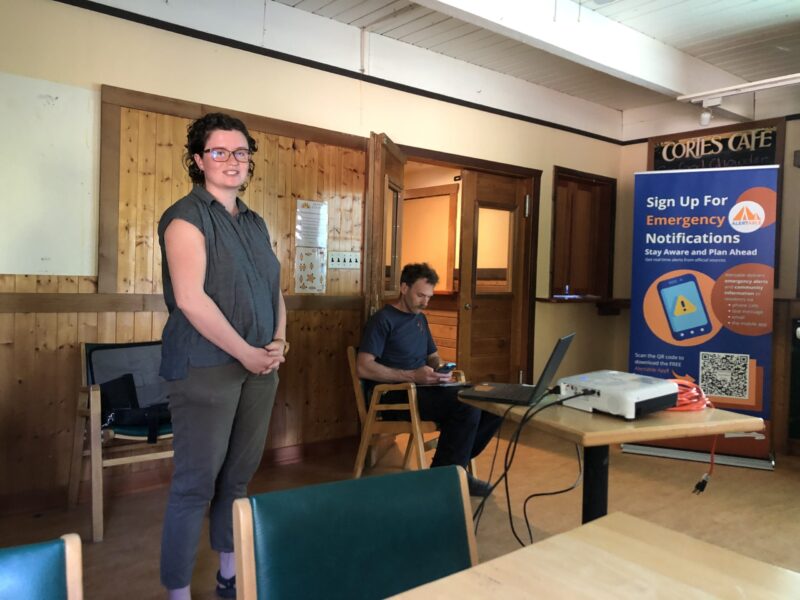
On May 3rd, Sarah Rosen from the Strathcona Regional District came to the Pioneer Room at Mansons Hall to talk about emergency preparedness… and there were about eight people in the room. As Sarah herself said, the biggest emergency preparedness risk on the island might just be that so few of us are thinking about it.
[I’ll admit that I’ve been procrastinating — not getting around to producing this story — and it might be because the subject is a little uncomfortable when you know that you yourself are not prepared. But avoidance and procrastination are exactly the problems that Sarah came to address, and she says being prepared might not be as daunting as you think.]
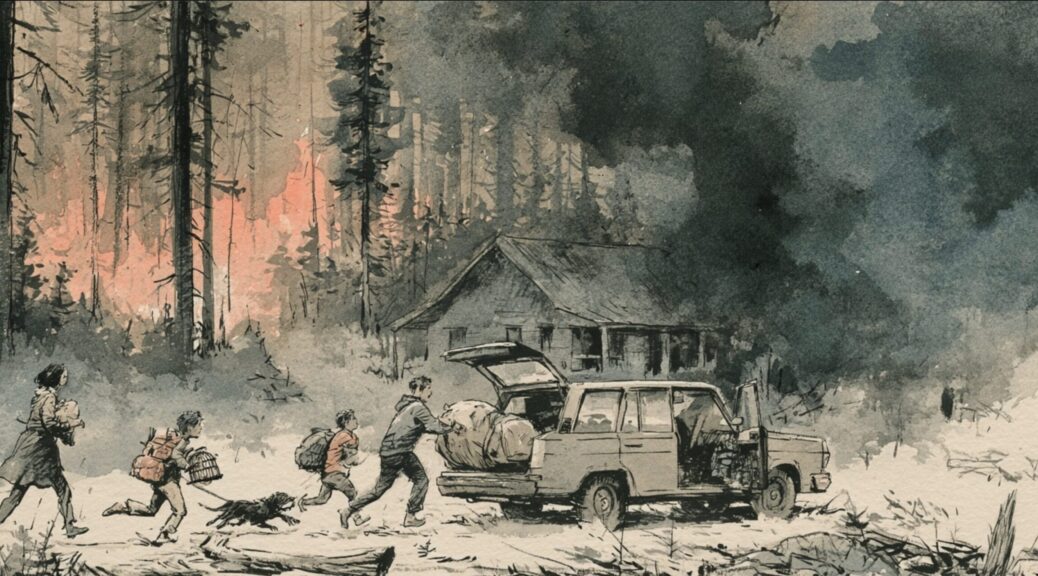
In the first week of my job, I was given an amazing insight by one of my former coworkers, the basis of these three questions: Should I stay? Should I go? How do I know? And what I learned from her is that basically there’s only two types of disaster and emergency in terms of how you actually wanna prepare for them: situations where you need to stay put or shelter in place, and then situations where you need to evacuate (and typically you need to evacuate fast).
Sarah works for the Emergency Services section of the Strathcona Regional District. She travels to communities across the region to offer these workshops, and her job is to make emergency preparedness feel manageable rather than overwhelming. So she structures everything around those three core questions.
My sense is that some people feel so overwhelmed by the scope of all the disasters that can happen that they choose consciously or subconsciously to just not even kind of open their minds up to the preparedness process, and I really understand that.
Like if, if you have this sense of like, you know, a wall of fire bearing down on your home or a catastrophic earthquake, and that’s what’s in your mind when you’re thinking of preparedness, it’s pretty easy to feel powerless in the face of that.
Imaginary Dangers
What should we be worried about?
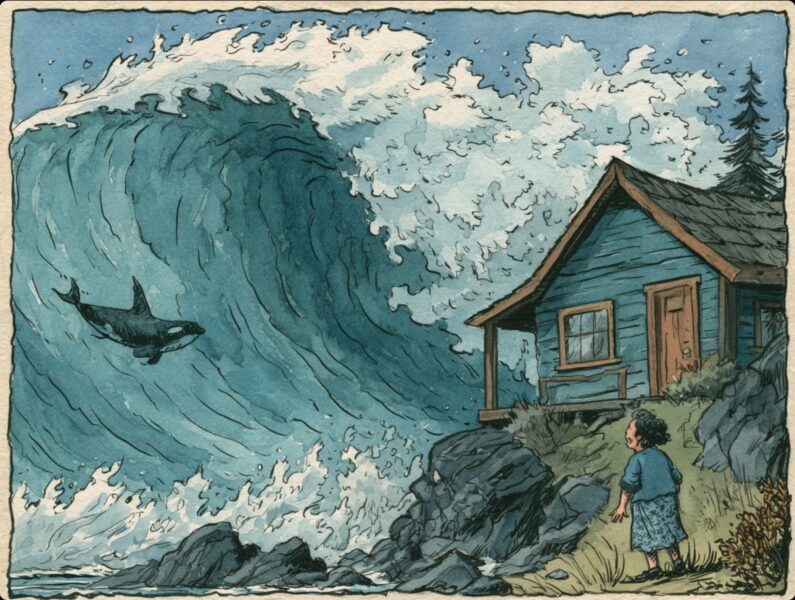
Before getting into the details of how to prepare, Sarah walked the group through the hazards that are actually relevant in our area — and they aren’t quite what most people might expect. Tsunami risk here, on Cortes Island, is very low. We might see some unusual tidal effects that could make it risky to go out in small boats, but we won’t see giant waves crashing into the foreshore. Earthquakes are possible, but they’re quite rare. Landslides are more likely to affect mountain or river valley commubities. Extreme heat is certainly an increasing issue for all of BC, and we should give some thought to it.
But the biggest risk for us on Cortes is wildfire, And that’s a big enough topic that we’re dedicating a follow-up story to wildfire risk on Cortes. So stay tuned for that later this week.
One unexpected risk in our area, which very few people know about, has to do with the hydro dam in Campbell River:
If there’s an earthquake that’s strong enough to knock you off your feet in downtown Campbell River, the dam is going to break and water is going to be released.
And so there’ll be, um… like a meter and a half of water at Shoppers Row an hour and a half after the earthquake. I don’t know if I brought my brochures, but I do have some resources on that. There’s maps,the city of Campbell River has actually mapped out the floodplain in an event like that, and the arrival times for water at certain areas in the town.
So for you guys who probably aren’t over there a lot, just for shopping or for appointments, that kind of thing: if you feel a strong earthquake, you want to go to high ground immediately after the shaking stops and you’ve counted to 60.
And you don’t actually need to go super high up. If anybody knows where the Strathcona Regional District offices are… just up the hill past that, is above the high water line. So that’s important to know. I see some faces that maybe tell me you haven’t heard that before!
Three steps to preparedness
Sarah breaks down preparedness into three steps. The first is know your hazards, which is why she discussed what emergencies are most likely in our area. Then comes build a plan. What are you going to do if there’s an emergency? Then gather the supplies you’ll need for your plan.
Working on the Plan
The planning activity is where things get specific and concrete, and that’s where most of us realize we haven’t actually done any work. We may have worried vaguely about the risks, but we haven’t actually made concrete, specific plans on what we would do if…
The whole point of a plan is basically to be your prefrontal cortex, to be the reasoning part of your brain.
So having something written down so that you can refer to that when you’re feeling panicked is really a must-have.
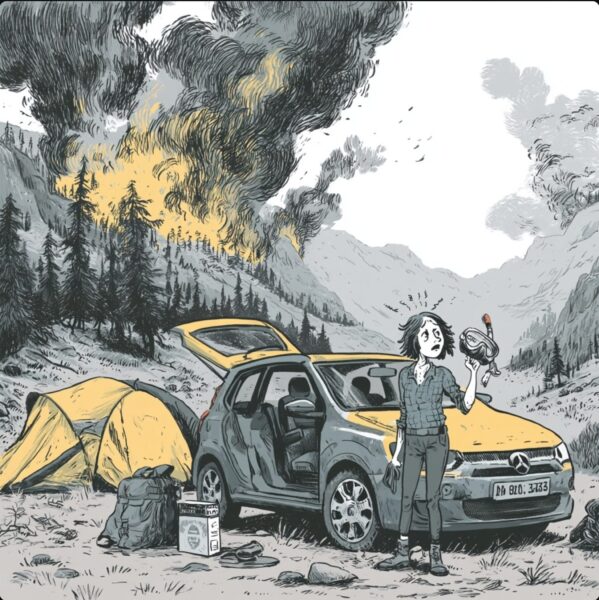
There’s a story that I heard about a woman who was evacuating her family during the Fort McMurray fires in, uh, Alberta, and she was put on evacuation, order and told, you know, you have, I don’t know, maybe ten, fifteen, twenty minutes to leave your house, and running around grabbing all kinds of things and realized later she’d grabbed a snorkel and mask, which, you know, I haven’t heard of being like a really important thing in wildfire.
It’s important to have some contacts, at least one local and preferably a remote contact as well. So if you have someone outside the region, say in Ontario or Manitoba, a family member who will not be affected by our local emergency, they can become your information relay to the rest of your family. If you text them, “I’m okay,” and your brother texts, “Yeah, I’m okay too,” and your auntie in Ontario reports that back to the rest of the family, that keeps the local phone lines clear, and yet your family can still be informed about how you’re doing and whether you’re safe
It is also very important to have with you physical copies of any health information — like your prescriptions — and your BC Services Card. Those are key to getting adequate medical treatment, and getting access to emergency resources.
It’s important to know your exits and your routes of escape, both from your house and from your property, and also from the island. It’s important to plan ahead for who’s going to pick up your kids if they’re in school; how are you going to reunite the family, if the family is scattered around in the middle of the day?
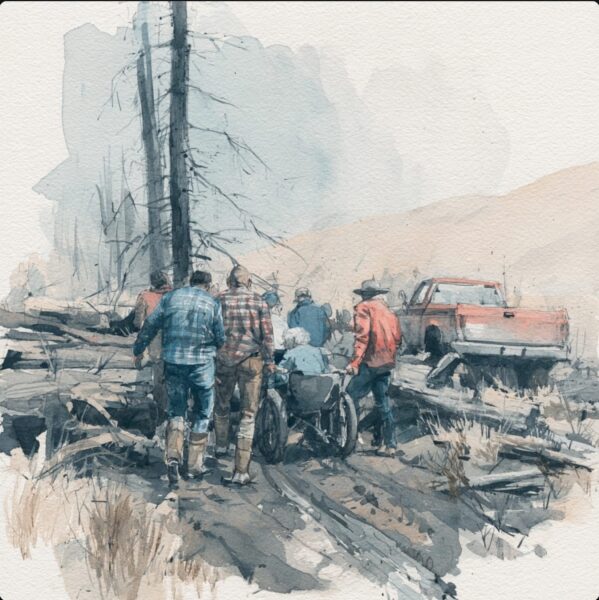
And anyone who has pets needs to do some planning for how you would get your pets safely away with you in a timely fashion, and what supplies they would need. And if there’s anyone with special accessibility needs in your family or in your neighborhood, now’s a good time to think about what you would do to get them moving, in the event of an emergency.
Lending some hands
Preparedness makes all the difference
Sarah emphasizes that the key to peace of mind is planning
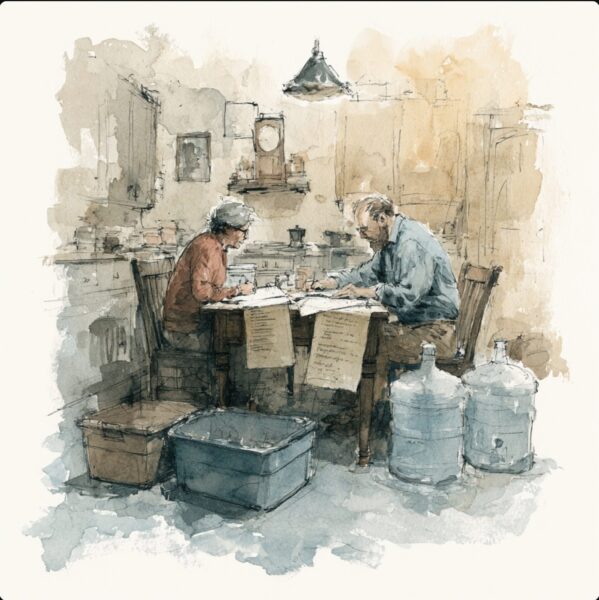
The argument that I’m often making is: emergency preparedness is something where if you really carve out one full weekend, you can do the three main steps to emergency preparedness. And then you check your kits every six months, you update your plan now and then, and it doesn’t need to be something that lives in your head anymore.
You want to be making sure you’re getting information, that you’re tuned into official sources of information and all of that, but it doesn’t need to be something that’s like an ongoing, “Will I? Won’t I? I don’t know, but the fire might come later, so maybe I won’t do it yet.” Like, get ahead of it, get it done, and then revise as more information comes in — that is the approach that I advocate,
And as an example, Sarah cites the fact that power outages are considered a disaster by officials and emergency services people. And in most urban areas, an extended power outage might well be a disaster. But on Cortes Island, a power outage is just another Tuesday — and the difference is how prepared you are.
No Hydro, No Problem
Has anybody ever lived through a power outage? [audience member: That’s not a disaster. That’s an endurance!] [2nd audience member: That’s not a disaster, it’s an opportunity!]
Yeah. The reason I love bringing that up is, technically that is classified as a disaster, but it’s one that we’re all so well prepared for, we don’t have that experience of it being a disaster. And so that’s an example of where the level of preparedness that most of us have — in terms of the gear we have in our houses or the knowledge that we have or the comfort that we have — allows us to get through that in a really comfortable way.
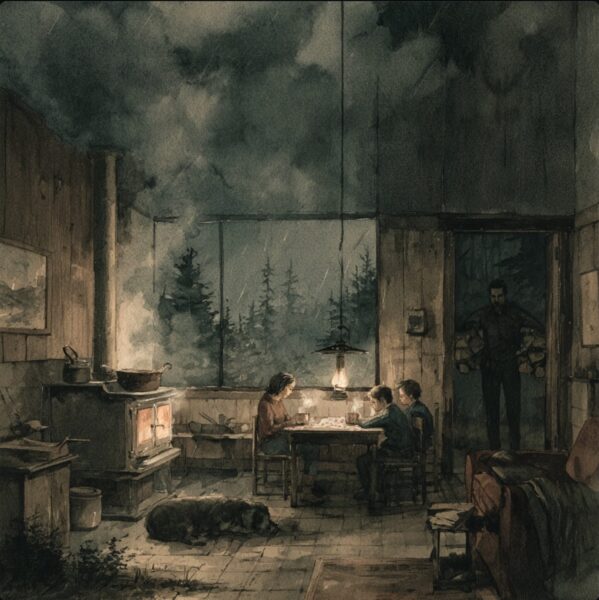
A power outage is not a disaster if you have firewood and a generator and a plan for how to use those things. And Sarah points out that the key to getting through any emergency is to have the supplies and the plan in place. She does emphasise particularly that if you’re planning to shelter in place, you should always have at least a week’s worth of water, at 4 litres of water per person per day.
Filters are nice, Sarah says, but don’t rely on a filter exclusively. Water can get so contaminated that a filter won’t protect you: it’s essential to keep a store of clean, potable water. You should also have
physical copies of important documents because you may not have internet access
cash in small bills because grocery stores even if open may not be able to make change
a battery powered or hand-cranked radio (but if you have a car, your car radio will go on working as long as you can keep the battery topped up)
Sarah says sheltering in place is not necessarily that intimidating:
Basically I think of this like, you know, camping at home. Either you’re camping in your house or you’re camping in your yard. And so whatever camping gear you have, if you’ve ever been camping — you’re probably pretty prepared for a shelter in place emergency, ’cause camping is basically just sheltering in place for fun.
What if you’re ordered to leave?
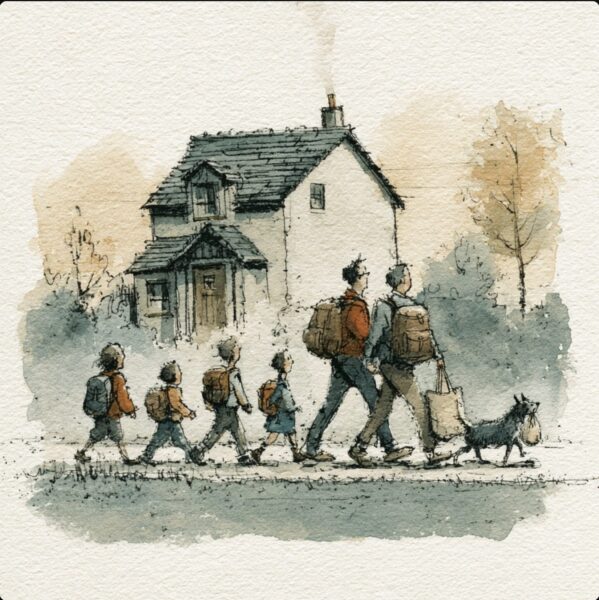
But there’s a big difference between grab and stay, the materials and supplies you need for camping at home, and grab and go, which is what you’ll need if you’re ordered to evacuate. The grab and stay kit is a home emergency kit with about seven days worth of supplies, and it stays put. But the grab and go bag is what you can carry with you if you have to leave in a hurry.
Each person in your household should have their own ”go” bag; and if you can’t carry it, it’s not a go bag. So it has to be light enough that you can quickly and easily take it with you.
A Go Bag For Everyone
Sarah emphasises that the amount of warning you get for evacuation can vary widely:
In an ideal world, you’d go on evacuation alert before evacuation order; but sometimes conditions change such that you’d get an order right away. So you might have to leave, you know, with only ten minutes notice. Not ideal, but possible.
Sarah also mentions that even if you do have to abandon your home, there are a few things you can do to be helpful to emergency responders. For example, you can leave all the lights on so that it’s easier for the firefighters to locate your house in the smoke. You can leave a sign in the window that says, ” We are gone,” so that they know there’s no one in the house who requires rescuing.
Getting accurate and timely information
But how will you know if it’s really time to go? The SRD uses a notification system called Alertable. Unlike the province-wide emergency alerts that hit everybody’s phone automatically, Alertable requires you to sign up. But once you have signed up, you can choose how you want to be reached: with a phone call, a text, an email, or through their app. You can sign up for your specific area or other areas of interest within SRD; so you could be notified if there’s an issue in Campbell River.
The BC Wildfire Service web page or app also will show evacuation zones as color-coded polygons, orange for alert and red for evacuation order. So it’s worth having that app on your phone in the fire season.
Sarah strongly emphasises, don’t be looking at Facebook first for information. SRD doesn’t update their Facebook page nearly as fast as they do Alertable, which is their official service.
It’s really important to have that [Alertable]. I didn’t know that before I started working here either, and I went, “Oh my gosh, wow,!” I think I had it where I lived before, but I was not nearly as aware that this, this is how you know. This is really how you know.
Three quick and easy first steps
Sarah wrapped up her presentation with three steps that she would love people to take that very day.
One, download the home emergency plan from Prepared BC.
Two, sign up for Alertable.
And three, have that conversation with your family about your plan.
That’s a time commitment of maybe an hour for all those three things combined. Building full kits and making detailed plans can come later, but those three steps are a good start.
And in the second segment of this story, we’ll return to the Pioneer Room event and share some very informative conversation about wildfire risk specifically, and what it might mean for Cortes Island — a community that hasn’t seen a major fire since the 1930s.
We think that conversation will be worth your time, and it’ll be coming up in just a couple of days.
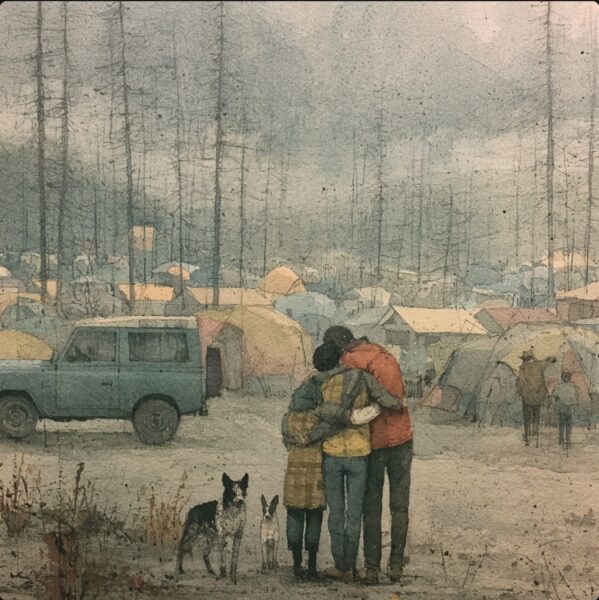
[All images by Midjourney, prompts by author, except photo of Sarah Rosen by Roy Hales. Original recording of the event by Roy Hales, processed for radio by De Clarke. All feature quotes in this text are from Sarah Rosen’s presentation, lightly edited for brevity and sequence. The theme music for De’s Cortes Currents segments is Burnett Thompson playing “It Ain’t Necessarily So” from his album “Uncertain Times.” The nicely formatted PDF transcript of Sarah’s presentation was made with the assistance of Claude, Anthropic’s LLM; but it was proofread and edited by a human.]