


Tamara Dawn has been travelling to India for the past 15 years. On August second she brings her personal interpretation of Tibetan Thangka art to the Old Schoolhouse Art Gallery in a watercolour collection called ‘Buddha as a Principle.’
“I was 18 when I took my first trip to the east, I went to Nepal. I went to India when I was maybe 20. I’ve been back and forth several times, going to India and Nepal, and then coming back to Canada and integrating what I learned,” she began.
Cortes Currents: What’s special about India?
Kathmandu street scene – photo by Inda Agudovia Flickr (CC By SA, 2.0)
Tamarra Dawn: “In my childhood there was a real absence of spiritual teachings. I was raised as a kind of pseudo-Christian. I have been baptized, but there were not really any real teachings involved with it, almost like a surface (Christianity). I was drawn to the East because of the preservation of tradition and the way that they’re alive in day to day life.”
“I think my favorite part is the embracing of the chaos and the embracing of just life being not all clean or pure. Life is full of the whole spectrum and an appreciation of that, the culture of worship and devotion being present. I think that inspired me in my life, and then really came through in my art.”
Cortes Currents: Give me some examples of this.
Tamarra Dawn: “Well, like day to day life, there’ll be people openly honouring their shrines out in the streets, and cleaning the front of their shop and then smudging it with incense and lighting candles and singing with bells and chanting prayers just right out in the open. There’s not really a separation from day to day life.”
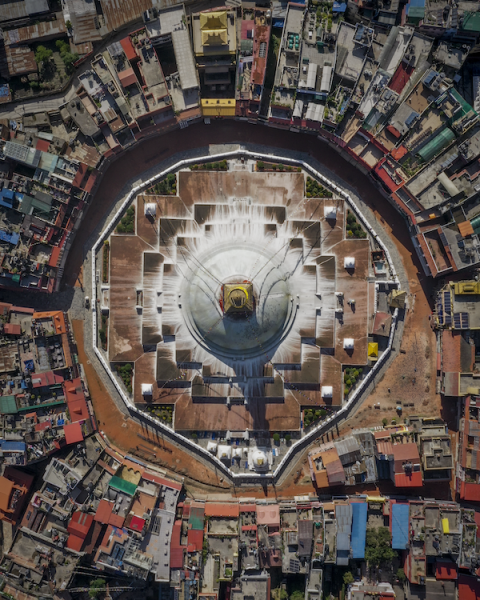
Aerial shot of Boudha Stupa in Kathmandu, Nepal – photo by Sumir Shrestha (own work) via wikimedia (CC BY-SA 4.0)
“Before I was in North India, I was in Nepal and I was studying Buddhism in Kathmandu and living right in what’s called Boudha, which is like the Buddhist temple of Kathmandu. The center of the town area, township zone, is a huge temple stupa, which has relics of the Buddha inside of it. It’s a huge, circular temple, where outside of it there’s prayer wheels all around the temple. All day there’s people circumambulating and chanting and praying. Then outside of that is just cafes, restaurants and shops, like it’s all integrated into life. Which I guess is related to what I’m trying to express, in my paintings, the way that religion or spiritual practice is embedded in the fluidity of life. They’re not separate.”
Cortes Currents: How do you express your faith in your life, other than painting?
Tamarra Dawn: “I’ve done my best to center my life around my faith, creating a lifestyle that has a lot of spaciousness in it so that I can have my practice in the morning. I have quite a dedicated virtual practice of meditation and yoga and prayer and chanting. I’ve centered my career around it as well. I’m a Ayurvedic therapist in bodywork.”
“Ayurveda is the sister science of yoga. It’s like traditional Chinese medicine, but in India.”
“I’ve centered my career and work life around integrating this way of embodying spiritual teaching. My bodywork is a lot more than that. I don’t like the term ‘bodywork’ actually, but we say that.”
Cortes Currents: What term, rather than bodywork, would you like to use?
Tamara Dawn: “I like to say ceremonial massage. I think the physical body of human beings and all beings is the expression and manifestation of all. We can connect to that through honouring the physical body and the spirit, the Tao within that expression that the body is a temple. That’s how I walk through the world as best as I can. Obviously, it’s a continuous culturing of one’s energy. That’s how I center my life around it.”
Cortes Currents: Where do you practice your ceremonial massages?
Tamarra Dawn: “Well I’ve moved around a lot, so I just got back to the Cowichan Valley, and I’ve been working, serving at a yoga studio. I often work in a treatment room that’s connected with a yoga studio. That feels like the right fit for me and my longer term vision is to build a little temple on the land. I’m really into these earthen buildings, so I’d like to build a little cob healing temple.”
Cortes Currents: Tell me about your artwork, how long have you been doing it?
Tamara Dawn: “I’ve been painting since I was a little child, and probably it was the first way I started to express myself but my style has developed quite a bit in the last five years. I started really focusing on painting deities.”
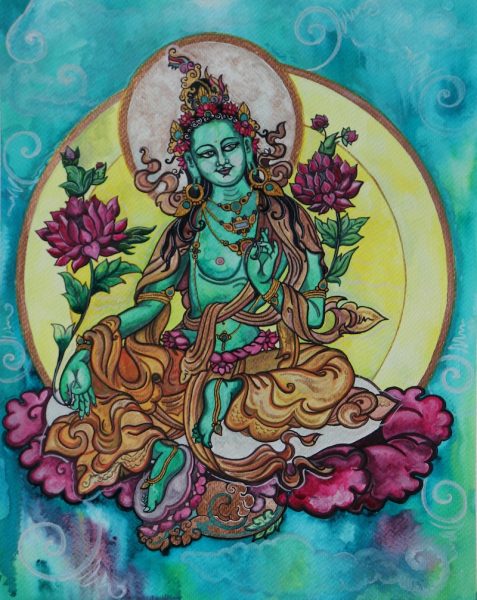
“It started in the Vedic tradition of India, and I did a collection of 16 of their primary pantheon of deities. Then most recently, what inspired this show is that I was spending some time in North India in Dharamshala, and I had the opportunity to study what’s called traditional Thangka painting with a Tibetan master in the mountains. He taught me how to depict the Buddhas and Bodhisattvas in a particular grid format so that the proportions are all correct. So I just studied with him for a little while to get the drawing in place.”
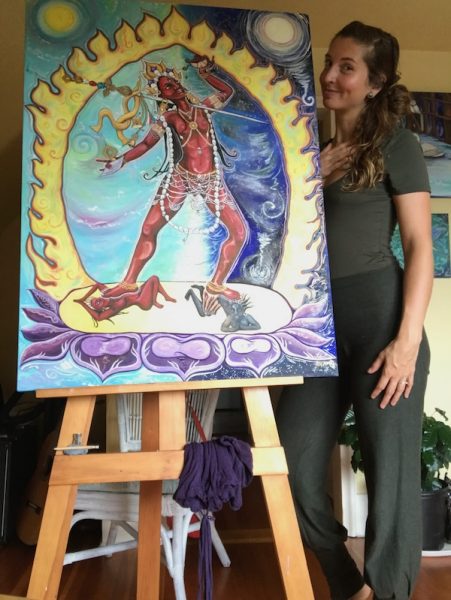
“Then I had this desire to express my feelings around Buddhist practice and Dharma. The way that the masculine energy of precision and rules and structure and the way that patriarchy influenced the religion, how that comes through in the art. I wanted to kind of express the feminine part of the tradition in art while respecting the rules. I did all the proportions and the technical side, according to the standard to the best of my ability. A Thangka master would paint for 20 years before they were doing a professional job, there’s so much precision and training. I tried to embody that and express that while letting the feminine fluidity of my essence and what I feel is underrepresented in the art come through, so more like the energy.”
“I started with just one painting and then I just really liked doing it. So it just evolved until I had this collection of 12 and thought that it would be nice to share them.”
Cortes Currents: Tell us more about the paintings you have in the show
Tamara Dawn: “There’s a series of 12, although I am also including a few other pieces that are not totally in the series.”
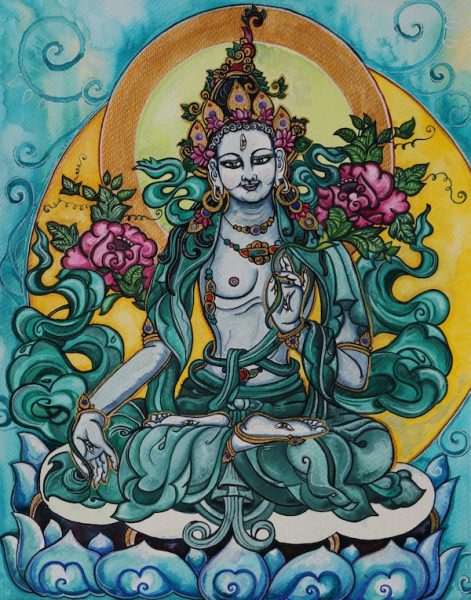
“The 12 are these watercolour paintings that are Thangka inspired. A Thangka is a painting that is used for meditation and visualization. A huge part of Tibetan Buddhism is visualizing the deity either on the top of your head, or in front of you, and giving you a transmission and then eventually you visualize yourself as that deity.”
“I followed the traditional style of the proportions and the details of the actual figures.”
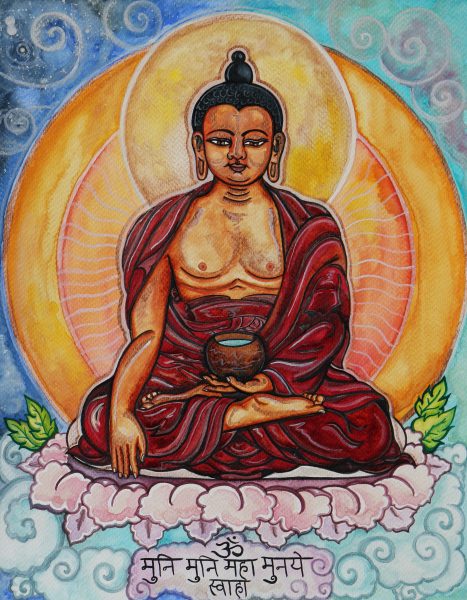
“There’s many different Buddhas in the Tibetan tradition. It’s not just the living Buddha of Shakyamuni and then there’s all female interpretations or expressions of the Buddha too.”
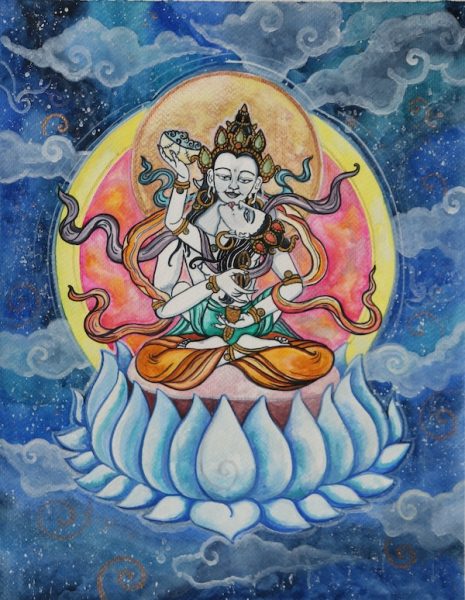
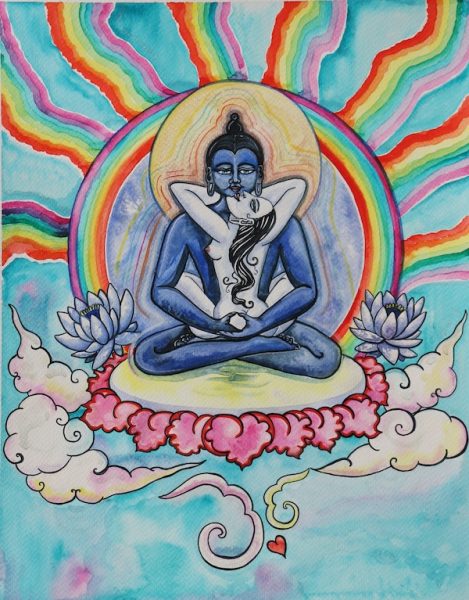
“So I did Tara’s and I did a Buddha with his concert, or Buddha with her concert in Yab-yum called, which is them together in their ecstatic union. So I’ve chosen 12 that I feel a connection with. I brought them through with watercolour, which is what I feel makes it really quite interesting. Traditional Thangkas are done with a paint made out of mineral and it’s quite a thick, opaque texture, which to me has this sort of certain energy to it of just flatness, actually.”
“They’re really exquisite and incredibly detailed, but there’s a bit of a flatness to them and the watercolour is the opposite of that. It’s all layer and depth and fluidity and playfulness and just letting the energy of life move through the paint and take the shape. So I’ve done this contrast of having the background of the central figure be this watercolour ambient, rich, dynamic, fluid, to me feminine, like more abstract and then the central figure, in my opinion, because of that actually stands out more and has more of an impression.”
“There’s a feeling of the teaching behind that, of how these polarized energies actually compliment each other so well when they are both honoured, where if one is overly emphasized, the other is missed out and then the beauty of that energy is actually lost in some way.”
“It’s like an outline brings forth what’s inside of it and they both work together. I’m playing with that a lot. I chose to work with watercolour even for all the detail work, which is kind of a unique approach to watercolour. It’s like bringing the watery feminine into the detailed focused expression. That was a really big journey for me because I’m not really that great with detail. I like to really learn some discipline to do these paintings and the steadiness of my hand.”
Cortes Currents: What’s your connection to Cortes?
Tamara Dawn: “I came to Cortes for the winter, hoping to live there. My partner and I were curious about whether Cortes would absorb us or not. We’d heard different legends about Cortes, whether you fit and it all works or Cortes bites you and chews you up and spiritually purges you out. I thought of that and I was just curious to see what would happen.
“It ended up being a very short journey, but I met Kristen Schofield-Sweet in the Co-op Cafe and was overhearing them talking about painting. She told me about the gallery and how residents can apply and I was a resident at the time, so I applied.”
Cortes Currents: Where were you living and how long were you here for?
Tamara Dawn: “I was living in the south end, renting a little tiny home really close to the beach. I was going to work at Hollyhock. I fell in love with Cortes. It was such a beautiful place and I finished quite a few paintings there because I wasn’t working very much.”
“I was really inspired by just going down to the beach. In the winter, it’s pretty quiet on the beach and I was just singing, connecting to the beauty and then bringing that energy into my paintings. It felt very sweet.”
Cortes Currents: Will you be here for the opening of the exhibit?
Tamara Dawn: “Yes, I’m so excited to come back to Cortes in the summer too, when we can swim. I’m going to be sitting in the gallery the whole time it’s open. I’m also a bit of a musician, so I’m going to share some music and chants associated with the paintings on the opening night.”
“I’m really looking forward to getting to share and dialogue with people about the paintings. They’re super conceptual and there’s a lot of meaning behind them, so there is a little bit of a write up that goes with each one in case you are interested in learning something from the content. There’s so much to just kind of nerd out about if you’re interested in talking about what the meaning is and how that’s applied in practice.”
“I created them for learning and sharing the Dharma because I am a Buddhist practitioner and I learn through the visual. Getting to see my interpretation of that image helps me understand more what I really grok about the teachings.”
Cortes Currents: You read Ray Bradbury.
Tamara Dawn: “A Stranger In A Strange Land.”
Cortes Currents: “Yes, that was it. It’s the Martian who came to earth and he grokked everything, that was the term he was using.”
Tamara Dawn: “I love that term.”
Cortes Currents: How long will you be here on Cortes?
Tamara Dawn: “I’m going to come on July 30th, I think, and stay until August 12th.”
“Lama Tsultrim Allione, who’s a really beautiful embodiment of the feminine as a leader in sharing teachings of Buddhism, she’s actually coming to Hollyhock the same weekend that I’m doing the show. If she hears this, I’d love to invite her to the show and it would be amazing to meet her and share this work and see what someone who’s really deeply versed in the tradition would say about it.
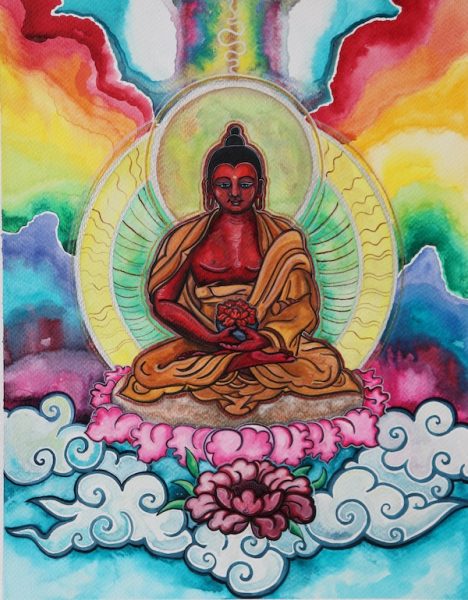
I’ve shown the paintings to the teacher who taught me how to paint Tangka and he approved. Whenever I’m doing something that is a part of a tradition, and I’m doing it in a different way, I’m always very intrigued and interested in feedback from the tradition itself.
Links of Interest:
- Thangka, An Introduction to Tibetan Art – ENLIGHTENMENT
- Articles about the Old Schoolhouse Art Gallery on Cortes Currents
- Old Schoolhouse Art Gallery website
All of the photos of paintings above were submitted by Tamara Dawn
Sign-up for Cortes Currents email-out:
To receive an emailed catalogue of articles on Cortes Currents, send a (blank) email to subscribe to your desired frequency:
- Daily, (articles posted during the last 24 hours) – [email protected]
- Weekly Digest cortescurrents – [email protected]