


There’s a lot happening at Wild Cortes this summer.
“Come to Wild Cortes because it’s the coolest place on the island, literally and figuratively. Literally because we’re in the basement and it’s always cool here,” said co-curator Donna Collins.
At 2 PM on Wednesday July 24, they are holding a bug hunt at Wild Cortes.
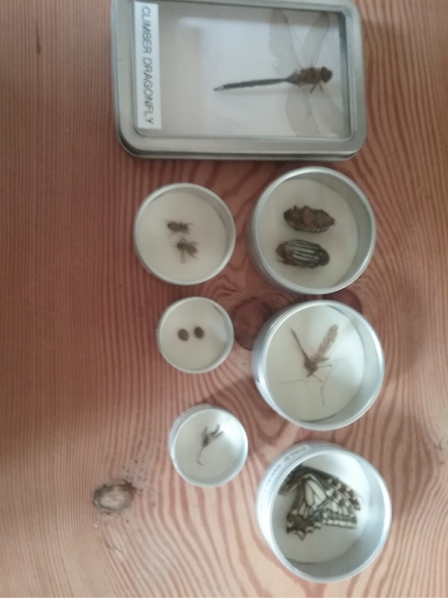


Donna Collins: “We’ve got an open invitation to everybody on the island to come. They’re going to find different bugs and bring them in. We ask everyone to collect one insect. The idea is to not collect the things that you already know, but things that you maybe haven’t seen. Bring them in, we’ll look at them through the stereoscopes and try and identify them.”
There will be a taxidermy display at an as yet to be determined time on Saturday July 27.
Taxidermist and co-curator Laurel Bohart explained, “I’m working on a specimen right now. It’s a small gull called a Bonaparte’s gull. Gulls are rather difficult to work with, but interesting and Bonaparte’s gulls aren’t found dead very frequently. This one comes from Manson’s Lagoon and was brought in, I think, during 2012. The bird appears to me to have died of avian flu. I can’t be certain, but by the discharge I noticed, and also the thinness of the body, I believe it was ill. It’s an adult.”

“Bonaparte’s gulls are the smallest gull on the coast. They’re often seen around the Campbell River area when the tide is changing, small, fast skipping over the waves and picking up insects and other little things.”
“I’m planning to place it in with the other gulls in the ocean scene. It’ll probably go between the kitty wakes and the mule gull. It’ll be fastened and it’ll be in the same position as the others with the tops of the wings showing, so it’s easy identification. Each of these birds helps people identify wild birds that they can see, which is one of the reasons for having so many.”
Kristen Schofield-Sweet will lead a session on drawing wild critters at 12;30 on Sunday, August 4.
Donna Collins: “We’ve invited however many we can fit in here, guests that want to draw any of the animals that we have on display Kristen is going to be giving us a little primer on how to look at things. It changes the way you draw them. She’ll speak for about, oh, 30 to 45 minutes and then they’ll spread out and see what they can come up with. We can spread over to the Eco lab by bringing individual mounts out there. If someone wants to draw in particular the raptors in particular because they’re usually on a single freestanding mount. We can bring those out so that people have lots of room.”
At 12:00 on Wednesday August 14, Ayamia Strike will offer a demonstration on crafting with nature.
Donna Collins: “We’re going to try and do a mini version of transferring using natural materials onto fabric so that we can dye with the natural material. Ayami Strike does this on a regular basis. Her work is in the shop at the Cortes Island Museum and it’s absolutely stunning. We’ll have to do small projects and things that will be done fairly quickly because if we do pieces as big as what Ayami does, then we’re looking at hours and hours and hours. We’re going to try and telescope that in and see if we can’t come up with things that perhaps are maybe eight, 10 inches long and have dyes from the leaves and flowers or whatever that people want to bring in or collect outside of Linnaea.”

Laurel will give a taxidermy demonstration, using study skins, at 1 PM on Friday August 24.
Laurel Bohart: “Study skins aren’t mounts. Those are the science end of taxidermy. It’s what people in museums do. Curators will be preparing study skins for mammals, birds, even reptiles. They’re weighed and they’re measured, location and date, and cause of death, if we can possibly figure it out. Most of mounts at Wild Cortes have that information on tags, which are put away in a different location, because you can’t just hang them off a bird. There’s a display right over there of what study skins are and you can go over there and take a photograph if you wish and that shows the difference. Birds are usually done with their legs crossed and tag attached. They’re prepared a lot of the same way a mount is but without the artificial body, the wire and no artificial eyes – just cotton.”
Wild Cortes will be holding a special Taxidermy showcase at 6:00 on Saturday September 14.
Donna Collins: “That’s from six till eight on Saturday. We’re going to rent one of the rooms in Linnea, and we’ll have all the mounts and displays up in that room.”
Laurel Bohart: “That will be the gull I’m working on right now and There’s a bunch of my older mounts that Donna would like to see displayed.”
Donna Collins: “You’re going to see animals that are not necessarily from Cortes Island and see different ways that she’s mounted things, some a little bit more elaborate, Laurel is going to do a talk beforehand explaining, where some of the mounts are coming from because she has a lot of African mounts and things that are not mounted for this tiny space. I’m thinking about the paddles that have the Canada geese on it, just as an example.”
“Laurel will speak about the different animals that she has and also, that will be in preparation for next year. We’re going to do a silent auction, and Laurel’s mounts will be part of that.”
“We’re going to do a display in the atrium and that should be completely up by the time she does the showcase.”

These events are in addition to the current exhibits, which are on display five days a week through the summer.
Donna Collins: We have a new display as of the 22nd of April, which is Earth Day. We always change what we call the partner’s wall on that day. This year, the Children’s Forest took over the partner’s wall, and they are celebrating the fact that they will be soon getting actual prices for two of the blocks that they want to purchase in order preserve those plots of land. We have a display encouraging playing in the forest. We have animals here that are puppets. They were made by the children, with Meinsje’s help. They can take these out and play with them. They explain the importance of this area, it’s very biodiverse. It also links very closely into the mother tree and in order to do another push to get some funding, they have a silent auction with items here on display that they hope to raise some more funds. They have some paintings done by some of the children who go into the forest. They are for sale for $20, and they’re displayed in this exhibit.”
“I would imagine that the board members are getting very excited about finally being able to purchase those two plots of land. It’s taken since 2013 to get these prices. There’s three more blocks that they have to negotiate.”

The island’s natural history centre is in the basement of the Linnaea Education Building and will remain open from noon to 4, Tuesday to Saturday, throughout the summer. In the fall Cortes Wild will switch to winter hours, which are noon to 4 on Fridays and Saturdays.
Links of Interest
- Wild Cortes page at the Cortes Island Museum
- Articles about, or mentioning Wild Cortes on Cortes Currents
- Cortes Island Museum Facebook page
Top image credit: Bonaparte’s Gull flying just over the surface of the water – Photo courtesy Shutterstock; undesignated photos taken by Roy L Hales
Sign-up for Cortes Currents email-out:
To receive an emailed catalogue of articles on Cortes Currents, send a (blank) email to subscribe to your desired frequency:
- Daily, (articles posted during the last 24 hours) – [email protected]
- Weekly Digest cortescurrents – [email protected]