


Once or twice a year, visitors are given an opportunity to ‘gumboot’ into the natural and human history of Mansons Lagoon. This is a joint event put on by the Cortes Island Museum and Friends of Cortes Island (FOCI). Jane Newman provides the glimpse into the lagoon’s past. In the following article, Cortes Currents supplemented her account with materials from the Museum and additional genealogical records found on the web.
Jane’s account started with a description of Mansons Spit during the precolonial era.
Jane Newman: “The Spit is known in Ayajuthem (Éy7á7juuthem) language as ‘Clytosin.’ I may not be pronouncing it correctly and I apologize for that, but my understanding of the word is that it means water on both sides. That whole area was inhabited by First Nations for thousands of years.”
“The smallpox epidemic in 1862 wiped out the Tla’amin, Homalco, and Klahoose population, and not just on Cortes, but in the whole region. Of course, there were still people that survived.”
“They spent a lot of time clamming and living in the lagoon area at different times of the year.”
“The area that’s on the ocean side all along the sandy beach before you actually get to the spit, where there’s little cliff faces, that’s midden. Midden is basically the piles of shells, tools and anything that indicated the human habitation. It’s deep there because it was a very rich area for First Nations to find their food. Along that same area where the middens are, there was a trench or lookout area, likely to protect them from marauders. There was also a lookout back in the depth of the lagoon. So, it was a very valuable area for First Nations.”
Cortes Currents: Who were the first Europeans to arrive?
See Also:
Jane Newman: “Mike Manson came from the Shetlands, Scotland to farm sheep. That was in the early 1880s. They were at Manson’s landing and built a small sawmill beside the lagoon and built a lodge.”
“Mike’s brother, John, came and also lived and worked at the Manson Lagoon area. It was a main trading post and it drew a lot of people.”
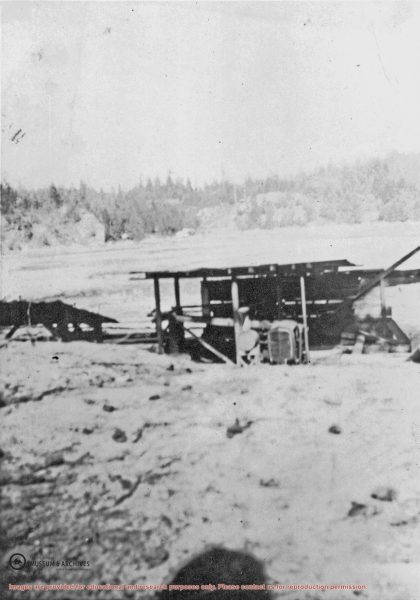
“There were three sawmills there and the first was very likely Mike Manson’s. He needed it to build the trading post, and two houses. The other mill was closer to the creek, from Hague Lake, and it was originally worked by Elmer Ellingson. I think remnants of its log walls are now disintegrating and hidden by the trees, but they may be able to be found as you walk around the lagoon. Logs were harvested around Gunflint and Hague Lakes and floated across the lakes, down the creek, and right into the back corner of the lagoon.
Cortes Currents: Were there many floathouses there?
Jane Newman: “In the 50s, there were about 50 people, mostly logging families, living on float houses in the lagoon and a few were pulled up on shore at that time. People would still be able to see the Ellingson floathouse. It’s on Hague Lake now, a white building with a red roof.”

Cortes Currents: Are there any buildings that have survived from the Manson era?
Jane Newman: “Yes, there were floathouses in the lagoon. Quite a few of them had been moved to different places. There was what became a store, where they sold gas, groceries and all sorts of things. The store was at the lagoon area until the area became the provincial park in 1974. It operated for another year before it closed, The building was there until around 1995, then provincial parks sold it to Cortes Island Museum and Archives for one dollar. That was just conditional upon them moving it up the hill to where the museum stands today.”
Henry Hague would later state there were five families living at Mansons Lagoon when he arrived in 1895, but three of them eventually left.
British Columbia was in the midst of a Fraser River Gold Rush in the fall of 1859, when Henry was born in Victoria. This was the era prior to the founding of Vancouver, when all roads led to the as yet unpaved streets of Victoria. Henry would later state that the streets were muddy when it rained, and dusty when it did not, but they were thronged with ‘traders, miners, prospectors the uniforms of officers, midshipmen, marines and sailors manning the warships at Esquimalt.” The Hagues were living in a tent when Henry was born. His father, an English immigrant named James Hague, disappeared sometime prior to the 1881 census, when his mother Elizabeth was listed a widow living on Yates Street. Her sons William, a labourer, and Henry, a store clerk, were living with her.

Henry married an American immigrant named Lydia Heay the following year. That was what ultimately led to Hague’s to Cortes Island. They were following Lydia’s mother, Eleanor Heay, and her son Horace.
Eleanor Davis was born in Ohio during April 1847. When she was a teenager, Eleanor married James Heay, a farmer from who was about 18 years her senior. A stream of written records testify to their 6 children born in Nebraska.
The 1881 census lists James and Eleanor Heay, with 8 children, living on a farm in Victoria. Eleanor later buried her husband and one of her daughters in Ross Bay Cemetery. The farm was probably no longer their primary means of support by 1890, when Henderson’s City Directory lists Alex, Horace and Walter Heay as boilermakers living with their mother, the widow Eleanor Heay, on 113 Chatham Street.
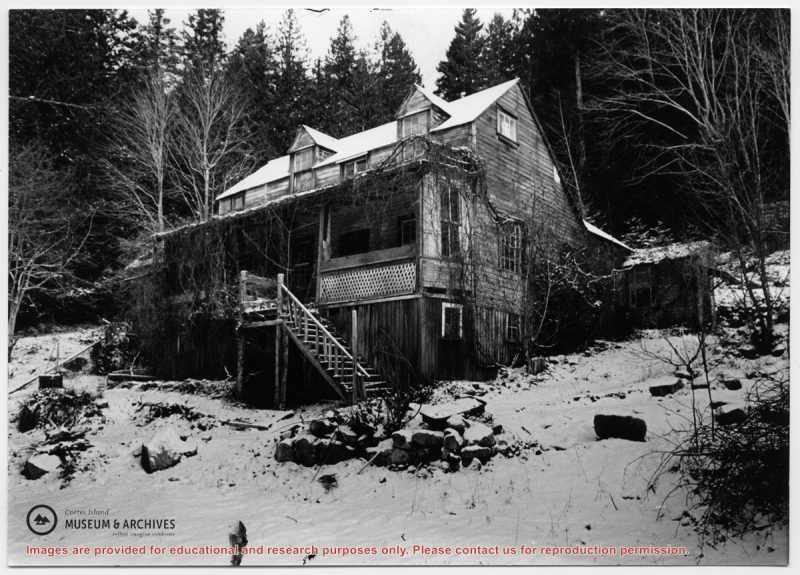
Horace is believed to have arrived on Cortes prior to 1895, when he registered a parcel of land at the mouth of Mansons Lagoon. He built a house there. His mother Eleanor moved in with him. So did did Lydia Hague and her daughters, until Henry Hague built a house for his family.
Horace was an engineer who sometimes worked on Mike Mansons boat and was also called upon to repair the neighbourhood machinery. He married Cora Smith from Read Island in 1897.
Eleanor Heay was living with her son Alex when the next census was taken.
A number of Eleanor Heay’s other children (Alex, Walter, James, and Frank) came to Cortes.
In September 1895, Cortes Island’s first schoolhouse opened in Alex Heay’s log cabin on Gunflint Lake. They didn’t have the 10 students necessary to qualify as a ‘rural assisted school’ so the Mansons persuaded some friends in Knights Inlet to board their children on Cortes. John Manson rowed 160 kilometres to pick them up. Miss B. A. Ward was hired as a teacher, at $50 a month, and lodged with the Hagues.

- Eleanor Heay
- her daughter Lydia, who married Henry Hague
- their daughter Mabel, who married Delmark Lowe
- their daughter Francis Lowe.
Henry Hague did not immediately settle down. He left Cortes to work for a wholesale grocer in Vancouver, then moved on to another job in Victoria.
Hague was back on Cortes when Lydia went into business with their son-in-law Delmar.
Jane Newman: “Around 1897, Lydia Hague, known to everybody as Granny Hague, opened a co-op clam cannery which she ran with Delmar Lowe. Her daughters, along with many people, dug clams inside and outside the lagoon, and packed them into cans, that were made onsite. They were processed and then shipped to the Hudson’s Bay Company. It just wasn’t sufficiently profitable, though, and they closed by 1904.”
Henry Hague: “I was not long on the island when three families moved off, leaving John Manson and family besides my own, on the South West end, a matter of eight miles by four. As there were not sufficient children to keep the school open, it had to close, and the Post Office also for a time.”
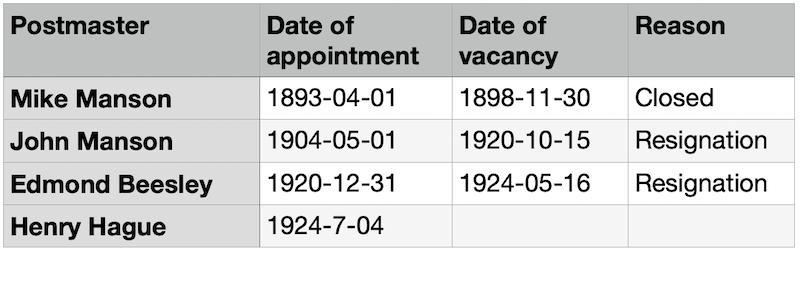
Mansons Post Office closed down on November 30, 1898 and did not reopen until 1904, when John Manson became Postmaster.
In 1899, Hague preempted a property which stretched from the east side of the lagoon to what is now called Hague Lake. .
His in-laws, the Heays, gradually left Cortes. Alex abandoned his property in 1906. Horace moved first to Whaletown and then Vancouver. The Hawkins family are said to have taken over his property beside the lagoon. Eleanor and her sons Frank and Walter were living in Vancouver when the 1911 census was taken.
Henry Hague wrote, “There was no road to my place for about eight years, only deer trails. There were some good deer trails that were interesting to me. Deer and blue grouse were everywhere, trout, wild geese and mallard ducks at the lake, while in and around the lagoon were racoon, ducks and salmon.”
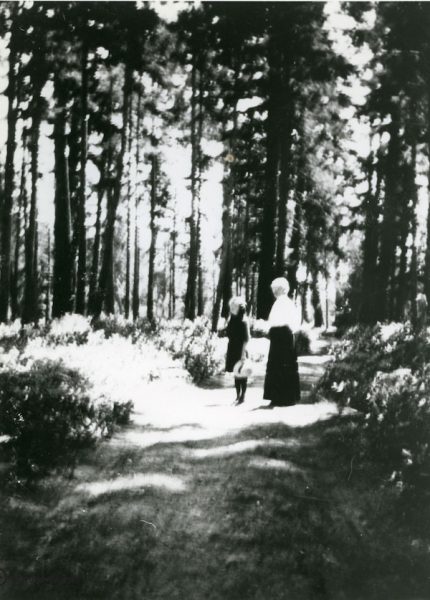
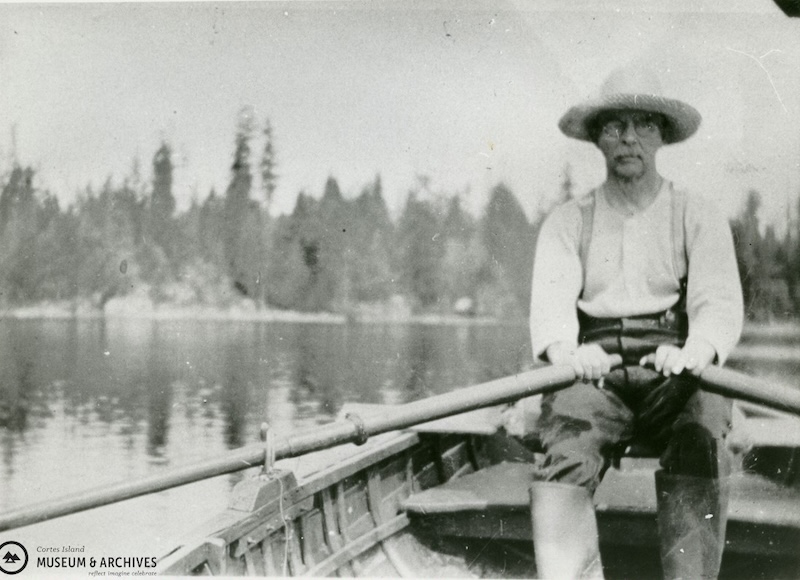
One of the photos in the museum depicts Granny Hague and her granddaughter, Mabel Lowe walking along a new road connecting Mansons Lagoon to the lake around the time of the First World War. Prior to that it had been a deer trail. There are also numerous photos of Henry Hague, including one depicting him rowing on the lake.
He became Manson’s Postmaster in 1924 and held that position for many years.
See Also:
Cortes Currents: Do you have any stories about the Union Steamships that came to Mansons Landing between 1899 and 1956?
Jane Newman: “Boat days were really special for all islanders, but especially for kids because they could go get comics, candy, and even ice cream sometimes. The steamship carried livestock. It carried all the groceries, mail, even cars sometimes. It was a fun weekly event to go down to the Manson’s dock when the steamships were coming in.”
“One time Bert Summers was on the boat getting his comics, and didn’t hear the whistle saying, ‘we’re leaving.’ The boat took off with Bert onboard. They were already out by Marina Island when Bert went up to the captain and said, ‘Hi, I’m Bert. I live there.’ That steamship had to turn around and bring Bert back. It took a long time to get that thing to turn around. They’re pretty large.”

Bert’s parents (Jack and Evelyn Summers) and maternal grandparents (‘Rosie’ and Ella Lowes) were partners in the lodge, store and fuel dock at Mansons Landing.
Frederick Hawkins would have known Bertie and his family. He believed to have obtained possession of Horace Heay’s property at the mouth of the lagoon about 1908, though the Vancouver City Directory still listed him as a clerk residing on Georgia Street. When the 1911 census came out he and his first wife, Sabina, were farmers on Cortes Island. Frederick outlived two wives and was in his third marriage when he passed away in 1952 at the age of 86. (His property passed through a couple of subsequent owners prior to Ian Disney, who now lives there.)
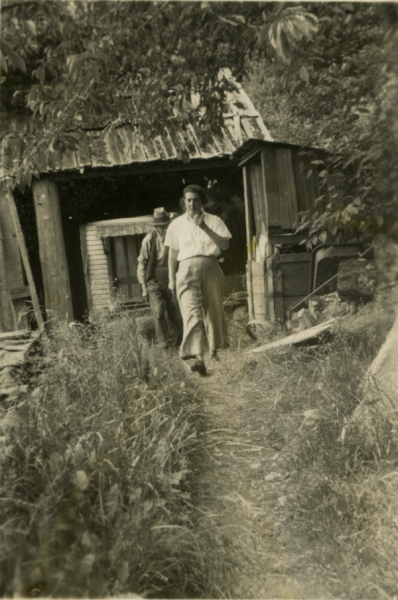
Jane Newman: “When the Hawkins family owned the big farmhouse across the entrance to the lagoon, they had hundreds of chickens and supplied eggs to hotels in Vancouver via the weekly steamships.”
“The Hawkins family needed to be hooked up to the telegraph at Mansons store, so they strung a wire across the lagoon. Float planes were also stopping at Mansons regularly. One day, it must have been a boat day because there were a whole bunch of people at the dock, a float plane came in. When the pilot got out, everybody cheered. He was like, ‘wow, what have I done to deserve this welcoming.’ Sure enough, he had come within a fraction of hitting that telegraph line. He’d flown right under it – without seeing the wire! From that day forward they marked the line, but this guy was a kind of a hero that boat day
Cortes Currents: What’s the story behind Cat and Kitten Islands?
Jane Newman: “There’s two islands that are just beyond the spit and they’re commonly known as Cat and Kitten Islands. The reason for that is all the chicks were born in the spring, and the barn cats were taken to the islands so they couldn’t eat the chicks. Hawkins would go back every few days and feed them. Someone who had worked on that farm said there was always one barn cat that swam back. So that barn cat had to become a house cat during that time period. It couldn’t go outside because it would just kill all the chicks.”
See Also:
These are some of the historical snippets that participants hear when they ‘gumboot’ Mansons Lagoon. It was Jane’s idea to splice in additional historical material. A local marine biologist named Deb Cowper brings a wealth of observations and some hands on experiences with low tide marine life to these events. The next Gunbooting the lagoon will start at 10 AM on August 31, when local history guide Melanie Boyle and Deb Cowper will be leading guests
Links of Interest
- The Cortes Island Museum website
- Browse the Cortes Island Museum’s Online Collections
- Cortes Currents articles about, or mentioning, First Nations history
- Cortes Currents about, or mentioning, Cortes Island history
Top image credit: Mabel and Frances Lowe in Granny Hague’s chicken yard (1917) – courtesy Cortes Island Museum
Sign-up for Cortes Currents email-out:
To receive an emailed catalogue of articles on Cortes Currents, send a (blank) email to subscribe to your desired frequency:
- Daily, (articles posted during the last 24 hours) – [email protected]
- Weekly Digest cortescurrents – [email protected]