


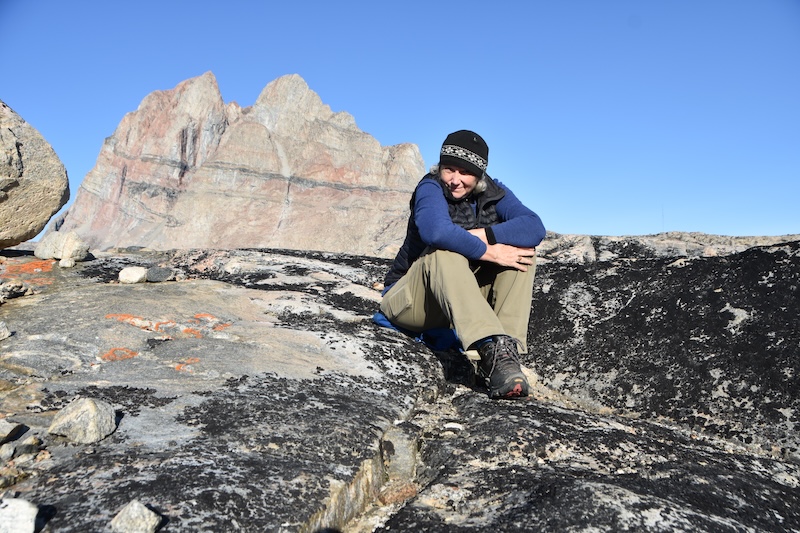
Iris Steigemann was an artist before she came to Cortes island in 1980, but for the last five or six years her work has taken on a new focus.
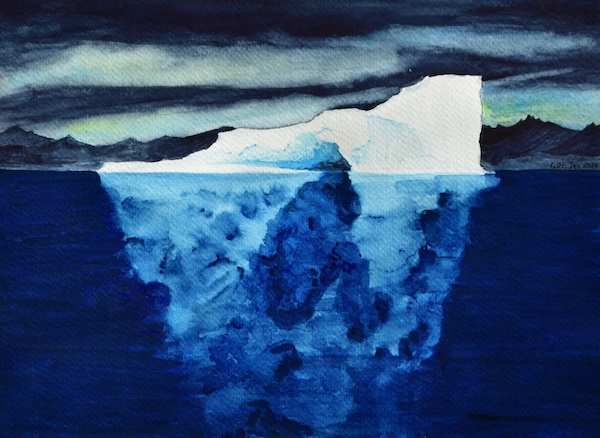
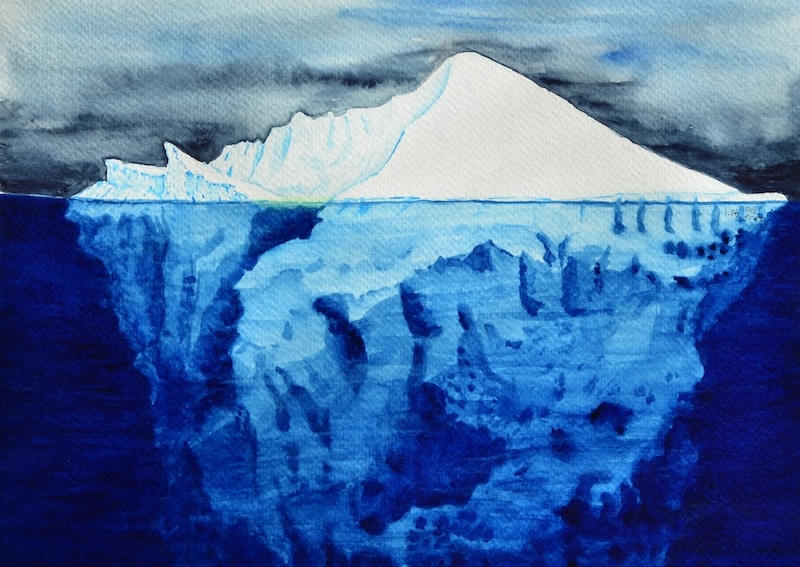
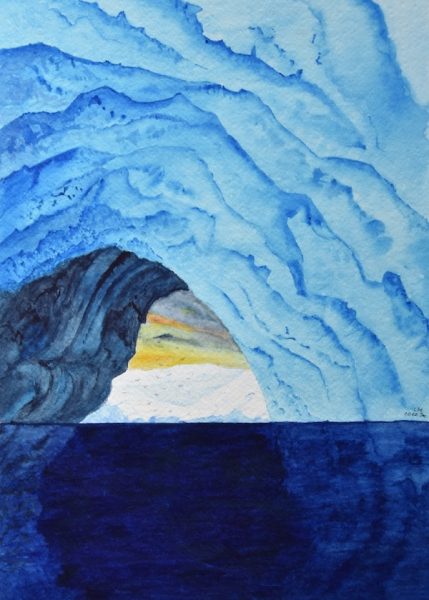
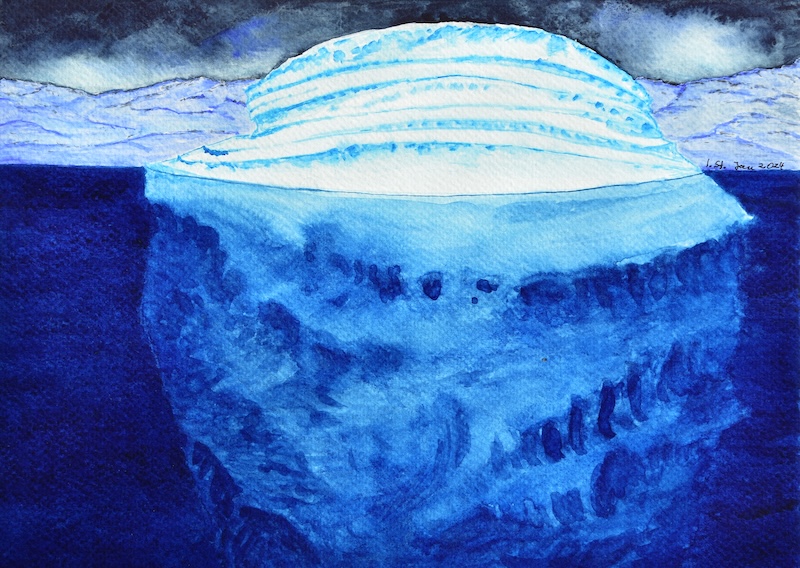
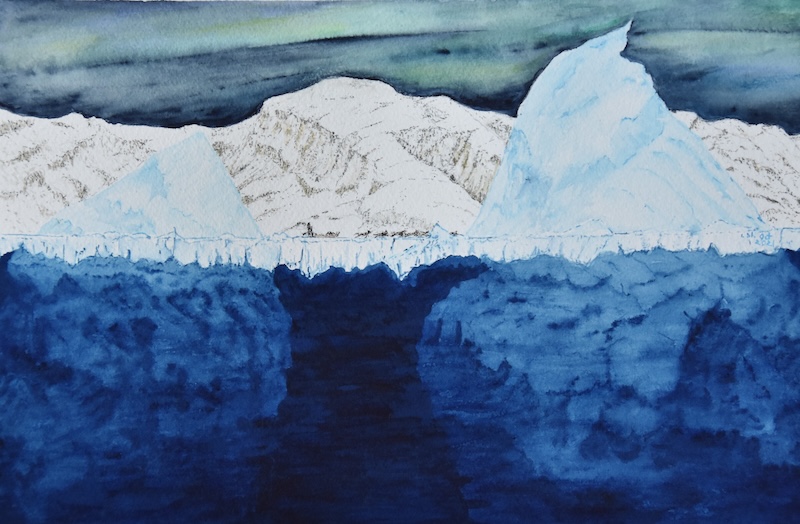
“I’ve been painting icebergs. What fascinates me is the underneath of the iceberg. You usually see a quarter to a third of an iceberg above the water. Under the water, it’s kind of a dream landscape. I like to play around with that,” she explained.
“There is also the environmental aspect of it. The ice cap there is melting way faster than what was expected. The thickest part of the ice cap in Greenland is about three kilometers deep. They’re doing ice cores of this and they can actually see what kind of weather there was, what was happening on earth at those times. Now this is all melting. They break off and a lot of them from Ilulissat Icefjord actually float around to the Canadian side. They drift down the east coast and then they melt.”
Her exhibition ‘Adrift Above The Arctic Circle’ will be on display at the Old Schoolhouse Art Gallery from July 5th to 14th. It opens at 6:00 PM on Friday, July 5th.
Her artist statement says, “Iris Steigemann was born in 1958 in Oberammergau, Germany, in the Bavarian Alps, into an artistic family. Iris’ father, Hannes Grosse, is a renowned artist and Iris began painting at a young age. She later attended three years of art school. Her favorite mediums today include watercolor, pen and ink. She spent most of her childhood exploring and hiking, the beautiful wild landscapes surrounding her hometown. Her father taught her how to identify edible plants and mushrooms in their local area. They would also go out to the river and catch trout by hand. In the spring, they would build a stone oven out of the flat rocks to cook their catch on. That same fireplace would be used until the late fall, when the first snow came, a lifestyle that installed a deep connection to the earth and nature in Iris. Iris’ family immigrated to Canada in 1980, making a new home and life at Loon Ranch on Cortes island.”
Iris Steigemann: “I went to a carving sculpting school in Germany. We did a lot of three dimensional drawings to sketch the things we carve, but then I came here. There was so much to explore, I didn’t have much time to paint.”
Cortes Currents: What did you think of Cortes?
Iris Steigemann: “I really loved it. It was so wild when we came here. We used to go swimming in Blue Jay Lake. Just park the car on the road and hike in. It’s beautiful what Henry and Margaret Verschuur have done up there, but we went before it was logged. You just walked in, and it was just bush.”
“There were hardly any paved roads. We used to have horses in the ’80s, and we used to go over the hydro line up in Cortes Bay. Seaford road wasn’t paved, and we would just let the horses run to Linnaea. There was no traffic. It wasn’t paved. It was perfect. We used to take the horses around a lot.”
“Then slowly everything got paved, people drove really fast and I wouldn’t want to take horses out on their own anymore. There’s more people, more housing and more everything. The wilderness keeps getting smaller, but I still do a lot of hiking here. I know a lot of places that are wild (laughter), where there are no people.” (laughter)
Cortes Currents: How many people were there when you came to Cortes?
Iris Steigemann: “I think in the winter there were maybe five hundred and in summer maybe a thousand, Hollyhock was running, so there were people coming through that.”
Cortes Currents: What do you think about living on Cortés now?
Iris Steigemann: “It’s still really special but with the new ferries and all of that kind of stuff coming in, it’s just going to take a little while and then they’re going to be really crowded again.”
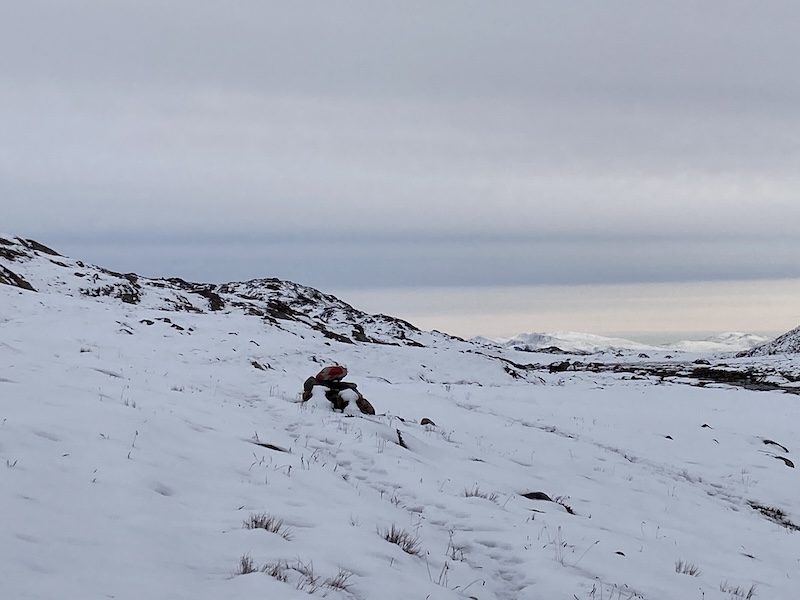
Her artist statement says, “In 2013 iris traveled to the raw and wild landscape of west Greenland.”
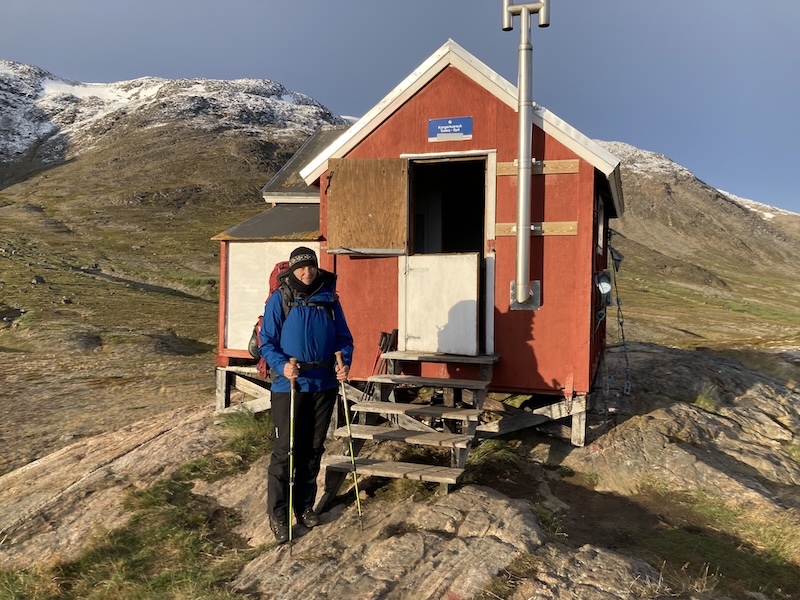
Iris Steigemann: “It’s going to be my ninth year this fall. I do the Arctic Circle Trail. That’s a very remote trail, from one town to the other, that’s about 165 kilometers long. There is nothing in between, so you have to take everything, your tent and your food. You carry about 20 to 22 kilos, but you get an incredible feel for the land if you hike like this. I mostly hike solo.”
“I’ve fallen in love with Greenland. The landscape is so raw and it’s just powerful. There’s not very many people and the climate’s harsh.”
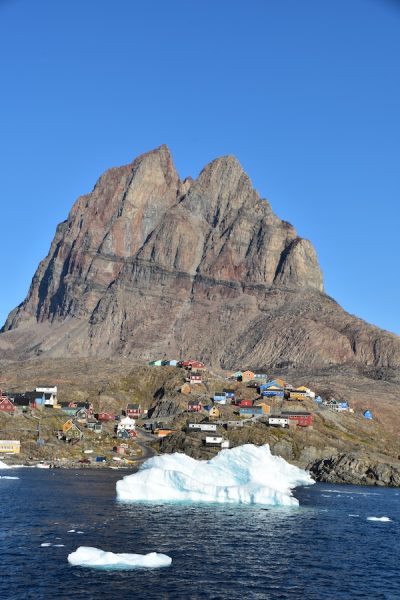
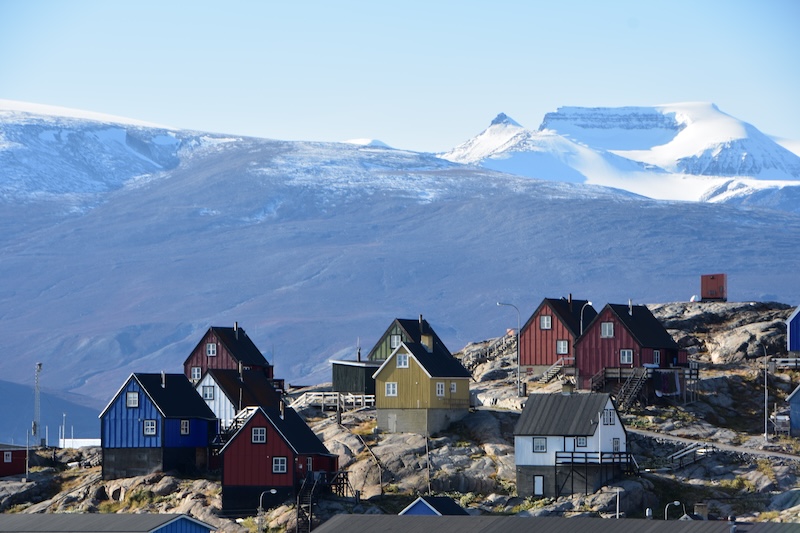
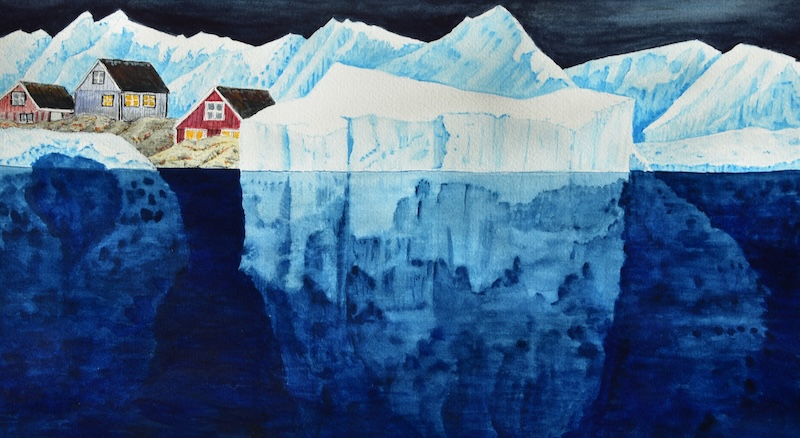
The second time I went there, I took the coastal ferry up to Ilulissat from Sisimiut, and saw my first icebergs and it was just amazing. I fell in love with them, but it took me a couple more years till I started to actually paint them. I like to submerge myself into the landscape, into the things I see, for a while before I start.
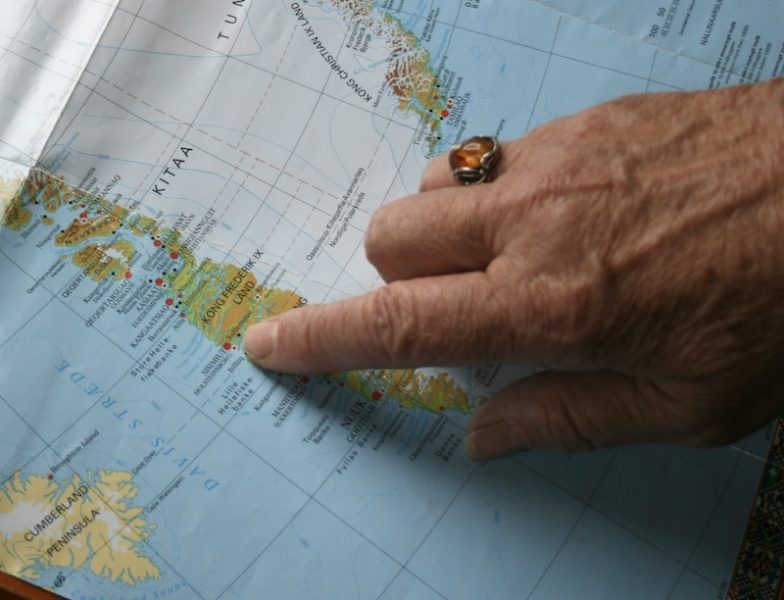
“I started painting in 2019. I had a solo show at the Old Schoolhouse Art Gallery in 2019, I think.”
Cortes Currents: A lot of these pictures show the undersides of the icebergs.
Iris Steigemann: “You don’t see that, it’s my fantasy, basically.”
“They actually take a long time to do. They’re all watercolor. You have to work them over and over to get the three dimensional aspect of it. I get them darker and darker and then you go over it again with a lighter, like the same color, but make it watery. Then you have to touch it up again to get the three dimensional. So it takes quite a while to get what I want in them.”
“I mostly paint in the winter when it’s dark and you can’t go out that much. I process what I have seen.”
“Last year for the first time the ferry went higher than Uummannaq. They went all the way up to Upernarvik. I was on the ferry for six days. They stopped in all the little towns, and some of the villages, for between four and six hours. You have time to look around, but you’re basically on the ferry.”
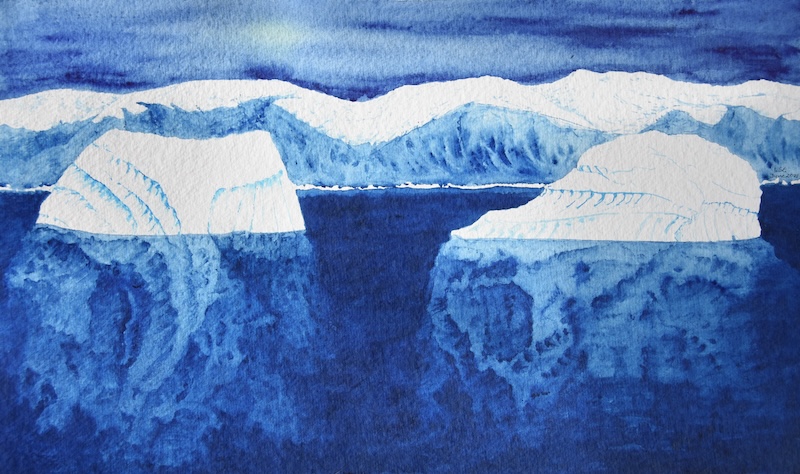
“From Disco Bay, Ilulissat, the whole time going up north you see beautiful icebergs and the landscape changes and it’s just very dramatic.”
Cortes Currents: How long are your trips usually?
Iris Steigemann: “Between 4 and 6 weeks, usually. I take about 2-3 weeks for hiking, and then the rest for exploring other things. I usually go from the middle of August to the middle of September, depending. It’s getting colder, but I like snow too.”
Cortes Currents: What kind of temperatures were you experiencing?
Iris Steigemann: “During the day, you usually have 4 to 10 degrees above, and sometimes in the sun it can get up to 18. You hike in a t-shirt, but nights can be quite cold. Last year when I was camping, I think it was minus four or five sometimes. You can get the odd snowfall, but it will melt again. There’s also huts you can use if they’re not occupied, but I camp in minus temperatures.”
Cortes Currents: What’s summer like?
Iris Steigemann: “It’s actually beautiful. There’s lots of wildflowers. I usually don’t go that early. I’ve only been there once, and Christine Robinson came with me. There’s lots of wildflowers and it’s actually green at that time.”
“Now the weather is really changing there. The last two years it’s been super wet, way more wet than it usually is. That means there’s a lot of flooding. A lot of the sled dogs sit in the muck, outside of the towns. It’s so hot. It’s all rock and a little bit of dirt. If it rains , it’s all puddles and it’s kind of sad, but that’s climate change.”
“It was really raining last year and I actually got sick at the beginning of my hike. I just stayed at one of the huts, then went back to the town and flew to Sisimiut. It was a bit unfortunate but it was the wettest year they had in a long time. That made the trail super mucky.”
“I don’t know what it’s going to be this year, but I’m trying again.”
“They had a very late winter. All the snow is melting right now and it’s after summer solstice, so it’s really late. They do have snow in September, but it will melt again. It gets a bit warm, and then it gets cold again, and it takes a while till stuff sticks.”
Cortes Currents: Do you see many people when you’re hiking?
Iris Steigemann: “In the beginning I would go 3-4 days without seeing anybody and I love it. Now you definitely will see 2 to 6 or 7 people a day coming towards you. Usually at the huts, you will see people. You’re kind of alone, but you’re never really alone. There are people around.”
“I’ve met hunters several times and they’re super hospitable. I shared a hut with them once in 2016. They fed us really nice reindeer stew and coffee. They were at that one hut, going hunting, for several days. So they had four reindeers out on the tarp because it’s cold. They just skinned them and put them under the tarp.When they have enough for their families, they leave. Their trail runs overland to a fjord, and then it goes to another fjord, and then it goes out to the coast. Where there are fjords, usually the hunters come in and hunt.”
She pointed to one of the pictures.
Iris Steigemann: “I did a series a couple of years ago. This is called ‘A Long Way Home.’ It has a dog sled team. I was really fascinated because they’re actually on the ice, but the ice is not very thick.
Cortes Currents: Do you ever meet any animals?
Iris Steigemann: “There are muskox. You can see lots of reindeer. Once in a while you see an arctic fox, that’s really special. There’s lots of birds out there and also arctic hare. I don’t have much wildlife in my paintings except for when I was doing whales.”
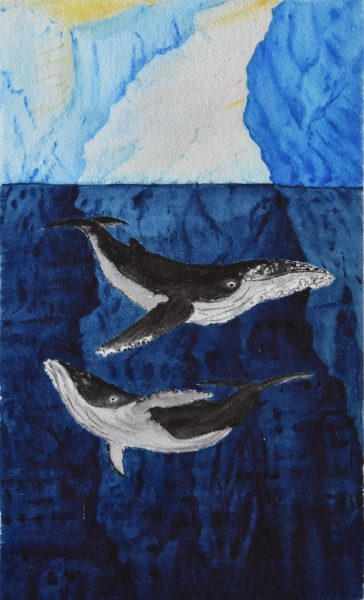
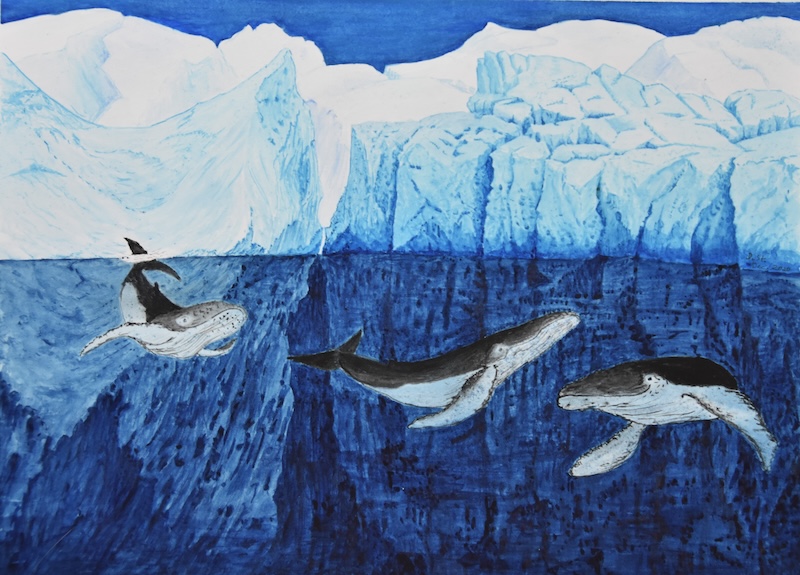
“One year you looked out to the ice fjord, where the big icebergs come out, and watched the whales. They were that close. So I started painting whales with the icebergs.”
Cortes Currents: How important are these visits to Greenland to you?
Iris Steigemann: “Visiting Greenland is still like a pretty big highlight for me, to go and see and explore. The thing is I’m 66, so how much longer can I carry a 22 kilo backpack? There is definitely a limit to that, but maybe I will go there in the winter one year and just see what that looks like.”
See Also:

Links of Interest
- Local Artist Hosting Art Show Depicting Greenland Travels And The Realities of Climate Change – CKTZ News
- The Old Schoolhouse Art Gallery Facebook Page
- Articles about, or mentioning, the Old Schoolhouse Art Gallery on Cortes Currents
Aside from ‘Where is Sisimiut?’ and the gallery calendar, all paintings and photos courtesy Iris Steigemann.
Sign-up for Cortes Currents email-out:
To receive an emailed catalogue of articles on Cortes Currents, send a (blank) email to subscribe to your desired frequency:
- Daily, (articles posted during the last 24 hours) – [email protected]
- Weekly Digest cortescurrents – [email protected]