


“When you talk about fuel, most people think about fuel for a vehicle or fuel for something like that, but fuel for a forest fire is wood on the ground or standing wood? The idea is to reduce the fuel load to reduce the severity of a fire. As it approaches that location, the fire will slow down and most likely drop to the ground because we’ve opened up the canopy. The danger trees have been removed and the debris on the ground’s been removed. So it would be a lot easier for firefighters to make a stand,” explained Tor Ellingsen of Reef Point Falling.
He was talking about the recently completed Cortes Island Recycling Centre Wildfire Mitigation Project.
Ellingsen was born and raised on Cortes, but now lives on Quadra Island. His parents are Bruce and Ginny Ellingsen.
His wife, Kate McLean, is from Quadra Island. They have two employees, one from Quadra and the other living on Cortes.
“My wife has 17 years wildfire fighting experience with the provincial government. She started as just a regular firefighter and by the time she decided to quit, she was an administrator. She was still a firefighter, but in charge of the fire,” explained Ellingsen.
“I’ve been an industry hand faller for 20 plus years. Nowadays you have to be a limited company. You have to cover your own workers’ compensation, cover yourself to work in the woods. I think I founded Reef Point Falling in 2011.”
“I decided, after marrying, that I wanted to slow down and not work as much as I had just falling trees. So Kate and I started this company a little over a year ago, keeping the same name because it simplifies things for WCB rates and liability insurance and all the things we need to do a project like this.”
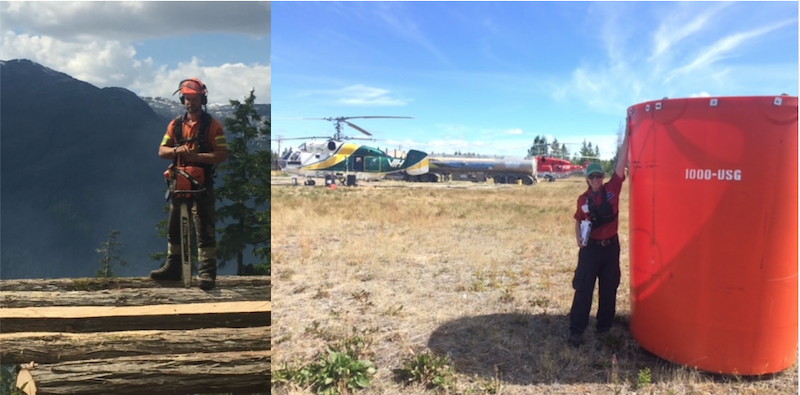
“We’re actually going to start a new company. We’re just waiting for a name clarification, whether the name we want is available or not for a new limited company because Reef Point Falling we feel isn’t the best name for wildfire mitigation company.”
Shaun Koopman, the District’s Protective Services Coordinator, emailed this was the Strathcona Regional District’s (SRD) first fuel management program on Cortes Island.
“This 4 hectare project was fully funded under the 2021 FireSmart Economic Recovery grant.”
It was also one of four parcels that Koopman and Mark Lombard, General Manager of the Cortes Forestry General Partnership, identified as top priorities for fuel treatment. There was sufficient marketable timber in Anvil Lake and Carrington/Coulter Bay projects, but the Recycling Depot was one of two projects in Squirrel Cove that were not commercially viable.
In an interview last year, Lombard said, “There’s not enough merchantable timber in there to pay for them. We’re going to get funding for those treatments. We won’t be able to sell any of the logs, so we’ll make them available as firewood.”
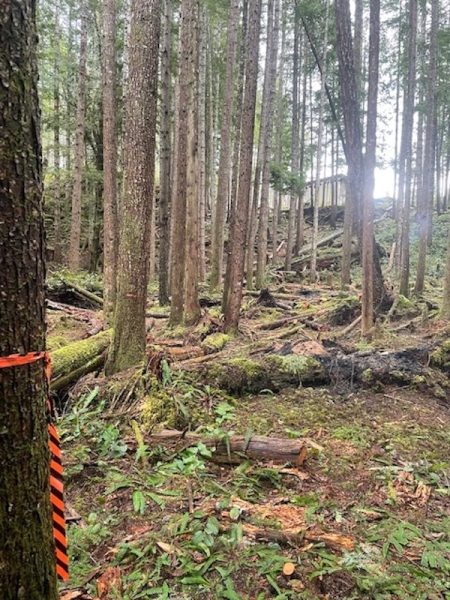
Ellingsen explained, “The prescription was done by a registered professional forester.”
“I like that we left all the White Pine, which is almost an endangered species. It used to be very prevalent on the coast. Disease killed most White Pine, but some were immune to it. So we left all the White Pine.”
“We found five or six Yew trees that we left to maintain the biodiversity.”
“People think the biodiversity is ruined when you do a project like this, but it’s not at all. All we’re doing is reducing the fuel load and gaining safe accesses for firefighters to get into the area.”

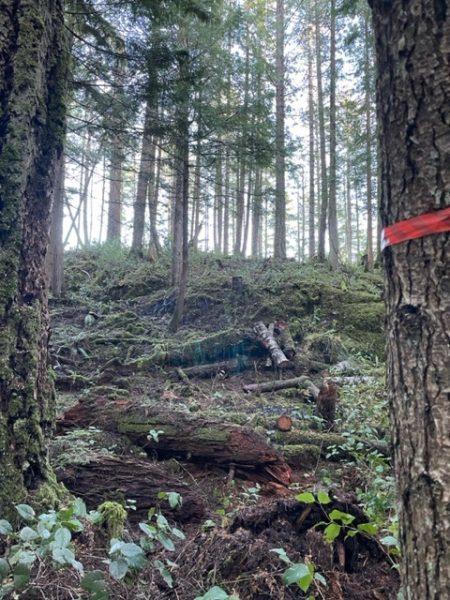
“The area we worked roughly surrounded the Recycling Centre, I would say about an average of 75 meters. More or less a circle right around the Recycling Centre, with the swamp as one boundary.”
“It’s important to reduce the fuel load in the forest, if a fire approaches the center, there’s hazardous waste stored there. The idea behind it is to reduce the fuel load to reduce the severity of a fire. As it approaches that location, the fire will slow down and most likely drop to the ground because we’ve opened up the canopy. The danger trees have been removed and the debris on the ground’s been removed. So it would be a lot easier for firefighters to make a stand against it.”
“It’s a very labor intensive job. You’re cutting trees down and you’re bucking up all the debris on the ground and then you’re burning it on site in small hand piled bonfires.”
“The biggest challenge we had was the government venting, allowing us what days we can burn and what days we can’t. They treat us like an industry, in the same spectrum as say Mosaic would be, or any of the big TFL (Tree farm license) holders that have literally thousands of machine built slash piles that they’re going to burn each winter. They lump us in with those guys, even though we’re just small hand fed piles. The project took a lot longer than it should have because of waiting and waiting for sometimes 10 days, two weeks between days we could burn and the days we couldn’t.“
“Other than that, there’s not really much challenge other than finding a labor force to do physical manual labor.”
Koopman emailed that while this was the SRD’s first fuel mitigation project on Cortes, they carried out another project in Gold River a decade ago. He has also applied for funding to conduct fuel mitigation around the Quadra Island Community Centre.
Ellingsen said he is waiting to learn the outcome of three bids on Cortes Island. One of them is for the Cortes Community Forest and while he didn’t say it, this may be the other Squirrel Cove project that Lombard identified.
His other bids are for Klahoose Forestry.
Top image credit: Some of the forest surrounding the Cortes Recycling Centre – Photo courtesy SRD
Sign-up for Cortes Currents email-out:
To receive an emailed catalogue of articles on Cortes Currents, send a (blank) email to subscribe to your desired frequency:
- Daily, (articles posted during the last 24 hours) – cortescurrents-daily+subscribe@cortes.groups.io
- Weekly Digest cortescurrents – cortescurrents-weekly+subscribe@cortes.groups.io