
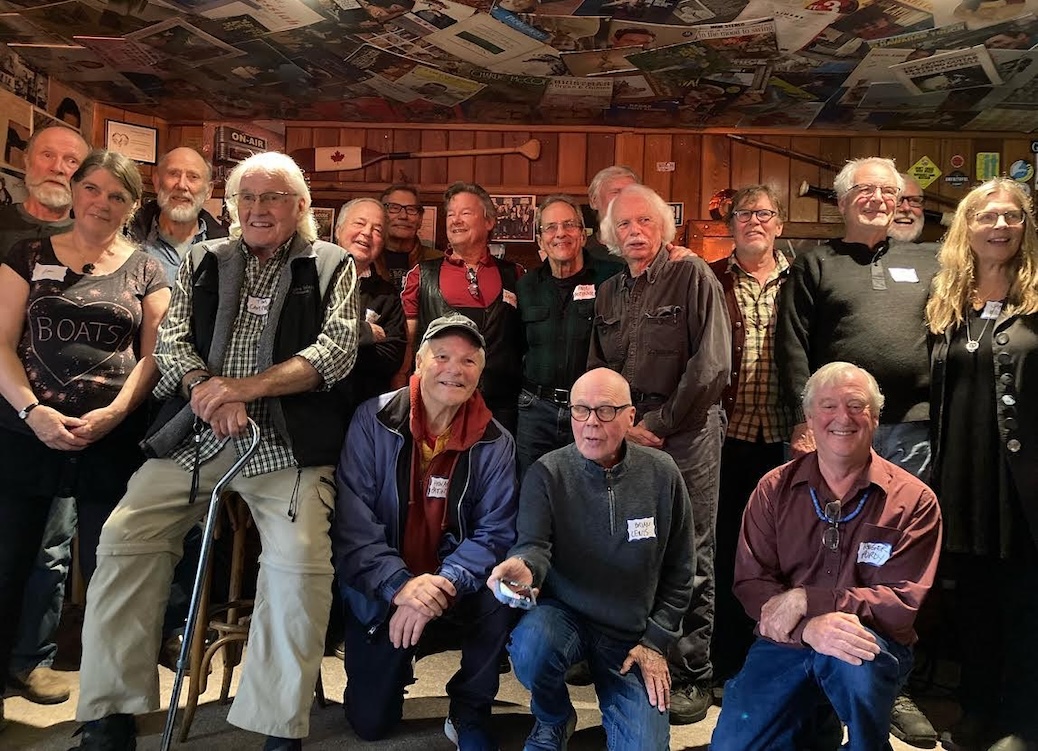

Book #4 of the Gumboot series, ‘Gumboots in the Straits’ is coming to Gorge Hall on Cortes Island on Saturday, September 20.
From 1:00 to 3:00 pm, six Cortes Island authors featured in this volume will give free public readings from their contributions.
Later in the day, from 5:00 to 7:00 pm, food and drinks will be available for purchase, followed by an evening of dancing to Cortes Island’s own He Said; She Said. Tickets for the dance are $25 and can be purchased at Marnie’s Bookstore and the Cortes Island Museum.
In this morning’s interview, we’ll be joined by Jane Wilde, the originator of the Gumboots series. She’ll also share short readings from some of the Cortes writers featured in Gumboots in the Straits.
Let’s go back to the beginning:
Jane Wilde: “We had a coffee/wine group of women in Dodge Cove, a little community off Prince Rupert, a boat access community where we all lived. Many of us had migrated West in the seventies from the States and Toronto and all over.”
“I got this idea from reading a book by a woman named Sheila Weller. She talked about women of the seventies and I said, Hey, that’s us. Let’s write our stories. So, I think, 34 women wrote short memoirs up to 2,500 words limit of the seventies. We put it together. We found a publisher and he said, ‘well, how many books do you think you’ll sell?’”
“I said, well, maybe a hundred, we’ve got friends and family. He said, ‘well, alright.’ I think we’ve sold 10,000 books of the Gumboot Girls. We’re like, ‘what?!!’ Like, who’s buying these? So it just started as a lark and then it has just kept going and we just keep selling books.”
“Nobody’s making any money, we’re not doing this for money. It’s all volunteer work.”
“Lou Allison is our editor. She’s a voracious reader and works at the library. She’s an English major, but she was willing to jump in and try the editing thing. She edits with a light hand. She doesn’t want to take the voice away, but each of the stories came through Lou, and back and forth and back and forth and came out the other side.”
Our publisher was happy with it. She says we’re the best sellers for Caitlyn Press.
Cortes Currents: Wow!
Jane Wilde: “I know. Like, what? – and unheard groups, unheard stories.”
Our publisher is Vicky Johnstone.

Cortes Currents: Tell me about this most recent volume, and how you ended up coming to Cortes Island.
Jane Wilde: “This all goes back again to our small North Coast community. Marnie of Marnie’s Books (on Cortes Island) is best friends with Lou (our editor) from the seventies years. When we came down here to do the launch on Quadra Island (photo at top of page), Marnie and Melanie Boyle from the Cortes Island Museum. They said, ‘why don’t you guys come over here and do a book event?’ It was getting too far into the not nice season to travel so we said, we’ll come over in the spring. Then spring came and then it was summer. It’s been about a year now since we’ve been out, but we’re still calling it ‘launch number two.’
Cortes Currents: You have six stories from Cortes. Are there some from other Discovery Islands as well?
Jane Wilde: Well, we have Dane Campbell from Loughborough Inlet. I don’t think there was anybody writing from Quadra. We invited many, many people to write, but it wasn’t convenient for everybody. Lots of writers from Sointula and some from the Denman, Hornby, Comox area.
Cortes Currents: Tell me who the Cortes writers are and some of the highlights of their stories.
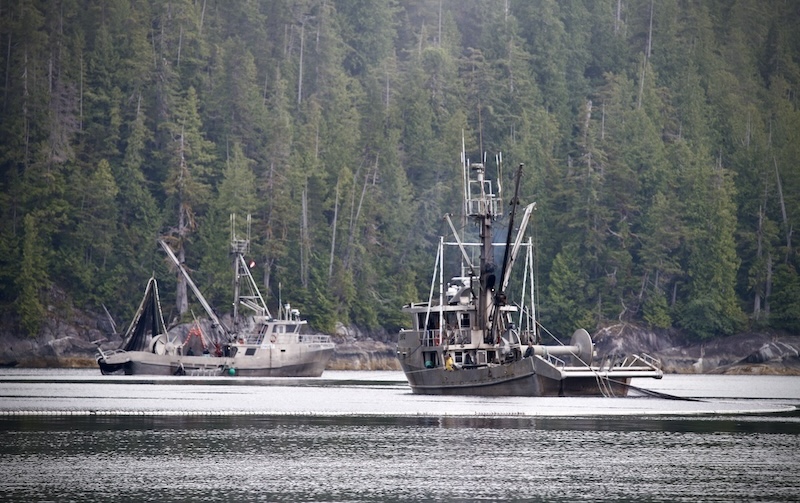
Jane Wilde: “Hubert Havelaar, Ian Campbell and Ron Bowen still live on Cortes. John Helme, Roger Purdy and Tim Campbell lived there during the ’70s. It’s all about boats. So with the last two books we did, ‘Gumboot Guys’ and ‘Gumboots In The Straits,’ part of the criteria was that you had to have moved to the area from away and you needed to have a boat of some sort, anything from a kayak to a freighter (I think). I just reread the whole book. I hadn’t read it for a long time, and the stories are about boats for sure. They’re about engines and engine parts, perhaps more than a lot of people would want to know.”
“The 9624 B pulley wrench thingy was included in some of the stories, but the thing that struck me about them was the humanity of the stories. The emotion that came through perhaps unintentionally as they wrote their stories and told about coming here from all over. Building these boats and finding boat sheds, and finding materials and finding tools, and also the community that formed and that was already there for some of them. There’s some great side stories about what was going on in Cortes.”
Cortes Currents: Give me some examples.
Jane Wilde: “Let me start with the dances at the Gorge Hall. Apparently those dances were quite the events. Everybody came, danced their hearts out. There were kids, babies, also some of the older residents and the older residents would teach the young hippies how to do these old style dances. It would be all different kinds of music, and it would be just rocking apparently. Several of the fellows mentioned the Gorge dances, and that’s where our dance party’s going to be on September 20th – at the Gorge Hall.”
“I think maybe some of the fellows were involved in building and repairing the Gorge Hall over the years. Each story includes some horrific water scenes, some horrific storms. How did we get out here? Why are we here? At least one of the fellows didn’t have enough money for charts, so they were using a roadmap to navigate on the ocean. It’s like Whaaat?”
“I was part of that ’cause I was a young hippie in Haida Gwaii in those same years. We didn’t know what we didn’t know. How hard can it be to drive a boat on the ocean and on and on – it’s some pretty great stories and a lot of house building and family building, babies, children, relationships forming, falling apart, reforming.”
Cortes Currents: Will this be your first time out to Cortes?
Jane Wilde: “No, I was there just recently but only just recently, stayed at Marnie Andrew’s place. Marnie’s a good friend of mine from Haida Gwaii days as well. We knew each other when we were in our very early twenties, and so here we are 50 years later, reconnecting as friends, and a lot of these friendships are 50 years old – reconnected friends and some that have stayed connected the whole time.”
Cortes Currents: Any hopes or wishes or your next book.
Jane Wilde: “We’re not talking about the next book just yet, although it’s coming up, and I think what I learned through all of this, is that we thought we were so special on Haida Gwaii, all of us cool kids from Toronto living in the bush. Well, it turns out there were cool folks living in the bush all over North America. When we go out and do events with our books and meet with people, they say, “oh, I was doing that in the Ottawa Valley.” “Oh, we were doing that in Virginia.” “Oh, we were living out in the woods on Cape Breton Island.” There’s a whole thing that was going on in the seventies. This is a piece of Canadian social history and I have a friend who’s doing her PhD in history right now, Jo Mrozewski, and she just keeps saying, go, go, go.”
“These stories are important. This is archive stuff. I hate to think of us as being history. We’re just kids still, but actually 50 years later, we do have stories that are important and that aren’t happening now. What we were doing in the seventies isn’t going on right now to the same degree, with the same amount of freedom and community and goodwill.”

Jane Wilde: “Can I just read a little section that hits me every time. I am just moved by the words, but it talks about a friend who was on Cortes as a kid from Vancouver and he talks about the things he lucked out on.”

Jane Wilde: “The thing that changed his life was arriving in Cortes on his little sailboat the Raireva. His friends that he had arrived with, left and he decided to stay. He was living on his boat and met some people..”
“David Giblin said we’re doing a firewood trip at Jerry’s tomorrow if you want to come and hang out with us. I had no idea what he meant, but it sounded like a chance to check out some of the island. We arrived at Jerry’s to find a group of strapping, bearded, long-haired fellas sitting on a large pile of alder logs, joints and coffees in hand. Jerry and Lynn were living in the barn shop where a gaggle of hippie chicks were making muffins. Soon the chainsaws were revving, clouds of two stroke smoke and chips flying, and the decked wood was assaulted. Mauls popped open the green wood and several trucks were loaded and reloaded, trundling up and down the gravel roads to various other homes. It was an impressive display of happy teamwork. By the end of the day, the pile of wood was gone. No money had changed hands. I had never seen anything like it. That was when my life took a right angle turn to the left.”
Jane Wilde: “So here’s this young guy, 20 something going ‘holy …!’ I think that was happening all over the place as people were helping each other. Whether it was building boats, building houses, midwifing children, sharing childcare, potluck dinners, or dances – It’s that community thing that comes through, even though this book is about boats and fishing, lots about fishing.”
“That was Roger Purdy‘s story.”

Jane Wilde: “I could read you a little clip of all kinds of them that are of a similar ilk, the goodwill and the big hearts that people have. I’ll read you one more, This is John Helme: “
“Having been used to an active social life on Salt Spring Island, I was concerned there would be a vacuum by moving to such a remote place …”
Jane Wilde: “I think they were in Carrington Bay, or somewhere. They weren’t in downtown Cortes.”
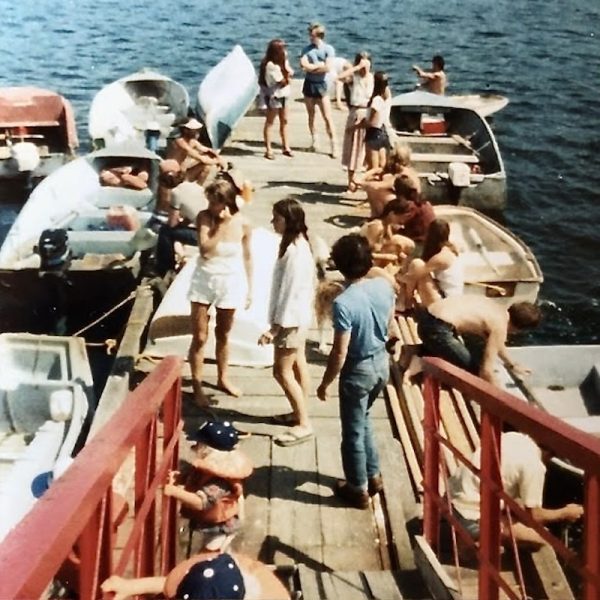
” … This was not the case! At first, I filled the void with odd friends from home who’d visit for extended periods of time as they loved the lifestyle, missing camaraderie and music, Beverly and I would host parties on our beach for local friends. What was unique about these parties in remote places was the fact folks didn’t show up for just a few hours in the evening. They’d stay for at least a day or two, sometimes more. I love this lifestyle as it gave us plenty of time together to play music, feast, get high and share life stories. Feast we did! Our parties almost always featured fresh salmon, crab prawns, cod, clams, and venison on an open fire on the beach. We’d play music to the wee hours of the night on acoustic instruments and drums that we would fashion from almost anything at hand.”
Jane Wilde: “John sent me a picture of one of the beach parties with about 40 people on the beach, all nude. We haven’t posted it anywhere, but it’s just a classic. It captures the time, like why would you wear a bathing suit at a beach party?

Jane Wilde: “I’ll read you Ian Campbell‘s. He went all up and down the coast. He was a surveyor, so he had a survey contract and he lived on a boat. So he was involved in updating sailing directions.”
“One summer a boat reported hitting an uncharted rock on Sutil point at the southwest corner of Cortes Island. A Friday afternoon low tide allowed a visual examination of the rock in question, confirmed by a skid mark of red bottom paint. A radio request was made to a Victoria office for additional survey control points to confirm the rock’s location. On Monday, we returned to record an exact position of the rock, using a horizontal sextant, (10 angles to shore stations) only to discover fresh blue bottom paint on the same rock. Obviously, another boater had taken a dangerous shortcut across the same reef area, which was in fact adequately charted.”

Jane Wilde: “Just imagine all these haywire boats out there. This is one that I just love, this is Ron Bowen:”
“Cortes in the early eighties, late seventies, had a population of less than 500 people in a ferry that carried 16 vehicles. It was pretty laid back, lots of dances, music nights, potlucks, and just plain hanging out. Going to Whaletown on Fridays to check for mail and get the week’s groceries was routine. Whaletown consisted of a store, the post office, one house and the government dock. There were a few liveaboards on the government dock. All the bush people from Carrington would be there as well. It was quite a scene. Dances at the Gorge Hall brought all sorts of folks out. The dock and the Gorge would be packed with boats from Read Island and the water access people from across and outside the gorge. All of them dance to bands like ‘Borama and the Valiant.’”
“One year, a local guy somehow got ‘Doug and the Slugs’ to play at the Gorge Hall. All good times. Some of the best winter dances were with our own old timers band- waltzes and Foxtrots galore, and an amazing amount of hard liquor. The potheads just couldn’t keep up to that.”

Jane Wilde: “Well, I’m looking forward to the dance at the Gorge Hall and Cortes on September 20th. This is our 10th dance that we’ve had since 2011. We try to have a dance or a party every year somewhere. People at the last dance on Quadra said, ‘I don’t know why Jane always wants to have these dances. Nobody wants to dance anymore.’ I’m like, ‘What? – Are you kidding?’ So the band started to play. Everybody was in the bar there and like in one song, the whole floor was bouncing. Everybody was up dancing, except the crabby ones in the back. So it’s like, we’re still dancing.”
“So here we are. I just turned 70. We still have a couple of 69 year olds in the crowd, but a lot of our folks are in their seventies and into their eighties now, and we like to dance. One of the writers in the book, Brian said, ‘Oh, I hope it’s not one of these dances where the guys get mad with you when you dance with their wives.’ I said, ‘Oh no, these are freestyle dances. Everybody dances with everybody.’ He came, he had a blast. We all had a blast.”

Cortes Currents: Tell me something about Hubert Havelaar before we go. Everybody knows Hubert.
Jane Wilde: “His story is of building this first sailboat, of his hilarious camping underneath it:”
“Only a few friends were aware of our under-hull existence and in relative privacy, we were entertained by candid comments from complete strangers about this sidewalk boat that was being built …”
Jane Wilde: “I think it was in Seattle, Yeah, in Seattle.”
“… So then finally after launching the tent was reinstalled inside the open hull and it became our shelter as we alternately towed and self propelled to Victoria. It was an amazing and foolhardy but grand adventure with an extremely steep learning curve. Flat broke by that time, we resorted to navigating with a roadmap …”
Jane Wilde: “He isn’t the only one that did that.”
“… intuition and a prayer on that first voyage as we couldn’t afford marine charts. We were young and felt immortal. When we struck an offshore reef, that roadmap didn’t show it and the hull started taking on water. We proved that some substitutions could be downright dangerous. We survived, persevered, got jobs and quickly constructed decks, cabins, and a rudimentary interior that made moving inside possible. It was rustic, crude even, but it was a start. I named our new floating home ‘αρχή’ – Greek for beginning and the root for words like archaeology. With oil finished woodwork, hand stitched recycled cotton sails and wood smoke curling from the stovepipe, the boat looked as archaic as the name suggested.”
Jane Wilde: “Of course he talks about the other boats that he built. It’s a really good story and to close, he said:”)
” … We often look out at Osprey swinging patiently on the mooring and realize how incredibly fortunate we are that more salt water adventures are just a sail raising away.”

Cortes Currents: Looking over this article I noticed we missed one Cortes author, Tim Campbell, who wrote:
“I was looking for freight opportunities for the fifty-six-foot landing craft we used for buying herring. We moored both boats in Cortes Bay and Gorge Harbour. (His son) Marty was now in school and would catch the school bus that was circling Cortes, often leving from one place and dropped off at another, by arrangement. It depended upon where we found fish.”
“Eventually the logging camps, tree planters, resorts, fish farms, islanders and the Forestry Service recognized our services. Before the Coast Guard had personal stationed at remote locations, an auxiliary volunteer program of private vessels worked uner their direction. When we performed rescues or salvages, the Coast Guard covered our insurance, loss or damage to our equipment and, sometimes some of our expences such as fuel. It was a good system. It covered the remote areas of the coast an recompensed us somewhat for an obkigation required by maritime law.”
“With baby Marina on her way, we moved ashore on Heriot Bay on Quadra Island, rented an old skid house, then built a house and worked out of Quathiaski Cove and Campbell River …”
Jane Wilde: “A lot of the writers are still boating. They still have boats. They’re still out there.”

Cortes Currents: Tell us what to expect on the 20th.
The reading in the afternoon, those are a bit raucous sometimes. There’s hooting and hollering.
Cortes Currents: Really?
“Well people laugh at each other’s stories. The six fellows are going to read five to 10 minutes each from their story, their favorite little cut. So it’ll be less than 45 minutes. That’s the rule for these readings. You can never go more than 45 minutes in a reading. I have to crowd control them with my trusty timer – it’s ‘okay, get the hook, you’re off next’ – But generally the crowds are very receptive and it’s lots of fun.”
“It’s happening at the Gorge Hall at one o’clock on the 20th. The reading in the afternoon, sort of one till three, and then the Cortes PAC (Parent Advisory Committee) is feeding us yummy supper of some sort. We don’t know what they’re doing and we don’t care. We just want food. Then at 7:00 o’clock the dance starts and runs to 10:00. We’ve got a band from Cortes playing, ‘He said, She said.’ They’re practicing up a storm. Looking forward to it. We’ve asked, ‘He said, She said’ for three 45 minute dancing sets. So it’s not a concert, it’s a dance. With some of the other groups, they’ve, I’ve said, ‘do you mind starting at seven and going till 10 instead of nine till midnight or one o’clock,’ which is what most dances are.”
“‘Oh, yeah. We’re happy to do that.’ I said, ‘yeah, we probably are going to be moving to afternoon dance pretty soon. We like to go to bed by nine.’
Gorge Hall’s going to be the center of action. We’re doing something different. We’re welcoming children with their parents, which we’ve never done before. Ron and Helen Bowen’s daughter, Claire asked if she could bring her kids, because she remembers those dances at the Gorge Hall where all the kids were there. We haven’t had kids, but the PAC is doing the liquor license and they’ve arranged for it to be okay to have kids, but not unaccompanied. They need to be with their parents. They can’t drop their kids off and go somewhere else.

Gumboots in the Straits background – by Jane Wilde
The four books in our Gumboot series started as a lark. The idea was to save the stories of women who migrated to the North Coast around Prince Rupert and Haida Gwaii from cities around North America 1970, for fun. The goal was to save the social history of the unique time and place for the women who arrived there. Their 34 short memoirs Gumboot Girls: Adventure, Love and Survival was published in 2012.
In 2016 I moved to Comox and found another similar, but different, gang of women so we gathered their 32 stories for Dancing in Gumboots: Adventure, Love and Resilience, Women of the Comox Valley (2018).
Then the North Coast fellows who loved boats shared their 31 stories in Gumboots Guys: Nautical Adventures on BC’s North Coast .
Gumboots in the Straits: Nautical Adventures from Sointula to the Salish Sea launched at the Heriot Bay in Fall 2024. Cortes is our second launch. This fourth book includes 27 more stories including 6 with a focus on the writers’ lives on Cortes in the 1970s
All of the books have spent time on the BC Bestsellers list and continue to sell briskly!
Links of Interest:
Top image credit: Taken at the 2024 launch of Gumboots on the Straits in Heriot Bay. All photos courtesy Gumboots in the Staits.
Sign-up for Cortes Currents email-out:
To receive an emailed catalogue of articles on Cortes Currents, send a (blank) email to subscribe to your desired frequency:
- Daily, (articles posted during the last 24 hours) – [email protected]
- Weekly Digest cortescurrents – [email protected]