
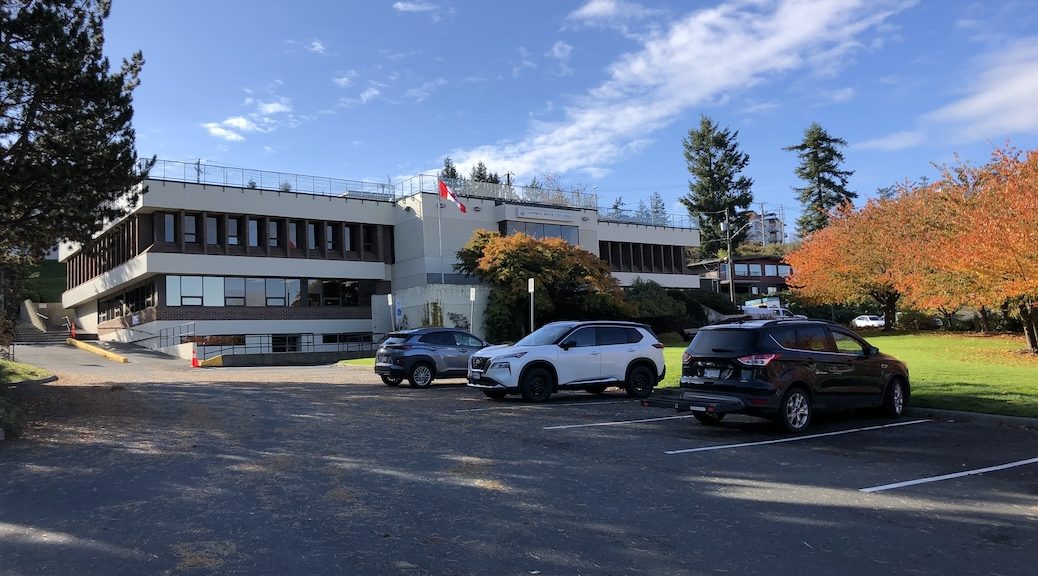

In the past, Rural Directors have not always appreciated Campbell River ‘interference’ in their affairs. An initiative coming out of the Strathcona Regional District’s (SRD) Municipal Services Committee could result in a lot more interference from Campbell River and other municipalities. A planning service typically manages zoning and land use rules, reviews development and building applications, prepares community and regional growth plans, protects environmentally sensitive areas, and coordinates public input on land use decisions. They would like to take control of the Electoral Area Planning Service.
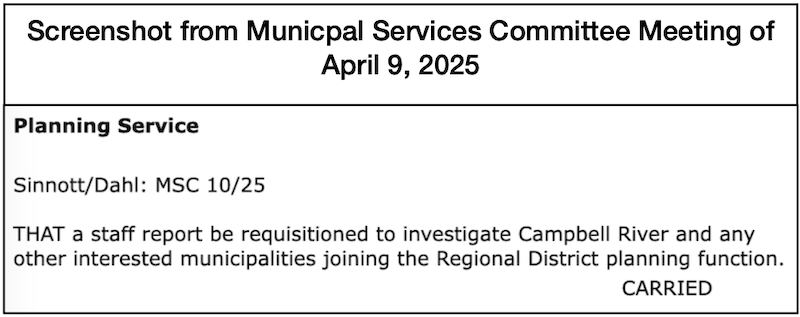
Some of the municipal directors were already discussing the idea of joining the service for months prior to it surfacing at the August 20, 2025, SRD Board meeting.
At that point Cortes Island Director Mark Vonesch asked, “ I just have a question for folks that brought this forward. My understanding is municipalities already have a planning function. I’m just confused as to why you might want to join when you already have your own planning service. Looking at this report, it’s looking at Campbell River paying $500,000 for something that they already have. Given tight budgets everywhere and being conservative with our tax dollars and responsible, I’m just curious as to the sort of reasoning behind it.”
Campbell River Director Susan Sinnott replied, “The region is important to Campbell River and we are an unfortunate region where we are so dominant that what happens in the region does impact us because we’re paying a good amount of money for it. So it’s a consideration we have to look at, but (we’ve made) no determination at this point.”
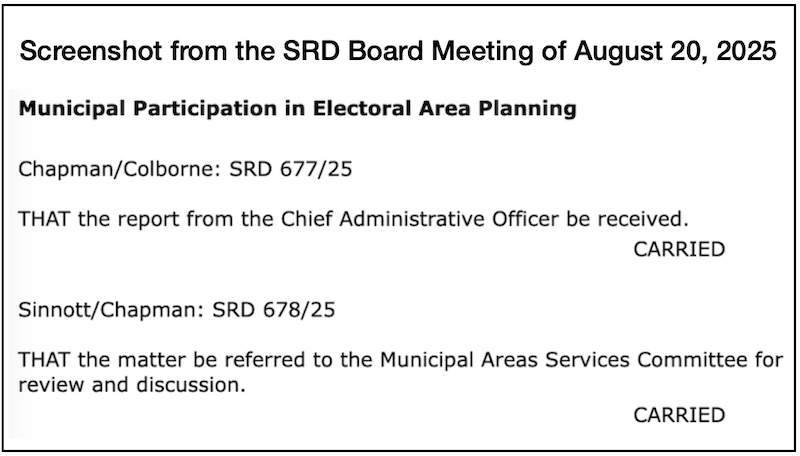
The matter was referred to the Municipal Services Committee.
The following program consists of gleanings from the Municipal Services Committee Meeting of September 3, 2025.
The mayors of Campbell River, Gold River and Zeballos were not present.
Campbell River Director Doug Chapman said, “I t’s sad that we at this point are thinking about this, because we’re supposed to be thinking about the region as a whole – not just electoral areas versus municipalities. We’re supposed to be one organization, one regional district, thinking regionally for the benefit of the region. For municipalities to join the planning would bring more regional thought into planning issues in the rural areas because municipalities are in fact affected by what happens in the rural areas.”
“Area D as an example, just in my observations and my opinion that we had an electoral area director, Brenda Leigh – Director Leigh was not more strict on any development that were to happen out there, and I’m talking about development of property owners, so these people had a right to develop their property as they wanted. Now we have a rural director, Director Rice, who’s more understanding and sympathetic to the development needs of the area. As they develop more, it does affect Campbell River indirectly.”
“We have some electoral area directors, I think, that are still trying to stifle development because I think they’re concerned that their portion of the requisition will go up if they have too much development and their main goal is to provide some government services at the least amount of cost and that least amount of cost is sometimes put on Campbell River. So I think this is a good thing, the idea of municipalities getting in, but I think it’s a sad thing that we are even contemplating this.”
Chief Administrative Officer David Leitch explained, “This is really about money, because this is a unique regional district. It’s very top heavy in terms of population and therefore requisition in Campbell River. So when we go through reconciliation and we bring a First Nation on or anything to do with land use referrals, First Nations always say that they want a voice in land use decisions in their territory. So the real dichotomy here is for Director Matthew Jack and KCFN, we’re literally talking about I’ll round it up: $50 to join the planning function. If you’re mayor Davis from Tahsis, we’re talking about a couple thousand dollars. The cost of Campbell River joining … The material change that would come would be actually to the electoral areas because their requisition amounts would drop, Campbell River’s would go up and the rest would be pretty neutral. So, if you want participation in a service, it’s a pay to play and a fairly significant cost.”
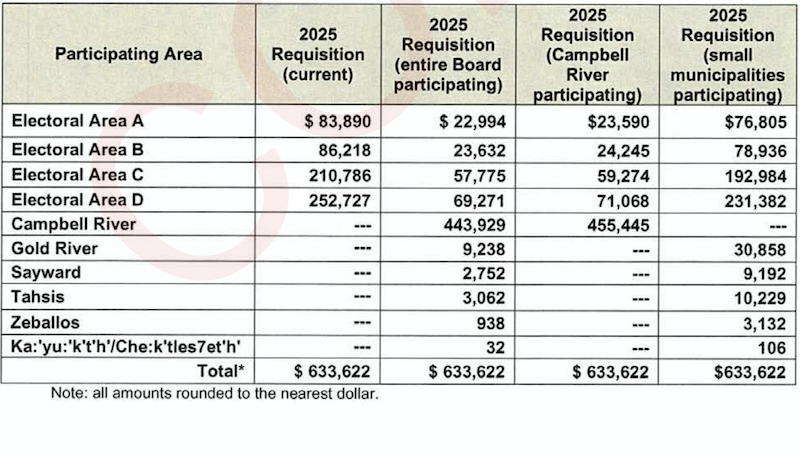
Several scenarios were depicted in the staff report for this meeting. They show Campbell River residents having to pay between $445,000 and $455,000 a year. If all the municipalities joined, Cortes Island’s contribution would drop from $84,000 to $23,000. Area C’s contribution would drop from $211,000 to $58,000. So this is a very important matter to Campbell River.
Director Chapman: “I agree with what you’re saying. We did have an issue where other electoral area directors thwarted a development in Area D and I don’t know the reason why. I suspect they were teaching him a lesson, but that’s not the form or the methodology to do that. I understand that decisions made by their electoral directors and planning issues, the legal expenses would be borne by them, but at the same time, it drags the Strathcona Regional District name down into the gutter. We would have a bit more control on decisions and we could stop bad decisions.”
“Now I haven’t seen any bad decisions of late, but I think we need to have the organizational view and the regional view as a whole before deciding anything like this. The bad side is that if we get into this planning and want out, then it requires a service review.”
CAO Leitch: “ No, if I can cut you off there: you’re allowed in and out without penalty. We attached the legal opinion and consulted municipal affairs, the timing of in and out and when you pay and when budget it depends how late you go out if you pay for the following year or how late you join if you pay for that year. The act allows you to jump in and out , no service review.”
Director Chapman: “Okay. I am glad to hear that because service reviews can take up to two years and can be very involved, so I’m glad to hear that. I agree we’re missing some people here who should be here. So I’m not sure if it’s appropriate for us to make a decision or refer it back to each council for their thoughts before proceeding.
Campbell River Director Susan Sinnott asked: “That was the first question, is it appropriate to just put this aside for the next meeting, waiting for the other people to attend? Or do the receipt and then do a follow up motion to do that sort of referral out?”
“I don’t want to stall things, but it’s a big deal for Campbell River. It’s going to take a long time for us to absorb and get staff views and understand the regional view, which isn’t always the focus of our staff because I was quite impacted by Director Chapman sort of talking about this regional view and understanding.”
“I feel sad that we don’t have a great regional view or consistency within the group that are the governors here and I always think it may be a function of island life or rural and remote life and different types of way that people live. It’s not that I don’t respect all the people that have different lifestyles, but there seems to be a lack of reciprocity to the pressures being felt in the large urban area that bears a lot of these costs and maintains a lot of the services to the benefit of some of the smaller areas.”
“Was it 1958 when the city of Campbell lost its waterfront to benefit Quadra? Campbell River had a waterfront and then it was filled in and probably those types of decisions if they were on a regional matter would’ve been more acceptable, or maybe more finely done, instead of the entire downtown of Campbell for losing his beaches. I’m looking for a little help from staff in terms of what’s the more productive way for us to wait for the receipt, like, defer that motion or just turn around and then ask for sending it out to the munis for feedback.”
CAO Leitch: “ I would humbly suggest that we make a motion to refer it back to the munis. Our chair has been challenged with similar issues before, that you come here to all regional districts and you make decisions on behalf of the regional district, you typically don’t go back and consult much.”
“But when you want to participate in a service needing a resolution, I would say what you want is to refer it to each council. Each director or mayor would bring it to their council and say, ‘Hey, are we interested in joining?’ Now we have most of Campbell River over here, but that’s unique.
“If Mayor Davis was saying, ‘Hey, we’re going to join this’ without consulting his council, they’ll probably be choked. Director Baker’s council would be the same. This would be a classic because you need a resolution. I’d say refer it back to each municipality for their comment and then they can all discuss it amongst themselves. Come back here and Director Davis, for example, could say we’re in or we’re out.”
Campbell River Director Ben Lanyon stated, “I just want to echo Director Chapman’s preamble. I agree with pretty much everything that he said. I have absolutely been struggling with reaching a conclusion about what we want to do. I know I want to join, but it is the financial implications that I haven’t worked out. Looking at it from Campbell River City Council perspective, it needs to have a reasonable payback period.”
“What would that come in the form of? – More workforce housing, the ability for people to live on Quadra and work in Campbell River more easily. Right now, there’s just a shortage of everything at every price point. I agree we need to have a more unified reputation as a region for development. I think also when you increase the number of good brains working on the problem, you’ll get to better solutions and make better decisions. Right now it’s a very small group influencing the land use decisions for a really large area. A lot of those decisions are made not for I would say not for mathematical, economic, or logical reasons. They’re made for ideological reasons and that really bothers me. I’ve lashed out about it before. So in summary, I want to join. We need to figure out how to pay for it.”
“I want to see all of the munis join because I don’t think this should be a Campbell River dominated situation. I don’t want to be that. If it’s just Campbell River that joins, that’s five votes (vs) I think four votes for Electoral Areas (EA)- Campbell River makes every land use decision. I don’t want that scenario. I think we need to talk as a group of munis about how we want to approach this, but I think for the public’s best interest, it shouldn’t just be Campbell River making the decision for the whole region, it should be all of you.”
“I think we need to spend a bit more time with our councils saying this is a possibility, are you okay with the cost? I think for the smaller municipalities, the cost is quite nominal per house. It’s definitely significant, it would be about a 1% tax increase effectively for Campbell River residents. So it’s not something to be taken lightly at all.”
Campbell River Director Ron Kerr, concurred: “I agree with I would say a hundred percent of every comment that’s been made so far. I just want to point out that really Quadra, Area D, to a certain degree, Sayward and the same with area A, – they’re all really bedroom communities for Campbell River right now. They all receive the benefit of the facility or the services and yet they don’t have to carry that burden. Going ahead, the population’s going to be growing. We know that. We really do need more of a regional, and I would’ve hoped that this would’ve evolved naturally, but in my time, 14, 15 years on the SRD, it’s never happened and I certainly don’t see us moving in that direction now. Organically it’s going to take the municipalities and Campbell River to step up and make their voice heard. I really do think that we need to hear from the other munis. We need support and really to hear that they understand the logic of it too. I think that’s really important. So, Mr. Leach’s comments about sending it back to the various councils, I think, is totally appropriate.”
Mayor Martin Davis of Tahsis said: “Interesting conversation and I do appreciate a lot of the comments that are coming forward here. I would also say that I believe the electoral areas as they are right now, like their autonomy and I’m not sure how they’re going to feel about that as a whole, but I do understand the value in everybody working together. I feel a little bit hobbled here. I did mention that I didn’t get a chance to read this agenda because we’ve had an internet outage, so that was what I was going to do this morning. I would be happy to bring it back to our council for further discussion and receive as much information as possible from the regional district so that I can come forward with a mandate from my council. I wouldn’t want to make a decision on my own regarding this. So that’s my position and also today with a small quorum, I don’t see a democratic process here.”
“So I think we need to kick it down the road and come back when we actually have a larger contingent to make these decisions.”
Director Chapman: “ I can see where the village municipalities may say, there’s nothing in it for us. I think it would be, depending on what you want to put in, for instance, out in the Tahsis area – maybe Tahsis would like a little more say on what happens at Moutcha Bay. Maybe Gold River wants something more to say about what’s happening at Moutcha Bay but without representation on the planning committee, other than the referrals that come into council, our input is limited. I think everybody needs to think about how much impact they want on what happens in the rural areas surrounding their small municipalities.”
Director Sinnott: “ Just to follow up with what our CAO had said, to make a motion that we refer the concept of joining in the planning process to each municipal council in the regional district second, and have their report back.”
Director Chapman: “I know staff are going to cringe at this (laughs), but forgive me, but if staff could be representative at each council meeting and discuss it . We need good information going out to each council. I don’t want any decisions being made based on assumptions.”
CAO Leitch: “The answer is yes, happy to do it.”
Director Sinnott: “Right now, the electoral directors have an OCP (Official Community Plan) for themselves, but if we had more of a regional planning, would we end up with a more regional input? In other words, an overall OCP that looks at those advantages on the corridors … because it’s been a big issue for me to rebuild our small municipalities and their strengths, and you’ve got go through all those regional districts.”
“Would we have some say in creating a better broader OCP that looks at maybe finding those benefits? And services and or things that help the connections with the gas bars or food places and things like that. If I’m going to be talking to staff, I need an idea of what the benefits are regionally that’ll strengthen us completely for all sorts of things that help the economy of Campbell River, like tourism etc.”
CAO Leitch: “We would do a regional growth management plan for the entire region and identify those areas and nodes . We wouldn’t override, like say zoning in Tahsis, but if an application came forward and the application focused on the direction of the regional growth management plan, you would think as directors, you would support that because you participated in that area. So it’s like a high level OCP. More support for developers. When they want to look at an area, they’re going to look at that growth management plan.”
Director Chapman: “ It would provide a level of comfort for developers. I worked in a municipality where a proposal was put together for, I think it was about a $60 million complex. They spent hundreds of thousands of dollars putting this forward to council and when it came to council, it passed with a 4-3 vote. The developer decided not to go ahead because he didn’t have the confidence in council with a 4-3 vote. So I learned a lesson with that, we need to appear to be unified. Growth is going to happen at the north end of the island, whether we like it or not. I would like to control how that happens , where it happens and when it happens. This is us getting ahead of the train instead of being dragged behind it. I think we need to be proactive instead of reactive. Development has happened here more in the last 10 years than we’ve seen in the last 40, and I think the next 20 years is going to dwarf what has happened so far.”

CAO Leitch: “ From my humble opinion, the development has happened in Campbell River because there is confidence, if you’re looking at development opportunities in electoral areas it will typically get down to that one person and so is that person pro or an anti-development? That does not provide confidence for development and growth. So I completely agree with you. Confidence in moving forward, developing, approaching property, they all want to know what the chance of success is. Let’s say you have participation from a larger group that doesn’t rely on one person because different regional districts have different amounts of EAs (Electoral Areas). I’ll give an example of Cowichan and they have nine EAs. So the one person thing doesn’t exist so much there ’cause it’s a larger group. Water’s going to find its own level in that. If you have a larger group, you have a regional growth management plan that provides confidence. That’s where you get development from.”
Mayor Davis: “ Historically, we lost 90% of our population when the mill shut down in 2000 and now we struggle to maintain services and we’re very dependent on grants for this to happen. We’ve been quite prolific in bringing in grants, which is great, but we’re going to be hitting the wall soon. We’re not going to be able to keep doing that because we always have put our percentage into these grants. Without a larger population, that is difficult. I’ve made it publicly known since I was elected mayor that I’d like to see a thousand people in Tahsis. Currently we’re somewhere north of 300. We really don’t know until the next census, but it would be a benefit to bring more people in. So what I’m saying is we’re pro development. We want to see more things happen because it’ll create a more sustainable community. If this planning function helps us in that, particularly in things like drafting OCPs, because we’re talking about doing a revision of the OCP, that’d be useful. When I look at the cost to the community, it’s a dollar per citizen. So it’s really not much. That’s all citizens, of course, including the children. I think we’re going to be in favor of this, but I’d be happy to bring it back to our council, and if you can assist with that, Dave with a live or online appearance, I’m sure that would go a long way too.”
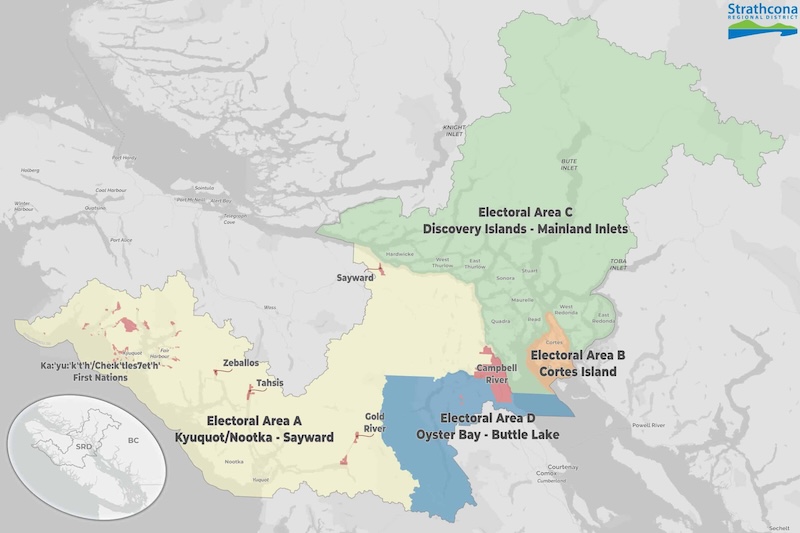
Director Chapman: “I want us to get to a point where we start thinking about the region as a whole. Now, let me give you an example of what I witnessed in economic development. I was never an economic development officer (EDO), but I always had EDOs and they are a pretty tight knit group. When one community was asked about a development, they reviewed it and they said, ‘you know what? We can’t accommodate this, but we know who can.’ They never hesitate to refer it to a community that could help with that development because it was good for the area as a whole. Maybe that municipality didn’t benefit directly, but another one could.”
“We tried to keep as much as we could in our area, and that’s what we need to do here. The regional growth plan has limitations, but that’d be one step. That’s a two or three year process. It has been a while since I’ve done anything like that and legislation has changed, but should we look at that first before proceeding with this. I hate to put more on staff, but you get a consultant in maybe and go over what’s going to be required on a timeline?”
CAO Leitch: “ It’s like an OCP. Area D had an OCP going on for 10 years, but it didn’t inhibit the opportunity. There wasn’t a lot of development there, but that wasn’t ’cause of the lack of an OCP. So I would humbly say again, it’s a good idea, but it’s not going to inhibit development because there’s so many areas that are always going through an OCP, but development happens concurrently with that. They run in parallel. If you want a long range plan, you start working towards that.”
“I think a regional growth management plan would have very little chance of success here unless municipalities joined the planning functions because most EAs don’t want anything higher level than their OCP.”
Director Chapman: “ That was my point. If we looked at organizing a growth strategy, the municipalities who were sitting on the edge might see the benefit and then join.”
Director Sinnott: “ I do think what director Chapman’s raising is important information that we may need for council and our staff to absorb in the pros and cons.”
“Is there any higher level information we can refer back to the regular board to develop, to assist these councils. Could we see 5 or 10 general strategic interconnections that benefit the region as a whole that also would be of interest to municipalities.”
“I’m just thinking like, you’ve got the road out to Gold River and you’ve got Strathcona Lodge, but maybe there’s something we’re not thinking about that way or going out to Tahsis. As a group, do we see that in other regional districts where they’re able to get paving because you’re more regional and now you’re going through zones that are in the EAs as opposed to right in the municipality. These are the kinds of things that I think would help our staff and if we can get it out of the SRD, that would be helpful.”
CAO Leitch: “ In my mind, I would provide that in a presentation at a high level, because you’re going to have legislative advantages. How do you measure some of the intangibles? There’s going to be secondary advantages. Like I always say, the health of Campbell River is important to all our EAs and member municipalities, because it’s the hub here in the North island. Anything that benefits Campbell River, I would argue benefits those areas because we rely on Campbell River.
Director Chapman: “ I think Campbell River is interested in seeing Sayward grow, Gold River grow, Zeballos grow and Tahsis grow because we can’t all have it all happen in Campbell River. I think it’d be advantageous regionally for all the partners to be strong and just not one.”
Director Sinnott: “ I’m conscious that we have a number of missing municipal reps, so I’m going to make a motion to defer to another meeting to be set.”
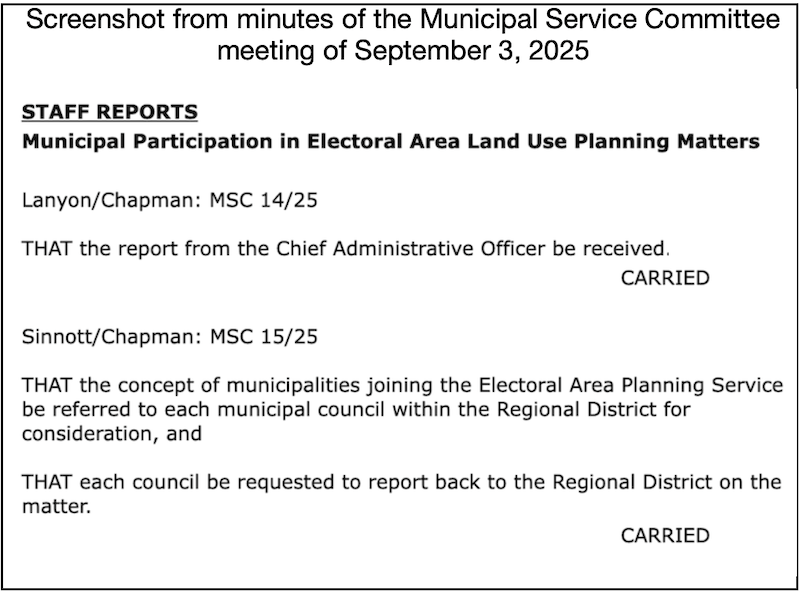
Sinnott moved and Director Chapman seconded a motion “that the concept of municipalities joining the Electoral Areas Planning Service be referred to each municipal council within the Regional District for consideration, and that each council be requested to report back to the Regional District on the matter.”
Mayor Mark Baker of Sayward, Chair of the Municipal Services Committee, declared: ”All in favour of deferral … Opposed? Seeing none, the motion is carried.”
Links of Interest:
- Recording of Sept 3, 2025, Municipal Services Committee meeting
- Recording of Aug 20, 2025, SRD Board Meeting
- Recording of Apr 9, 2025, Municipal Services Committee meeting
Top image credit: Directors Doug Chapman, Kermit Dahl, Ron Kerr, Ben Lanyon and Susan Sinnott all serve on Campbell River’s city council. This is their city hall. – Roy L Hales photo
Sign-up for Cortes Currents email-out:
To receive an emailed catalogue of articles on Cortes Currents, send a (blank) email to subscribe to your desired frequency:
- Daily, (articles posted during the last 24 hours) – [email protected]
- Weekly Digest cortescurrents – [email protected]