


MLA Michele Babchuk was on Cortes Island for a few days last week. She spoke to Cortes Currents after meeting with some of the island’s non-profits in the Village Commons. This was the third time she’s visited the island since she was elected in 2020.
“I’m hearing that Cortes actually has a lot of capacity and we’ve known that for a long time. There’s a lot of not for profit groups here. A lot of them are feeling extremely underfunded,” she explained.
“I’m really excited because in my past visits there’ve been a lot of not-for-profits doing really great work at a grassroots level built specifically on need for the community, which is super heartwarming because it’s a community feel, but now we’re taking a look at those organizations scaling up. They are not dispersing little amounts of money that are not getting where they are needed. I’m seeing a lot of collaboration with people actually taking a look at where there is overlap, where the highest need is and being able to collaborate and scale that up so that you’re actually hitting that next level of service delivery.”

Babchuk has visited a lot of rural communities in her riding.
Michele Babchuk: “I’ve been traveling through the North Island for the last four years, It’s a large riding but I’ve been able to go to all of the communities at least once or twice to see if the direction of the government in housing, health care, public safety, all of that is working for the community, and if not, what are the things that need to change. Rural communities are different from urban communities, different from metropolitan communities and sometimes it feels like we’re fitting a round peg into a square hole. We need to be able to listen to the communities to make that happen.”

Cortes Currents: In the meeting we just came out of, you were mentioning a shift towards a more rural-friendly approach in provincial government policy.
Michele Babchuk: “We’re doing that because Premier Eby has allowed us to form a rural caucus inside of our larger caucus Some of my rural colleagues are having exactly the same challenges that I am fitting some of the initiatives that are happening in our rural centres into the regulatory frameworks of some programs.”
“We see that with BC Housing and the cost per square foot. Over on Cortes, the cost to build is exponential and for Port Hardy – it’s an extra $125 a square foot as soon as you get past Sayward!”
“So even when we were talking about the difference between a stick build, for any sort of social housing, to a modular build we thought maybe that would work – as soon as you add the transportation costs in on that modular build, you’re once again over that threshold. So we weren’t quite fitting in.”
See Also:
Cortes Currents: BC Housing has turned us down three times in a row. We thought the bias was urban versus rural, but what you’re telling me is it’s actually financial.
Michele Babchuk: “I don’t particularly believe it’s urban versus rural, it might be looking like that because of the way the matrix is designed. BC Housing is looking at how that can be fixed. I know that they are still working with Rainbow Ridge, and they’ve received the pre-development funding, I think three times now, to keep that going. I’m advocating very strongly with the Minister of Housing for BC Housing to move forward. We’re still working with Sadhu and the Housing Society here on Rainbow Ridge. Hopefully, fingers crossed, we’ll actually see some results.”
“We’re having bigger conversations about what housing and social housing and affordable ownership looks like on Cortes. I’m very new to the conversation, but I think there’s some really great ideas that are happening here.”
See Also:
Cortes Currents: What’s another topic that came up during your stay on Cortes?
Michele Babchuk: “There is an initiative right now to look at the island class ferries to come over here. I think it’s January- February of 2026. In order to do that, there’s going to have to be some infrastructure upgrades. I have been talking to a couple of people in the community about what that looks like for the community and how those service levels are going to happen. So being able to have that conversation with the ministry already while I’ve been here and put that on the radar.”
“I’m not sure what that’s going to look like because I haven’t had a conversation with BC Ferries yet, and I’m not sure that BC Ferries has that totally worked out yet, but we’re going to have to come up with some modified service level to make sure the Cortes population does have the ability to move. It can’t just be like the ferry’s gone for two months because we’re doing this work.”
“I think BC Ferries is very aware of that, but I would think it would would be best if the transportation group that’s on the island is actually working in lockstep with BC Ferries and having that conversation.”
See Also:
“We’ve also been having a conversation about public transportation and how we can move people from Cortes to Quadra, and Quadra to Campbell River in a more sustainable way, so that we’re not having to take cars. Instead of looking at any sort of temporary service level adaptation. while some of the upgrades are being done, we’re going to start taking a look at being able to move people in a better way. The people involved with the transportation group are looking at lots of different opportunities. They gave me a presentation today. Everything from ride hail to ride sharing, to bus, to electric bus, to all different opportunities, which I think really takes the metrics and boils it down to what people are actually looking for.”
“I’m not sure what this will look like, because it’s not mine to design, but certainly the transportation group that I’ve been having conversations with here and talking with others on Gabriola, which we did this morning, I think we’ve got a really good idea of what needs to happen and we can start that level of advocacy.”

Cortes Currents: What are some of the other topics that came up?
Michele Babchuk: “We’ve had conversations around economic development, conversations with the Cortes Island Community Foundation and with the fire hall. We live in a beautiful forest, and we choose to live in that forest, but with climate change that forest is becoming at risk. How do we mitigate that with FireSmart, with urban interface interventions, and being able to take these volunteer fire calls to a place where they are FireSmart and they’re looking at wildfire suppression, not just structure fire.”
See Also:
Cortes Currents: There were references to a living wage in the meeting we just came out of.
Michele Babchuk: “There has been some studies done on that and at this point that’s not an implementation strategy of the government, but the goal is to make sure that we have our communities where people can afford to live. We’re seeing a lot of factors in that. Like the cost escalation of housing, the cost escalation of groceries.”
“We’ve put some pieces into place to try to mitigate some of the extra money that’s happening there. We’ve dumped some subsidies through ICBC to give people a break on their insurance. The child tax benefit is absolutely huge. We’re funding things that we know affect working families, like childcare and going to the $10 a day childcare and looking at the new spaces funds for childcare. What I will tell you is in the North Island $22 million has gone back into constituents’ pockets because of the child care incentives that we have put forward.”
Cortes Currents: What about BC’s growing provincial debt, (which is expected to reach over $123 billion at the end of the fiscal year 2024/25)?
Michele Babchuk: ”Right now, we are always going to invest in the people of British Columbia. We’ve gone through COVID. We knew that was a challenge. We’re coming out on the other side of COVID. We’re seeing all those costs in escalations. We still have a triple A credit rating. We are managing that debt, very, very well. We will continue to invest in British Columbians as long as that’s what is needed. We’ve listened to Mr. Rustad (Leader of the Conservative Party of BC) talk about reducing the provincial budget by 25%. We’ve seen that in the past. We’ve seen what that looks like for them, and that is cutting public service, cutting doctors, cutting nurses, cutting teachers and then taking away a lot of the social programming that, at this particular point in time, British Columbians need.”

Cortes Currents: Do we have a metric to gauge how far in debt we can go?
Michele Babchuk: “I would have to defer to the Finance Minister for that, but we’re one of the best economies in Canada right now. That’s why you’re seeing a lot of people come here. 10,000 people are coming to British Columbia every 37 days.”
Cortes Currents: Do you happen to know how many people are coming into your riding?
Michele Babchuk: “No, I do not.”
Cortes Currents: But you hear a lot of stories.
Michele Babchuk: “Yes, we’re watching communities grow. It’s not far, two ferries away over to Campbell River, and you can watch the growth there for sure. We’re seeing people remain in the rural parts of the riding that maybe historically would have left as a retiree and gone to a warmer climate like Parksville or Nanaimo or whatnot, but we’re actually watching people stay in place now. We’re not watching any of that movement out.”
“I think rural BC is still considered affordable with their housing, although some people that have lived here for a long time don’t see that from a Vancouver or an urban point of view. Housing is still relatively affordable, but what we need to do is make sure that the services are in those communities to be able to sustain them, because housing’s not everything. You still need to be able to buy groceries, you still need to be able to transport, you still need to be able to recreate.”

Cortes Currents: A lot of my listeners are on Quadra island, have you been there recently?
Michele Babchuk: “I recently met with the Community Foundation there. Was a wonderful, diverse group of people as well. A lot of the same challenges, trying to do a lot with very little, working with volunteer boards that are getting burnt out, that aren’t doing succession planning because we’re not seeing the next generation actually be able to come up and a lot of that is because they are busy trying to make sure their needs are met and their families are taken care of.”
“So we need to take a look at what that looks like going forward and is volunteerism totally the way to go? Should we be trying to get some money in the pockets of the executive directors that are running these institutions? Are we going to be able to incentivize in one way, shape, or form the next generation of society to come up and do some of these volunteer, grassroots needs for the community.”
Cortes Currents: What are you hearing from the non profits themselves?
Michele Babchuk: “The not for profits are usually very, very appreciative of the money that’s coming from the government right now for capital and programs and project initiatives. I’m hearing over and over again that the operating dollars are where they really struggle and in smaller communities. When you’re looking at donations from the communities, they’re burning out those donors at a very high rate.”

Cortes Currents: Is there anything you want to talk about, the floor’s open.
Michele Babchuk: “I’m extremely grateful to be here. I love Cortes. I love the idea of the riding that I serve, the best riding in the world. I don’t know why everybody doesn’t want to come here, although I’ve talked to a lot of Cortesians who say, ‘no, we don’t want everybody here.’” (laughter)
“I would be remiss if I didn’t talk about the fact that we are going into a very political season with the election happening in October.”
“I do have some concerns, not just for my riding, but for rural BC and some of the comments that have come out of some of the opposition parties, in regards to cutting the budget by 25%, which means they’re cutting public service and social funding. Usually that’s where they have a tendency to go.”
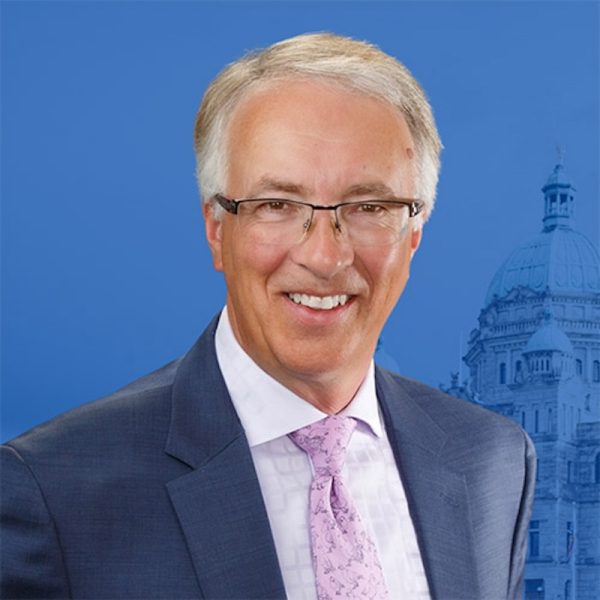
“We have an opposition leader (John Rustad) who is talking about the idea that human caused climate change isn’t real. I know that’s something that is extremely important in this riding. As Islanders, we all have a very large environmental ethic and we’re seeing that play out in everybody’s everyday life whether it’s from FireSmarting communities like we talked about earlier with the fire department to, being able to grow our local food and have food security.”
“I’m also really concerned about the fact that the opposition leader has also talked about cancelling DRIPA or rolling DRIPA back.”
“One of the things that I’m most proud about with the government that I am in, is the fact that we are giving our Indigenous communities that level of self determination that they have not had in the past. I think our responsibility is to make sure that they are participating at a level in our society that makes them full community partners and gives them self determination. That’s something that they’ve never had. That’s something that we as a government are prioritizing. Our responsibility is to be treating people of all stripes exactly the same way and they have been in a suppressed situation for many years.”
“I know that it’s a cultural shift for some people, but education and learning about some of the atrocities that have happened in the past is part of that recognition. I have talked to people that are my parents’ age that had no idea that some of that was going on and are sitting back now and saying, Oh my gosh, right? We didn’t realize that that was the case.”
“I, myself, was born in 1965. If I had been Indigenous, they could have walked into my parents house and taken me away and put me in a residential school. That’s not something that my mom and dad ever thought about. And they’re thinking about that now, because it’s been highlighted and going, ‘holy smokes’ like, we put a whole demographic of our society into a state of poverty and into a state of angst and into a state where they didn’t feel like they had any power at all.”
“Now with those conversations, things are starting to turn around and as an elected official, I’m extremely proud of that.”
If you were listening to this interview closely, you may have heard a breeze hitting my mic when Babchuk first spoke. Then we moved inside my car, to ensure the audio was clear. This was the last night of Babchuk’s visit. After our interview, she’d walk over to the Burger Barn to meet her husband for supper. After about 40 minutes, I told her I had ‘one last question,’ but her answer sparked yet another. It was 6:30 and the Burger Barn closes at 7:00. I don’t know if she was thinking about this, but I was and I was also aware that we don’t often have long interviews like this.
Michele Babchuk: “You said ‘last question,’ Roy. (laugher) I can see the wheels turning.” (laughter)

Cortes Currents: What’s it like coming to Cortes?
Michele Babchuk: “As soon as I get off the ferry, the level of stress here just depletes for me. It just feels cathartic. I can come here, I can participate, I can talk to people, the level of conversation is great, it’s grassroots, and it just feels fantastic.”
There was a moment of silence, then she added, “I’m getting out of the car before you think of another question.” (laughter)
Links of Interest
- Michele Babchuk’s Facebook page
- Articles about, or mentioning, Michele Babchuk on Cortes Currents
- Articles about, or mentioning, the 2024 provincial election
Top image credit: Arriving on Cortes Island – courtesy Michele Babchuk’s Facebook page
To receive an emailed catalogue of articles on Cortes Currents, send a (blank) email to subscribe to your desired frequency:
- Daily, (articles posted during the last 24 hours) – [email protected]
- Weekly Digest cortescurrents – [email protected]