


While most of the Strathcona Regional District’s costs can be directly allocated to specific areas, others are labelled administration costs and need to be shared among the 10 communities. At their February 19 meeting the SRD Board discussed ways to make a more fair allocation of this expense.
Chief Administrative Officer David Leitch explained, “ To put this in perspective, let’s say the SRD’s total budget is $20 million or whatever it may be this year, we’re talking about the $2.8 million for admin costs.”
Campbell River has close to three quarters of the SRD’s population, but only contributes $1.6 million towards the $2.8 million administration bill. That’s just under 56%. Some Campbell River Directors dispute that number and most appear to think they are paying too much for a service they derive very little benefit from. Mayor Kermit Dahl served notice that at the next SRD Board meeting he will move to slash Campbell River’s contribution by 82%.
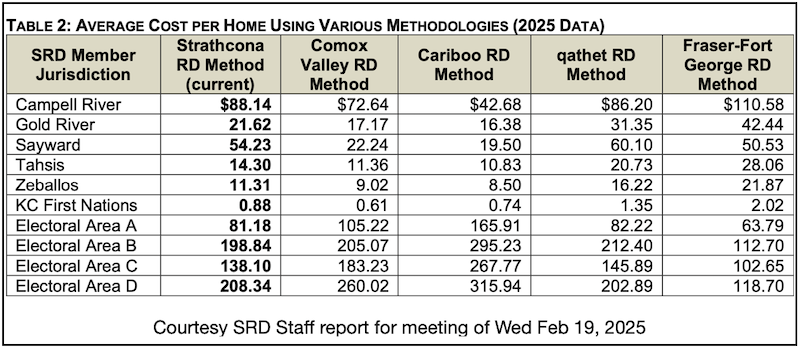
According to SRD staff in 2024, the average Campbell River resident paid $88.14 a year towards the SRD’s administration costs. This is substantially more than municipalities like Sayward, Tahsis or Zeballos, but far less than most of the Electoral Areas. The exception is Area A, where property owners pay almost the same amount as their Campbell River counterparts. In Area D and Cortes Island, property owners pay more than twice as much as their Campbell River counterparts, $208.34 and $198.84 respectively. The margin is less on Quadra Island but, at $138.10 per property, they are still paying substantially more.
John Rice, Regional Director for Area D, pointed out that his constituents are paying more than anywhere else in the SRD.
According to Gerald Whalley, the only remaining Director from when the SRD was set up, “I was here in 2010 and I remember we hired a new CFO, Mrs.Christensen from Campbell River. She worked as a CFO at Campbell River City and she came up with a new system that would reduce Campbell River’s budget and download it onto electoral areas. At that time, the municipalities were delighted, and that’s what happened.”
He pointed out that, according to the statistics staff presented, “Campbell River pays 55.88% (of the $2.8 million). Electoral areas are paying 42.58%. So we’re paying almost half.”
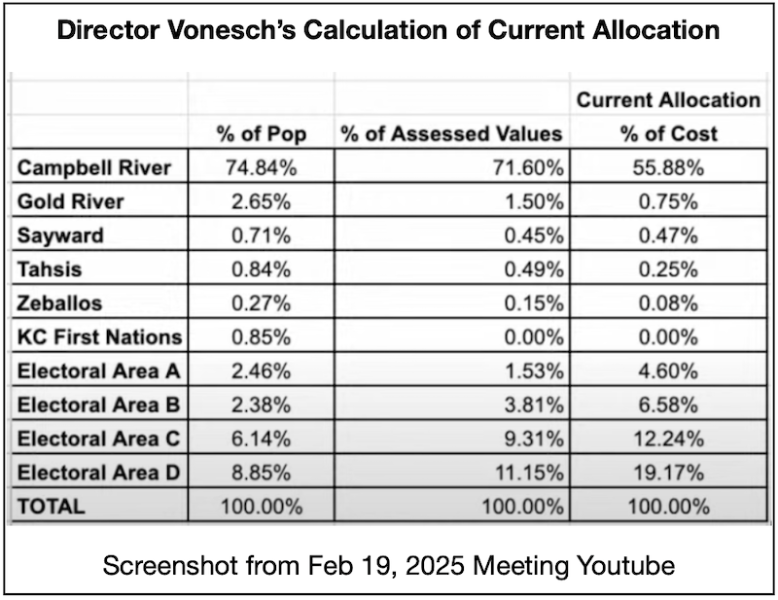
Director Mark Vonesch, from Cortes Island, agreed with those figures, adding, “ if we did it completely by assessed values, Campbell River would be paying 71.6%. Similarly using the proportion of population, Campbell River would pay 74%. All I’m asking for, is let’s just take a little bit of extra time and have a bit more discussion and analysis so that we can make a good decision for everyone. I think we all want that.”
CAO Leitch: “It’s never as cut and dry as that. When you say electors are paying their own costs, let’s say you have a planning item function and it’s worked through their planning. When it gets to the table, there is a corporate administration that’s coming through another share. Even in Campbell River, it’s a blended rate. For regional services, we’ve always said it’s 70%, but then if you take support services their blended rate is about 65%.”
Campbell River Director Doug Chapman said, “ I have worked in local government for 36 years, so I’m not totally ignorant of what goes on. If staff look at the emails that come in, the phone calls that come in, I bet it’s predominantly electoral area issues. Municipalities have their own staff to deal with their own things. The electoral areas depend heavily on senior staff at the regional district level and that’s fair.”
“I agree with Director Rice that the per household allotment for Area D is higher, but in my opinion and I haven’t studied it, Area D offers more services to their residents.”
As for the $88 a year that the average Campbell River property owner is said to pay, Chapman protested, “that’s just for residential. We’re not factoring in what the commercial properties are paying the regional district. It’d be a lot higher than $88. I don’t want that being lost.”
Chief Financial Officer Mike Harmston gave a presentation of how the SRD’s allotments would change if they followed one of the systems used by four other regional districts.

Gerald Whalley: “ I don’t think any of these other regional districts even come close to our situation. For example, the Caribou Regional District has 12 electoral areas and only four municipalities. Of course, electoral areas are going to pay more in the Caribou. They’re paying 75% of the administration, it just makes sense. Here in the SRD, the planning department for electoral areas has a small number of employees, but general administration and all our other staff is a vast number. That’s not an electoral area responsibility solely, that’s the responsibility of the entire board.”
CAO Leitch: “Our policy, I would say, is closest to Fraser Fort George Regional District, but our practicality of why assessment wouldn’t work here, because they offer so many regional services and we don’t.”
(If we were following an allotment system like they use at Fraser Fort George, Campbell River would be paying more and the electoral areas considerably less.)
Director Susan Sinnott, from Campbell River, said, “W e don’t have a lot of regional services. The municipalities are paying for stuff that normally is done in a regional district. What is the value that each municipality is getting from the Regional District?”
Director Ron Kerr, also from Campbell River, added, “For 15 years, Campbell River has had a regional support philosophy. We know that we’re the hub of the area, and we’ve had a philosophy that what’s good for us is good for the region, but not so with a lot of the communities and electoral areas around us.”
“I’ve lived in them, I’ve been in this area for 50 years. I know the joke about being on the other side of the dividing line between Campbell River and whether it’s the islands or north or south. You get all the services, you get all the amenities, you get all the benefits of being in the city, but you get lower taxes. It’s not just the money, it’s not just the dollars. I think it’s appreciation of what Campbell River has done, and I think it’s time to change.”
Campbell River Director Ben Lanyon explained, “I’ve been questioning the value that is being returned to the taxpayers of Campbell River. There’s a few sources of that consternation and I feel like in some sense it’s a value clash on certain things. You have a certain portion of the directorship that is more ‘climate activist.’ You have some that’s more jobs and industry focused. I think we can all share that we have a housing concern but, even so, I see some areas not approving things that I would have approved. Overall, I see us moving at a snail’s pace. I see individual areas seeking their own interests and generally just ignoring the regional interests.”
“The only value that Campbell River will get to justify its level of participation in this admin budget is the utilization of the SRD for added services. We’ve seen total opposition to those. We haven’t been able to do anything. I’ve seen some strange voting dynamics, where it’s really the tail wagging the dog in a lot of cases.
“Going on to what’s the source of the gut feel that there’s something very wrong here, when you look at the agenda, you see that it’s predominantly electoral area business, which is understandable because you don’t have your own local government to handle most of your issues. I did some agenda analysis with AI and I came to the conclusion that this is about 60% Electoral Areas business. These $2.8 million administrative costs that we’re talking about, those are the wraparound things that you can’t possibly directly assign. All of the direct staff and planning services like Strathcona Gardens are directly allocated.”
“This is what’s left over and we’re trying to figure out who should pay for what. I agree, fairness is very hard to achieve. I think you could define it as who gets the value or you can define it as who’s consuming. In both of those cases, the area directors are consuming a disproportionate amount, at least in comparison to what’s being paid.”
“We have the city of Campbell overpaying, just over 70% of that $2.8 million. We’ve got the other municipalities contributing about 2.7 or 3%, which is relative to their population. Then the area directors are paying about 25%-25%, somewhere in there, but I really truly feel like we’re talking about area directors consuming about 60% of the total resources of the organization.”
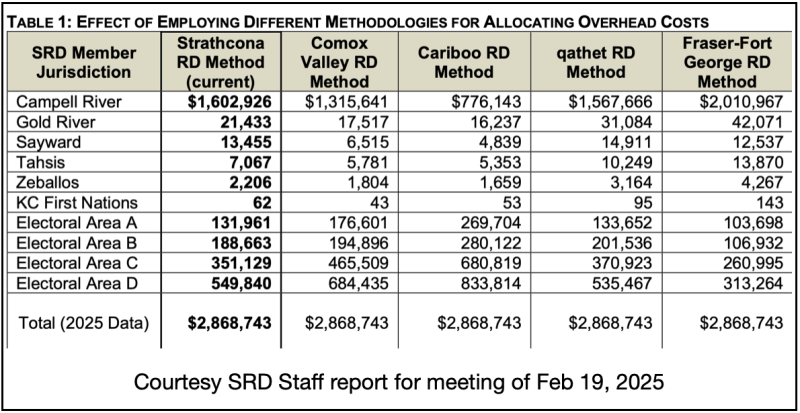
This calls for a fact check. Director Lanyon just claimed that only a quarter of the money going to administrative costs comes from electoral areas and over 70% comes from Campbell River. Directors Whalley and Vonesch said the electoral areas are paying 42.58%. They are correct according to the chart supplied by staff. The total electoral area contribution is $1,221,593, which is 42.58% of the total given for administrative costs. It’s not clear how commercial assessments factor in, or if they need to be added, but the chart shows Campbell River’s contribution to the $2.8 million as only 55.88%.
Director Lanyon: Long term what I would like to see is an addition of regional services for the benefit of promoting jobs and tourism and industry and affordable housing to match those jobs. Increase the population, increase the wellbeing of the municipalities on the North island and, to the extent that they’ll cooperate, the area directors.”
“I think we’ve had great cooperation with John Rice. He’s been in some awkward situations, so I’d like to ensure that we don’t cause any long-term harm to Area D through cost reallocation. I think initially that’ll be inevitable, but I think we can work something out.”
Mayor Kermit Dahl declared, “ Just be prepared on March 26 for me to make a motion to reduce the tax requisition requirements from the city of Campbell River by $1.3 million and then you can figure it out. Because we are paying $1.6 million dollars for administration costs that I see very little to no value in. Maybe 20 years ago, the city of Campbell River got value from it, but they don’t now. The city already pays for a CAO, we already pay for a planning department. We already have these things, but have to pay for them again within the SRD. Every time for the previous two years that we’ve tried to get regional services considered we’ve been defeated. When we talked about regional transportation, we were told how it would only benefit Zeballos or Tahsis and Campbell River, but Cortes and Sayward and Quadra weren’t interested in it. You didn’t vote for it. You wanted to start your own Cortes transportation afterwards. We’ve tried for two years to get value here by having regional services, and for two years, that’s been defeated. So on March 26th, things will change.”
Director Vonesch: “ We had some issues with transit for sure, but we have fire, we have housing. We have two new regional services that are benefiting the whole region. All we’re asking for is let’s get this right. Let’s get it fair so that you’re happy, so that we’re happy, and that we can say we did this fairly.”
Gerald Whalley: “We should defer this to the Committee Of The Whole, because this is really complicated stuff, and come up with our own ‘made in the Strathcona area’ policies. We just can’t go willy nilly and look at the chart and say, ‘Oh, well, my area is going to save $45 bucks if we do this.’ That’s not fair, that doesn’t make sense. Let’s discuss it, come up with all the different options, get some policies behind it, and work out something that’s fair. There’s no rush on this.”
Regional Director Robyn Mawhinney of Area C suggested, “ We really need to have a conversation about what makes sense for our regional district. I’m not going to say that it doesn’t make sense to increase the rates because I don’t know, but I don’t really think that we have enough information. I think it’s really important that we are making this decision, not from a reactive place, but from a thoughtful place.”
The Campbell River Directors voted against having a Committee of the Whole Meeting.
CAO Leitch: “ I don’t see much point if no one from Campbell River is there.”
Mayor Dahl reiterated his threat that things will change at the next SRD Board meeting.
Mayor Julie Colborne of Zeballos said, “We know what’s going to happen on the 26th, we need to find a policy in some way moving forward during the other years, so this doesn’t happen every year. We still have two more years (until the next election).”
Director Lanyon made a comment which appears to refer to the rural sentiments in favour of preserving the environment, old growth forests and wild salmon stocks. Forestry and the salmon farm industry are two of Campbell River’s three economic pillars. (The third one is tourism.)
Ben Lanyon: “ I’m seeing too much pressure in terms of ecological activism. I’m serious. You will shut down anything, any development or business that you can.”
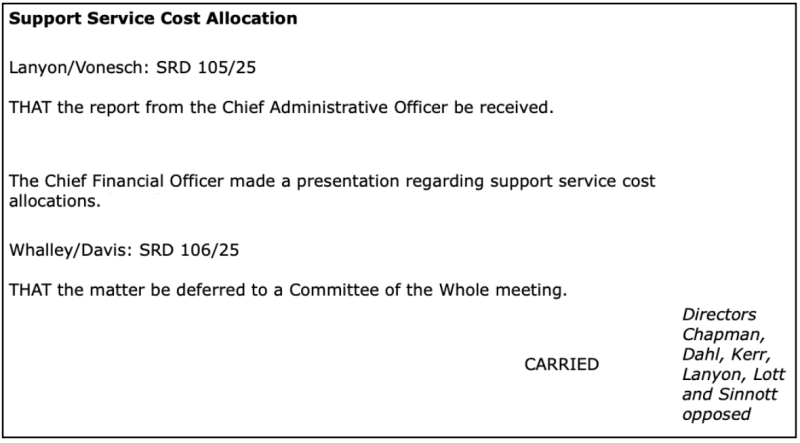
You have been reading highly edited gleanings from a segment of the February 19 SRD Board meeting that lasted for over an hour and twenty minutes.
Links of Interest:
- Opposition to being asked to pay for Campbell River’s REC-REATE Strathcona Gardens project
- Articles about the SRD Housing Service
- Articles about the SRD Fire Service
- Articles about the proposed SRD Transit System
- Articles about alternates to automobile transportation on Cortes Island
- Articles about alternatives to automobile transportation on Quadra Island
- Articles about the Caddisfly Wetlands Restoration Project
- Articles about the SRD Board
Top image credit: Campbell River by Darren Kirby via Flickr (CC BY-SA 2.0)
Sign-up for Cortes Currents email-out:
To receive an emailed catalogue of articles on Cortes Currents, send a (blank) email to subscribe to your desired frequency:
- Daily, (articles posted during the last 24 hours) – [email protected]
- Weekly Digest cortescurrents – [email protected]