

When Jan Zwicky talked about the need to be independent of the grid, she referred to a 60 second power outage at 4 AM last year. Zwicky wasn’t aware there was a problem until she went into the basement three days later. Her freezer, which had been packed with food, was still off. Most of the contents were ruined.
Zwicky said she is not dependant on a computer and has a back-up system that can keep the lights on, “ But boy, I don’t want that freezer to fall apart!”
“So I think I can encourage all of us to do an energy inventory. Where do you really need it? What would it take to keep you functional?” she said.
Mike Gall added, “We’ve learned very quickly in the past two years, and then in particular, in the last two months: how fragile our systems of sustaining our society truly are.”
Both Quadra and Cortes Islands receive their electricity via a cable from off-island.
“All it takes is a severing of that artery and suddenly we’re into a 2, 3, 4 week scramble to try and live with literally no electricity available to us other than what we can do by running generators or some secondary means of supplying our electrical requirements,” he said.
Jan Zwicky and Mike Gall are members of Quadra Island’s Energy Self Sufficiency team, one of several groups that came out of the community meeting which launched ICAN, in March 2020.
“It was suggested that we divide up into interest groups and energy was one of them. I ended up talking with Rod Burns and Jack Segal. Those were the two folks most interested in energy. I’m really aware of the places where for me electrical energy is essential and I don’t trust the grid staying up,” Zwicky explained.
She remembers Quadra Island losing power for 10 days, when a hurricane struck in 2014.
Zwicky was living in Edmonton in 1994, when the Northridge earthquake in California took out Alberta’s grid.
That was when it dawned on her, “This is a continental system. You can’t count on it’s being there if there’s a crisis somewhere else.”
“We believe that there will be upcoming stresses on the energy system. There’s going to be way more price hikes , but also a lot of our energy contributes to climate crisis,” said Zwicky. “We’re encouraging awareness of ways in which energy can be conserved to make your life less dependent on the grid and then awareness of alternative ways of satisfying your energy needs to make you even more independent of the grid.”
The energy self sufficiency team is working on a number of projects right now. They’re putting solar panels on the roof of Quadra Elementary School. They also intend to hold workshops on an inexpensive DYI window insulation; testing, cleaning, and recharging batteries; and on the pros and cons of various solar heating systems.
The ICAN energy self sufficiency team also supported the recent Canoe Pass Tidal energy project on Quadra Island which, according to the Quadra ICAN website,” hinged on government’s willingness to allow a non-profit island energy co-op to participate in BC Hydro’s net metering program.”
However, the Energy Self Sufficiency team says Quadra residents will need to do more than just produce more energy.
“The first step is the conservation mode, learning all the techniques that you can possibly garner to bring your energy consumption levels down,” said Gall.
Some ways that we are vulnerable when the grid goes down:
- Many houses are heated and obtain light through electricity
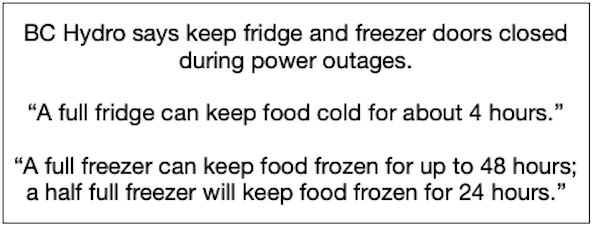
- Fridges and freezers require electricity
- Much of the food in stores needs to be refrigerated (and is usually transported for hundreds or even thousands of miles!)
- While no electricity is needed to store dried foods, it was used to dehydrate them.
- The water in many wells cannot be accessed without electricity to drive their pumps.
- Many septic systems were installed uphill of houses, which means they do not function when the grid goes down.
Zwicky pointed out that throughout most of humanity’s existence, there was no electricity. She remembers her grandparent’s excitement when it was hooked up to their home.
“I read somewhere that the expenditure in an average middle-class home is equivalent to having 89 slaves. So that’s one thing that energy does. It helps democratize a culture,” she said. “We don’t want to go back to the time when there were people who only did all the work that electricity allows us to avoid. We want everyone to continue to enjoy a really good life, but with a lower expenditure of energy.”
Gall pointed out that some supposedly green energy solutions – like solar panels with a Tesla battery pack – are expensive, and require a technician to maintain them.
The Energy Self Sufficiency team endorses less expensive low tech solutions.
“What are you going to do when the grid goes down for four weeks? What if it goes down in the summer? What’s your big issue? I think it’s going to be water. What if it goes down in the winter, what’s your big issue. It’s going to be [heat or] food preservation,” said Zwicky. “Think of ways that the community as a whole can be resilient.”
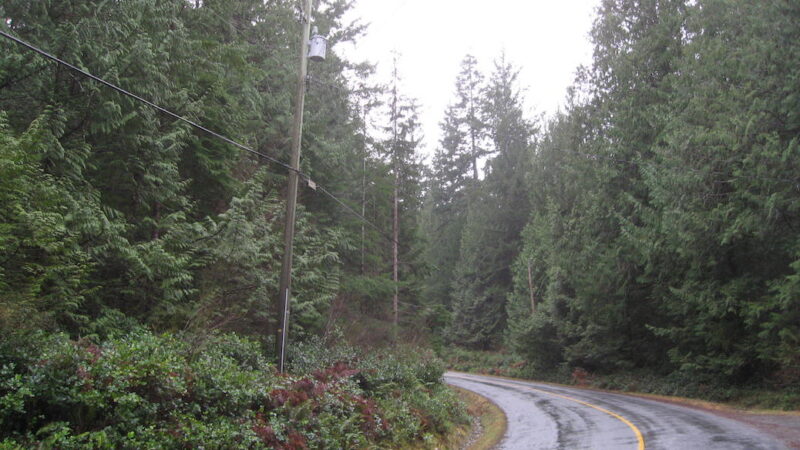
Top photo credit: Power lines Photo by natsuki on Unsplash
Sign-up for Cortes Currents email-out:
To receive an emailed catalogue of articles on Cortes Currents, send a (blank) email to subscribe to your desired frequency:
- Daily, (articles posted during the last 24 hours) – [email protected]
- Weekly Digest cortescurrents – [email protected]