
Tag Archives: Coastal Gaslink

The last 33 caribou: fighting for the survival of a Wet’suwet’en herd

By Matt Simmons, The Narwhal, Local Journalism Initiative reporter

There’s a serene pocket of mountainous habitat in northwest B.C. where 33 caribou live, drinking from glacial-fed creeks and grazing on alpine lichens. Though it’s peaceful, they have nowhere to go. They’re surrounded.

They’ve been cut off from where they gave birth to their young and the tracts of land that supported them through the long northern winters by highways, hydroelectric dams, rail lines, clearcuts and farmland. The herd’s range has been fragmented for more than a century and faces imminent threats.

Continue reading The last 33 caribou: fighting for the survival of a Wet’suwet’en herd
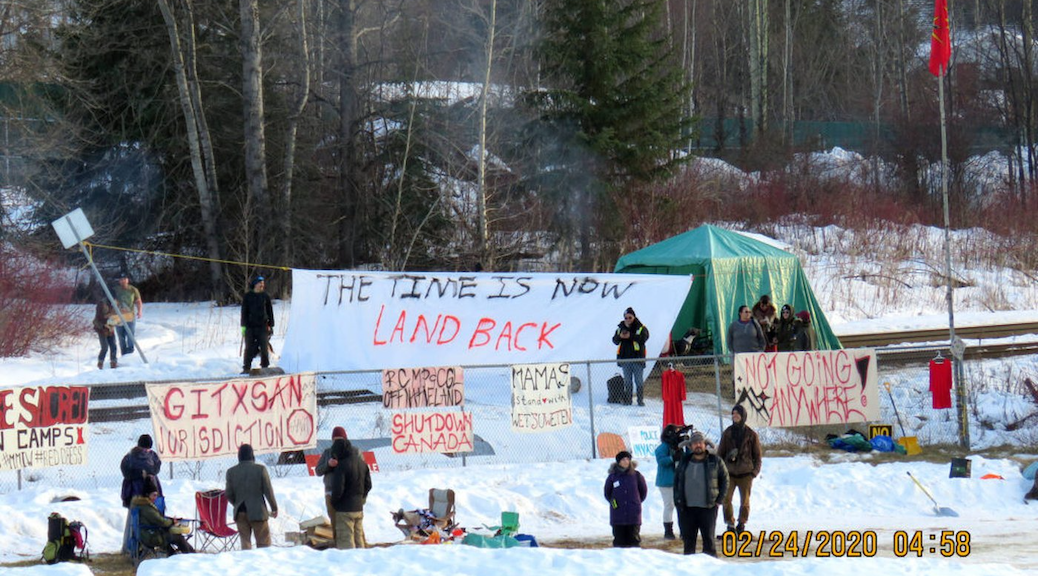
RCMP do not agree to abide by Gitxsan chiefs’ ban on ‘militarized squadron’

By Kaitlyn Bailey, Prince Rupert Northern View, Local Journalism Initiative Reporter

The B.C. RCMP will not respect a ban from the Gitxsan hereditary chiefs which prohibits the police force’s Community-Industry Response Group (C-IRG) from entering their traditional territories.

In an email to Black Press Media, Sgt. Kris Clark wrote that while the B.C. RCMP will “do everything possible” to respect the ban, they have obligations and responsibilities to enforce court injunctions and maintain public safety.

The C-IRG unit is “uniquely situated” to do these tasks through specific training and resources, Clark stated.

Continue reading RCMP do not agree to abide by Gitxsan chiefs’ ban on ‘militarized squadron’

An invisible climate killer is lurking behind B.C.’s LNG boom

By Matt Simmons, The Narwhal, Local Journalism Initiative reporter

Invisible to the naked eye, undetectable by smell and 80 times more powerful than carbon dioxide for its  short-term warming impact on the climate, methane is explosive, toxic  and can make helicopters fall out of the sky. It’s like something out of a superhero movie — or a bad dream.

About half of Canada’s reported methane emissions  are produced by the oil and gas industry, both from regular operations  and leaks. But much of the climate damage caused by the sector’s methane  pollution goes undetected due to weak regulations.

Continue reading An invisible climate killer is lurking behind B.C.’s LNG boom

‘We should avoid monitoring’: feds quietly backed off while Coastal GasLink pipeline work killed fish

By Matt Simmons, The Narwhal, Local Journalism Initiative reporter

On a dreary gray day in late October, passers by gawked at a scene outside a hotel in Smithers, B.C. The charred remnants of several trucks sat in the parking lot in the wake of what police described as a “targeted attack” in the pre-dawn hours of the morning. 

Among the blackened wreckage were four police cruisers — marked and unmarked vehicles with the RCMP’s Community-Industry Response Group, a special task force assigned to police opposition to industrial projects. The controversial RCMP unit maintains a constant presence on Wet’suwet’en yintah (territory) where Coastal GasLink (CGL) is building a pipeline without the consent of the nation’s Hereditary Chiefs. 

Continue reading ‘We should avoid monitoring’: feds quietly backed off while Coastal GasLink pipeline work killed fish

Coastal GasLink bill climbs to $14.5B amidst continued opposition and environmental woes

By Natasha Bulowski, Canada’s National Observer, Local Journalism Initiative Reporter

Environmental and financial woes continue for another Canadian mega-project as TC Energy announces construction costs have ballooned to $14.5 billion for its natural gas pipeline in B.C.

The 670-kilometre Coastal GasLink pipeline originally had an estimated $6.6-billion price tag. The project — which has faced staunch opposition from Wet’suwet’en hereditary leadership and received three environmental fines to date — will transport natural gas from northeastern B.C. to the country’s first liquefied natural gas (LNG) processing and export facility in Kitimat, B.C.

Continue reading Coastal GasLink bill climbs to $14.5B amidst continued opposition and environmental woes