

The offshore region between Northern Vancouver Island and Haida Gwaii is one of the most seismically active regions in Canada. There have been more than 2,000 earthquakes during the last 4 to 5 years, and four of them measured more than 6 on the richer scale. While the magnitude 2.9 quake in Campbell River last February was smaller, it is a reminder that earthquakes happen here. In this morning’s broadcast Andrew Schaeffer, an Earthquake Seismologist with the Geological Survey of Canada, describes the network of seismic stations that observe earthquakes off the West Coast
Continue reading Observing Earthquakes off the West CoastTag Archives: Hakai Institute

DFO: a potentially transformative decade
National Observer, Local Journalism Initiative Reporter
Canada is in the enviable position of having the longest coastline in the world. But our trio of oceans is being battered by a storm of negative impacts, be it overexploited fish stocks, plastics pollution, degrading marine food webs, increasingly fragile coastal ecosystems or biodiversity loss accelerated by ocean warming and acidification. Yet, at the very crest of their vulnerability, Canada’s oceans may stand to benefit from a potentially transformative decade.
Continue reading DFO: a potentially transformative decade
The Discovery Islands Sea Star Monitoring Program

Friends of Cortes Island (FOCI) has become the Hakai Institute‘s first partner in a new citizen science sea star monitoring program.
As Helen Hall, Executive Director of FOCI explained, “”We just launched a really exciting joint project with the Hakai Institute. They are initiating a project to monitor the health of Sea Stars in the Discovery Islands and we can contribute from Cortes Island.”
Continue reading The Discovery Islands Sea Star Monitoring Program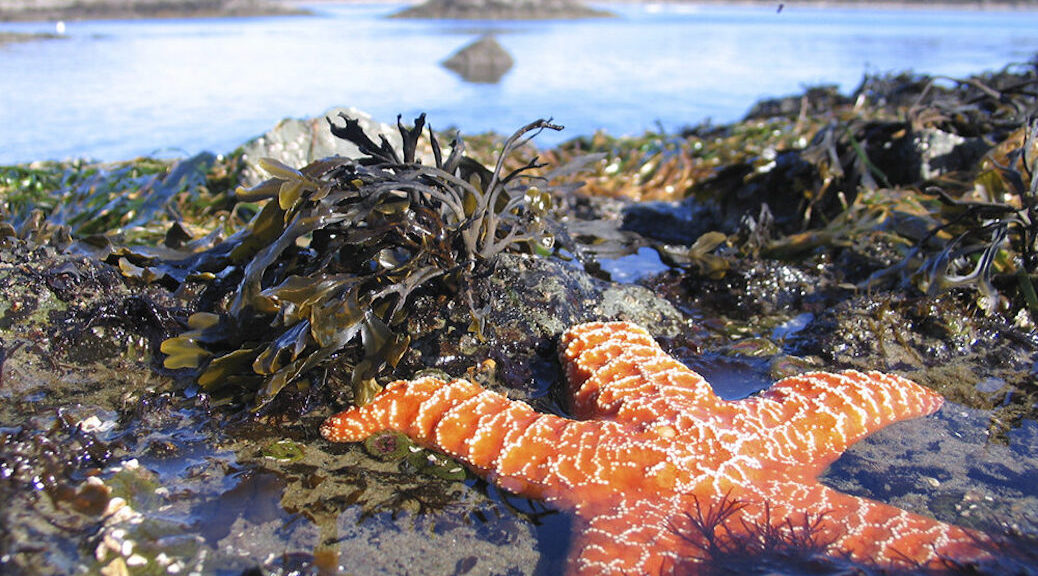
Sea Stars – Wolves of the Ocean floor
Kelly Fretwell from the Hakai Institute recently described sea stars as wolves of the ocean floor.
The topic came up when I mentioned that they prey upon the oysters in Gorge Harbour, on Cortes Island.
Julia Rendall, President of the Bee Islets Growers Corporation, said they normally eat about a third of her crop. The bottom clusters are “all chewed, eaten.” She remembers the summer that Sea Star Wasting Disease reached the Gorge.
“That was the year I had the very best harvest, for shuck oysters,” said Rendall … I got about $8,000 a raft instead of $5,000.”
Continue reading Sea Stars – Wolves of the Ocean floor
Sea Star Wasting Disease
“Sunflower Sea Stars are one of the largest and fastest sea stars in the world’s oceans and a decade ago they were a common sight from Mexico to Alaska. Now this once abundant predator is missing from most of its range. The Global population has shrunk by over 90%, a decline that recently earned them the ICUN Red List status of “critically endangered.”
“So what happened?”
Continue reading Sea Star Wasting Disease