Category Archives: Rivers & Oceans

Ancient clam gardens nourish the Mamalilikulla’s past and future

Canada’s National Observer, Local Journalism Initiative Reporter

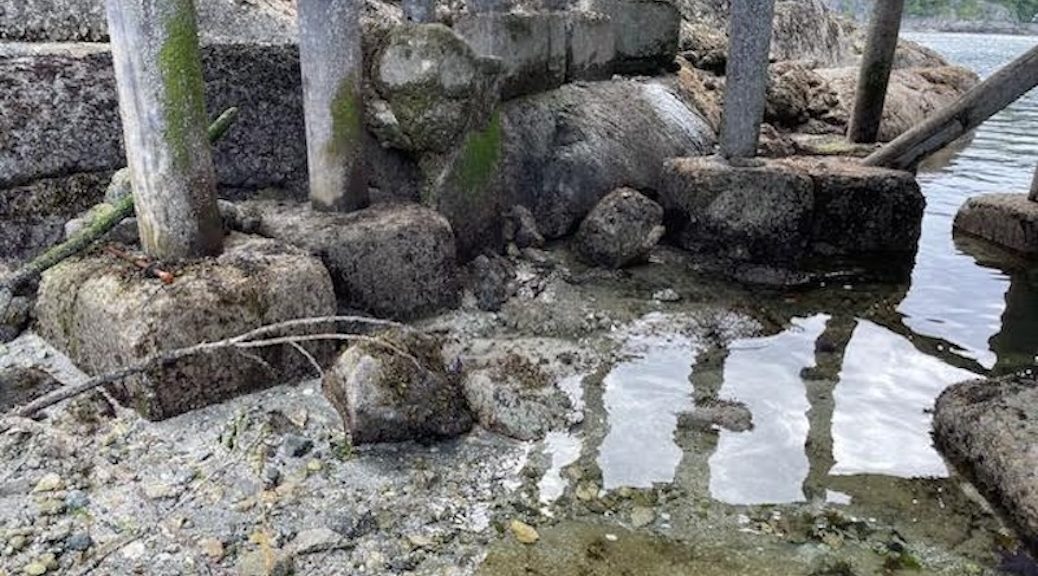
Mamalilikulla Chief Winidi, or John Powell, wiggles his pitchfork back and forth to loosen the sand and gravel along a remote stretch of beach in the Broughton Archipelago, sandwiched between Vancouver Island and the BC mainland.

As he churns over layers of sediment, a fistful of clams surface with a couple of disturbingly large, fiery red marine worms that flail hundreds of legs to rapidly burrow back into the sand.

“Look at all those worms. That’s a good sign,” Powell said.  

“You see those a lot when you’re digging. They seem to aerate the soil.” 

Continue reading Ancient clam gardens nourish the Mamalilikulla’s past and future

Oyster update

From the Cortes Island Seafood Association

First, some relevant facts —

  1. Under the Pleasure Craft and Non-Pleasure Craft Sewage Pollution Prevention Regulations, Gorge Harbour has been a no-discharge-zone for boater sewage waste since June, 2000.
  2. Under the terms of the CSSP (Canadian Shellfish Sanitation Program), the presence of actual or potential pollution sources, which includes transient boats, warrants a preventive closure recommendation.
  3. In 2012, Environment Canada made a preventive seasonal closure on the west end of the Gorge due to the presence of recreational boats; this was not a pollution event.
  4. In early Dec 2024, there was an illness report on oysters shipped from a Gorge Harbour oyster farm to Vancouver.  An illness report goes to Coastal Health, the BC Centre for Disease Control, the Canada Food Inspection Agency and back to the Federally Registered Shellfish Plant. Inspection and testing at the restaurant is done by Coastal Health. In this case, a Michelin star restaurant in Vancouver served only oysters from Gorge Harbour, ie., there were no other oysters involved.
  5. Today, we have 55+ boats anchored out, some with people living in them. And more seasonally moored liveaboards will soon be moving into the harbour.

The pressing problem now —

Continue reading Oyster update

Summer Moorage Spots on Cortes Island

Harbour Authority Cortes Island (HACI) started taking applications for summer moorage spots at 9 AM on April 1st. 

Harbour Master Jenny Hartwick explained, “What’s happened over the last few years on Cortes, especially after Covid,  is we’ve seen a steady increase in summer visitors  and local residents getting out on the water. That puts additional pressure on the available moorage that we have at the docks.”

“The one point that I want to make really clear is we have ample space available for anyone who is looking for moorage at the docks. What we do not necessarily have available is moorage at your first choice dock.  We have some  areas of higher population density and the docks that are in those areas tend to be the most popular. For safety reasons, we cannot accommodate every single boat that puts in a request for moorage at those docks.  If we tried,  there would be too many security issues: be it vessels getting damaged or the possibility of people getting hurt and, literally, the facilities themselves wouldn’t be able to support the weight of all of the boats that we have asking to stay there.”

Continue reading Summer Moorage Spots on Cortes Island

‘I wish we had our territory back’: Influx of float homes in Clayoquot Sound forces Tla-o-qui-aht families to go farther for traditional foods

By Nora O’Malley, Ha-Shilth-Sa, Local Journalism Initiative Reporter

This is article is part of a series of stories on Nuu-chah-nulth clam gardens.

Clayoquot Sound, B.C. – From the captain’s seat of his fishing boat called ‘La Fortune’, Tla-o-qui-aht First Nation (TFN) fisherman Leo Jon Manson popped the lid off the proverbial can of worms labelled ‘float homes’. 

Float homes are encroaching cultural and harvesting sites in Tla-o-qui-aht territory, says Manson. One spot in particular, Lemmens Inlet, a protected body of water located just north of Tofino that cuts into Meares Island, has succumbed to the region’s “laidback” regulations on float homes.

“We still have some spots in our territory, but we have to travel farther away from Opitsaht or Načiks (Tofino). We have to go farther back in the inlets. Our local grounds are gone, pretty much,” Manson said.

Continue reading ‘I wish we had our territory back’: Influx of float homes in Clayoquot Sound forces Tla-o-qui-aht families to go farther for traditional foods

Fisheries and Oceans Canada expects to flounder under mounting climate costs

Canada’s National Observer, Local Journalism Initiative Reporter

Hurricane Fiona left a trail of destruction across the Atlantic Coast in September 2022 wreaking havoc on wharves, fisheries, vessels, and gear and the federal government’s pocketbook.

In response to the climate disaster, Fisheries and Oceans Canada (DFO) has had to earmark more than $563 million to deal with Fiona’s aftermath, including damage to 142 out of 184 small craft harbours on the Atlantic coast.

However, internal communications obtained by Canada’s National Observer suggest that Hurricane Fiona was just a harbinger of escalating climate-related costs and operational threats DFO expects to face in the coming years. With a shrinking budget, the department is bracing for more severe financial and logistical challenges as the climate crisis intensifies.

Continue reading Fisheries and Oceans Canada expects to flounder under mounting climate costs