
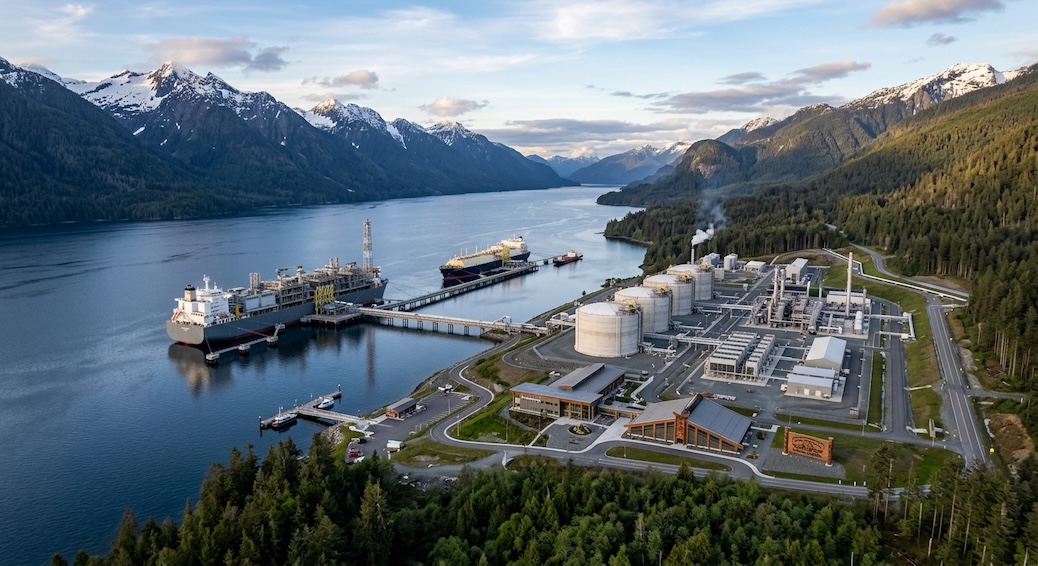

Germany is a leader in the global energy transition. It is also one of the few nations whose emissions are falling at a rate close to what Climate Action Tracker says is needed to limit the rise in average global temperatures to 1.7°C. Yet last week, Germany’s leading utility, Securing Energy for Europe (SEFE), signed an agreement to purchase one million tonnes of Canadian LNG per annum for up to 20 years. What does this mean for Canada, Germany and the world, in terms of emissions?
What the press release claims
Tim Hodgson, Canada’s Minister of Energy and Natural Resources, declared, “Today’s agreement between Ksi Lisims LNG and SEFE is about much more than energy – it is about delivering on our promise to build a stronger, more sovereign economy that generates opportunities and prosperity for Canadians.”
Premier David Eby said, “B.C. has championed Ksi Lisims LNG with the Nisga’a for years, together with getting it added to the federal major projects list. Glad to be feeding the puck up the boards to the federal government on this; congratulations to Prime Minister Mark Carney on putting the puck in the net, side-by-side with our new partners in Germany.”
Eva Clayton, President of Nisg̱a’a Lisims Government, added,”This is the kind of project the world needs as it transitions to a lower carbon future.”
Germany’s emissions and LNG
Only, in this case, there is no energy transition.
If the product is shipped to Germany. it would merely replace other sources of LNG. More than a quarter of Germany’s energy comes from natural gas. Most of this gas is imported and, prior to Russia’s invasion of the Ukraine in 2022, 55% of it came from Russia. Now Germany obtains its supply from a variety of sources.
Europe’s biggest economy has already reduced its emissions 48% below 1990 levels. Two months ago Chancellor Friedrich Merz’s cabinet unveiled a plan to reach at least 65% below 1990 levels by 2030. This calls for a reduction of nearly seven billion cubic metres of natural gas and four billion litres of petrol. A 12 gigawatt expansion of onshore wind turbine capacity and schemes to boost electric vehicle (EV) sales will help fill the gap.
Trying to keep Global emissions to 1.7°C
When the delegates and leaders of 196 nations met in Paris for COP 21, they agreed to try and keep the rise of average global emissions to 1.5°C above pre-industrial levels. Few experts believe this is still possible. According to Climate Change Tracker, achieving that target would now require emissions reductions of 17% per year. Even the more realistic goal of 1.7°C requires a 4% annual drop in emissions.
Few nations come anywhere near this standard and they are mostly members of the European Union. Germany cut its emissions 3.7% a year between 2015 and 2024, the Netherlands 3.9% and the United Kingdom 3.5%. A few smaller, less industrialized, European nations have even broken the 4% barrier: Greece 4.78%; Ukraine 4.61%; Czechia 4.36%.
The World’s Worst Emitters
By way of contrast, Canada managed to reduce 1% a year during the same time period – but that was under the Trudeau government, whose climate plans antagonized oil rich Alberta. Prime Minister Carney has taken a more conciliatory approach towards the fossil fuel sector, though his government still claims Canada can reach net-zero emissions by 2050.
In the decade ending in 2024, the world’s three worst emitters were China, which produced more than 26% of the global total; the United States +11% and India 8%.
The United States made some progress curtailing its emissions during this period, reducing them 0.6% a year. But that was prior to Donald Trump returning to office. The United States emissions rose 2.4% in 2025.
In their race to modernize, China and India increased their emissions by 2.6% and 2.8%, respectively, from 2015-24.
There was good news in 2025: China’s emmision’s declined 0.3% and India’s only rose 0.7%.
Apologists for Canada’s fossil fuel sector like to point out that we only produce 1.5% of the world’s emissions.
Viewed per capita, however, the average Canadian’s carbon footprint was 20.5 tonnes in 2024. That is almost three times more than the average German’s (7.9 tonnes) and also worse than the United States (18.2 tonnes), China (10.3 tonnes) or India (3 tonnes).
On A Trajectory To Reach 2.3-2.5°C
Meanwhile the UN Environment Programme’s 2025 Emissions Gap Report indicates some improvement. If every nation on the earth implemented all of its nationally determined contributions, the planet would now be on a trajectory to reach 2.3-2.5°C. Last year the trajectory was 2.6-2.8°C.
KSI Lisims
The Ksi Lisims video (above) claims it is setting a higher standard for environmental performance with 90% fewer greenhouse gas emissions than a typical facility elsewhere in the world. It will save 3 to 5 million tons of greenhouse gas a year.
According to SEFE’s press release, “Ksi Lisims LNG’s electric-driven liquefaction trains, powered by renewable hydroelectric energy, are expected to generate among the lowest greenhouse gas emissions for large-scale LNG projects globally, while its strategic Pacific location minimizes reliance on bottlenecks in key shipping routes as well as exposure to conflict zones. These advantages position Ksi Lisims LNG as a secure source of low-carbon LNG from Canada.”
Natural Resources Canada claims, “Once fully electrified, Ksi Lisims LNG will become one of the world’s lowest-emission LNG operations, with emissions 94% below the global average.”
Environmental Defence responded that this statement was misleading:
“It refers to just the process where gas is supercooled into a liquid, which represents between 6% to 10% of the total lifecycle emissions of the fuel.”
He also pointed out this deal is for only a fifth of the project’s capacity and it “doesn’t solve any of the core problems with Ksi Lisims LNG project. This project is still legally contested by impacted Indigenous communities, has lacked investment for over a decade and will leak toxic methane pollution across the supply chain.”
Walker suggested the product will most likely be shipped to Asia, not Europe.
“The deal suggests that SEFE has signed a long-term purchase agreement for Canadian LNG cargoes, which are typically delivered to Asian markets. Global commodity traders or SEFE can swap equivalent LNG volumes elsewhere in the world. For example, a shipment of LNG leaves from Ksi Lisims to Japan. A U.S Gulf Coast shipment that otherwise would have gone to Asia is redirected to Europe. A financial settlement occurs between traders to balance the value difference. This kind of deal is common in gas markets …”
Little Emissions Change in Germany
Shipments under the Ksi Lisims LNG agreement are expected to start in the 2030s, by which time Germany intends to cut back on its usage of natural gas by nearly seven billion cubic metres. It hopes to be carbon neutral by 2045.
Even if the LNG is shipped to Germany, the only significant impact may come from transportation emissions if it merely replaces other sources of LNG.
Significant impacts in BC
However the emissions impacts in BC could be significant.
An independent assessment done for CBC News calculated the Ksi Lisims project “would increase BC’s annual greenhouse gas emissions by between 6% and 8%.”
This is not the only LNG project underway in BC.
A report from the Pembina Institute concluded, “If all proposed LNG projects are built and electrified to fit under the provincial cap, the equivalent of 8.4 Site C hydroelectric dams would be needed. This is enough electricity to supply almost 3.8 million homes.” Emissions from the province’s production of gas and oil ‘would be at least double.’
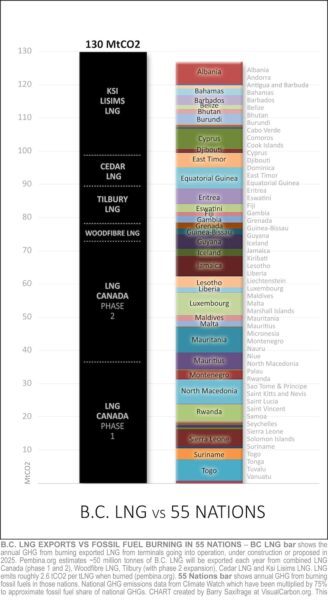
Sierra Club BC adds that most of the emissions would not be in BC, but in nations overseas that burn BC’s LNG.
Links of Interest:
- Canada secures first European LNG deal – Natural Resources Canada
- SEFE signs Heads of Agreement with Canada’s Ksi Lisims LNG – SEFE
- Ksi Lisims LNG-Germany Deal Ignores Indigenous Opposition, Methane, Underinvestment – Environmental Defence
- LNG development poses challenge to B.C.’s climate goals and clean economic growth – Pembina Institute
- KSI Lisims
Top image credit: Gemini AI depiction of the Ksi Lisims LNG project
Sign-up for Cortes Currents email-out:
To receive an emailed catalogue of articles on Cortes Currents, send a (blank) email to subscribe to your desired frequency:
Weekly Digest cortescurrents – [email protected]
Daily, (articles posted during the last 24 hours) – [email protected]