
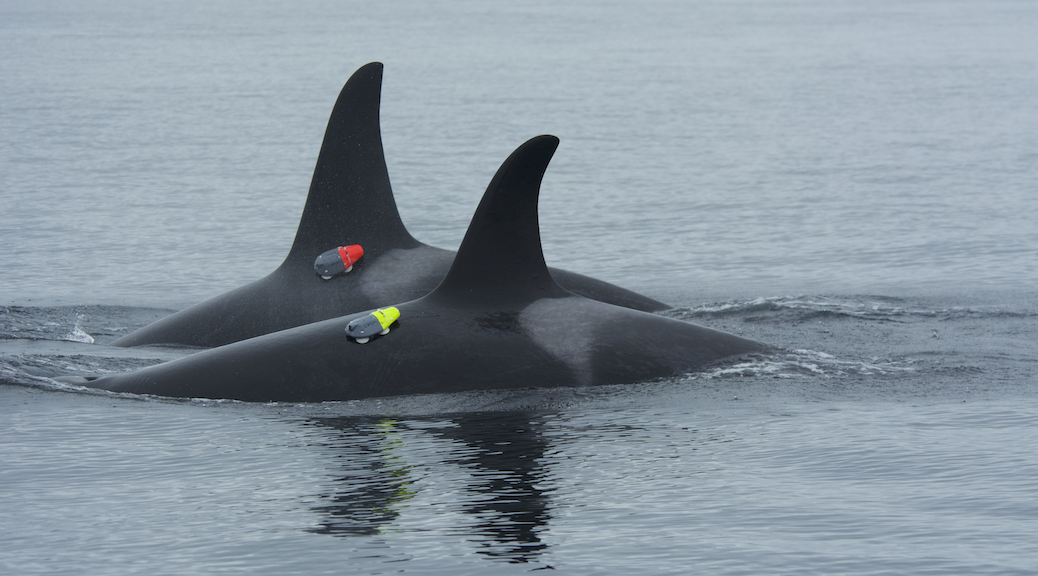

A new study found that Northern Resident Killer Whales and Pacific white-sided dolphins have formed a cooperative hunting relationship to catch Chinook salmon in the Johnstone Strait and Queen Charlotte Sound. The dolphins utilize echolocation to locate fish at depth, but their small teeth are designed primarily to grip prey, and they cannot swallow large species like Chinook salmon whole. Instead, dolphins locate the fish, and then wait for the killer whales move in to tear them apart, scattering bits of tissue and flesh into the water.
Dr. Andrew Trites, a professor and director of the Marine Mammal Research Unit at UBC’s Institute for the Oceans and Fisheries, explained, “The dolphins are getting leftovers, but that seems to be reward enough, so there’s no competition for what is ultimately killed. Everybody comes out a winner.”
This was the first time Customized Animal Tracking Solutions Tags (CATS) were used on whales and allowed the researchers to collect 3D kinematic data with video and acoustics, continuously recording high-resolution dive data, along with vocalizations and feeding-related sounds.
“ This tag has got a video recorder. It’s got a hydrophone. It’s listening for all the calls that are being made by the killer whales, but it’s also recording dolphin calls as we discover. It has a depth sensor so we know what depth the whale is at. It’s got three-dimensional accelerometers. So we can reconstruct all the swimming movements of the whale, whether it turns or heads down or heads up. It does water temperature as well. So it’s a very sophisticated fitbit that was designed to be put onto marine life, such as Killer Whales.”

“All of my life I’ve seen whales from a boat, with a camera in hand or binoculars. Here we’re getting a bird’s-eye view with a drone, which others have used before, but for the first time, we got the orca eye view of what’s really going on, and that changes everything, to see the world as the killer whales experience it.”
Trites suspects but does not know if killer whales and dolphins cooperate in the same manner around Cortes, Read, and Quadra Islands.
“ I don’t know how frequently you see white-sided dolphins around Cortes. There is a resident population of white-sided dolphins living in the Salish Sea. I don’t know much about their distribution and whether or not those dolphins behave the same as the ones that are up in Johnstone Strait and Queen Charlotte Sound. Certainly, the northern residents that are going to your area know how to work with dolphins. The question is whether or not the dolphins in your area know how to hang out and work cooperatively with northern residents.”

Initially, the research team believed these dolphins were harassing Southern Resident Killer Whales, but this perception changed after Keith Holmes, a drone pilot with the Hakai Institute, observed their interactions. He noted, “From above, you could see this incredible amount of activity. It was clear that there was some sort of communication happening, and they were actively foraging together,” as stated in the UBC press release.

Dr. Sarah Fortune, the lead author and Canadian Wildlife Federation Chair in Large Whale Conservation, emphasized the significance of these observations by saying, “We’ve long known that resident killer whales interact with Pacific white-sided dolphins, but seeing them dive and hunt in sync with dolphins completely changes our understanding of what those encounters mean.”
The research team initially aimed to investigate the limited population of Southern Resident Killer Whales, which numbers only 74-75, compared to over 350 Northern Residents. They assumed there was an abundance of Chinook salmon in northern waters, prompting them to set out on the research vessel Gikami to verify this assumption. The team selected two study areas: one in the Salish Sea and another in the Johnstone Strait-Queen Charlotte Sound area. They attached suction-cup tags to the backs of the whales and tracked them with a drone. To their surprise, the researchers recorded 258 interactions between killer whales and dolphins.

Dr. Trites acknowledged the unexpected nature of these findings, saying, “They were never part of our study, but they were present and interacting with the killer whales.”
Previously, scientists believed that dolphins were either harassing killer whales or stealing their food. However, the research team found no evidence of such behaviour. Instead, they observed instances where dolphins appeared to injure a Chinook and then waited for the killer whales to finish the hunt for them.
Dr. Trites summarized their findings by stating, “The conclusion we came to was that they are feeding cooperatively. They’re going on a joint hunt. They’re playing a different role. The dolphins are taking the lead, and they’re acting as scouts. Essentially, it’s almost like a military action. They’re going out to find the large Chinook down at depth. They’re fanned out, and these scouts are equipped with onboard radars. So they are echolocating, and the killer whale is going quiet as it is now eavesdropping on the dolphins in front. Both species are using the same technology to find fish. The killer whale can decode the signal to know when and where a Chinook has been located. It then goes in for the kill.”
“Now, all this is occurring in pitch-black water. We can’t see anything. All we can do is hear. We can hear the dolphins echolocating. We can hear the killer whale also echolocating, hear it go into buzzes as it goes in. We hear the crunch as it’s now made a kill, and then we hear thrusting, and now we start to watch as the whale comes up to the surface with a fish dangling out of its mouth.”
Cortes Currents: Don’t killer whales prey on dolphins?
Andrew Trites: “We have different types of killer whales. The ones that eat only fish, we call resident killer whales. There’s another ecotype, we call them transient killer whales, or they’ve also more recently been referred to as Biggs killer whales, and they only eat marine mammals. They eat dolphins. They also love seals more to eat.”
“The dolphins can tell the difference. They know which are the good whales and which are the bad ones. We suspect it’s probably through vocalizations. They can tell the different calls, and perhaps there’s some visual cue that they use as well to identify them. There is some thinking that as long as the resident killer whales are present, the dolphins are relatively safe because it appears that the two ecotypes don’t get along, and the stronger of the two turns out to be the fish eaters. You would’ve thought mammal eaters would have been even more ferocious. But now it appears that something eating salmon has made them stronger and a more cohesive unit.”

Cortes Currents: Do Southern Resident Killer Whales also hunt with dolphins?
Andrew Trites: “We haven’t heard of it. I suspect it probably does occur, although we may discover also that it is unique behaviour that the northern residents have developed with some of the Pacific white-sided dolphins.”
“What happens as we publish papers is that we’ll start to get reports or emails from people saying, “You know what? I’ve seen something similar. It never occurred to me that they might be cooperating, but what you’ve seen is very consistent with what we’ve seen.” It may be occurring in Russia as well. An old conference abstract mentioned dolphins being seen with killer whales, so there is a possibility that it also occurs elsewhere, but at this point, we don’t know. All we reported is this behaviour with the northern residents.”
“We also know that there are times when we’ve got Dall’s porpoise in with the killer whales as well. We documented some of those co-occurrences. We didn’t see any evidence of them hunting together. But we did see underwater footage where they were present.”
Dr Trites encourages people with further information to contact him.
“I’m very easy to find on the internet, and an email would be great if people have seen these sorts of things. There’s a tendency to think we can only trust what the scientists have seen, but I’ve learned so much more about Chinook from sport fishermen than I have from any salmon scientist. Many people living on the coast spend more time looking at the sea in boats and are seeing things, and sometimes it’s just a question of where to report it or who would have thought what I saw was interesting enough to tell them about it.

Links of Interest:
- Orcas and dolphins seen hunting together for the first time – UBC News
- Cooperative foraging between dolphins and fish-eating killer whales – Sci Rep. 2025.
- Southern resident killer whales are not starving due to lack of BC chinook, study finds (interview with A. Trites) – Cortes Currents
- Our neighbours, Pacific White Sided Dolphins – to cull or cultivate? (interview with Alexandra Morton) – Cortes Currents
- New subpopulation of Deep Ocean Orcas Identified (Biggs Orcas) – Cortes Currents
- These dolphins have orca ‘friends.’ They may have an ulterior motive – National Geographic
All photos credit University of British Columbia/A. Trites; Top image credit: Side shot panning down to see a pod of Northern resident killer whales near Hanson Island, British Columbia
Contact Information
Email: [email protected]
Office phone: 604-822-8182
Location: Rm. 246, Aquatic Ecosystems Research Laboratory (AERL) Building, 2202 Main Mall, UBC
Website: Marine Mammal Research Unit; North Pacific Universities Marine Mammal Research Consortium
Sign-up for Cortes Currents email-out:
To receive an emailed catalogue of articles on Cortes Currents, send a (blank) email to subscribe to your desired frequency:
- Daily, (articles posted during the last 24 hours) – [email protected]
- Weekly Digest cortescurrents – [email protected]