


Work is about to resume in the Cortes Community Forest.
Mark Lombard, General Manager for the Cortes Forestry General Partnership, explained, “The spring cut is going to happen in the Coulter Bay area of the community forest. We’ll probably start a small segment of road in about three weeks. While the road is being built, maybe a month from now, we’re going to move over to Larsen’s Meadow. They’re both relatively small projects.”
(Mark Lombard (l) and Bruce Ellingsen in the Community Forest.)
Hemlock Cutblocks In Larsen’s Meadow
While there is some quality timber near the road in the Larsen’s Meadow: to the north there is a large 40-hectare plantation extending towards the Stitchville area, that was logged 35 years ago. To the south, along the logging road, there’s not much unharvested timber left.
“One of the things that we’re looking at is the area is excessively heavy to hemlock. A lot of it is pretty unhealthy and a lot of it is mature hemlock or getting to be mature. We’re going to log some of the hemlock because hemlock prices are pretty good right now,” Lombard explained.

“The hemlock seemed to be thriving a lot more when you go north towards Sayward. Where it’s wetter, the hemlocks can live 300 to 400 years. Here, on Cortes, it’s rare to see a hemlock get much past 80 or 90 years.”
“Once it gets up to 80-90 years, it starts to develop butt rot. With the longer dry summers, they’re really vulnerable. When a tree is stressed, it’s easier to have an ingress of a disease like a mistletoe. In the Larsen’s meadow area, there’s quite a bit of unhealthy hemlock.”

There are four specific cutblocks in Larsen’s Meadow, three of which were logged during 2015, the community forest’s inaugural year. Although the team initially used what they believed was an appropriate level of retention, it proved to be too much shade for the seedlings to thrive.
“Right now we’re in a state of ‘conditional non-compliance,’ which basically means we have about five or six years more to get those trees up to free to grow. To do that, we’re going to thin out the forest to the south of those to let more light in and in addition we’re going to fertilize those seedlings.”
This project involves logging two blocks that are primarily hemlock while leaving healthy Douglas firs as ‘seed trees.’ The area will then be replanted with fir and cedar, as these species are better adapted to the drier summers the region is experiencing. The long-term plan is to return in ten years to repeat this process, replacing small hemlock blocks with cedar to better utilize these rich growing sites.

Wildfire Risk Reduction at Coulter Bay
Once the Larsen’s blocks are finished, the crew will return to Coulter Bay. This year’s proposed logging is a vital component of the Wildfire Risk Reduction Strategy for the entire island. During the 2020 Community Wildfire Protection Plan assessment, Blackwell and Associates evaluated the island’s infrastructure and residential neighbourhoods to determine how summer winds might drive a fire. Since there is a residential neighbourhood along the entire boundary of the community forest in Coulter Bay, the experts recommended a buffer of 150 to 450 meters.
“Take out all the dead small trees, prune the ‘leave trees’ up to 10 feet and then chip up or burn the fine debris and then chop and then drop to the forest floor the coarse debris so it meets FireSmart standards.”
“When the team saw the work that we did in 2020, they said, ‘it’s exactly the kind of thing that does the wildfire risk reduction’ because we put down all of the fine fuels and drive over them with the excavator to protect the soil and it compacts the slash so it’s not as much of a fuel hazard.”

“When the funding was awarded last year to do the wildfire risk reduction treatment in Coulter Bay, we brought the Forest Enhancement Society of BC people in there and said, ‘look at this treatment that we did in 2020. There’s this other area adjacent to it that we could do the same treatment without government funds. We can make an economically viable thinning harvest, like a true individual tree selection, logging. And then let’s take the funding that’s available and treat the third growth plantations that are just outside of that 150 meter base. That just would be good forestry.”
He said, “Absolutely, let’s make that swap.”
“So we swapped a certain number of hectares out of the buffer area that we then promised that we were going to do our intermediate harvest next, and then we got to take that money and apply it to the hugely overgrown dog hair plantation.”
(‘Dog hair stands’ are dense thickets of young trees that have grown so closely together that they resemble the fine, thick hairs on a dog’s back.)
“It was a win-win-win, across the board. So for our next harvest, this year, we have to do this thinning in here. This project is about 4.2 hectares of light touch. So we’ll take about one third of the volume out, and then leave healthy, good ‘leave trees.'”
2026 Spring Cut: The Bigger Picture
Lombard proceeded to give an overview of how the Community Forest operates and where the wood goes:
“The Community Forest operates as a 50/50 partnership between the Klahoose First Nation and the Community Forest Cooperative. It’s one of the really good examples we have on Cortes of economic reconciliation in action with the Klahoose. It’s a 50/50 consensus decision making board of directors and we’ve got a good crew doing the work. I’m really grateful for all those people and it feels like the right thing to be doing on the traditional and unceded territory of the Klahoose First Nation.”
“The Cortes Community Forest Co-operative board is meeting next door, in the office at the new community building (at Rainbow Ridge).”

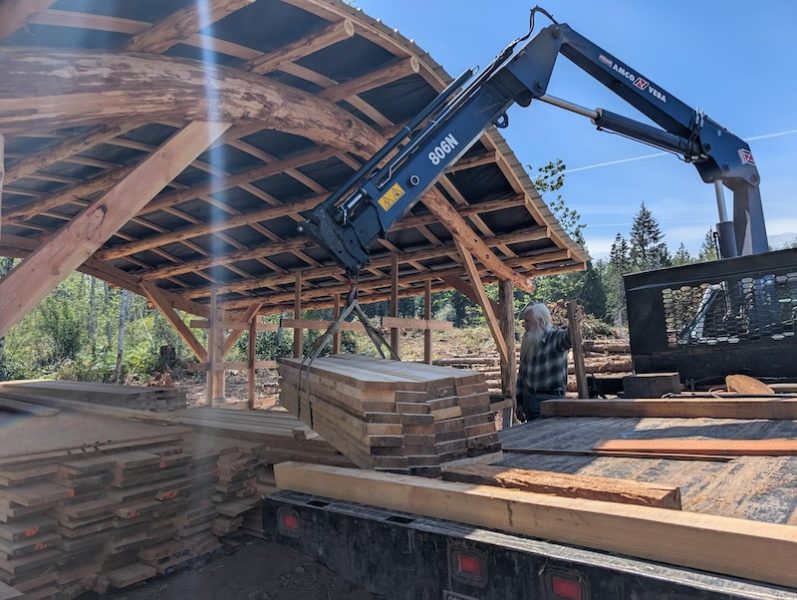
“Our priority is going to be to supply the logs to our local mills. The Klahoose Sawmill needs some cedar logs from the community forest. Some of the other mills on Cortes, Blue Jay Sawmill and the Tiber Bay sawmill need some fir logs.”
“Fir is going to go to Coastland, the plywood mill in Nanaimo. Hemlock will probably go to make green-treated ACQ (Alkaline Copper Quaternary) lumber that you buy at the store. It is made in the Lower Mainland, along the Fraser River.”
“Anything that pulp grade or lower grade logs, ‘chip and saw’ – we will keep on the island for firewood for the community. So any firewood contractors who are interested in buying bulk firewood logs are invited to contact us.”

“At the end of the project, we’ll do a community firewood day where individuals can give the name of their neighbour, or a senior, or somebody they know who’s in need. Then we’ll ask for volunteers to come out and we’ll distribute firewood to everybody who’s on that list. Everybody who volunteers to come out, either to load loads or with a pickup truck will get a load of firewood for themselves. It’s a really good community day.”
Links of Interest:
- Cortes Forestry General Partnership
- Cortes Community Forest Cooperative
- Articles about, or mentioning, the Cortes Community Forest
Top image credit: Salvaging blow down in the community forest – Mark Lombard photo
Sign-up for Cortes Currents email-out:
To receive an emailed catalogue of articles on Cortes Currents, send a (blank) email to subscribe to your desired frequency:
- Daily, (articles posted during the last 24 hours) – [email protected]
- Weekly Digest cortescurrents – [email protected]