

Editor’s note: Food security is a major concern in the Discovery Islands. 98.4% of the 245 respondents to a ‘Quadra Island Eating and Growing Local survey’ stated they wanted more access to locally grown food. Most participants at the recent Conversation Cafe, on Cortes Island, shared a rough consensus that the existing food system (industrial farming, long-haul transport, and large scale grocery chains) was likely to falter or fail under the pressures of climate change and rising energy costs. The Cortes Community Economic Development Association [CCEDA] will soon be releasing a report of the findings at that event. A Garden Club/ICAN Food Security Team project is increasing that island’s protien supply.

229 blight resistant nut trees were most likely planted on Quadra Island during the past 12 months, and that number should soon increase. There are Hazelnuts, Sweet Chestnuts, Black Walnuts, Persian/English Walnuts and a Heartnut. Most of these trees have been sold to private residents, but the Quadra Nut Tree Project’s third planting was on January 4, 2024.
“We really wanted a source of plant protein as well as oil, and so nut trees that are going to do well on our island as the climate changes was something that we thought would be a good idea, in terms of our overall food security strategy,” explained Jen Banks-Doll, one of the principal organizers.
“So far we’ve planted 76 nut trees and we’re hoping to get to 85, in terms of commercial or government owned land. In addition, we sold trees to help fund the project and also to meet our goal of getting as many nut trees planted on Quadra as possible. So we ended up selling 153 trees. Overall by the end of this month, we hope to have added 238 nut trees to Quadra Island. ”
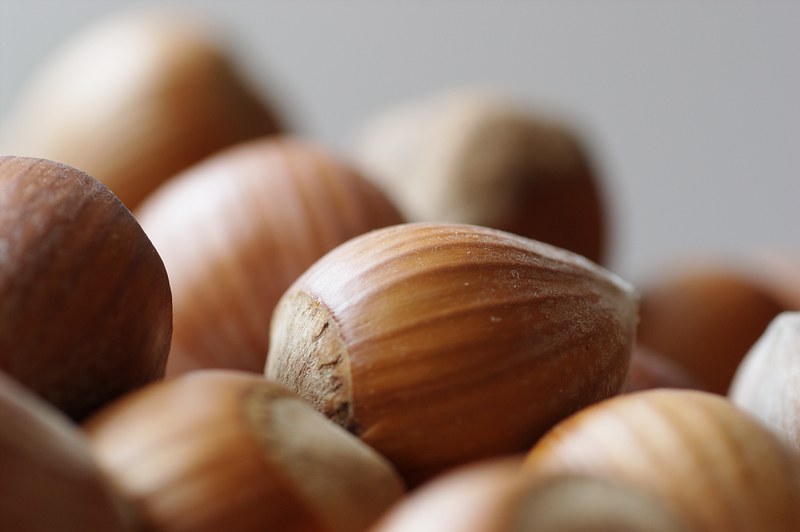
“These are all the new varieties. There are a lot of hazelnuts on Quadra already, but they’re the older varieties that are not blight resistant. All of our trees are Eastern Filbert Blight resistant varieties, so they hopefully will last for a very long time,”
“It started with a conversation with a few members of ICAN, the Island Climate Action Network. Food security was one of the very hot topics in terms of preparing for climate change and increasing the resiliency of our island. We’ve had many different projects on the go. We were looking at United Way food security grants and thinking of a project we could use to apply for a grant. My partner, Marc Doll, came up with the idea for the nut tree project. His idea was to plant as many nut trees as possible on Quadra Island. I’ve been involved since then.”
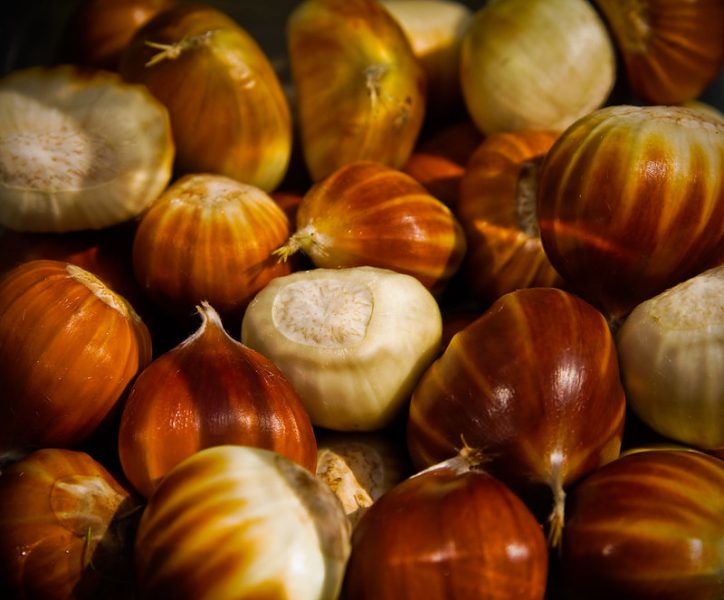
One of the other organizers, Bradford Vinson, added, “I’ve been involved with the project since just before we started planting trees, so at the end of 2022.”
CC: Do you both eat a lot of nuts?
Jen Banks-Doll: “ I have oatmeal every morning with walnuts or almonds on it. I don’t have a source of hazelnuts yet, but yes, I eat a lot of nuts.”
Bradford Vinson: “I eat nuts in the afternoon. It’s more of a snack for me, or on top of something for dinner, but I do eat nuts and I really enjoy using nut oils and nut flours. One goal was to give us options to produce our own oil and to produce our own flour. A lot of us on Quadra garden a lot, and I think Cortes is the same, but there really is almost nothing in our gardens that makes oil and almost nothing that makes a full complete protein. I don’t have any proof that it actually makes a huge difference, but it sure feels like we’re trying to make a difference.”
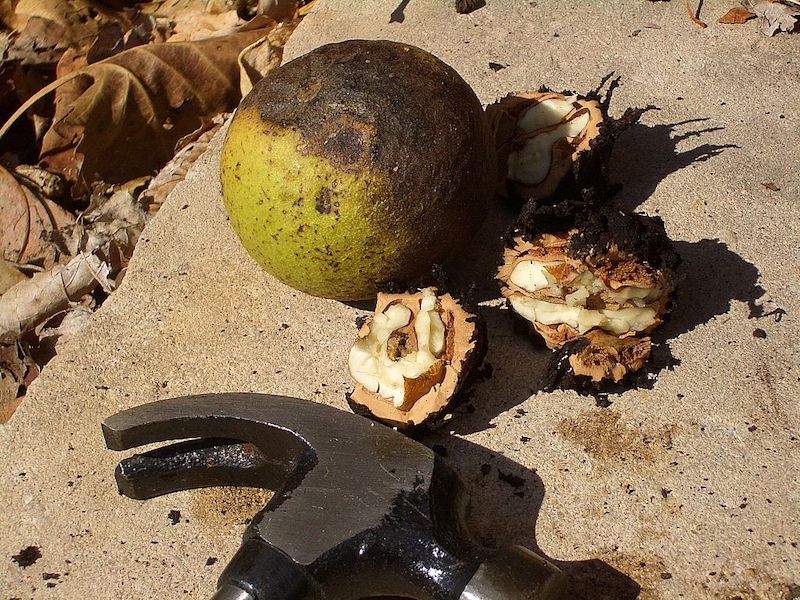
CC: Did you both come to this project through Quadra ICAN?
Bradford Vinson: “I’m specifically through the Garden Club. That’s how I met Jen. She’s at least friends with all the people that are in all the clubs.”
Jen Banks-Doll: “I came out of both. What happened is ICAN formed the food security team, and then that food security team had lost a bunch of volunteers. So the food security team approached the Garden Club to partner. It became the ICAN Garden Club food security team, and at that point we applied for the grant. It has been a joint venture, which has been really helpful in terms of drawing in from those different pools of volunteers, and putting our minds together.”
“It’s a lot of prep work. I’ve certainly felt overwhelmed. The part I’ve enjoyed the most was working with Bradford as well as Aaron Quesnel, who’s away right now. He didn’t participate in the last planting. I think he’s in Portugal. I’m used to working on a lot of these things alone. The three of us work together to come up with different ideas. The big thing for me was just motivation because we’re all so busy with our lives and organizing these community nut tree planting days is a lot of work.”
“Bradford in particular has been really good at saying, ‘okay, when are we doing the next planting? How can I help you and how are we going to get this done?’ That’s been really helpful for me when I’m kind of dreading the amount of work that needs to go into preparing for something, and then he makes it seem so easy.”

“The volunteers have been awesome too, just their enthusiasm to come and plant trees. A lot of our volunteers are in their 70s, but they come out and work super hard and get the job done. We’ve also had a bunch of young people come out, which is great, and a lot of new people to the island.”
Bradford Vinson: “It’s been a great way to meet people, being new to rural Canada myself. I’ve met a lot of people on Quadra, but I know Jen and maybe one person that came out to volunteer. Everybody else is a new person, then I see them at the grocery store and I say ‘hello.’ That’s been a lot of fun.”
Jen Banks-Doll: “We started out by creating a list of all the possible places that we might be able to plant trees, but that we would have to get permission for, of course. So all the different businesses, as well as government owned pieces of property on Quadra. Our spreadsheet had 35 possible places we could plant, and then we ended up planting on seven of those sites. We have one more group that we’re working with, the We Wai Kai, and are trying to figure out if we can work with them to do another planting.”
“Then we also decided to open it up to private residential property owners because we wanted to get as many trees planted as possible. We looked for property that was either along a major road or just a road that people drove down, or along a pathway. We had a list of 14 different private property owners who volunteered but only five were suitable in terms of having space for at least two trees, proper sunlight and proper soil. That was a huge amount of work up front: going through the list, contacting everyone and scoping the sites”
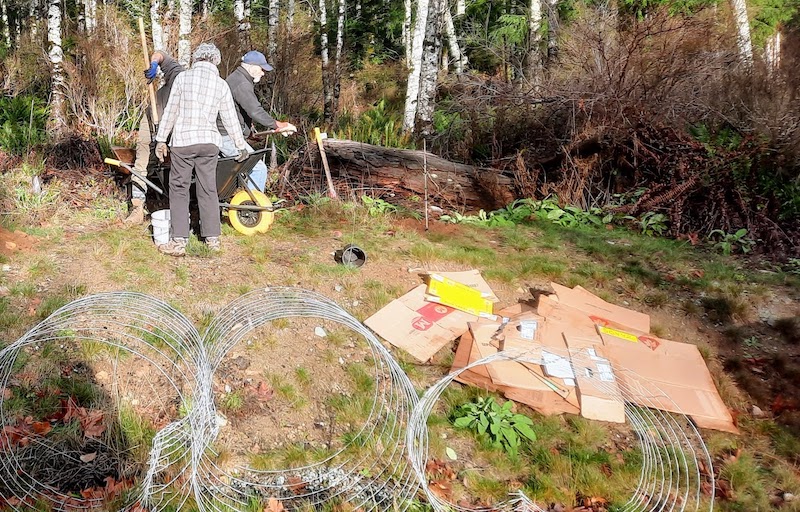
“All of our plantings have been in the winter. My biggest concern was always, is the weather going to be horrible and no one’s going to come out to plant trees because it’s pouring rain or freezing cold? We were incredibly blessed all three days that we planted trees, the sun shone and it was a gorgeous day. So the experience of planting trees with our community was much improved by the weather being nice.”
“We plant at this time of year just because we want to give those trees a few months of free water from the sky, so their roots can get a few months of growth before the drought hits.”
Bradford Vinson: “When there’s no leaves on a tree, it is usually a good signal that it’s probably a reasonable time to plant.”
Jen Banks-Doll: It’s all a big grand experiment in terms of how these trees will do long term. We did plant in various different terrains, so we’ll see how those trees do. Some of these areas were kind of wet, others were on the dry side, some were rocky, others were better drained in terms of sand. We planted many different varieties of hazelnuts and we’ll probably be pruning them in different ways as well, just to see what works best.”

Jen Banks-Doll: “Our original planting was at the end of January of 2023, and it was kind of our practice run because we only had three sites at that point that had been approved. We only planted 16 trees.”
Bradford Vinson: “I think we finished before 2 o’clock in the afternoon.”
Jen Banks-Doll: “We figured out how to organize people into teams. Bradford is really the expert on tree planting. I joked that even by the second tree planting day, I still hadn’t planted a tree in my life. I have now planted a few trees but I was the organizer. I wasn’t actually the planter.”
“It’s not hard to plant trees, so as long as you have some good instructions, I think the hardest part was pounding in the fence posts. At least that’s what I struggled with the most.”
Bradford Vinson: “Yes, getting them past the rocks.”
Jen Banks-Doll: “Yes.”
Bradford Vinson: “These are the size of seedlings.* They tend to be anywhere from one foot to three feet tall. Young trees transplant really well.”
CC: Did you use shovels to plant the trees?
Bradford Vinson: “I think a couple of people, on our second day brought mattocks or pulaskis, but the majority of the trees were planted with shovels.”
“We have a lot of rocks here, so it’s hard to just poke a hole in the ground and tuck a tree in. You usually hit a rock. I’m sure that’s the same on Cortes, but on Quadra we like to joke about how we have a lot of sand and a lot of rocks in our gardens. Lots of people brought wheelbarrows and their own shovels. At the end of the day, we were labeling everybody’s tools with tape and a marker so that everybody got their tools back.”
“We were using some composts that we had picked up and added a little rock phosphate to help promote root growth. We avoided bone meal because it attracts the animals that we’re trying to protect the trees from. Then make sure to give it a nice , big, deep layer of mulch when we’re all done, just to help keep the earth cool and the roots safe from the summer heat and dryness.”
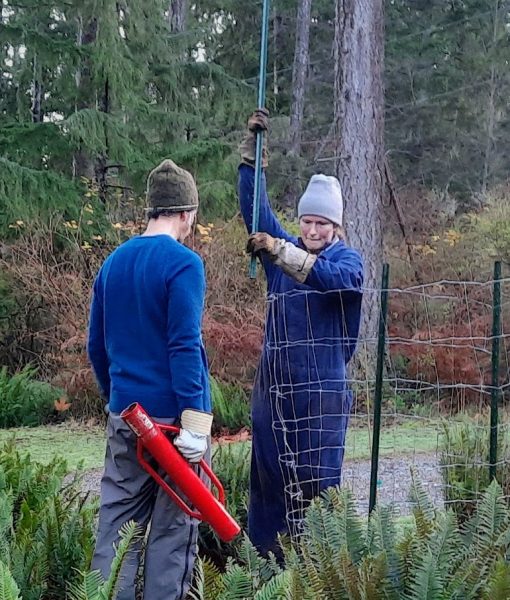
“Talking about all the logistics: there were truckloads of mulch, compost and wire mesh to wrap around the trees to keep them protected from the deer. Fence posts, like heavy T posts, pounded into the earth to secure the wires, so the trees doesn’t get knocked over, or pushed away by the deer. So it’s a lot of supplies and just a lot of hauling things around to the different locations.”
Jen Banks-Doll: “The first two tree plantings we provided lunch and so we had to find locations. So at the South End Winery, we were doing a major planting. I think we planted 16 trees there. Wasn’t it Bradford?”
Bradford Vinson: “Yes, 16.”
Jen Banks-Doll: “They have a lovely room where they do their wine tastings and it was open that day. There were wine tastings going on as we were doing our presentation. Three different volunteers made three different types of soup, and then we provided some more to fill out that lunch. Certainly if anyone wanted to do a tasting during our lunch, that was available to them, but I don’t know if anyone did. It was a lovely place just to come in and get warm and have a seat and take a little break for a while.”
“That second planting, when the owners of the nursery gave a talk, we attracted a whole bunch of people who just really wanted to learn as much as they could about planting nut trees.”
Bradford Vinson: “The second planting day was just in December. We planted around 40 trees and in several different locations, which was very exciting. Lots of people turned out to volunteer.”
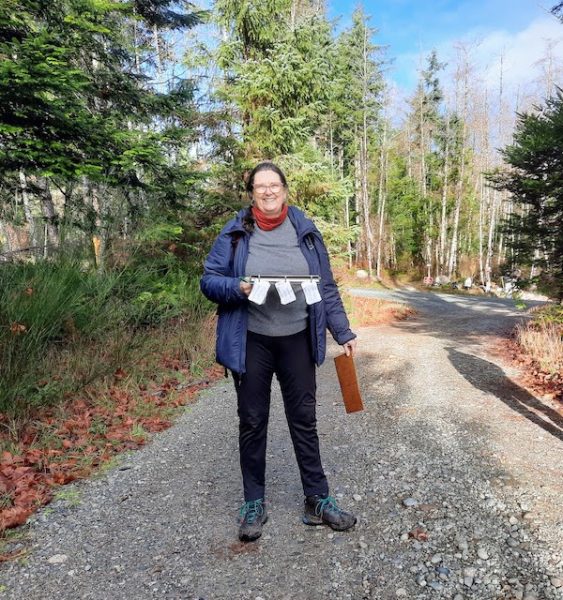
“Going back to the rocks in the soil here, it was just shocking how quick the holes were dug. Wheelbarrows were just magically flying all over the place. It would be a half an hour and ten trees would be in the ground, mulched, caged, and fence posts in, labels on, everything’s mapped out, recorded, and everybody’s asking ‘where are we going next?’”
“We just finished up the final planting day last week on Thursday and we planted 15 trees on the Haskin Farm Trail.”
Jen Banks-Doll: “We really tried to get some families out and some kids. We weren’t hugely successful, I think because it was during the holidays and everyone wanted to sleep in, but we did have some kids join us.”
Bradford Vinson: “Then Jen and I went around and individually planted another five trees in little single spots, where we had one or two trees to go in. It’s been a really great exercise in ‘community’ for sure.”
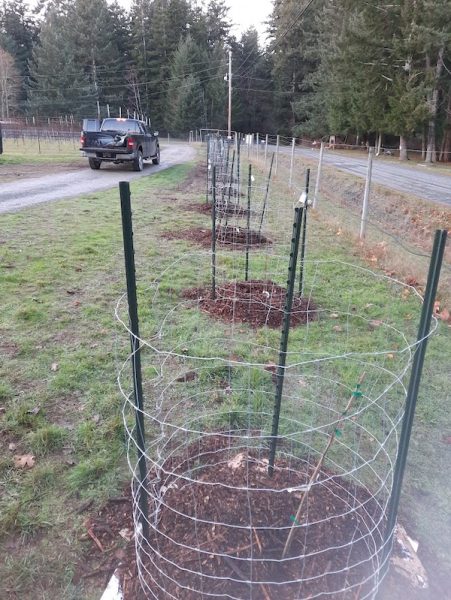
Bradford Vinson: “I went back a couple of days later to take my dog for a walk on the Haskin Farm Trail and I ran into somebody as I was heading out through the orchard. They were commenting on all the trees and wondering what was going on. It was exciting to get to explain a little bit about this not tree project and what we had done. They hadn’t heard of it. Then on my way back the same thing happened, but with a different person and their dog. So our dogs are running around as this fellow is asking me questions about all of these nut trees. He was very excited to see something happening in the community that looked like it had been pretty ignored or abandoned. The old fruit trees that are there have been neglected for probably several decades.”
CC: So what’s next for the Quadra Nut Tree Project
Jen Banks-Doll: “What’s next is figuring out how to water all these trees this summer. So last summer Bradford volunteered to go to the three sites that we planted last year and then one of the sites was the fire hall.”
Bradford Vinson: “They volunteered to water those trees at their site.”
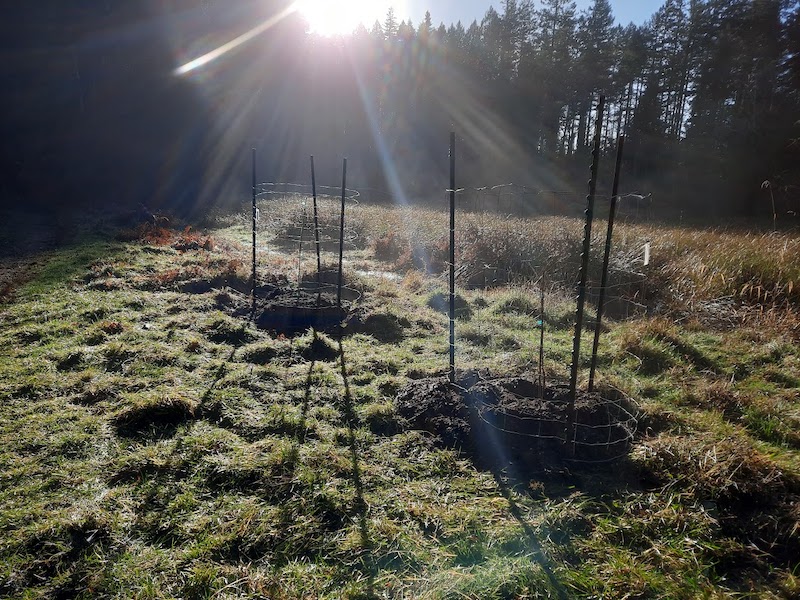
Jen Banks-Doll: “This summer we have up to eight different sites we’re going to be trying to water and so that’s going to be the big puzzle to solve. Then in the future, we do the pruning.”
“I’m hoping through the garden club, we’ll be doing some pruning workshops and get a whole big crew of people who are willing to help prune the trees. Beyond that, it’ll be planning harvesting, how to get the nuts before all the squirrels and the Jays get them, and experimenting with drying them. Hopefully providing some equipment to help people with cracking nuts and turning them into oil.”
“This is only the beginning. The grant was really for the planting, but now we need to figure out the rest of it. One day those trees won’t need those fence posts or fencing anymore and we may be able to do a whole other round of planting of trees in the future.”
Top image credit: a deep layer of mulch around the tree – Courtesy Quadra Nut Tree Project
Footnote: *The hazelnut trees that were planted are not seedlings as they were not started from seed. It is very difficult to propagate Eastern Filbert Blight Resistant varieties from seed. The hazelnut trees planted and sold by the Project were propagated vegetatively (i.e. clonally) by the nursery where they were purchased.
Sign-up for Cortes Currents email-out:
To receive an emailed catalogue of articles on Cortes Currents, send a (blank) email to subscribe to your desired frequency:
- Daily, (articles posted during the last 24 hours) – cortescurrents-daily+subscribe@cortes.groups.io
- Weekly Digest cortescurrents – cortescurrents-weekly+subscribe@cortes.groups.io