


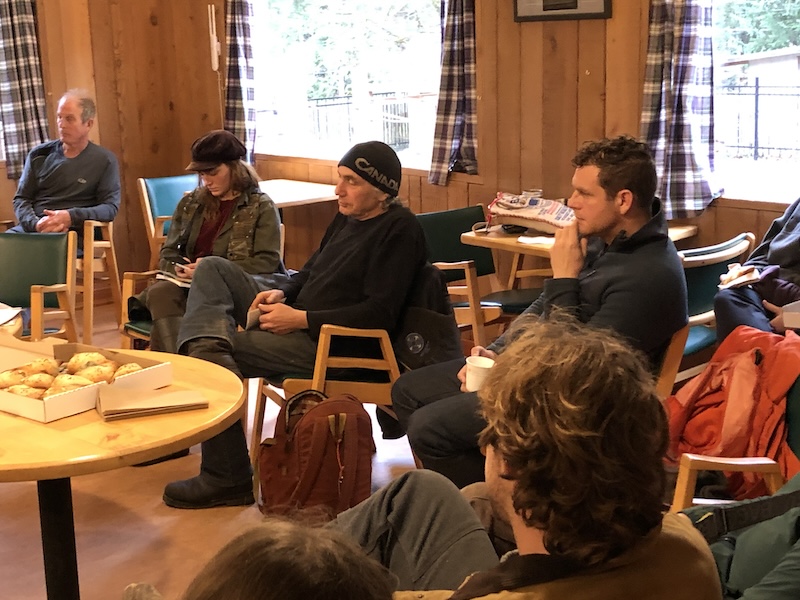
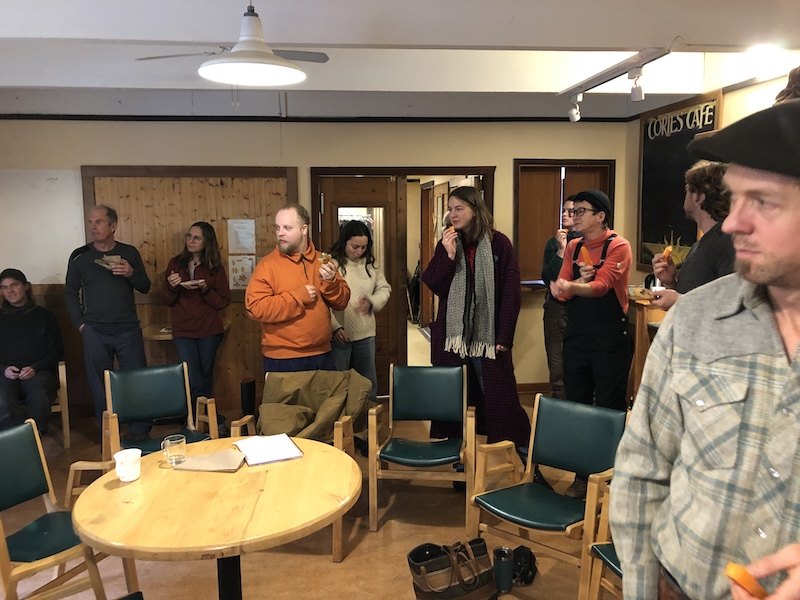
NDP candidate Tanille Johnson recently visited Cortes Island, where 20 people were waiting to see her in the Pioneer Room at Mansons Hall. The event was sponsored by Cortes Island’s Climate Action Network, which also provided lunch.
Johnson said she prefers small meetings like this, “I’ve been spending most of my time going to people’s houses, meeting with their friends, I like to think that I’m a very truthful, honest person and I actually care about what happens in this riding. It means a lot to me, like my family, generations and generations, lived here.”
Recent polls suggest the Conservative Party may have lost its early lead in this pre-election period. Both EKOS (February 26) and Ipsos (February 25) released polls that show the Liberals edging forward in what has once again become a two party race. The NDP are a distant third and fading.
That’s on the national level, it has always been a very different race in North Island-Powell River. If you include the results from the former Vancouver Island North riding, the choice has been NDP or Conservative for decades. Rachel Blaney has been our MP since 2015, but her predecessor John Duncan was a Conservative and the Conservatives have been a close second in every recent federal election.
Now Blaney is stepping down. 338Canada’s most recent projections still depict Johnson as the underdog in our riding, but those projections will only be released on Sundays until the election is declared. A great deal has changed since last Sunday. More will change in the weeks to come.

Her Background
Tanille Johnson began, “ I was born and raised in Campbell River, that’s my home territory and my home community in more ways than one. I am a member of the We Wai Kai First Nation, one of the three Liǧʷiłdax̌ʷ Nations that make up the greater Campbell River area and a little bit up into Sayward for our traditional territory. I didn’t grow up on reserve. I spent a ton of time on reserve, but my house was down in Willow Point in Campbell River, which started me off in an interesting place in my life.”
“I purposely moved back from Victoria eight years ago because I wanted to be home. I wanted to be home for me and for my kids. I did not want to raise a family outside of my traditional territory. I’m extremely connected and loyal to this area. I’m not going anywhere. I recognize that Ottawa is very far away and I will be in Ottawa when I have to be in Ottawa but I will have big accountability for showing up in the riding and having my ear to the ground and showing up when you need me and being where I need to be.”
One of her first political discussions took place in the split grade three and four class of her elementary school. When her teacher described a US plan to build a floating bridge from the continental US to Hawaii, Johnson responded:
“Well, that doesn’t seem to make very much sense. Why don’t we give them our ferry, Campbell River to Quadra. They can build us a bridge and they can have our boat. She just laughed and she said that if I ever ran for political office that I would have her vote.”
“My background in education is in social work.”
“For my Master’s degree, I wrote a thesis on Kwakwa̱ka̱ʼwakw fatherhood and what it means to be a dad for a community. So I met with different dads and how they self identified as being a dad. Whether that was an uncle that had fatherly responsibilities to their nieces or nephews, or whether that was a neighbour that really took care of their neighbour’s kids a lot. However, they saw themselves as a parent in that role. So it wasn’t a very narrowly scoped research project. It taught me a lot about where historically, our dads in the community have learned how to parent, which was actually on the fish boat. Every single father or dad that I interviewed had a story about what they learned on a fish boat. I thought that was a really crazy connection to make, everybody going back to fishing in all of their stories.”

Entering Politics
“I first got into politics in post secondary education. I dove in with both feet. I was on the Native Student Union Council, I was on the UVic Student Society Board of Directors, I was on the UVic Senate. I sat at the Equity Advisory Council for the School of Social Work, federally with the Canadian Federation of Students on their Federal Executive Board as well as their Provincial Executive Board.”
Johnson was the only non Conservative candidate elected to Campbell River City Council in 2022, but decided to run as a candidate in the Federal election after Rachel Blaney announced she was retiring.
“I felt really compelled to do something. I knew that Aaron Gunn was the Conservative candidate in our riding. I don’t know him personally, so everything I know about him is from posts or newspaper articles , but just doesn’t seem like a super great safe person to look after our land and water and our geography here. I felt that being someone who had just recently gone into local politics at the municipal level, I had a duty and a responsibility to step up into that space and if the NDP registered members wanted me to fulfill that obligation and run in Rachel’s place, I would do that.”
“That’s hopefully, a fairly quick summary of who I am as a person and how I got here and why I’m here, but I really would love to hear from you guys.”
Smudging
Sherman Barker brought up the topic of smudging, an Indigenous practice which involves breathing sacred smoke to purify the soul of negative thoughts.
Tanille Johnson: “Everyone needs to take care of themselves in the climate that we’re in today. However you do that for yourself, I think it’s a great idea. There’s definitely been some moments where it’s like … What? What is happening? As a part of the whole gig, I have some folks that feed me some big headlines for that day, things that I should be aware of. A part of that is every morning getting inundated with like the latest and greatest that’s coming out of the south of the continent. I definitely encourage people to take care of themselves and smudging is a great way.”
Sherman Barker: “If politics was entered as a ceremony, it would certainly have a lot more integrity attached to it.’”
Tanille Johnson: “The first thing I asked for once I was elected municipally was to have the city hall smudged. Those walls had never heard a drum before, they had never been smudged ever. For those who don’t know, my council in Campbell River is six Conservative party members and one of them loves to wear his conservative pin in meetings. So it’s super interesting.”

Splitting the Vote
Someone asked, “There’s this incredible lurch to the right, and not just in BC, and not just in Canada, but all over the world. What I see potentially happening is the NDP will split the vote with the Greens, and the Conservative will get in. Do you have an idea, or thoughts on that?”
Tanille Johnson: “It’s really horrible, but please don’t vote Green! I have had an initial meeting with Green Party candidate Jessica Wegg, probably over a month ago , to essentially say, ‘Hi, this is me, and that’s you.’ She knows what I would be wanting to ask you. I need you to believe that I can carry Green with me. Trust me with it. That takes trust from folks that really lean heavy Green to know me, to give me the opportunity to hear them, and then to give me the opportunity to do that work for them, through the NDP in the house.


Climate Change
Maureen Williams responded, “I just want to challenge the idea that one person or one party can represent the interests of everyone. I wonder what your thoughts are about where the NDP is on the issues of climate change. I know our provincial NDP is not great and certainly not representing the interests of everyone, which would be to take care of us and preserve some kind of livable futures, such as is possible.”
Tanille Johnson: “There’s no phenomenally good excuse for any party to not have a really solid approach to climate mitigation. I do think that the NDP can review where we’re at and consult a lot better on things that we could actively do better and also fulfill. So I do fully acknowledge that parties very commonly say a lot of things and then there’s not the action that supports the words.”
“I struggle a lot with that. I think if you make a promise and you say you’re going to do something, you have to follow through with that promise. You’re giving it life and if you’re going to give it life, you have to support it.”
“We can do things that can enable more immediate action. There are huge policy changes that will always be really hard to get across the line because of individual beliefs about our government and having a majority government that truly believes and wants to invest in climate. We haven’t seen that yet. I would love to see that.”

“I’m not going to claim to be a policy expert in the area of climate by any means, but I do a lot in my life personally, because I believe in climate change and that we need to do a lot in order to curb it. My house runs off solar panels. I was super excited when we were getting them installed. Even down to my diet, I’m fairly pescatarian. I still eat my traditional seafood, I can’t give that up. Other than that, I’ve learned a lot about how impactful certain animals are to our environment. (Beef cattle?) I don’t want to be a part of that, so I’ve recused myself from that area. I do have two daughters. My eldest is six and is very much a little climate warrior, always picking up garbage. Definitely wants to recycle everything and even if that means keeping every one of our tissue boxes in our house, and making smaller houses out of those for every doll that she owns. I try my best as an individual to show up in a way that demonstrates a commitment to climate.”
“Moving to higher levels of government really opens up those opportunities for conversation and change. I’ve tried to also push things at a municipal level. We have an airport, not a very climate friendly airport if those even exist. The one thing that I’ve tried to offer is looking at our land for the opportunity for solar. It’s big, it’s flat, it’s fairly open for solar power energy all over the place. Why aren’t we trying to push more e-charging stations? We don’t have very many in the city of Campbell River. It’s something that municipalities are investing in all over the place. Victoria is going to put them on the side of the road so you can plug in residential areas, which is super exciting.”
Cortes Currents: “Berkeley Earth is saying that Canada’s average temperature has risen to 2.1°C above pre industrial levels, and we’re currently on a trajectory to reach 5.2°C* by the end of the century. The leader of your party has said that under certain conditions, he would build more oil pipelines. We appear to have enough for our own needs, so this expansion seems to be about export. Are you supportive of this? The BC NDP is supportive of the LNG industry. Given the amount of emissions from LNG projects, would you be supportive of them? And what would you do if your party said differently?”
Tanille Johnson: “The party already says differently.”
“Personally, it’s been pretty horrific to see how that’s all gone down. I did have to stop paying attention at a certain point because watching Nations go through that process is very dismantling.”
“Our party’s been leaning a very specific way on LNG. I think everything is on the table, it needs to be reconsidered about where we’re putting our investment. Especially given our new relationship, if we want to call it a relationship, with our southern border.”
“I think we as a country, have such an amazing opportunity to come together inside of ourselves and resource ourselves in a way that not only supports our environment, but also just enables our local economy in a phenomenal way. And I don’t think that necessitates new pipelines by any means. When we look at a lot of industries, whether energy, or pipelines, or fishing, or blueberries, we are shipping a ton of stuff out of our province and out of our nation as a whole. I think there’s some fairly large signs that are asking us to review what that looks like. I would love to be a part of looking at that. Why are we driving all of our economy off of shipping things out of our country and not making sure that we can be sustainable within ourselves. Then looking at supporting other countries that maybe we can have some really solid exchange relationships with, but erring on the side of caution.”
Sherman Barker: “You come from a culture that has been living sustainably for a thousand years. We have a lot to learn. It would be nice if that was somehow implemented in high school.”
Tanille Johnson: “People use different climate mitigation strategies . They talk about all the negatives and all the what ifs, or we don’t know, because, but if you never enable something to happen, you are never going to know. You’re never going to be able to collect the data.”
“There’s very interesting stuff coming forward right now with the fish farms that got towed out up in the Broughton Archipelago. There’s new Sockeye that are coming down through that area. Like we’re told all the time that there’s certain things that aren’t impacting whatever it is that we’re offering. Well, it’s probably impacting it and until it’s removed and there’s an opportunity for things to return to whatever the original state was, you won’t ever get to know.”

Cortes Currents: Alexandra Morton said the Chum run we had last fall is the first generation since fish farms were pulled out of the Discovery Islands. It may be a coincidence, but on Cortes the run was larger than anything we’ve seen in the last 35 years.* There’s similar reports from Quadra., where the runs were three times the size of anything in recent years.


Leona Jensen, one of Cortes Island’s stream keepers, added, “Nature has perfect conditions to grow the fish. Fish farms destroy that. If we left the fish on their own, even with the climate change which makes it a lot more stressful for them because of the higher temperatures, we have a lot more fish, a lot more jobs, and a lot more food security.”
Mark Vonesch replied, “One of the big fights that I’m seeing that’s going to come is the fish farms. What I’m seeing from your colleagues, and what I’m seeing from Aaron Gunn as well, is that’s something that could be potentially reversed. All the fishermen and women that I speak with, they’re like, fish farms contribute to the lack of traditional fishing in this area. Campbell River is the Salmon capital of the world, not the Salmon farming capital of the world! I’m just wondering on that issue: Where do you see it gaining some traction? And what are the dangers?”
Tanille Johnson: “I need to learn all of the ‘whys’ and the ‘why nots’ behind both sides of the story and possibilities for options.”
“Our latest delegation (at Campbell River’s City Hall) was from the fish farm leaders, which was super interesting. I learned a lot from that presentation. We’re like the number two export of fish down south, because it was suggested that fish farms are contributing to food security. They brought it up in a local context. So I asked how much of the fish from the farms stays in BC because they had offered this stat that 26 percent or something goes down to California. So it was clarified that that food sustainability comment was made more of a worldwide context and not necessarily specific to Campbell River.”
“We’re getting a lot of large numbers that are being kind of facilitated through conversations around fish farms. Like 6,500 jobs, no 7,000 jobs, or 400 jobs, and it’s like where are these jobs coming from?”
“There’s large numbers cited for how withdrawing fish farms is just going to be destructive to our economy. They were billion dollar figures, but there was no breakdown of where are you getting that billion dollars from? When you say that the fish farm industry is so interconnected to all these other different opportunities that are allowing our economy to thrive, are you including when someone is on their way to work at one of the farms and they buy a coffee? Is that part of your economic review of the impact of fish farms? Because that person that’s employed by the fish farm industry is going to buy a Tim Hortons coffee on their way? Does their gas count? Does the ownership of their vehicle and/or their home, does that all count in your economic review? Where are you coming from with these big figures, because they’re scary, terrifying, and that freaks people out.”
“I’m someone that likes to understand how the numbers got there so that I can really understand what’s being presented to me. I did offer that feedback because there’s been a report developed about the loss to their specific industry, but there hasn’t been a report developed about the industry’s impact. We definitely really need that.”

Eli McKenty said, “On the fish farm topic, I was quite involved in it a number of years ago, and I’m not so in touch now. As somebody who spends as much of my free time as I can on the water, it’s been so obvious how fast things have started coming back the last couple of years.”
“I’d be very curious in the economic analysis that the fish farms are putting forward, if they’re taking into account the economic damage that the fish farms are doing to other industries, like sport fishing, that are much more of a distributed benefit to the community. Additionally, how much of that net economic activity they’re claiming for fish farms is money that’s going elsewhere, to the shareholders and so on. Finally the whole concept of farming somewhat of an apex predator. seemed totally backwards. At that point, I think it was averaging three to five calories of fish that was being fed to the salmon for every calorie coming out of it. So it’s a net loss from a food security perspective.”
Tanille Johnson: “Where I’m at with the fish farms is, I want to meet with the Nations that have wholeheartedly embraced the fish farms. I would like to sit down with the Chiefs and Councils and hear them out for their investment and what that means to them so that I can really get a kind of a holistic picture.”
“I hear all the support for getting them out of the water, and it’s becoming very visible, the support for getting them out of the water with the Sockeye returning and where those nets have been reviewed. I’ve met with some climate activists in Alert Bay and learned about the different nets and pieces of equipment that have been sunk to the bottom of the ocean that people were not aware of until they were going down there and doing cleanup and retrieving vessels. That’s just heartbreaking and just so Irresponsible.”
“Naturally, as an Indigenous person, I don’t understand why Nations would stand behind fish farms. I need to be educated more, so that I can understand. I do know that removing all of them from the water is very expensive. We were offered a figure of $2.2 billion dollars to move the fish farms out of the water. Immediately my brain’s like, how could we fundraise that? Or create a granting opportunity that could do that?”
“I’m not negating the fact that perhaps there needs to be some sort of farming of fish. Does it have to happen in an open net system in the water? It does not have to. It can happen in other ways, and it probably should.”

Mark Vonesch: “I would argue that what you’re going to hear from these Nations when you speak with them, just like the Nations have signed on to pipelines LNG and all these things, is: we need money; we need to feed our people; we need to find programming.”
Tanille Johnson: “They’ve asked for $9 billion from the federal government because if you close the fish farms, it’s going to cause mass mental health considerations that are going to annihilate their people.”
Mark Vonesch: “So what we need on the left is, ‘here’s what we could do instead.’ The left often gets painted (by Conservatives) as wanting to kill everything. I think what’s really missing is where can our economy go? Where’s the future?”
Tanille Johnson: “There’s other countries that are doing great things with on-land fish farms. There’s a huge opportunity for soil development because you can create really neat filtration systems that actually take all the fish poop and turn it into manure for gardens. There’s a phenomenal relationship between on-land fish farming and seaweed growth. There’s such cool things that could happen from having a fish farm on the land and that could generate tons of economic value and also food sustainability.”
“I would offer that a lot of the time, when we’re hearing from elected leaderships, the institution of elected leadership was put into our communities by the federal government and the Indian agents.”
“The Nation’s membership, community members that belong to that nation and identify with that nation, don’t always have the opportunity to have a vote or a referendum to provide their leadership with guidance in decision making in a variety of things. It’s challenging for community members, and it’s challenging for other elected leaders, when you know very well that the community membership would likely be very different from their elected leadership that’s speaking for them. This is what you saw at pipeline protests and stuff, right? This is what happened with the Wet’suwet’en and even the Nisga’a had a real tough go with some other elected leadership historically.”
“It’s this colonial system that we’ve been embedded in well over a hundred years. It is hard for us to work in. I see decisions made that just break my heart from my own community. There’s not a lot I can do about it, which is very, very challenging.”
DFO & Fishing
Sherman Barker: “How would you bring back integrity to the DFO?”
Tanille Johnson: “The DFO is a super big complex organization that I would offer doesn’t have all the right people around the table to do the type of work that it’s trying to do. One of the factors in my research into fatherhood was the big change when all of a sudden the fishing industry was highly regulated and licenses were put in place.”
“Our boats used to go out in our traditional fishing grounds and they’d feed the community. Suddenly they weren’t able to go out because you needed to own all of these different licenses and they were costing a said amount of money that community didn’t have. We couldn’t send out as many boats. That whole situation has gone so far one way that we’re seeing these licenses owned by people that don’t even harvest the food and are not interested in getting on a boat. One person owns this license and leases it out for an astronomical amount of money to two or three other people that go and do all the hard work only to yield just enough to get by and not to thrive by any means and like that system needs to change.”
Sherman Barker: “Do you think that Canada could actually perceive a point with the DFO where maybe fisheries need to be put in the hands of the Aboriginal people?”
Tanille Johnson: “I don’t know, maybe, I think at least having more Nations around governing tables that are fully embedded in that industry would be a great place to start.”
Why Did the NDP ……?
Someone asked, “After the last election, I was really hopeful that a coalition government would include the NDP holding the Liberals accountable to more left environmental policies? (Which shouldn’t be left or right, but have been.) That seemed like a really good solution. I’ve been really frustrated with the party leaderships’ opportunistic finding room to the right of the Liberals on environmental issues.They backtracked on the carbon tax record, and they seem to have been opposing the Liberals on some environmental policies. I’m curious how you view that, because I just think it’s important if the party stands for something, to stay there and not to try gain ground on the right.
Tanille Johnson: “I want to be super transparent. I get to watch a lot of this stuff the same way that you guys do. I don’t have a secret line to getting strategic decision making information sent back to me as to why that decision was made. I’m hoping I will get that information at some point, because a lot of stuff that I see on social media and that I hear about in news articles, I will have questions about myself.”

The Carbon Tax
“The carbon tax was a tough one for me to try to understand strategically. The carbon tax is like getting a mortgage, right? You’re going to have to pay for it for 30 years (plus 80 years in today’s world of affording a home). It’s not something you just give up on right in the middle and arguably it looks like we’re giving up at the beginning. You start seeing the benefits of this in 30 years, but you have to invest for the 30 years to actually pull out that benefit.”
“So letting go of the carbon tax this early in the game, it’s very easy to criticize and that’s why it’s this low bearing fruit for the Conservative party because no one’s really felt the benefit so much that they would champion that benefit.”
“It’s doing what it’s supposed to do, creating these granting opportunities that are enabling everyday people to do their own climate mitigation, like the $5,000 grant that you can apply for to be reimbursed after you install solar panels.”
“There’s taxation that’s enabled those grants, in order to get that money back down into the community. You don’t see it and feel it every day, so it’s not a really simple image that you can look at saying, ‘here’s where you paid your taxes and then here’s how your taxes spread out into these different columns. Then here’s how those columns were used to create these little granting opportunities that you were then able to apply for within your province or within the federal government.’”
“I’m a big supporter of those kinds of graphics, even at a municipal level. I’m constantly like, ‘can we get a graphic that shows people what this actually means?’ when you’re trying to pull it out of a 40 page document to understand where your taxes went. Or if you’re trying to go through the federal government’s website to find something. Holy moly that is going to take you a while to figure out where everything went and then understand it! It’s not necessarily in very reader friendly language.”
“I was pretty disheartened at the language that I was hearing about the potential of backing out of the carbon tax. I think we could have used our position in government to push Green initiatives more, and I think we need to listen to the younger generation on that.”
“I always get really excited when school districts are going to host elections for their students. I think the students are very telling in who they elect for their government, and I would love to see those schools starting to do those elections a lot earlier, before elections are called, before their parents are voting because it’s very telling the way that those elections fall. I know in Campbell River, we would have had a very progressive council if our kids had elected us 100%.”
Sustainability & Preparedness
Eli McKenty: “As the local fire chief, I’ve been coming from an emergency preparedness perspective, but looking at the opportunities in the intersection between emergency preparedness, sustainability, or resiliency, local abundance and local economic activity. I think that’s something that would be really cool to see championed at higher levels of government.”
“I’m not sure if the NDP has any platform material on that, but just looking at relocalizing things that over the past decades have been centralized more and more into a handful of corporations, where everything is outsourced and brought in from afar. How can we work to relocalize things that really should be handled at a community scale in ways that increase our resilience to climate change, natural disasters and support local communities.”
Tanille Johnson: “I think that would be pretty amazing to see happen and to be demonstrated by a smaller community that this can work and how it contributes to us locally and then also how much money you save.”
“When disasters strike it does really pull on resources from everywhere. You see people flying in from all over the place. It’s commonly thought that if we centralize something, it’s going to be more cost efficient and potentially more human resource efficient, but I would argue that that’s probably rarely true.”
Eli McKenty: “Even just to take food security from a local disaster management perspective, we stockpile a five year supply of food and water. We have contracts in place with suppliers from other places to bring more provincial and federal aid and all this kind of stuff. That’s almost a net loss to the community because five years rolls along and we didn’t have a disaster. So all of that gets thrown out. We buy a new set of stuff versus finding ways to support local agriculture and increase local warehousing for the food stores and or the food bank.”
Links of Interest:
- Tanille Johnston for North Island-Powell River | Facebook
- Tanille Johnston « Canada’s NDP
- Q & A With NDP Candidate Tanille Johnson – Cortes Currents (Jan 25, 2025)
- NDP Latest News
- 338Canada projections for North Island Powell River (only updates Sundays until the election is called)
All undesignated photos and graphs by Roy L Hales
*CORRECTIONS: (1) During the meeting I said the 2024 Chum run was three times larger than any previous runs, (this failed to take into account the strong 2016 run); (2) Berkeley Earth stated Canada is on a trajectory to reach 5.2°C by 2100 (not 5.4°C). The text and audio have both been corrected.
Sign-up for Cortes Currents email-out:
To receive an emailed catalogue of articles on Cortes Currents, send a (blank) email to subscribe to your desired frequency:
- Daily, (articles posted during the last 24 hours) – [email protected]
- Weekly Digest cortescurrents – [email protected]