


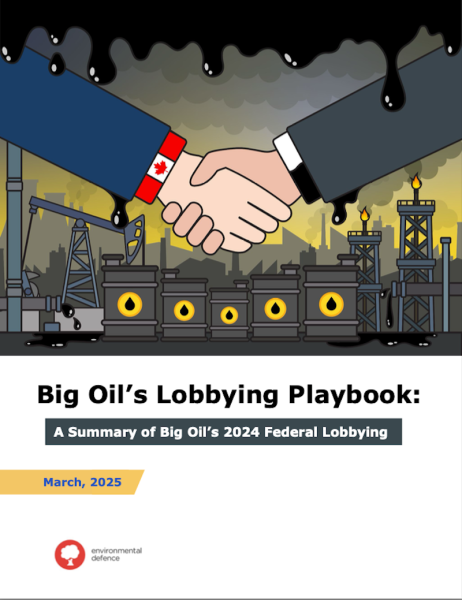
Environmental Defence just released a report showing that last year oil and gas company lobbyists were targeting the Conservative Party, in preference to the Canadian Government, by more than a 2 to 1 ratio. Cortes Currents interviewed Emilia Belliveau, lead author of ‘Big Oil’s Playbook, A Summary of Big Oil’s 2024 Federal Lobbying’ and asked Max Thaysen, from the Cortes Island Climate Action Network for his insights.
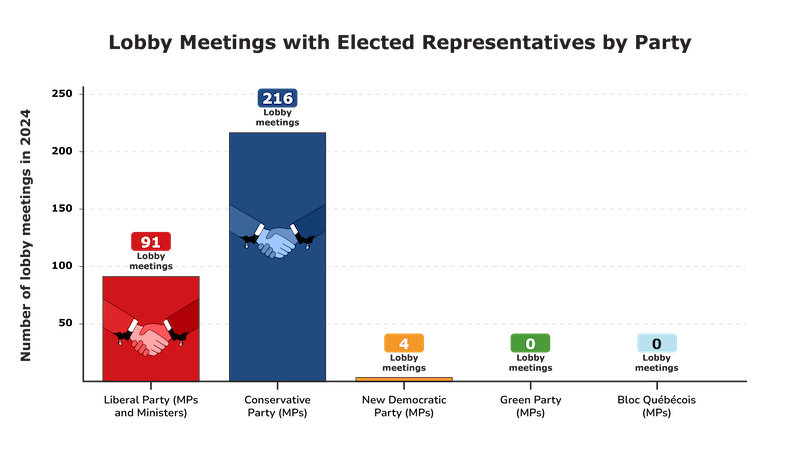
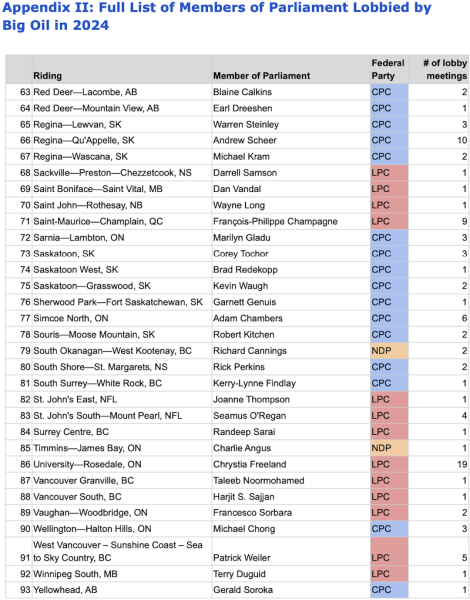
Emilia Belliveau: “Environmental Defence is a charity, so we are nonpartisan. What I can do is simply relay the facts, which are that the Bloc Québécois and the Green Party did not take any lobbyist meetings. The NDP took a very small number, four. Then you have most of the lobby meetings targeting the Federal Liberals and the Federal Conservatives. The Federal Liberals had 62 meetings with ministers and 29 meetings with backbencher MPs, and Conservative MPs took 216 lobby meetings.”
Cortes Currents: That’s 91 contacts with government ministers and Liberal MPs, which is less than half of the 216 meetings the lobbyists had with Conservative party members.
Belliveau said this was a change from 2023 when gas and oil lobbyists met with Canada’s two leading parties about 200 times each. (203 Liberal meetings vs 197 Conservative meetings.)
Max Thaysen, a member of the Cortes Climate Action Network pointed out, “The numbers presented for who the fossil fuel companies were lobbying, means that they are hoping for and planning on a Conservative government. This would be very strongly in their favour as far as I can tell and probably as far as they can tell. That’s something that we need to consider when we’re making our decisions and taking action leading up to our celebration of democracy (voting day), whenever that comes.”
Emilia Belliveau: “Environmental Defence tracks the fossil fuel industry’s lobbying of the Federal government in order to get a window into the ways that they’re trying to influence climate policy. That has huge implications because we need ambitious government climate policy in order to tackle climate change at the scale that’s really required.”
Max Thaysen: “To quote one scientific paper that I’m still working through, ‘We are on the brink of an irreversible climate disaster.’ This is a global emergency. We can’t really remember that often enough and that should form the context of how we interpret these kinds of activities.”
Cortes Currents: What about meetings that are initiated by the government or by one of the parties? Are those tracked?
Emilia Belliveau: “When we try and track lobbying, what we really see is only meetings that are initiated by lobbyists get tracked in the government’s registry. If the government itself requests a meeting, or sets up a working group, which we know they have done with certain oil and gas companies on major projects, those meetings don’t count as lobby meetings. So they’re not filed in the public record.”
“There’s actually way more contact with the government that we know is happening, but can’t report on in our analysis. We’ve seen some really wonderful investigative journalism. For example, in the past year, the Narwhal did a great investigation into TC Energy where they revealed lots of other ways that industry is trying to influence government. Lobbying is just one tactic, in this real playbook that they have, for trying to shape government policy in favor of fossil fuels.”
Cortes Currents: Do you happen to track the number of times that environmental groups contact the government?
Emilia Belliveau: “Some researchers who were formerly based out of the University of Victoria, did a 10 year study looking at different sectors, from 2011 to 2022. So covering both years where there was a Conservative Harper government and where there was the Trudeau Liberal government. In that 10 year study, the fossil fuel industry was the second most active industry lobbyist, following the agricultural sector and ahead of manufacturing. Environmental groups were ninth in that ranking list and had roughly half of the number of contacts with the Federal government than big oil did.”
Max Thaysen: “Big oil had a total of over 25,000 contacts over the period of 2011 to 2022, as compared to the environmental sector, which had a total of just over 13,000. We see that big industry has big money to put into lobbyists. The groups that are working hard to defend our lives from the destruction of climate change have fewer resources.”
“In this report there is another section comparing business interests versus public interests and the ratio of lobbying there is four to one ratio. We know that lobbying seems to have an effect. If we have ‘for profit’ interests having a four to one ratio over public interests, that’s a big problem.”
Emilia Belliveau: “ We have seen an increase in environmental sector lobbying, certainly, and that was actually a concerted effort on behalf of groups like Environmental Defence, who saw how much industry access to government was having an impact. We’re obviously still vastly out resourced by the fossil fuel industry when it comes to lobbying, but we do try.”

Cortes Currents: “Can you see any specific policies where the lobbying suddenly increased?”
Emilia Belliveau: “While the lobbying data that we are able to get access to and track doesn’t tell us the details of the conversations that they’re having, the big picture is the high frequency of the lobbying, the advocacy that industry is doing against climate policy. The outcomes for a lot of climate policies are weakened regulations, delayed implementation, or lots of loopholes that allow for fossil fuel companies to get exceptions to the overall intention or rule.”
“I hesitate to make super specific claims about a direct correlation between these meetings and this outcome, but what we can see, for example, that the industry has been fighting really hard against things like the emissions cap, which limits the pollution from the fossil fuel industry.They have been advocating against that in the media. They’ve run campaigns to their own lists and networks. We know that they’ve put statements and participated in consultation with government against the emissions cap and that regulation went through a lot of delays and ultimately didn’t materialize before the prorogation of Parliament.”
“You also have the clean electricity regulations, which basically clean up our electricity grid and remove fossil fuels from our electricity grid. What happened throughout the process of consultation for that regulation is that there were allowances made that allow gas on the grid for a longer period of time or for gas power plants to be grandfathered into this system and have exceptions made for them.”
“That’s the type of outcome that Environmental Defence and other climate change advocacy organizations really fought against, but ultimately we saw the government make these compromises which benefit the fossil fuel industry.”
Cortes Currents: Can you put a dollar figure to the lobbying attempts or the publicity attempts of the fossil fuel industry?
Emilia Belliveau: “Unfortunately, we can’t really put a dollar amount to it. Some of these companies have in-house lobbyists that they presumably pay very well, that are working full time for companies. Some of them have external consulting agencies that are working full time for companies. Because they’re private corporations, there’s no obligation for them to disclose the amount of resources that they’re spending on lobbying.”
“We sometimes are able to get more information about the hundreds of millions of dollars that they spend on advertising and as an industry, that gets spent to try and influence public opinion or influence government through advertising. Unfortunately, when it comes to lobbying, that doesn’t need to be disclosed.”
Cortes Currents: Who are the biggest lobbyists?
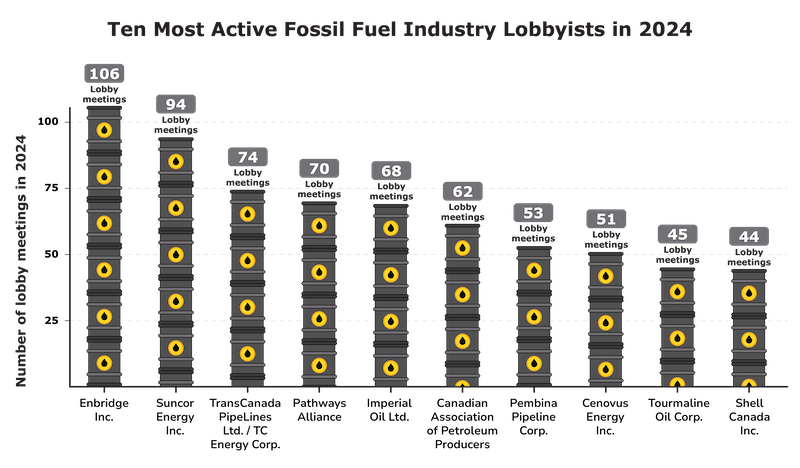
Emilia Belliveau: “In the past year, the top two biggest lobbyists were Enbridge, which is one of the largest natural fossil gas distributors, and Suncor, which is one of Canada’s biggest tar sands corporations.”
Cortes Currents: To put that into more of a BC context, Suncor is one of the oil sands giants using the Trans Mountain Pipeline.
On Enbridge’s website it says Westcoast Energy Inc. is an “Enbridge company (that) owns and operates British Columbia’s major natural gas transmission system referred to as the Westcoast or BC Pipeline system. This system transports processed natural gas to consumers throughout the province, Alberta and the US Pacific Northwest. This gas is ultimately used to heat homes, businesses, hospitals and schools. It is also used as a fuel for electric power generation and is a staple in many industrial and manufacturing processes.”

Emilia Belliveau: “Then you also have industry association groups like the Pathways Alliance and Canadian Association of Petroleum Producers, or CAP, that are also up there in the top 10.”
Cortes Currents: Would you happen to know if any of them are connected to LNG in BC?
Emilia Belliveau: “TC Energy Corp or Trans Canada Pipelines. They’re one of the backers of Coastal Gas Link, which is, of course, highly controversial. Another one of the most active lobbyists is Shell Canada, Inc.”

Cortes Currents: Can you put Canada’s expansion of its fossil fuel sector into more of a global picture? What’s going on in the energy world?
Emilia Belliveau: “Looking at macro trends, you see the International Energy Agency and other major assessors of long term oil and gas outlook, talking about the peak demand for oil and gas within this decade. We know that the long term outlook is shifting, and we know that Canadian heavy crude, which is, of course more expensive, more polluting, requires more upfront capital, then easier to access oil. It is a category of fossil fuel industry development that is likely to be hit harder by declines in oil production.”
“So we have a bit of conflicting stories happening where you have the fossil fuel industry within Canada trying to still portray that they have a lot of prospects for the future. They are still expanding production. Some were opening a new Fort Hills Oil Sands Mine expansion through a very sensitive wetland in Alberta. You have Imperial Oil with a new project that they’re looking to develop. So they are still very active, still intending to expand, maintaining steady or growing extraction within the Canadian oil industry, but I think what’s clear from those long term macro trends is that it won’t last forever.”

“You come back to this discussion about what do we do with these boom and bust cycles? I would advocate that it’s much better for the workers in those industries and better for us as a whole to be talking about how to manage the decline in fossil fuel production than just waiting for it to happen and allowing these multi-billion dollar corporations to wring out as much profit as they can while the times are good and then just abandon the communities and workers and cleanup efforts when the times are bad.”


Cortes Currents: Despite all of this expansion, I noticed that emissions are actually going down a bit.
Emilia Belliveau: “Canadian emissions as a whole have started to go down, but fossil fuel sector emissions are still the largest source of emissions in Canada. They’re not doing their fair share when it comes to overall emissions reductions in the country. Other industries are basically picking up the slack of the fossil fuel industry because their emissions have not declined at a similar rate.”
“So you’ve seen more substantial declines in energy production, for example, like electricity. In Canada we’re very lucky we have places like BC that have mostly clean grids and you’ve seen the phase out of coal and the expansion of renewable energy. We’ve seen excellent reductions of climate pollution in that sector. What we’re not seeing significant enough emissions reduction from the oil and gas sector.”
“We’re deeply concerned about the level of access that the fossil fuel industry has to government decision makers because we’ve seen time and time again that big oil really can’t be trusted to work in our best interest. They consistently are prioritizing their industry’s profit motive above the health of the planet.”


Links of Interest:
- Big Oil’s Big Year, A Summary 0f Big Oil’s 2023 Federal Lobbying – Environmental Defence
- Articles about, or mentioning, fossil fuel sector lobbyists – Cortes Currents
- Growth in global oil demand is set to slow significantly by 2028 – IEA
- World oil, gas, coal demand to peak by 2030, IEA says – Reuters
- The Environmental Defence website
- Articles by, or mentioning, the Cortes Island Climate Action Network – Cortes Currents
All undesignated photos and charts courtesy Environmental Defence
Sign-up for Cortes Currents email-out:
To receive an emailed catalogue of articles on Cortes Currents, send a (blank) email to subscribe to your desired frequency:
- Daily, (articles posted during the last 24 hours) – [email protected]
- Weekly Digest cortescurrents – [email protected]