


Frank Mottl’s latest novel, Cumberland Gold, takes us to the quaint village of Cumberland BC. This is the same setting as his first novel, The Cumberland Tales, in which Mottl described the community he knew in the 1960s. Only now he is writing about the late 19th century, when Lord Dunsmuir (1825-89) was attempting to recruit Chinese immigrants to work in his coal mine.
Mottle explained, “ I did some research at the Cumberland Museum, and there was an unsolved homicide in the 19th century in the old Cumberland Chinatown. Nobody knew much about it, other than it was unsolved. That really appealed to me, so I just ran with it. Of course I spent a year teaching in China, so it did have a lot of that Chinese influence inside of it.”
Cortes Currents: I’m wondering about the divisions you mentioned in the Chinese community, with the secretive Buddhist and Taoist basement temples and the Confucian temple and the Presbyterian church. You’re tracing them back to the periodic persecutions of Chinese academia during the early Qing dynasty.
Frank Mottl: “Yes, there were a lot of revenge scenarios in ancient China, and I portray some of that in the book. What I did is I pulled those old revenges into the Cumberland Chinatown to give it a political edge, to make more sense of what was going on. So I introduced the Qing dynasty (1644-1912), the Ming dynasty (1368-1644), and the Tang dynasty (618-907). Each dynasty had their loyalists and there were betrayals. Especially between the Ming and the Qing dynasties. There’s one passage in the book about a Ming dynasty general actually leaving the capital’s gate open so Qing forces could come in and start slaughtering people.”
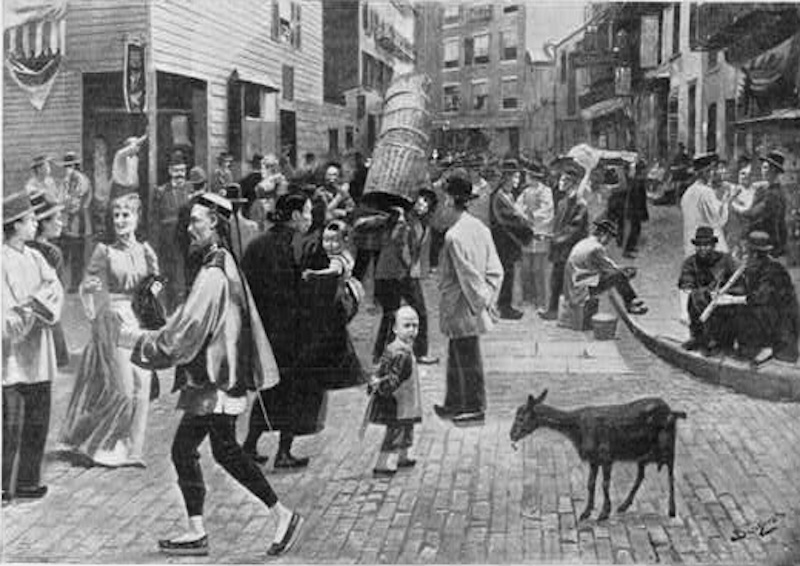
Chinese immigrants in New York – Drawn by W. Bengough.1896 courtesy US Library of Congress (Public Domain)
Cortes Currents: Was that kind of division actually occurring among the Chinese communities in British Columbia and San Francisco?
Frank Mottl: “As far as I know, no – but can I say for sure? A lot of people hold on to political beliefs, so it would not surprise me if the old Chinatown held on to these things.”
Cortes Currents: I like that scene where Dougal learned how to speak Cantonese. Do you want to talk a little bit more about that one?
Frank Mottl: “That’s from a true scenario. My wife told it to me. One of her relatives did a speech in front of a group of people, I’m not sure if it was in his native Norwegian. He assumed that the people could understand him, then all of a sudden realized that nobody knew what the heck he was saying.”
“As soon as I heard that story I thought ‘oh my god this is great’ because of course in China, a Mandarin speaker can’t understand a Cantonese speaker. They are two different dialects. I thought that would be great because it was a real nice little conflict where the bad guy is embarrassed In front of this big union hall meeting with all of these Chinese gentlemen watching him and they don’t understand what he’s saying. His higher up, Lord Dunsmuir, had no clue. He said, ‘Wow, wow, it’s really going great.’”
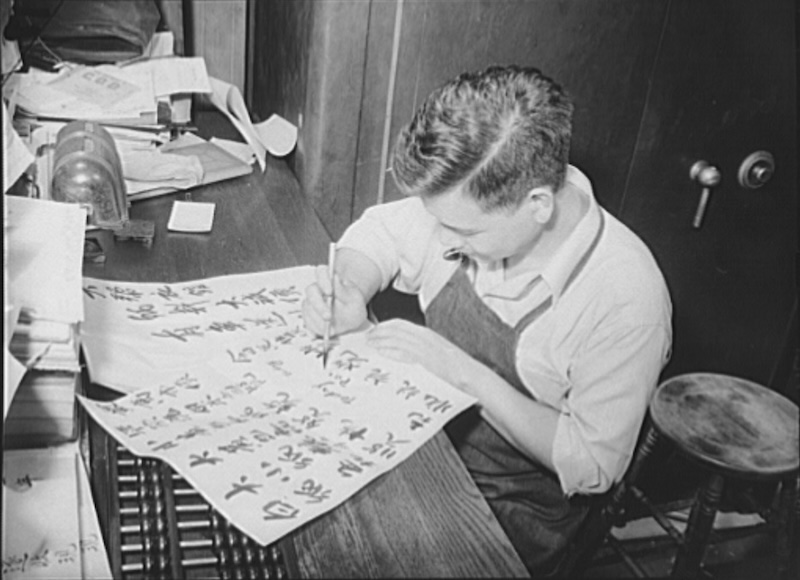
Manager of Chinese store writing down prices for merchandise – Photo by Howard Liberman courtesy Library of Congress (Public Domain)
Cortes Currents: I noticed that you brought one of the characters over from the Cumberland Tales, Sam Yick. Mind you, it could have been his grandfather. Do you want to tell us a little about this?
Frank Mottl: “The character intrigues me and I wanted to get some poetry in there. I knew that I would, I wanted to have two characters that were poets. There’s an old Japanese technique from the 14th century where they would make the characters poets. So I stuck with Sam Yick and then I came up with this other character’s name called Crowheart.”

Cortes Currents: You mentioned you were in China for a year. How does that happen?
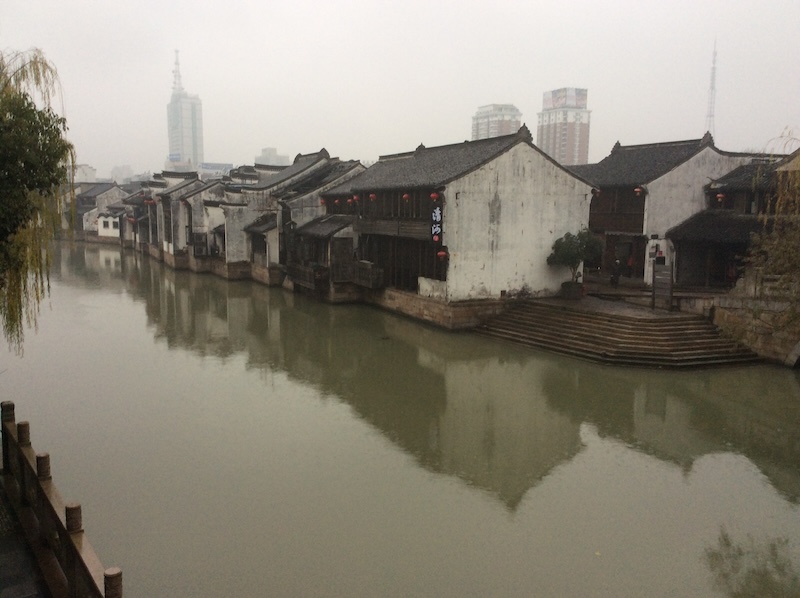
Frank Mottl: “I taught in a public school in China: 5,000 students, over 200 teachers. Grades kindergarten right up to grade 12.”
“The first week I thought, ‘Oh my God, what have I gotten myself into?’ My wife Linda was in Canada and she said, ‘Frank, you get in there and you teach those kids.’”
“It was difficult because Chinese students really don’t say much, and my job was to get them to speak, but I had lots of help from the Chinese teachers. I remember Rachel, one Chinese teacher who spoke English very well, she came up to me and she said, ‘Frank, I just want you to know that you have the support of every single teacher in this school.’ That really made a difference.”
“After a week, the students were just so interested in the way that I taught, because they really gave me a free rein. Chinese teachers were so strict because they’re overworked. They have so many students, and the only way they can really deal with everything has to be regimental. So, when I came in the classroom, it’s like, ‘Oh, it’s Mr. Frank, relax everybody.’”
“Here’s an interesting caveat. I’ve always been into writing poetry. I mentioned to one of the teachers, ‘ Some of the students have trouble writing sentences, I’m gonna Introduce them to poetry.’. They said, ‘oh, no, they’re too young.’ Picture this. Forty five students: about forty minutes of class or forty five minutes of class, I can’t recall. Every single student was concentrating on writing poems. I still have many of those poems, and they’re very good.”
“In fact, one teachable moment that I really kicked myself in the butt for, is when this one fellow came up after we had finished a poetry class. We were going on to something else, and I had a class plan. He showed me this sonnet that he had written and it was absolutely outstanding. I could not believe this kid wrote this sonnet but here is my error. I said, ‘Listen, I really want to talk about this, but I can’t do it right now. Just go sit down. We’ll go through the class. Come to my office afterwards and bring your poem.’ Well, he never showed up. What I should have done, in hindsight, was stop the class, get him to read his poem out loud to the class, and really talk about it. So that was one thing I really regret, and it was one poem that I don’t have.”
“Poetry really opened up a lot of venues and I was just fascinated that these Chinese students really took to it so well.
Cortes Currents: What year did you go?
Frank Mottl: “I think I came back in 2009, I’m not sure though. They wanted me to stay there for another year, but I was missing Canada and my wife wanted to come home.”
Cortes Currents: Were you a teacher over here in Canada?
Frank Mottl: “No, I never taught here in Canada at all. I got a degree in English and this fellow approached me just over the internet and said, ‘would you like to teach in China?’ I said, ‘sure.’”
“China gave me the opportunity to teach. Now I tutor at a private school in Canada.”

Cortes Currents: Do you have anything more you would like to say?
Frank Mottl: “There’s a heavy Chinese influence in Cumberland Gold and the Cumberland Tales. The people of China are wonderful. I don’t know about the government, that was behind a veil but the people, the kids, the parents, I mean, they were just outstanding. They treated us like real friends, I would definitely want to get that across.”
“I took a few interesting turns with Cumberland Gold. I call it a thriller, murder, but I wanted to take a detour. I wanted to leave it with a question in the reader’s minds.”
If you want to know what, you’ll have to read the book.
Links of Interest:
- Frank Mottl’s website
- The Inspiration for Mother’s Keep (Nov 16, 2021)
- Behind the Cumberland Tales (April 30 2018)
Top photo credit: The cover of Cumberland Gold (photo painted by Linda Mottl) alongside a historic photo of Cumberland’s Chinatown – both images supplied by Frank Mottl. All undesignated photos courtesy Frank Mottl
Sign-up for Cortes Currents email-out:
To receive an emailed catalogue of articles on Cortes Currents, send a (blank) email to subscribe to your desired frequency:
- Daily, (articles posted during the last 24 hours) – [email protected]
- Weekly Digest cortescurrents – [email protected]