
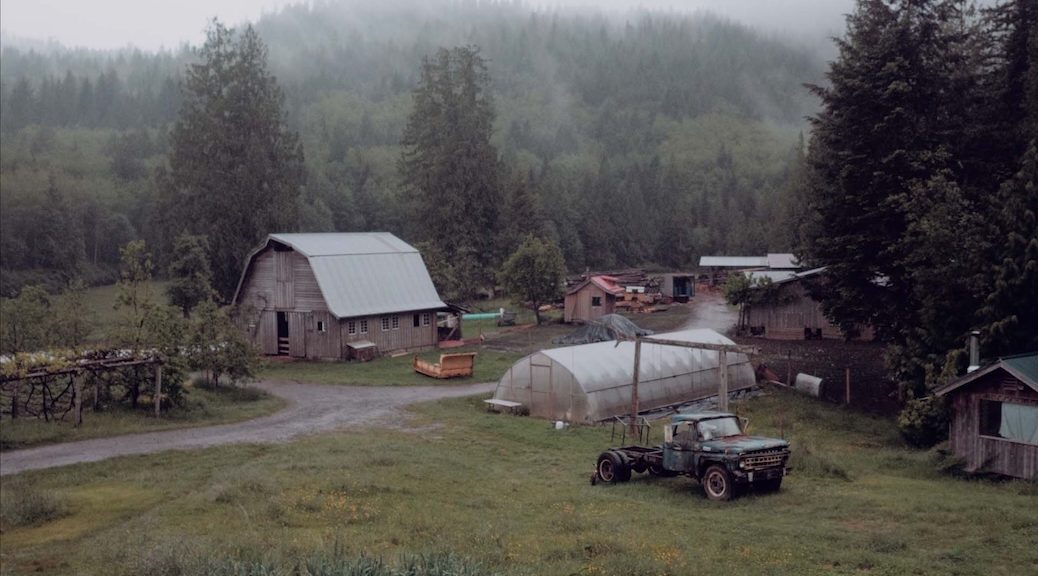

Morgan Tams was an integral part of the Cortes Island community for eight years before he and his partner Carly left in 2024. He recorded part of their experience as members of the Blue Jay Lake Farm community on a documentary that will air at Vancouver’s DOXA Festival on May 3 and 9, as well as the Knowledge Network later this year.
Morgan Tams: “ It was about five years working on this, not exclusively but of my time. I’ve had some really great showings on Cortes, which was really fantastic.”
“Now to have it play in Vancouver where I think there will be some crossover, some Cortes people in Vancouver, but I think there’s a city where people are right now so interested in alternative ways of living. I think partially just the direction the world is going, ideas about community, about being more connected to our food sources, about being connected to one another and being connected to skills like building and growing food are really pertinent topics for our time.”
“If this film can give some people some insight or some inspiration, or maybe even make them laugh within the context of all that stuff, then that’s great. I’m just so happy that it can screen here in Vancouver and hopefully people enjoy it and we can talk about it after. It’s always great to just to hear what people really think.”
Before Blue Jay Lake Farm
Cortes Currents: how long were you at Blue Jay Farm?
Morgan Tams: “We were at Blue Jay Lake Farm for almost eight years.”
Cortes Currents: Why did you go there? Why was it important?
Morgan Tams: “This would’ve been way back in 2016. I was on a road trip with my partner Carly. We were driving from Victoria back to Toronto. Our car broke down. And our car was a 1990 Volvo station wagon and, in the middle of Manitoba, it’s really hard to find parts. They quoted us three days for a new fuel pump to come. We were holed up in Brandon Manitoba. So we spent three days just hanging around the motel and wandering around town.”
“We got to talking about our lives in the future and neither of us were really feeling set on Toronto. It’s a great city when you’re young and we were feeling like as we got older, we weren’t really taking advantage of being in the city. I happened to mention that I always wanted to spend time on one of the islands on the west coast of BC.”
“Carly had spent a little bit of time at this place called Blue Jay Lake Farm, where she was a WWOOFer. She went for two weeks and ended up staying for two months. So she said, ‘oh, well, we could always go to Cortes to Blue Jay Lake Farm and connect with Henry Vershuur and the rest of the crew there.’ So right then and there we decided we were going the wrong direction and we decided to head back out west. I think it was November 1st, 2016, we landed at Blue Jay Lake Farm and we stayed for eight years.”

Arriving at Blue Jay Lake Farm
Cortes Currents: So what was it like? Was it a surprise?
Morgan Tams: “It was for me. I had an inkling that it was a different way of life, the back to the land thing, the do it yourself thing, and these were all things I wanted to learn. I wanted to learn to build with wood and work on my carpentry skills, and I wanted to learn to be able to fix machinery. I love being in community and connecting with people on that level. I also just love the landscapes of the West Coast. So while it was a big departure from our lives in Toronto, it was a world that I really, really wanted to be in. And I knew from being there for half an hour that somebody had to make a movie about this place.”
“You could just see it teetering, always teetering on the edge of chaos. You’ve got Henry running around doing a million things at once. You’ve got this beautiful farm. Then you’ve got all these WWOOFers, some of whom may have arrived the day before, but are suddenly in charge of making cheese or making yogurt or chasing the cows into the next field. There’s just always this flurry of activity going on.”

“All these buildings that are hand built; piles of junk. All these really, really rich textures, which as a filmmaker always really speaks to me in terms of what a place looks like, the qualities of light. Then also meeting the rest of the community of Blue Jay. And just being really interested in who they are as human beings. Why they chose to live a life like they have; what the sacrifices were; what the celebrations were and what’s motivating them to do such a thing.”
Cortes Currents: How long did it take before you started filming?
Morgan Tams: “If we were on Blue Jay for eight years, it was about four years before I actually started filming. Honestly, a large part of that was building relationships and trust with the people there. I knew that I wanted to make a film, but it wasn’t always at the forefront of my mind. It was something I was toying with, but it’s just so important for me as a filmmaker to have an authentic relationship with a person you’re filming. It’s not an extractive process. It’s much more of a collaborative process to get to know these people and get to know the landscape and get to know the routines of the farm and live alongside them.”
“It wasn’t that we were living there because I wanted to make a film. The film was totally secondary, but it did take a chunk of time for me to really come to a point of thinking ‘okay, I think I’m ready to make this film.'”
“The next big step was asking everybody if they wanted to be in a movie, which was absolutely terrifying. Of course if they said no, then I would honour that. And thankfully the five people you do see in the movie did say yes. There were a few other people living on the farm who weren’t as interested and that actually worked out to be okay because I think even having five main characters in a film is a lot of main characters,. It would’ve been quite difficult to have seven or eight people, even though the reality of the farm is that there are many more people who are long-term residents there.”
Max and Heidi

Cortes Currents: I am thinking of a scene where Max Thaysen was hunting. You don’t actually show him killing an animal, but later on you see one being slaughtered.
Morgan Tams: “It’s a lifestyle that in the context of Max and Heidi, who live about, say 95% off of what they grow, glean, gather, and hunt. It’s a lifestyle they have chosen and a big part of that lifestyle is hunting animals, eating animals and using animals to survive. That’s not something that comes lightly to them, or to me or to an audience. So the scenes where they are either hunting with Max, or butchering a cow a little bit later in the film, I really wanted to treat with as much sensitivity as possible. Obviously honouring the life of the animal, but also honouring the challenges of everybody on the farm those days.”
“It’s not just a hard day for the person that is doing the slaughtering of an animal. It’s a hard day for all of us ’cause those animals, especially livestock, are part of the community. I wanted to lean on that. One thing that I tried to do in the film is that there aren’t a lot of interviews, I would say none really at all, so just to show those levels of emotion, those levels of relationships between humans and the natural world, through expressions, through pacing, through shot framing and shot choice.”
“Those were also really challenging moments to shoot because when you’re behind a camera you’re not actively participating , you’re observing. That’s hard, as it is on a farm where there’s a lot of work to be done. It feels a little bit disrespectful, being behind a camera when an animal is losing its life, for example, but I also think it’s important to share those struggles.”
“People have certain views or attitudes or dreams about what it’s like living off the land and living on a farm. I wanted to make sure that those challenges, those struggles were addressed.”

“The choice to not really show any graphic slaughter was that I didn’t want to put people off. We’ve seen those images. We know what that looks like, a graphic slaughter of a chicken being killed or something like that. Instead of showing those, leaning into the fact that movies can be a bridge between people with different points of view, different opinions.”
“I’ve had vegans and vegetarians watch this movie and I said to them beforehand, ‘you’re going to see some things that are going to be challenging for you, but I encourage you to look at it like a conversation and stay open-minded to what you’re seeing and to what the people in the farm are going through.'”
“If I had gory images of animals or something like that, people are just going to shut down or turn the movie off. As a filmmaker, that’s not what I want. I want it to be a conversation and it’s going to mean different things to different people.”
5 from maybe 12 full time residents
“The other challenge was just working with my friends and neighbours. For people that don’t know the community at Blue Jay Lake Farm, it’s maybe about 12 full-time residents. It was pretty tightly knit living there for eight years. This is a chosen family and close friends that I’m working with. And to have me for the duration of two and a half years that I spent filming the movie, emailing, calling, coming, knocking on their door with my camera, saying, ‘Hey, can I film you today? Can I hang out with you today?’ –
‘Well, I’m not up to much.’ – And like, ‘that’s okay.’ That was really hard for me to keep up that level of not quite harassment, but maybe like borderline harassment, showing up and invading people’s privacy. For the most part, people were really welcoming. I was always sure to check in and have conversations about it.”
Anne Dzakovic

Cortes Currents: There were quite a few references to isolation. Living in one room with kids, I’m thinking of Anne Dzakovic in particular.
Morgan Tams: “She has that line at the beginning of the film when we’re first meeting her, ‘it’s really hard to be farmers and raise two kids when you’re living in one room.’ The film captures a very specific time in her life that’s totally different now, five years later, but she had two kids under the age of three and a half and were living in a small cabin that was built in 1969 in Whale Town by a bunch of hippies and moved to Blue Jay Lake Farm. It is totally rustic and, I think as many parents do at that age, they do feel pretty isolated from the rest of the world when childcare is your world.”
“On top of that, she’s a market farmer. So as soon as February rolls around until October, she is grinding it out in the field and in the greenhouse and at the farmer’s market, selling vegetables so that they can live. That’s a pretty intense lifestyle and an intense period of time for her in the film.”
“Isolation is a big theme. Cortes Island is isolated and then Blue Jay Lake Farm on top of that, is isolated by Cortes Island standards. So what it creates is this kind of magical little bubble. It’s like this weird wonderland that we all live in down in Blue Jay Lake Farm, and you come down the driveway and it takes forever to get down the driveway, but then you’re there and you’re in this little bit of a community.”
“What makes it so special is that we are this funny little community bubble in this expansive forest, in this expanse of the whole north end of Cortes Island. There’s only one property north of us and the rest is just Northern Cortes. We are really in that valley between those hills in the middle of the forest. It definitely does feel isolating that way.”
“What does Sam Gibb say? He says ‘three ferry rides away from the nearest hardware store.’ Some people look at the piles of junk that feature in the film, and they see junk and they see garbage and they see waste. Other people look at it and they see opportunity and they see recycling and reusing in a do it yourself kind of attitude. I wanted to play with that. For me, living on the farm was a shift in that point of view, and I hope that audiences, especially urban audiences, can have that shift in point of view as well.”
Seasons

Cortes Currents: The rhythm of work and being apart, and then coming together again. Can you talk a little bit more about that. How long was a workday, for example?
Morgan Tams: “Some days it’s a bunch of different tasks, or some days you’re just pulling weeds in the sun and swimming in the lake. It goes with the seasons. Spring and summer, the activity really ramps up and the tension really ramps up and those are the really busy times for anybody. Part of it is the reality of trying to grow your own food and understanding that from an audience point of view is that it’s a crazy amount of work.”
“Everyone’s got their own home and their own little unit.”
“Max and Heidi have their little cabin, their garden and salmon (fishing). Henry has the farmhouse and his crew of WWOOFers. They have the big garden too. Generally for Henry’s crew, it would probably be breakfast at eight and I think you work till four, with lunch.”

“For Sam and Anne, for example, in the summertime Sam would be up at 5:00 AM, make some coffee, go down to the field, pick a bunch of things for farmer’s market before it gets too hot and then they’re loading up the truck and doing the farmer’s market. That day for them ends at five. So that’s a full 12 hour day in the high summer. And that includes driving to Manson’s landing and setting up for the farmer’s market and dealing with people and dealing with kids and all of those things.”
Coming Together
Cortes Currents: There were also times when the community came together. The one that sticks out in my mind is Henry’s birthday. Did those happen very often or was that an infrequent thing?
Morgan Tams: “It was COVID while I was filming and the movie wasn’t designed that way, that was just what came down the pipeline as I started to take this movie seriously. We got together a lot less in those two years of COVID than we normally did on the farm. It was a real challenge in the editing process to create scenes where it felt like the ‘farmily’ was all coming together.”
“Henry’s birthday was a big one. I just knew that there would be a bit of a gathering and so made a point of showing up with my camera and being present. I didn’t want to make the movie about COVID and have masks and things because that starts to date it. That wasn’t a story that I wanted to tell. It’s a valid story. It’s just not the one I wanted to tell.”
“I have somewhere close to 200 hours of footage and the movie itself is 84 minutes. So what is that 1% or so that is needed in the film?”
“Once or twice a year everybody would get together and we’d have some meetings about some bigger decisions we needed to make around the farm. A lot of people ask why I didn’t include how the farm is governed. For me, a lot of those things, despite having everybody all together, which is really nice, sitting around a fire or having a laugh, it’s really boring. People talking about policy, whose turn it is to take the cows out or what kind of fences we’re going to build isn’t really cinema.”
“So I had to be really choosy and clever about how to build that sense of community.”
Cortes Currents: What made the movie worthwhile?
Morgan Tams: “Honestly, for me, it’s a bit of a gift to everybody who lives on the farm. It’s a document of a place and a time that none of us can go back to. Life continues to move on, which is obviously a huge theme in the movie. Those kids are now five years older, so they are 10 and six now, very different kids than the kids that are in the movie. Henry’s life is a little bit different. Max and Heidi’s life is a little bit different. Same thing with Sam and Anne. It’s something that I could give and say not only thank you for being in my film, but thank you for being in my life in such a special way in that period of time.”
Henry Verschuur

“I think too that just what Henry has built at Blue Jay Lake Farm as his life’s work. He moved there when he was, I’m going to guess, 33 or 34, probably a bit younger. That whole place was a clear cut. The whole story of that piece of land and what he’s carved out of that space is absolutely phenomenal.”
“It’s haywire sometimes, and yes, sometimes we disagree , and all of those things, but it is just a phenomenal, beautiful, beautiful place in the world. I feel so lucky that I was able to spend time and doubly lucky that I was trusted by everybody in the film to be able to tell a little bit of their stories.”
“That’s the takeaway for me and then if it lands with an audience, that’s just a bonus.
Cortes Currents: As you were talking, I was thinking of some of the scenes with the mill, especially when he is talking about a log rolling off and him just about getting hit.
Morgan Tams: “He’s actually at Sam and Anne’s place on the couch, with the kids on his lap, when he is telling that story of the log rolling off.
Cortes Currents: So he’s always working by himself?
Morgan Tams: “Henry’s relationship with the mill is interesting. He goes to the mill when he needs to think. He needs to clear his mind because it can be just him and machinery. It’s a repetitive task and it’s a little bit of meditation for him. I think that this is the mill that built Blue Jay Lake Farm and also built a lot of buildings on Cortes Island. It’s his safe space.”
“In the middle of winter, you’d be sleeping and you hear the mill fire up at five in the morning. It always does. You hear it and you roll over and you go back to sleep knowing that all is well in the world. Henry’s up and he’s milling some logs and he’s just doing his thing.”
“That was the best time to connect with him. The poor guy’s doing a million things at once, all day long. I would make the effort to get up at five and that’s how we were able to have some of those conversations. The conversation where he talks about his cancer diagnosis. For a lot of men, for a lot of us, it’s hard to talk so openly about our health, and so to be able to connect one-on-one like that, again, you had to put the time in, but also just to know where the special spots were to go and do that.”
“Same with his shop. It’s his special safe place, even though it’s totally chaotic there, he knows exactly where everything is. If you catch him there at the right time, he’s happy to talk about whatever’s on his mind – which is a really nice way to spend time.”

Sam the Inventor
Cortes Currents: Going back to Sam and him making stuff, how often does that happen?
Morgan Tams: “Sam Gibb is an inventor. He’s a bike mechanic on Cortes. He’s always making weird little inventions, whether it’s like a dish rack out of corrugated metal in their house or some kind of fun mechanical toys for the kids to play with, or he is finding old e-bikes at the dump and making e-bikes for his children out of scrap. He’s just always building stuff.”
“There’s a bunch of scenes that didn’t make it into the movie with more of Sam’s wacky inventions. He took a cordless drill and hooked it up to this piece of plywood with wheels and these spinning bicycle parts. It was a weeding machine. He would wheel it through the garden and it would chop all the weeds. He’s always just building all these things and part of that is he has access to these junk piles at Henry’s, of course, but that’s just how his mind works. He likes to tinker.”
“The other thing is that because of the way Blue Jay was built, largely 30 years ago, a lot of things go wrong. You need to have certain skills where you’re able to go and figure out why the water is not flowing? Oh, it turns out there’s a frog in the line. These are just things that happen. All of us cultivate those skills to varying degrees ’cause you have to. No one else is going to come fix it for you, which is something else Sam says in the movie. It’s also, what’s so beautiful about that way of life, is learning to adapt and make do with what you have.”
Cortes Currents: Is there another moment that you’d like to mention?
Morgan Tams: “I worked a long time trying to get the beginning of the movie. For a while I had these long sweeping drone shots down the Blue Jay driveway, which works in terms of the experience of arriving at the farm, but the beginning of the movie starts with Henry and he’s doing something with a goat. You don’t quite know what it is. Then the camera pulls back and he’s making a cast. The cast is like PVC plastic and some canvas and duct tape, and Henry’s duct taping the cast to the goat’s leg. You’re wondering what the heck is going on? Is this goat okay? Then the scene ends. You see the mum goat, and then you see the little goat with its little cast on hobbling after the mum. The goat goes in and has a little drink. For me, that really summarizes so much about Henry’s character.”
“There’s a level of care there that is incredible towards the animals, towards everybody that lives in the community, but also it’s that DIY plastic pipe and duct tape make it happen attitude, which is a Cortes thing and it’s a farmer thing that combined for just a really beautiful, mysterious way to begin the film.”
“Once I landed on that scene as the opener, I was just like, ‘yeah, this is it because it hooks you right by design. It’s like, okay, I’m interested. I’m going to watch the rest of this movie, hopefully.”
Cortes Currents: When did you leave Blue Jay Lake Farm?
Morgan Tams: “We left in October 2024.”
Cortes Currents: And you went to …?”
Morgan Tams: “To Vancouver.”
Cortes Currents: What’s your life like now, in comparison to the farm?
Morgan Tams: “Well, let me tell you, having hot water on tap is pretty sweet. There’s no more making fires to heat up hot water for a shower. There’s no more filling all the pots in our house with water and heating them on the stove and then pouring it in the bathtub to have a hot bath. Turns out in the city, you can just turn on a tap and hot water comes out. It’s a miracle! I really like that part.”
“It’s a lot easier to hop on a flight and go see family in Ontario or Prince Edward Island, where most of my family lives.”
“Blue Jay feels a little bit isolating. Cortes can feel a bit isolating, especially in the wintertime. In the city here, I can just walk out down my street and I’m in a busy neighbourhood and there’s interesting shops, or restaurants, or things to do, or friends to go see and that’s really nice.”
“On a work front, I’m still making films and doing things like I was doing on Cortes. It’s maybe a little bit busier in Vancouver, but I wouldn’t say measurably so.”
“I definitely miss being on the farm and living in the forest. That’s a big one for sure.”

Cortes Currents: That was actually my next question, what do you miss?
Morgan Tams: “A big part of it’s the community. I miss having friends a hundred meters away. You could just go knock on their door with a cup of coffee and see what’s going on and have a laugh, go down the hill and see the kids. Those kids are always happy to see you.”
“Obviously it’s such a treat to have Blue Jay Lake right there. Or going for a walk in the forest. You could walk all the way out to Von Donop Inlet or walk out to Peter Police’s homestead or Carrington Bay. It’s all right on the doorstep of Blue Jay Lake Farm, and I would do that daily, especially when I was working on this film. I would have moments where I was like, ‘I need to get off the computer. I need to get my brain settled. Go walk in the woods for an hour, man’ – go anywhere, any direction, discover all kinds of beautiful things out there. It gives you a fresh perspective on any project you’re working on. I do miss that and I miss the sound of the owls at night.”
Cortes Currents: Did you hear other wildlife?
Morgan Tams: “You hear wolves and owls out there for sure.”
Cortes Currents: Have any encounters?
Morgan Tams: “Over the years I’d see the odd wolf on the Blue Jay driveway, usually while driving, never while walking. Then evidence of wolf tracks and things not far from our homes, but in the mud, especially in wintertime, you can follow their tracks up to 200 meters from where we were living – but no close calls, no.”

“They do come around the farm. There’s a pretty extensive fencing system to keep them out and particularly keep them away from the livestock. We bring the cows in at night, otherwise we could just let them range in a field or something. For goats especially, it’s pretty high risk, but we have a good relationship with the wild animals around for sure.”
Cortes Currents: Did this fill something inside of you, the whole experience of being at Blue Jay for eight years?
Morgan Tams: “Absolutely. I’m a changed person. I’m not a super spiritual person, but I can’t imagine a better way to have spent the last eight years.”
Cortes Currents: What have you taken from Blue Jay that comes into your life?
Morgan Tams: “In a practical sense, skills that I’ve developed. In a more esoteric sense, a ‘do it yourself’ ethos. There’s a lot of tasks that actually aren’t surmountable and that you don’t actually need to spend a lot of money on or outsource. You can teach yourself to do it yourself, and you can really enjoy the process.”
“There’s magic in that, there’s magic in reclaiming that, and there’s magic in doing that with the community. That’s been a big takeaway for me as well. The film is exactly that. You know, it’s a bare bones movie, with a really small budget. I’d never made a feature length film before and inspired by Blue Jay I just taught myself the whole process from financing, editing, and now putting it out in the world?”
Cortes Currents: Morgan’s documentary ‘Green Valley’ is 84 mins long and will be shown twice at Vancouver’s 2026 DOCXA Festival. It will be at the Djavad Mowafaghian Cinema at SFU on Sunday, May 3, at 7:40 and downtown at the Cinematheque on Saturday, May 9 at 5:50 PM.
Is there any way that people from Cortes can still watch it?
Morgan Tams: “It will eventually be able to be streamed online starting in July, through the Knowledge Network. So they’ll be able to see it through their website. And also, I am planning right now a small tour of Vancouver Island and Quadra, and I may also play on Cortes again.”
Cortes Currents: You can’t do a film about Cortes and not bring it here!
Morgan Tams: “I’ve played on Cortes twice already, and so I feel like I’m beating a dead horse a little bit by showing it on Cortes a third time, but maybe, we shall see.”
Links of Interest:
- Blue Jay Lake Farm
- Morgan Rhys Tams website
- Green Valley-the documentary
- Articles about or mentioning Blue Jay Lake Farm
- Doxa Festival: May 30-May 19, 2026
All photos are courtesy Morgan Tams and the Morgan Rhys Tams website
Sign-up for Cortes Currents email-out:
To receive an emailed catalogue of articles on Cortes Currents, send a (blank) email to subscribe to your desired frequency:
- Daily, (articles posted during the last 24 hours) – [email protected]
- Weekly Digest cortescurrents – [email protected]