

One of the hot topics for Cortes residents, at the April 12 Electoral Areas Services Committee (EASC) meeting, was garbage pick-up. We may soon be asked to pay another $43 per household for a service many of us do not use. This is the amount Recycle BC is currently subsidizing our garbage collection program. They are threatening to withdraw that subsidy, but Mark Vonesch, Regional Director for Cortes Island, believes the Strathcona Regional District (SRD) will come up with a plan that will satisfy Recycle BC.
On January 25, SRD staff met with Recycle BC representatives to discuss the fact that the curbside pickup on Cortes Island is not delivering the amount of recyclables they expect. They want Cortesians to put out a minimum of 67 kg per household, which means that virtually 100% of the recyclables currently taken to the Cortes Recycling Depot would have to be left at the curb. The SRD was given until April 15 to come up with a draft plan to increase the volume.
Cortes Currents (CC) asked Mark Vonesch (MV), “What do you think of the fact you were not informed of this until days before the April 15th deadline?”
MV: “I think it’s disappointing. Good government is having open conversations early, and often. Having more time for me to be able to understand this issue would’ve allowed me to consult with more people, and understand the issue in a deeper way. I certainly brought that to staff, that I would appreciate more time, but there’s a lot happening at the SRD. I certainly don’t hold any ill will, but hope in the future when this kind of thing happens that I get a ‘heads up’ as soon as it comes into play.”
CC: Do you think part of this omission could be a cultural difference between Cortes and Campbell River? Do Cortesians tend to be more communicative about what’s happening in their community?
MV: “I think everybody likes to know what’s happening, understand the issues, and be aware of things early. I don’t think it’s a cultural thing across the geography of the SRD. I’m not entirely clear why this wasn’t brought to my attention earlier, but since it has come up and I have been aware of it, staff have been really responsive. They have welcomed my input.”
CC: Do you know how many people actually use garbage pickup?
MV: “For a lot of people, the curbside pickup is important. I don’t know the exact numbers. I think it changes during the seasons. It’s definitely used more in the summer, when more folks are here.”

Glass Shards like this cannot be left for curbside pickup – Photo by Beatrice Murch via Flickr (CC BY SA, 2.0 License)
“It’s a service that everybody pays $97 for and, as we’re discovering, about $40 of the cost is subsidized through Recycle BC. They’ve recently approached the SRD and said, Cortes needs to increase the amount that gets picked up otherwise we’re at risk of losing that subsidy.”
“I’m confident that we’re going to find a way to increase our numbers and keep the subsidy. I don’t think anybody wants to pay more for the service. I think with a bit of education and some rejigging of what the service looks like, we’re not going to lose that subsidy.”
“That’s why it was brought to the attention of the EASC Committee yesterday and why the SRD is putting together a plan to do our best to keep that subsidy. One of the things that we’re talking about is allowing glass to be picked up as well. The other idea we’re talking about is potentially having rotating weeks where garbage week this week, next week is recycling and just making it also work better for the contractor who does the curbside pickup.”


CC: I suspect that a lot of Cortesians have a lot less garbage than our urban counterparts.
MV: “I think that’s maybe generally accurate (for year-round-residents), but I don’t think it necessarily is true because we’re such a touristy place in the summer. Tourists don’t necessarily have the same values around waste as we do. The amount that goes into the garbage in the summer increases a lot per capita, compared to the rest of the year. It’s two different numbers that we’re looking at.”
CC: Part of the problem is soft plastics and glass are currently not part of the curbside pick-up program, which means Cortesians have to go to the recycling depot anyway. This brings us back to the question, how many people use the curbside pick-up program? Is this a service Cortes residents should be paying for? Or should we be targeting the people who use this service?

MV: “I’ve had that question before. I’ve had people email me and say, ‘I don’t use curbside pickup, why do I have to pay for it?’ My thoughts up to this point have been that we all pay taxes. Some of us don’t have kids in school, but our taxes get used to make sure that the children in our community get a good education. Not all of us use the healthcare system in the same way, but we all pay taxes into that. It feels like garbage pickup, and those kind of services, are a similar kind of thing where we all collectively pay into to because it’s a worthwhile service. Obviously that’s up for debate and all things are possible to change, but it feels like that’s what the will of the community is.”
CC: Recycle BC also encourages people to take their soft plastics and their glass to the recycling depot. I know there are Cortesian families that, after they are through composting and recycling, produce a handfull of garbage most months. I wonder if Recycle BC is aware of who they are dealing with? And if their standards are valid here?
MV: “I don’t think there’s a question of whether Cortes cares about the environment or whether we recycle enough. The story here is that Cortes is great at recycling. People on Cortes really care. They want to reduce their footprint. The reason the free store is something that’s alive and well here is because people want to reuse, recycle and reduce our footprint in the world.”
“People want to know that their recycling is getting recycled properly. They want to know that they have access to be able to recycle all the different things, like soft plastic and glass.”

Glass jar – Photo by Sreve Johnson via Flickr (CC BY SA, 2.0 License)
“One of the interesting things when you look at the letter that recycling BC wrote is that curbside pickup has increased by three times over the last eight years. It is increasing, it’s just that it’s really low compared to the total amount that’s getting collected.”
“We are recycling a lot, we do care about the environment and we want to have all the things that can be recycled, recycled, but it’s just not happening through the mechanism that allows this subsidy to be in place. That’s what we’re addressing.”
“For a lot of people, the curbside pickup is important and I think we just need to do some more communications around how to make the curbside more effective and maybe rejig some things so that it works better for the contractor.”
“It’s really just an administrative thing. How do we increase those numbers so that we still qualify for the subsidy that’s specific to curbside pickup?”
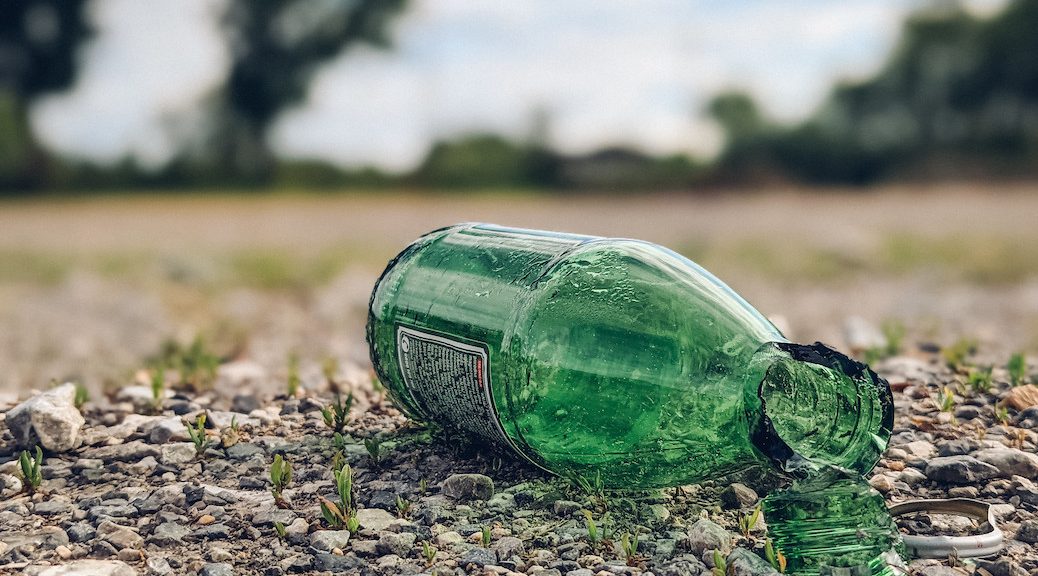
Top photo credit: Close-up of a broken glass bottle that was dumped rather than recycled – Photo by Ivan Radic via Flickr (CC BY SA, 2.0 License)
Sign-up for Cortes Currents email-out:
To receive an emailed catalogue of articles on Cortes Currents, send a (blank) email to subscribe to your desired frequency:
- Daily, (articles posted during the last 24 hours) – [email protected]
- Weekly Digest cortescurrents – [email protected]