


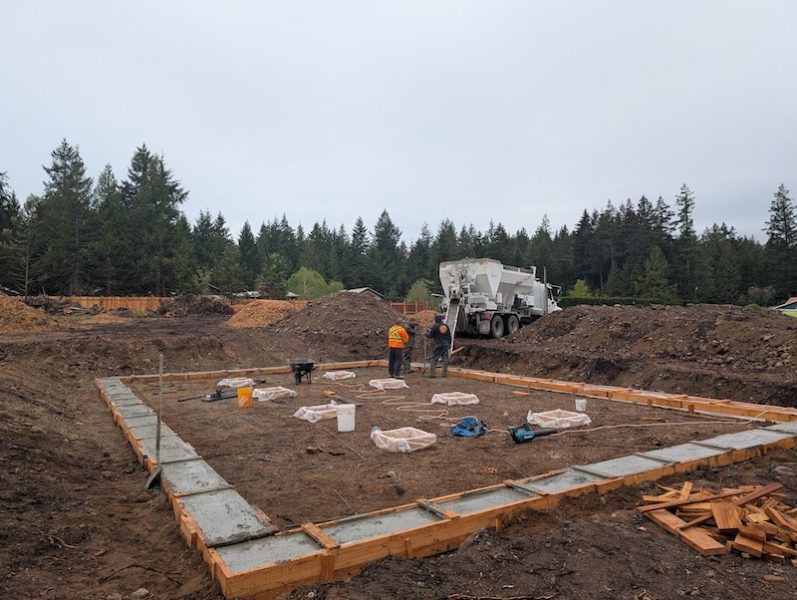
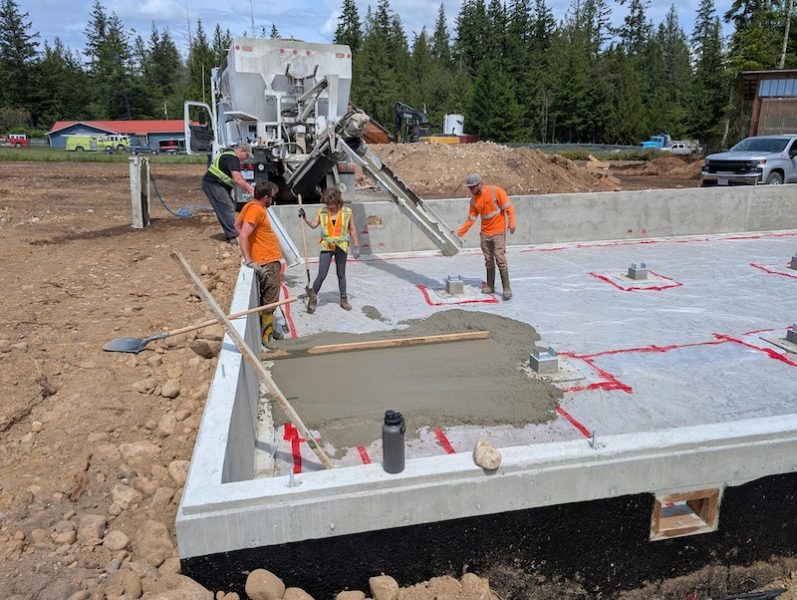
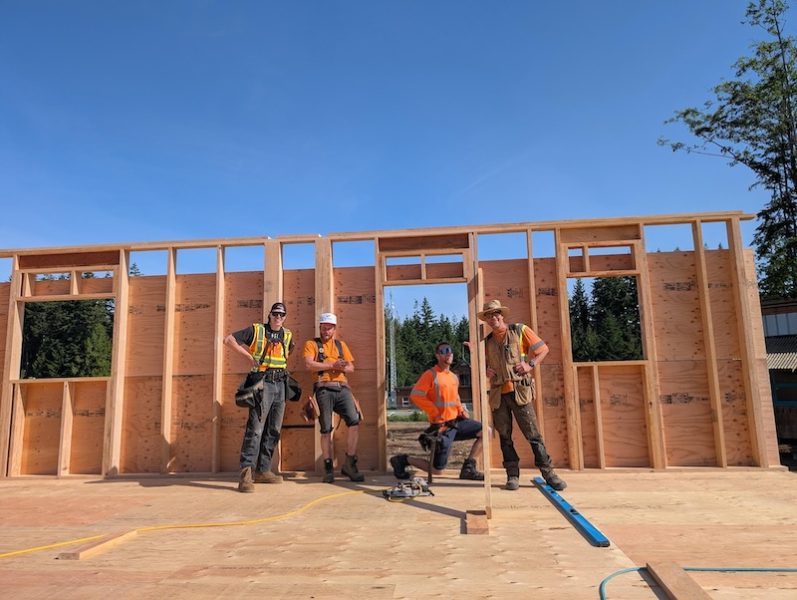
Mark Lombard from the Cortes Housing Society recently gave an update on progress at the Rainbow Ridge Affordable Housing Project.
“At this point we’re well along the way of building a community building with an office for the housing society. It’ll have:
- a utility space that has controls for the water systems and filtration to send water to all the homes.
- the controls for the battery and solar system that will provide backup power for the water and sewer for the buildings.
- a laundry room that’ll serve the women’s shelter and other people on the south end who need it.
- a guest bedroom that people who live in the seniors village or at Rainbow Ridge will be able to rent for a modest price per night.
- a lounge area with a kitchenette that people can have a little birthday dinner or a card game, or if the Housing Society board wants to meet, there’ll be a big table that can be used for that.”
“We’re putting the siding on right now, and working on the interior finishing.”
Cortes Currents: Tell me about your electricity needs and how you’re meeting them.
Mark Lombard: “We’re trying to really think through everything right from the beginning and because we’re designing this project from scratch, we really have the opportunity to optimize the buildings for passive gain, solar photovoltaics or PV panels. We’ve got a team that’s really interested in all of those things and our builders are drawn to a project like this because they get to work with some of those things.”
“We’re probably two to four months away from BC Hydro being ready to start the installation of the grid connection. There’s a lot of work that needs to go into the site planning and approvals for that.”
“We’ve been running off a long extension cord from the Cortes Fire Department, and that’s pretty challenging, a lot of electricity loss.”
“We also have a generator here for when we run larger tools.”
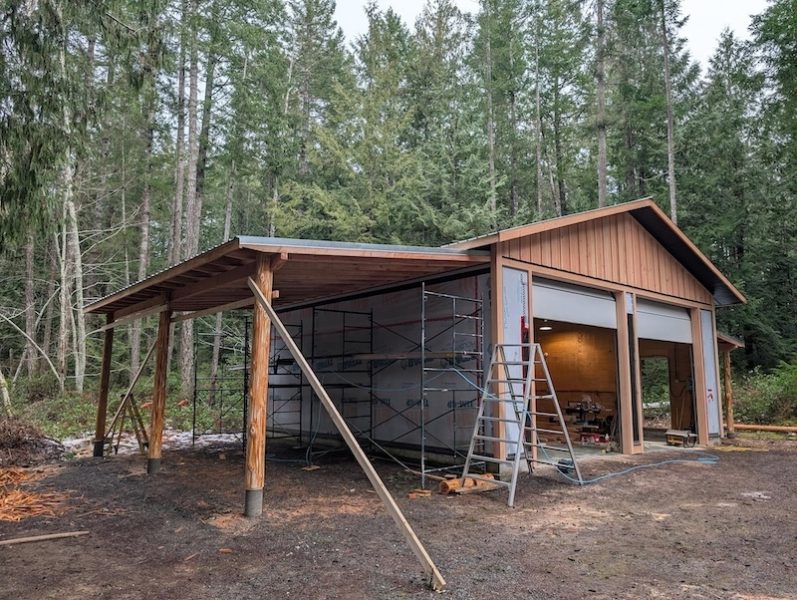
“We’re fortunate to have access to the Makerspace, so if we have to process a bunch of lumber in the table saw, we can do it over there.”
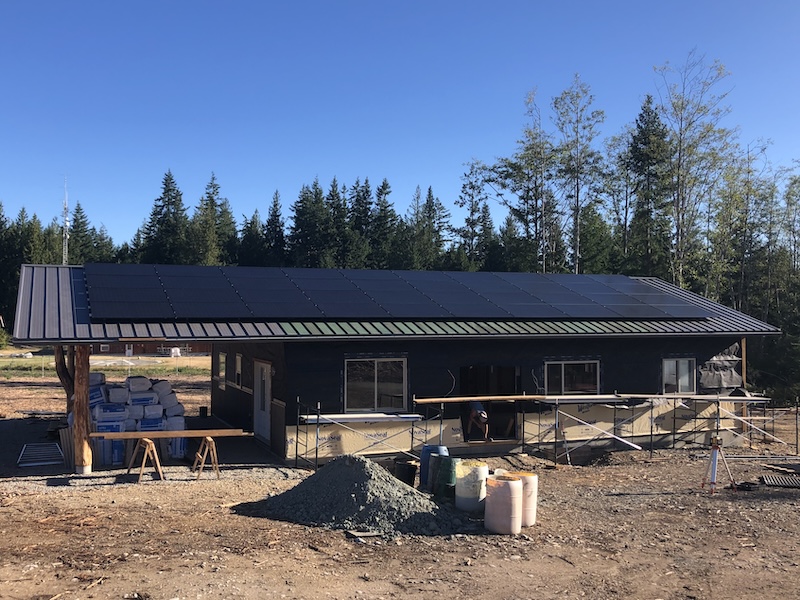
“Today we’re going to hopefully see the final phase of the installation of the solar panels and battery backup systems so that by the end of the week we’ll be running mostly off the battery bank and solar power. A residential system typically ranges from 5,000 to 10,000 kilowatts and this is an 18,000 kilowatt system and our battery backup system is 16.4 kilowatt hours. So the solar array is roughly double a typical residential system.”
“We want to be able to have running water and flushing toilets and septic that works in an extended power outage, and it’ll all be covered by the solar system. This way we don’t have to have a propane generator, with all the costs and maintenance associated with a generator.”
Cortes Currents: I understand you’re using a passive design which would require a fraction of the energy of normal heating methods.
Mark Lombard: “That’s right, passive solar is the first thing to do when you’re talking about energy.”
“The broad strokes of passive design are to have really good insulation, really good draft proofing, also have thermal mass that can absorb heat in the wintertime and hold the heat, but also stay cool in the summertime.”
“From a design perspective, you want to orient the buildings on an east west axis or within 10 degrees of that so that you can have the main solar gain in the wintertime come through your south facing windows. In the summertime you’ve got good overhangs that shade the sun from coming into the south windows. You particularly want to make sure you don’t have overheating from east and west gain, when the sun gets lower in the wintertime. We’ve got those things integrated into the design. You also want to have an open concept on the south side so that the heat can spread out to the main living areas.”
“We’re probably going to have something in the order of step code 5 or enter guide 95, if you want to call it that. With the solar panels on the roof of each building, they probably won’t be quite net zero, but they’ll be close.”
Cortes Currents: Tell me about other green aspects to the project?
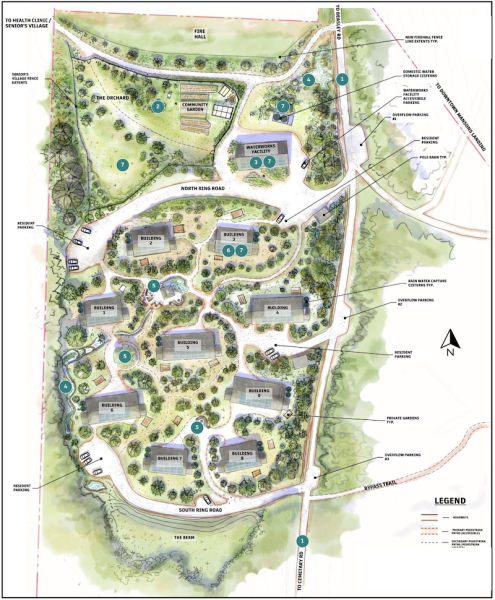
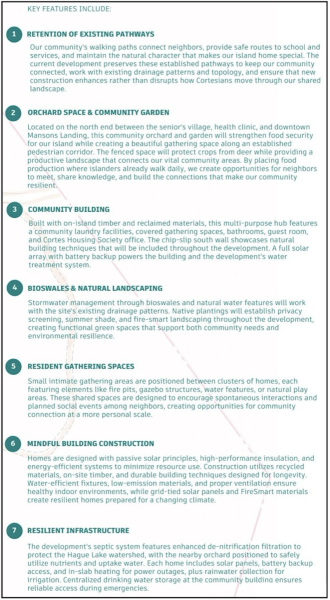
Mark Lombard: “First and foremost, we’re thinking about how to design the site to make sure that we don’t significantly impact the water and the runoff from the area into the greater Manson’s Landing area.”
“Similarly, with the septic system, we’re using an advantex system that’s going to reduce the nitrogen load before it gets pumped into the field by roughly 80% from a typical septic system. Then we’re going to add carbonaceous material down slope from the field so that any residual nitrogen will be absorbed by this carbonaceous material, it’s a little bit of an advanced maneuver. So for the site water septic management, thinking in terms of permaculture and not like investing in really maintenance heavy capital infrastructure, but having permaculture where you have swales and you use plants and vegetation and really work with the site.”
“We’ve talked a lot about the energy side, on the water side, we’re going to use energy efficient fixtures and appliances that will also have rainwater capture so that people can irrigate with rainwater capture. We’ll use low toxicity and low VOC finishes for the materials on the inside of the house.”
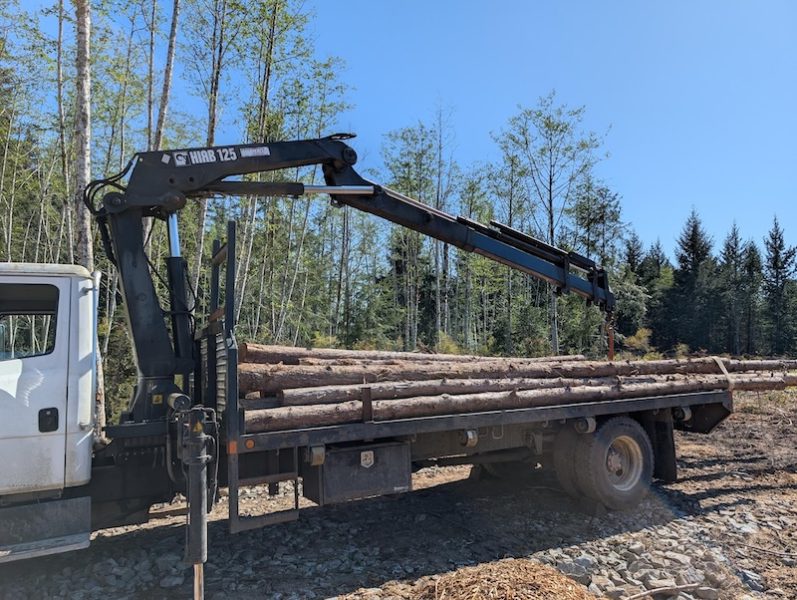
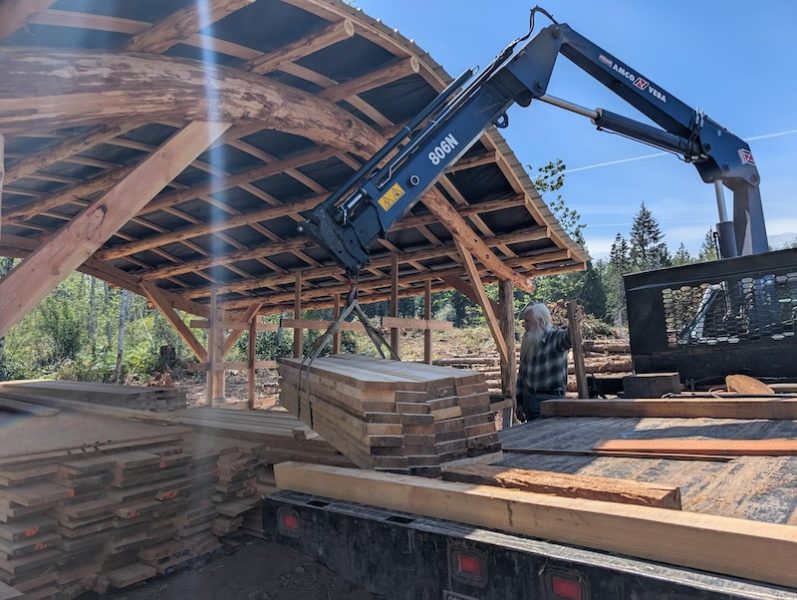
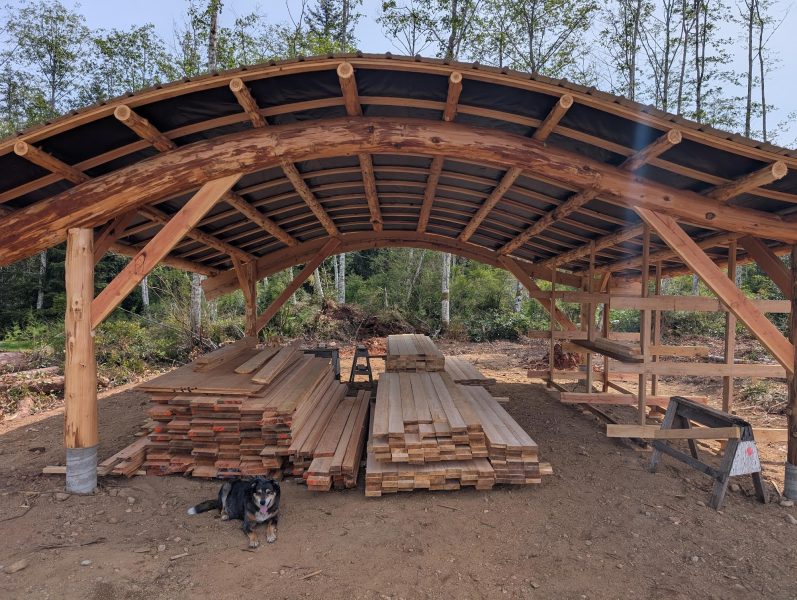
“We’ll be using some wood donated from Cortes Island. Now we’re going to go over to Ellingsen Woods Kiln and planer molder, and we’re going to be taking hemlock out of the kiln that Ron Wolda milled up for the Housing Society Project. The logs for that hemlock were donated by members of the community and by the community forest to go towards the project. Ron milled them up, we put them in the kiln, and then today they’re coming out of the kiln to go through the planer molder and they’ll be made into tongue and groove paneling that will be installed next week in the community building.”
Cortes Currents: These are all environmental goals, what about the other goal of making affordable housing? How is that coming?
Mark Lombard: “It’s coming really well. We’ve been really fortunate to have had donations that are funding most of this work so we don’t have the additional regulatory and requirements say, for example, with BC Housing. Some of the senior’s cottages were built using BC Housing funding and this makes it a lot more expensive.”
“We also had put together a project design that was intended to build 24 units all at once and apply for BC Housing funding to do it. We didn’t get the funding for three years in a row and we’ve regrouped and pivoted away from that. We’ve really simplified the design in a way that it can be done in a modular way, one building at a time. As we get the money we can keep going. Maybe once we’ve got a couple buildings built, we’ll be able to get financing either through banks, community bonds or something like that. Maybe it’ll accelerate at some point, but at this point we’re just doing it one building at a time.”
“We’ve also really simplified the designs that were initially going to be modular panels brought from Vancouver Island that would be craned into place. We’re changing that to make a simpler, more rectangular box that’s easy to build.”
“With the ferry ramp limitation, we’re not able to bring trusses over so the buildings are designed to be able to frame them simply with dimensional lumber for ceiling joists and rafters.”
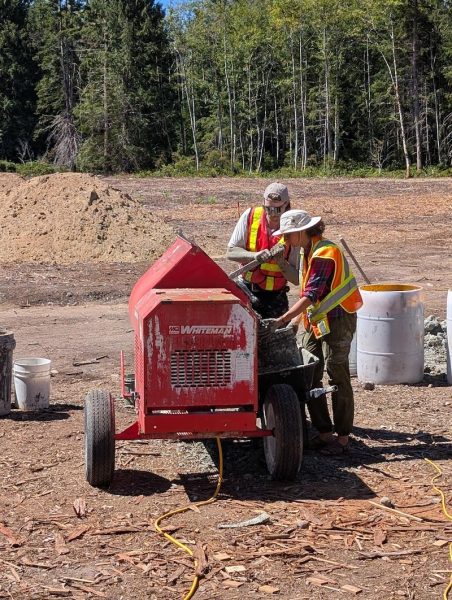
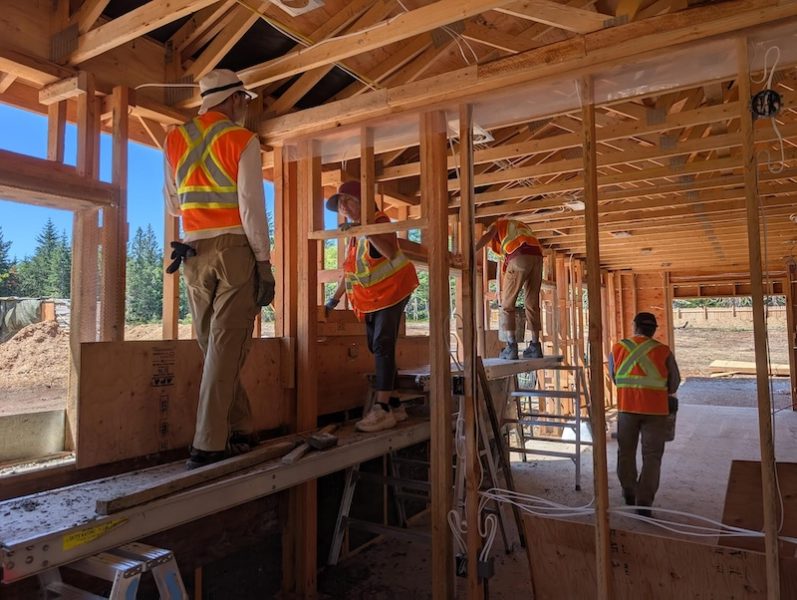
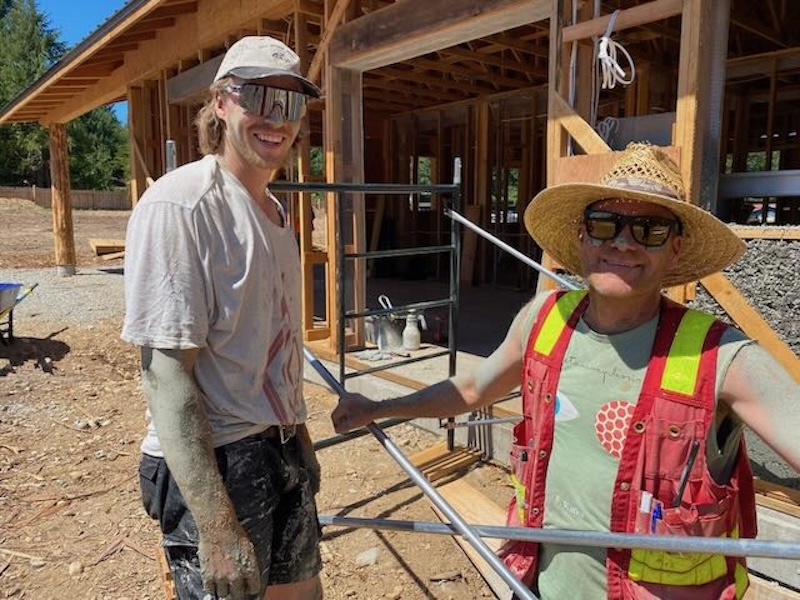
“One of the things that we did on our community building is a natural building feature wall on the south side, where the wall is 12 inches thick. It’s insulated with wood chips that are chipped up small cedar logs from our site and clay from Blue Jay Lake Farm.”
“The wood chips are coated in clay and they go into a slip form in the wall. So the wall has a piece of (plow?) on each side. About two feet high in that you fill that with wood chips and clay and then you unscrew the plywood and you move it up with as a slip form. It’s a little bit more labor intensive than a typical stick framing and bad insulation assembly, but we’re able to use volunteer labour. We ran a workshop on the weekend of the open house in July and that was really fun. There were lots of people from Cortes who came out and built that wall.”
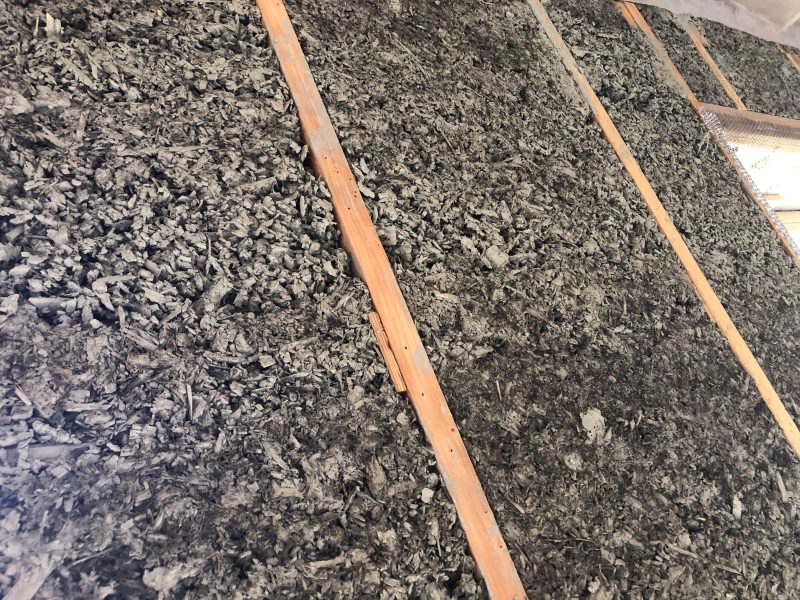
“The chip slip wall is a really good thermal mass. It helps keep the building really cool in the summertime and it holds the heat in the winter, but it also breathes. There’s no vapor barrier requirement for a wall like that. If there’s excess moisture in the building, the wall can absorb a little bit of it and then release a little bit of it. It makes the building feel naturally cool in the summertime.”
“If you build a modern airtight building like our duplexes are going to be, we have to have continuous ventilation in those buildings so that you don’t get mold and moisture issues. If you build with natural technique like the chip slip, it’s breathable.”
“We’re planning to build the first building over the first winter, so it could be ready in June but the next two buildings we’re going to try to do the chip slip in the spring, which allows it to dry over the summertime and then we can plaster it. So we’re trying to bring in some of those techniques too that’ll help reduce costs and make the buildings more comfortable and livable.”
Cortes Currents: A lot of people get the idea that using green techniques is more expensive, but in reality they are either cheaper or in the long run will be cheaper because of the cost saving benefits.
Mark Lombard: “I really agree with you. if you build a fairly typical building in a fairly typical way, and then you add a more efficient furnace, and you add lower VOC paints and you maybe get windows that are a little bit more expensive and a few things like that, then the whole thing’s going to be more expensive, but not if you go right back down to basics and start from scratch.”

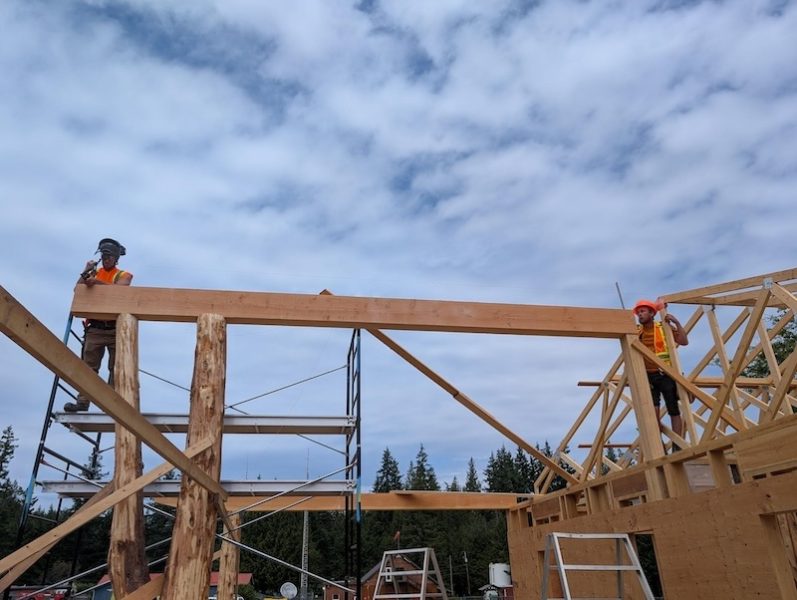
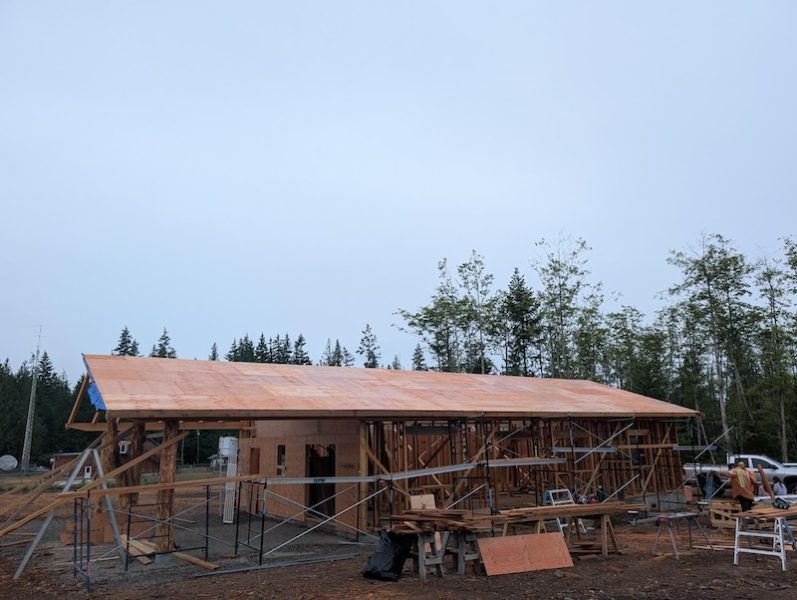
“These buildings don’t have any hips and valleys in the roofs. They don’t have dormers, they don’t have any L shapes. They’re just a simple roof. When Robert Tweedy came to install the roof on our community building he said, ‘wow, this is just going to take a couple hours because it’s so simple.’”
“It doesn’t cost any more money to put the building on an east-west axis, but the shade that is provided by the summertime means that the building is going to be cooler than most buildings are because it’s not going to have any chance to overheat and with the really good insulation. It makes it easier to keep it cool in summertime and it makes it easier to keep it warm in the wintertime because you’re getting that free passive solar gain.”
“The building code calls for good insulation now. So if you’re building a new building in British Columbia that’s done properly and meets all the code requirements, the insulation is actually pretty good and the draft proofing is really good. So just meeting the basic code and actually adhering to that, you’re building a really energy efficient and building in terms of the envelope.”
“We’re adding passive design features that cost nothing but add a lot of benefit for the operation over time. So I think that having a really simple design, like just a square box with a simple roof, but with nice, decent quality finishes on the inside and a pleasant aesthetic, I think it’s going to be cheaper than building a fairly normal building,”
Cortes Currents: Did I ask about the cost of the rents?
Mark Lombard: “The board of directors of the Housing Society will be convening a working group to talk about the exact rents, how that’ll be determined and how we’ll manage the list of people wanting to get into the buildings.”
“At this point our broad sense is that we’re going to build more two bedrooms than anything else because that’s likely one of the more versatile options for people. So three quarters of the units will be two bedrooms, and then the other quarter will be a mix of one and three bedrooms. Our general idea is that the one bedrooms will be somewhere around approximately $1,100. The two bedrooms would be something in the $1,500 to $1,600 range, and then the three bedrooms might be somewhere around $1,800 or $1,900. It could be a little bit less or a little bit more, I really want to emphasize it’s not been fully decided yet, but that’s what we’re targeting.”

Cortes Currents: Talk to me about the relationships you’ve been having with the community
Mark Lombard: “The Housing Society’s been sending out a newsletter every four to six weeks to the people who are signed up to the mailing list. We also make posts on the Tideline and on social media. In July, we had an open house that was attended by somewhere in the 80 to 100 people range over the course of the day, and had a lot of good feedback. We had our duplex draft plans to show people and we collected feedback and input from people on the draft plans for the first round of duplexes.”
“We’ve had open houses. One in the late winter this year, before we started, and we had another one last year. In our newsletter we ask people for input and feedback, and I think that there’s like a standing invitation to the community for input. We’ve also been working more and more closely with the Seniors Village, in getting ready to start the project.”
“Now that the Housing Society is going to be managing those rentals as well as taking that load off the Cortes Senior Society, we’ve been working with the Seniors Village. We’ve been asking them what works, in terms of the heating and cooling of those buildings, and trying to bring some of those really preferred heating strategies into our buildings.”
“We heard from the seniors that they have one bedroom cottages, and they don’t have a place to get together for lunch or card games. That’s one of the reasons that we put the community space front and center, so the seniors can use it.”
“They also don’t have a place for guests to stay and so that’s one of the things that informed our prioritizing building a guest bedroom in the community building right off the bat.”
“We heard from the Cortes Island Women’s Shelter that there are lots of folks who could really use a place to do laundry and maybe have a shower. So the community building is going to have that facility where there’ll be four washers and dryers, an accessible washroom and a shower. Even people in a wheelchair could come in and have a shower and use the facilities. So we’re trying to collect information in a variety of means.”
“We’ve heard really loud and clearly that the environmental goals, particularly with respect to the watershed and the lake are really important.”
Cortes Currents: Do you have wells?
Mark Lombard: “We do, we have one really good high flowing well that has really good quality water for the site, so it’ll be nice to bolster that with rainwater capture for irrigation.”
Cortes Currents: Are there also storage tanks for the well water?
Mark Lombard; “There will be some pressure tanks in the community building, in the utility space, and there’ll also be one or two large storage tanks for the drinking water.”
“We’ll have rainwater capture off each roof and then for the storm water coming off the roof that the cisterns don’t hold. There’ll be little water features and swales to slow the water down on the property before it leaves.”
“We’re looking at options for recharging the water tanks at the fire hall with the runoff from the community building roof. When we use a lot of water out of the tanks at the fire department, we either have to go shuttle it from the lake – which means running up and down the hill with a big diesel truck – or pumping it out of our shallow well. This puts a strain on that water system.”
“So if we can capture it off the roof here, which is almost the same height or elevation as the tanks, it could be pretty synergistic. So you know, the rainwater will mostly be for fire and irrigation.”


Cortes Currents: Are there more examples of Rainbow Ridge working with other community organizations?
Mark Lombard: “We’re right beside the fire department, and the fire department needed more space in the training yard. So we’ve moved the fire department fence back a little bit to create more space for the helicopters to land. One of the things that we’re trying to do in amongst all of the design criteria is integrate wildfire risk reduction in Fire Smart principles. Example: having the fire department’s training yard be an area that in the event of a serious wildfire where we weren’t all able to evacuate the island, we have a defensible area.”
“You need to have an area that’s four times the height of the nearest trees and approximately eight times the height of a flame wall that could be around it. The trees were so close that they were literally falling on the helipad, there was a lot of diseased trees in this north end. It was a third growth area that had been logged twice in the past and was really unhealthy.”
We cleared out the conifers. A lot of them were unhealthy, so we couldn’t keep them.”
“We are going to plant a whole mix of deciduous trees that’ll provide leafy cool shade in the summertime and let in more light in the wintertime. Deciduous or leafy trees are much more fire resistant naturally than conifers, which release volatile oils when they get warm and it creates a real fire risk.”

The Housing Society site owns 58 acres at Rainbow Ridge and we’ve only cleared 4.5 acres, and they’re the four and a half acres that are closest to the Senior’s Village, the skate park, Mansons Hall and the fire department.”
“So that probably has the biggest benefit in terms of wildfire risk production. We’re not doing anything with the other 52 acres. The conifers will all remain there.”
“The fire department got new tanks and we’re going to move them up to the highest part of the land, which for the fire department is the southwest corner, and it would be just to the northwest of our project. Those fire tanks are going to be connected to a water line that goes down to Manson’s Hall. It goes down to a filling station, adjacent to the fire department and it will also provide water to a hydrant and the hydrant will be the primary fire protection for Rainbow Ridge. We can protect the whole area, or fight fires in the village as needed.”
“The line that comes off those tanks is going to serve the fire department to fill the trucks, it’s going to serve our fire hydrant in Rainbow Ridge, and it’s going to go down to Manson Hall as well, to provide sprinkler protection to Manson Hall.”


“As much as possible, we’re trying to bring in a multi solving approach.”
“So rather than the Fire Repartment operating completely in a silo and Rainbow Ridge operating completely in a silo, we want to work together as much as possible to optimize the resources. There’ll be several rows of trees there to provide visual and separation from the two projects. It also makes sense that if there are two really big water tanks right there, we might as well use them for Rainbow Ridge as well rather than buying more tanks, and having our own fire suppression.”
“A multi-solving approach benefits everybody. The fire department’s more defensible in a wildfire.”
“The housing site may also even be able to provide housing for a future Fire Chief, which is a really big challenge for the fire department to be able to recruit a good Chief.”
“With the doctors coming to work on Cortes, it was really hard for them to find places to live. So the Housing Society has rented out one of the homes that it owns to the Cortes Community Health Association so that the doctors always have a place to live.”

Links of Interest:
- Cortes Housing Society website
- Articles about, or mentioning, the Cortes Island Housing Society
- Articles about, or mentioning, Rainbow Ridge
- Articles about, or mentioning, the Cortes Island Senior’s Village
All undesignated photos courtesy the Cortes Housing Society
Sign-up for Cortes Currents email-out:
To receive an emailed catalogue of articles on Cortes Currents, send a (blank) email to subscribe to your desired frequency:
- Daily, (articles posted during the last 24 hours) – [email protected]
- Weekly Digest cortescurrents – [email protected]