

Tag Archives: Co2 in the atmosphere

The Quadra Project: A Moment for Methane

Carbon dioxide (CO2—a single atom of carbon with two attached atoms of oxygen) gets most of the attention as the cause of global warming
because it can persist in the atmosphere for centuries. Methane is a
gas (CH4—a single carbon atom with four attached atoms of hydrogen)
that deserves attention, especially because every portion of a degree
is crucial in avoiding the worst consequences of global warming.

Although methane persists in the atmosphere for only about 20 years,
it is about 80 times more warming than carbon dioxide, so its
importance in the short term is critical. “Cutting methane is the
single most important strategy in slow near term warming,” says
Durwood Zaelke, the president of the Institute for Governance and
Sustainability (The Guardian Weekly, November 21, 2015). Its
pre-industrial atmospheric concentration was about 715 parts per
billion, and its 2025 level is presently measured at about 1930 ppb,
an increase of nearly 270%. Because of the short life of methane,
these high levels are maintained and increased by the continuous and
rising rate of emissions.
Continue reading The Quadra Project: A Moment for Methane

Watts Up? – The Quadra Report

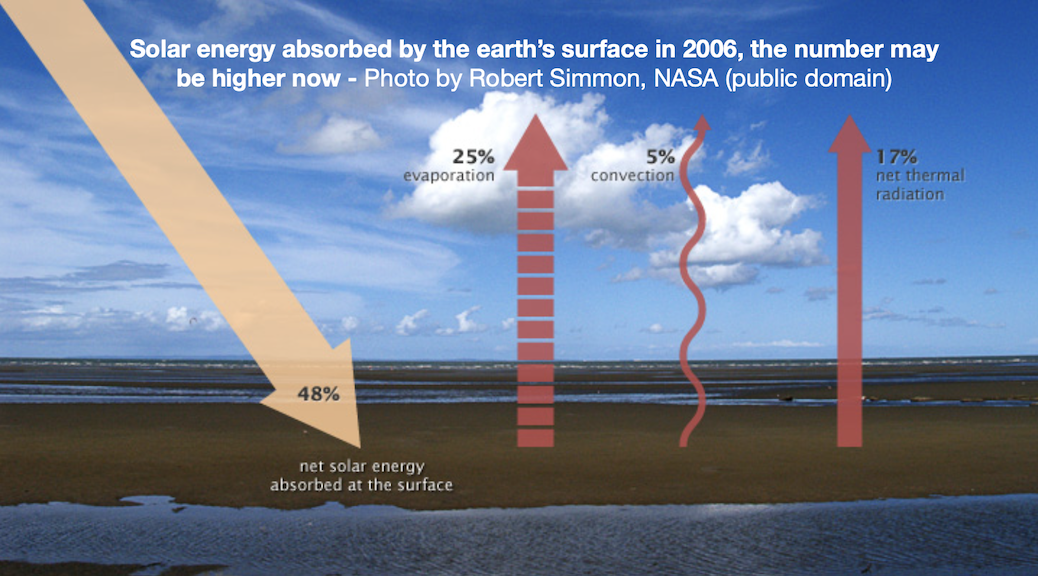
Besides calculating global warming by correlating it to the carbon dioxide concentration in the atmosphere—which, incidentally has now risen from 280 ppm to nearly 430 ppm—another method is to measure the direct heating of Earth’s surface that comes from sunshine. This is done by measuring the energy that strikes the surface of our planet as watts per square metre. This energy is then reflected from Earth’s surface as radiant heat, blocked from escaping back into space primarily by the carbon dioxide in the atmosphere.

Without the warming effect of any greenhouse atmospheric gases, the energy we get directly from the sun would only heat Earth to -18°C. In other words, the unique gaseous composition of the atmosphere enveloping our planet warms it to the so-called “Goldilocks Zone”—not too hot and not too cold for sustaining life as we understand it.

Unfortunately, writes Madeleine Cuff in New Scientist (“Earth Warms as Heat Trapping Doubles”, June 15, 2024). “Earth’s atmosphere is trapping more than twice as much excess heat as it did in 1993.” The surplus heat “in the climate system… is the difference between how much energy enters Earth’s atmosphere from the sun, and how much is radiated back into space.”

Continue reading Watts Up? – The Quadra Report