


The Cortes Island School Wetland Project is transforming part of the school field into a living classroom that blends ecology, culture, and community effort. In today’s interview, we speak to Miranda Cross from Rewilding Water and Earth, the wetland restoration specialist, and biologist on the project
Miranda Cross: “The Cortes Island School Wetland Project is a wetland restoration project funded through the Ministry of Environment and Climate Readiness through the Union of BC Municipalities and a fund called Disaster Risk Reduction-Climate Adaptation Funding. This is a partnership project between the Strathcona Regional District, school district 72 and the Cortes Island School.”
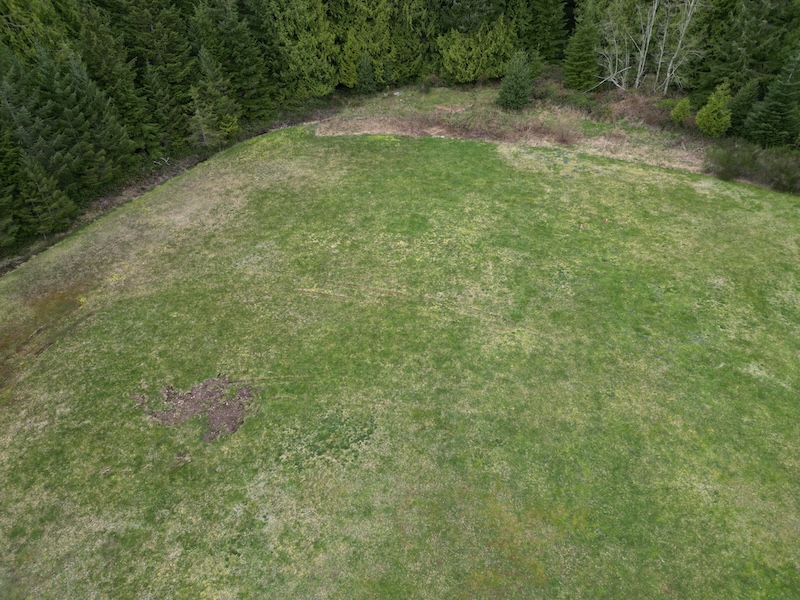
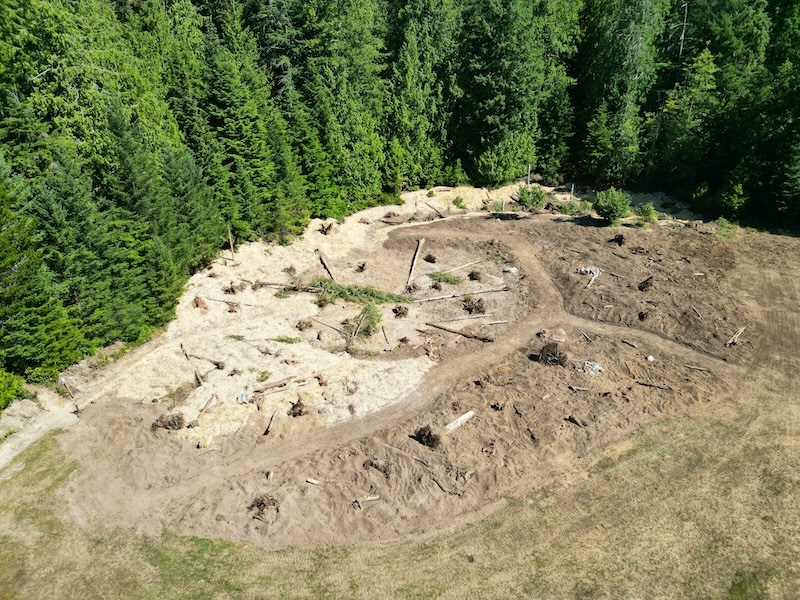
“My role is to design, build, and manage the project through all the phases. We built two wetlands in the back of the school field in July, and we’ve been working with the Friends of Cortes Island Society (FOCI), Klahoose First Nation, True Foundation’s contract team (which is Laurier Mathieu heavy equipment operation) and the Strathcona Regional District have been involved in all phases of the project, as has obviously the school.”
“What we’re looking towards now is planting the wetlands with native plants and working with Klahoose First Nation.”
Cortes Currents: Why did you seek Indigenous knowledge on this project?
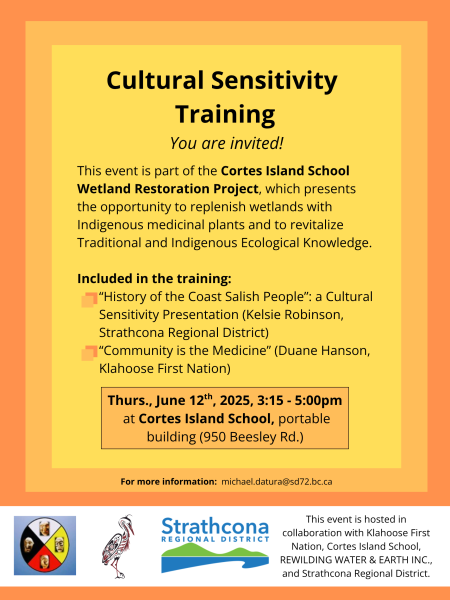
Miranda Cross: “The Indigenous people of this land and this area have been here since time immemorial and have very strong and deep connections with the plants that they’ve been taught about through their culture and ways of life. It’s only fitting that we learn about this place from the people who’ve been stewarding this land forever.”
“Duane Hanson has been really instrumental in engaging with the elders and starting the process of talking about traditional plant medicines and sharing appropriate knowledge with the community and the school. We’re developing signage , so there’ll be an interpretive walk through the wetland area and riparian area surrounding the wetlands that will describe some of the plants that we’ve planted and the cultural relevance and the traditional ecological knowledge that’s been shared from the Klahoose elders that we’re working with.”
Cortes Currents: Tell us about the plants.
Miranda Cross: “It will need to be fenced for deer. At the Dillon Creek Wetland, we fenced each plant individually, for this project we’re going to fence the entire restoration area, which ends up being more cost effective , less labor over time, and it’s easier to maintain the plants because each one is not individually caged. It also really promotes natural revegetation. Whether it’s seed we collect or windborne seed that comes into the restoration area those naturally re-vegetated young saplings and everything get browsed by deer really heavily. We want to get as much natural revegetation as possible. We will be planting a whole diversity of wetland and riparian species. We’ll be planting aquatics below the high watermark sedges, rushes, bullrushes.”
“I don’t think we have any floating aquatics on the plant list. I don’t have the plant list in front of me, but from wet to dry, because where we excavate the basins of the wetlands, then we have soil that we pile in pits and mounds and variable topography and those areas get planted with riparian vegetation.”
“So the areas that are closer down to the water will have willows and Red-osier Dogwood and Pacific Ninebark and Mock Orange and Salmonberry. The species that live closer to the stream in the riparian area and then further up higher will have more dry loving plants like the roses and the red flowering currants.”
“Then you have your in-betweens, like elderberry, cottonwood, and I think aspen’s on the list. From our conversations with the elders, I’ve heard that Devil’s Club is an important plant and that it will probably want to be incorporated as well.”
Cortes Currents: I understand there’s been significant community involvement.
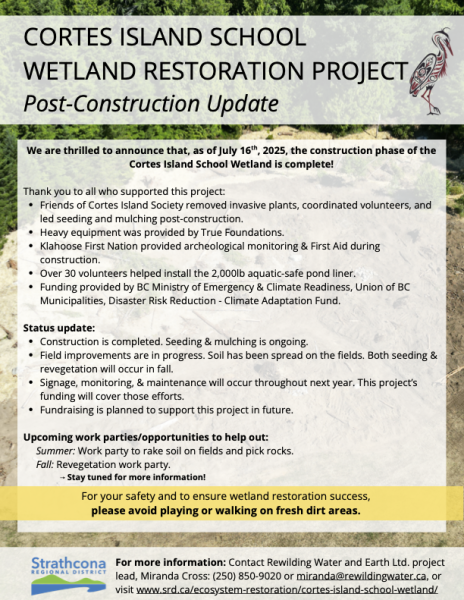
Miranda Cross: “During construction in July, we installed an aquatic-safe EPDM liner that’s 80 feet in diameter round, and we had about 34 community volunteers come out to support that effort because we need a lot of bodies to move this really heavy liner into place. I just wanted to express my gratitude to all those who came out to support and we really couldn’t have done it without the community effort and spirit.”
“We re-ditched all along the west side of the field, which probably hadn’t been done since 1979, when they built the school. It was really clogged up and wasn’t draining well. So we re-ditched and cleaned up that side. We also spread topsoil in the field that we had excavated from the basins rather than bringing screen topsoil from town, which was just not possible given the budget. We ended up with a little bit of sticks and rocks in the field, and we had another community work bee on September 1st. About 10 people showed up to help rake and pick rocks and roots out of the field.”
“That will be reseeded very soon now that the rains are starting to show up. Right now there’s a few dirt patches, but that will be a short term interruption for a long-term gain of improvements in the sports field as well.”

Cortes Currents: What are the benefits of this project to the school and to Manson’s Landing?
Miranda Cross: “There’s so many benefits to school children having access to natural environments as part of their everyday learning. Cortes is special because we already have a school garden, the butterfly garden and lots of forested areas that teachers are using regularly as part of class time.”
“Wetlands are very rare ecosystems in our urban landscapes and often to get a field trip to go to see a wetland can be quite challenging logistically. We are lucky on Cortes that we have access to a few wetlands.”
“I heard a story that was so inspiring for me when I was at the Wetlands Institute in Rossland. It was a past school wetland project and one of the teachers was giving us a tour and she was trying to relate how connected the students became to the wetland and how it really fostered a sense of stewardship and responsibility to the earth and to the natural environment.”
“On the weekend, a student was seen carrying a kayak to the wetland. He got reported and brought into the principal’s office. It turns out he had noticed that there was some plastic garbage floating in the wetland and he took the initiative upon himself to go down there and remove that so that the frogs and other animals in the wetland wouldn’t be eating the plastic or potentially harmed by it.”
“That story really touched my heart because what we need is conscious, caring people in the world who take initiative to take care of the earth and each other, and the wetlands provide an opportunity for children and adults alike to connect with nature. So many wetlands have been lost, so that’s why they’re so rare , these rare environments that are so dynamic and so exciting and so full of life and diversity.”
Cortes Currents: What are the next steps?
Miranda Cross: “The next step is planting the wetlands. So first we’ll do a perimeter fence so that we can encourage natural revegetation and then planting. We will be inviting community members to come and help with the planting. Students will be involved, the BC Wildlife Federation will be involved.”
“After that, we’ll all be working on the developing signage for the wetlands over this next year. We have another year in the current funding. And then, you know, these wetland projects, as many folks have seen at Linnaea, do take some maintenance, particularly with invasive species management. That’s what we’re seeing most of. So we will be seeking funding as well as a next step for the coming years to be able to support the school , with help on invasive species management particularly.”

Cortes Currents: Is there anything you want to add?
Miranda Cross: “We didn’t talk about the history of the site itself, which I find fascinating. I’ve heard accounts from different people. One person told me that they heard that old timers used to hunt in canoes where the school field is now, indicating there was quite a bit of water there. I guess they were hunting waterfowl. I’ve heard accounts of people skating through the forest where the school field is now. Those two historical accounts tell us that it was some sort of wetland, maybe a mixture of open water, wet meadow and forested swamp.”
“Maintaining the use of the field as well as restoring wetlands is a bit of a fine balance. We only took up about the top quarter of the field, right next to the School to Sea Trail. One of the nice things about that is everybody who’s using the School to Sea Trail will pop out and they’ll be able to see and visit the wetland. Once the signage is installed, we’ll be able to learn about it as well.”
Links of Interest:
- Cortes Island School Wetland Restoration Project Overview & Construction Environmental Management Plan
- Rewilding Water & Earth listing – Victoria Chamber
- Cortes Island School – SD72
- Articles about, or mentioning the Dillon Creek wetlands project
All photos courtesy Miranda Cross; posters courtesy SRD website
Sign-up for Cortes Currents email-out:
To receive an emailed catalogue of articles on Cortes Currents, send a (blank) email to subscribe to your desired frequency:
- Daily, (articles posted during the last 24 hours) – [email protected]
- Weekly Digest cortescurrents – [email protected]