
“History repeats itself,” wrote Karl Marx, the 19th century German philosopher and economist, “first as tragedy, second as farce.” Of course, he meant this politically, but it applies mythologically as well, a parallel that requires some explanation.
The most influential historical myth that has shaped Western civilization is the Genesis account of Creation. And, like every myth, this biblical story is a template which we have placed upon a raw reality to give order and structure to a mystery that must be made meaningful by interpretation. Today, our world of scientific objectivism requires this myth to be understood as being metaphorically rather than literally true. However, for nearly 3,000 years, it was understood as an unquestioned account of what actually took place. But, as anthropologists and mythologists now explain, the form and meaning of the story representing this myth was reshaped as the repeated retelling of it mixed with complex historical, psychological and sociological dynamics.
According to the biblical record, there are actually two Creation stories. The first, in Genesis 1, describes the divine formation of the world, all things in it, and a man and a woman who were placed in it. They were made in the image of Yahweh, the Creator. This version can be traced to a Semitic priestly account of the 4th century BCE.
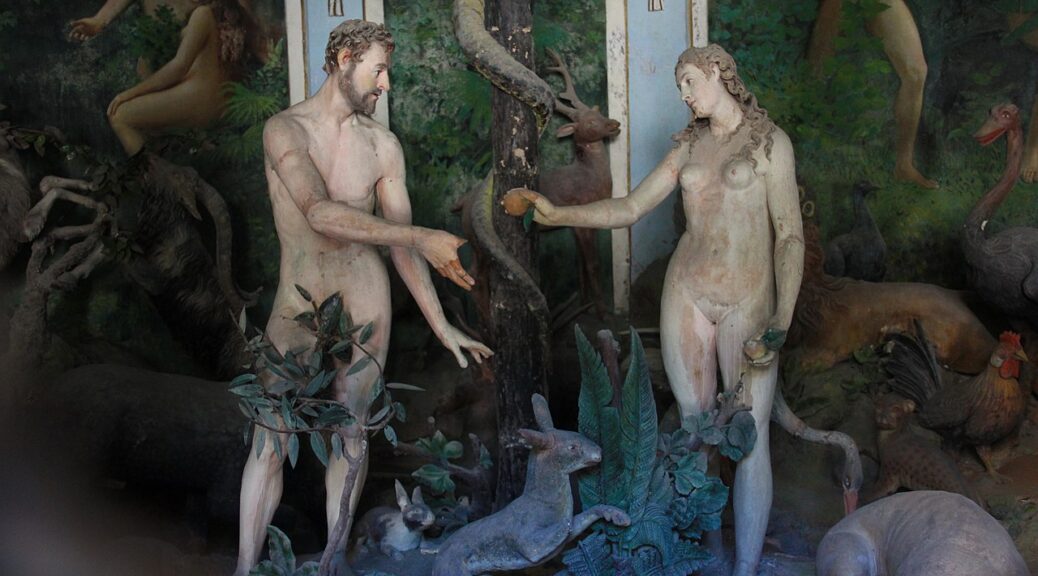
The second Creation story is in Genesis 2. It also describes the divine formation of the world and everything in it, but sets aside a special part as a Garden of Eden. To tend this Garden, a man called Adam was placed in it. And for a helper, a woman called Eve was made from his rib. She eventually tempted him to eat of a forbidden fruit from the Tree of Knowledge, and the two of them were subsequently banished from the Garden for disobedience. This story has its roots in Sumerian literature from the 9th century BCE, half a millennium earlier than the Genesis 1 version. This time difference is important.
Historically, Genesis 2 takes place about the time that the rich agricultural lands of the Tigris-Euphrates—where the mythological Garden was probably located—were being exhausted after centuries of abuse and salinization. The scholarly explanation for the banishment of Adam and Eve from the Garden, therefore, was for an ecological disobedience. They were being evicted because the once fertile land was no longer able to support them. Consequently, they were condemned to the less favourable lands outside the Garden where they were to toil in the hot and dry soil to eek out a laborious living for themselves and their descendents. As the American mythologist, Joseph Campbell, contends, the myth is true, but in a metaphorical rather than a literal sense. Indeed, the people represented by Adam and Eve were evicted, but not for the disobedience described literally in the biblical story. Because the Old Testament is a sociological document rather than an ecological one, the details of the myth were transformed to suit its biblical function.
All those who have subscribed to this myth over the three millennia of its existence, which was almost everyone in the Judaic-Christian-Islamic branches of Western culture, have been trying to return to the Garden by reconstituting it in the image of their imaginative understanding of it. Outside the lost Garden nature was imperfect, stained by its association with banishment and punishment. In mythological terms, nature always fell short of Eden’s perfection, and was imbued with connotations of alienation and threat.
As the literal understanding of the Creation myth relaxed in a more liberal modern culture, the pejorative connotations of nature have shifted. Indeed, almost reversed for many people. They now recreate and immerse themselves in nature, treating and relating to it as if it were actually the original mythological Eden. But, for most of Western mythological history, this was not the case. Nature was the fallen place into which humanity was banished, and needed to be treated accordingly. It was therefore approached and treated with hostility and resentment, even victimized by its association with guilt.
It has been this attitude to nature that is the mythological explanation for the ecological mess in which we now find ourselves. As we stumble into anthropogenic climate change, massive species extinction and rampant pollution, once more we find ourselves confronting our responsibility for an existential disobedience. This time, however, the mythological story is of a different scale—it’s not the Garden from which we are being evicted, but from the entirety of nature. Since there is no place to which we can be banished—except off the planet, perhaps to Mars—the punishment is different. It’s as if Yahweh has essentially said, “Okay folks, here’s the Garden. You’ve ruined it. It’s all yours. I’m no longer taking responsibly for it. You made a mess of it, so you fix it.”
This is the mythological burden that we have now earned for ourselves. Because of our disobedience to fundamental ecological principles, we have just repeated the transgression that evicted us from the first Garden of Eden, and have now inherited the perpetual responsibility for managing a multiplicity of interrelated global ecosystems of overwhelming complexity. This is an onerous and daunting task which will haunt uncounted future generations as we try to restore the biophysical balances that we have destroyed. Indeed, in historical, psychological and mythological terms, we may never be able to do this, and once again we will find ourselves permanently alienated from an imagined Paradise that we once inhabited.
Is this tragedy or farce? If Marx’s political definition were applied to the original Creation myth, it would be farce because we have lost the Garden for the second time. Since we are evolving a different mythological structure to explain how we got here, what is happening, and what we do next, and because our plight is not political but existential, then it has to be tragedy—if that’s any consolation.
Ray Grigg for Sierra Quadra
Top image credit: Polychrome clay statues of Adam and Eve by Jan de Wespin known as il Tabacchetti, 1597-98 – Photo by Mattana (Own Work) via Wikimedia (Creative Commons Attribution-Share Alike 4.0 International license)
Sign-up for Cortes Currents email-out:
To receive an emailed catalogue of articles on Cortes Currents, send a (blank) email to subscribe to your desired frequency:
- Daily, (articles posted during the last 24 hours) – [email protected]
- Weekly Digest cortescurrents – [email protected]