

By Michelle Gamage, The Tyee, Local Journalism Initiative Reporter
It’s been four and a half years since Jane McCormick’s son, Jeff, was killed by unregulated drugs. Were he alive, he would have just celebrated his 40th birthday with his two kids.
McCormick said that for the first three years she was filled with sadness. And then she started to get mad.
She’s mad because Jeff’s death, just like the more than 18,179 British Columbians killed by unregulated drugs since April 14, 2016, was preventable.
Today marks a decade since B.C. declared a public health emergency to respond to a spike in overdose deaths.
At the time, the province was reeling because the synthetic opioid fentanyl had started being added to the unregulated drug supply, killing 528 people in 2015. It was an emergency.
Annual deaths continued to climb until they peaked at a catastrophic 2,590 in 2023 and then shrank slightly to 1,833 in 2025, according to the BC Coroners Service — still nearly three and a half times the death rate of 2015.
Bernie Pauly, a professor in the University of Victoria school of nursing and a scientist with the Canadian Institute for Substance Use Research, said B.C. is stuck in a cycle of “ongoing, tragic and preventable loss,” because it is still operating in a criminalized environment of prohibition. This makes it difficult to scale up evidence-based health-care interventions to address the crisis, she told The Tyee.
As examples she pointed to supervised consumption and overdose prevention sites and the province’s safer supply program, which are highly effective and evidence-based, but most people struggle to access them.
Supervised consumption and overdose prevention sites create spaces where people can access sterile equipment and have someone step in if there is a medical emergency, such as an overdose, and connect people to services such as wound care, housing and treatment services, she said.

The provincial safer supply program, also called prescribed alternatives, was plagued with misinformation and used as a way to score political points, Pauly added. Today the program is very restricted.
To end the crisis, Pauly said, B.C. needs to immediately scale up evidence-based interventions such as safer supply, drug checking, supervised consumption and overdose prevention sites and access to treatment services.
Treatment should include a wide range of services, such as detox services, rehabilitation, continuing to use drugs but in a safer way or with prescribed alternatives, using opioid agonist treatment or working towards abstinence, she said.
For some people, treatment may need to include addressing trauma, improving pain management or connecting people with mental health services.
Regulate all drugs
Long-term, Pauly said, Canada needs to make regulated drugs available as an alternative to the current unregulated drug supply.
Water, food and alcohol are all regulated for the same reasons that all drugs should be — so that the end-user is safe, she said.
The government knows it needs to regulate the drug supply and is choosing to not do it, said Leslie McBain of Moms Stop the Harm.
McBain co-founded Moms Stop the Harm in 2015. Her son, Jordan Miller, was killed by unregulated drugs the year before, when he was just 25.
McBain said she has met with Health Minister Josie Osborne and other ministry representatives several times to advocate for a regulated drug supply. She told The Tyee she feels as if she can “see in their faces that they know we’re right.”
Drug regulation is a solution that’s supported by a lot of experts, including the province’s own.
But there is no similar consensus on how these regulated drugs should be accessible. Most calls for a regulated supply recommend expanding the current medical model, where people can access pharmaceutical-grade drugs through a prescription, and introducing a non-medical model where, for example, people can access drugs without a prescription through a compassion club.
Regulating all drugs is a solution that was originally proposed by the BC Coroners Service 2022 death review panel, which brought together 23 experts, including doctors, academics, police and policymakers, and asked them how to solve the ongoing toxic drug crisis.
The death review panel said the province’s first priority should be expanding safer supply for people using street drugs, followed by decriminalization of substance use.
At the time, B.C. had been running a safer supply program for about two years, in which people could be prescribed pharmaceutical-grade alternatives to the street drugs they used. However, this program was not able to prescribe drugs strong enough to actually replace the unregulated drugs many people were using. To access the program people also needed a family doctor, which were in short supply, and a substance use disorder diagnosis.
Lisa Lapointe, chief coroner at the time, warned the province that an estimated 225,000 people were using unregulated drugs and were at high risk of overdose. Barely a fraction of that — 5,000 people at the height of the program — were ever signed up for the provincial safer supply program. By October 2025 that number had dropped to 3,000, according to reporting by CBC.
Lapointe called another death review panel in response to government inaction, asking 21 experts how the province could realistically go about implementing a regulated drug supply.
The province rejected the proposal the same day the death review panel’s recommendations were published.
B.C.’s top doctor, provincial health officer Dr. Bonnie Henry, has called on the provincial government to expand its safer supply program and consider reducing the barriers to accessing the program.
The province declined to do so. Instead, early last year, it further restricted the program.
Speaking at a media event Monday, Henry said it has been “challenging and disappointing” to see the province walk back programs she recommended, such as decriminalization, expanding safer supply and regulating the drug supply.
“I still very strongly believe it is an appropriate measure,” she said, adding that the crisis is complex and there is no single solution to it. Health Minister Josie Osborne has her “full confidence,” she said.
B.C.’s human rights commissioner, Kasari Govender, has also weighed in on the crisis, criticizing how the province’s response to the toxic drug crisis has been in contradiction of “evidence-based recommendations for a decade” and saying she supports a regulated supply of drugs.

Dr. Ryan Herriot, a family physician and addiction medicine specialist based in Victoria, said regulating the drug supply would benefit everyone.
This is “an overdose crisis, not an addiction crisis,” he said.
Humans have always experimented with drugs, Herriot said. But when they use unregulated drugs they are “playing Russian roulette” because the supply, without government protections like regulations, is getting more contaminated.
Herriot said the recent small decrease in annual deaths is due to changes in unregulated supply rather than any government intervention, and that’s risky because without regulation the drug supply will continue to be unpredictable and could become more deadly any time.
The outsized impact on Indigenous Peoples and construction workers
The ongoing overdose crisis has hit Indigenous Peoples and construction workers disproportionately hard.
As of the first half of 2025, which is the most recent data available, First Nations people were dying from toxic drugs at 5.4 times the rate of other B.C. residents, according to the First Nations Health Authority. First Nations women died at 8.5 times the rate of other women in B.C., and First Nations men died at 4.6 times the rate of other men in B.C.
First Nations people make up a little over three per cent of the province’s total population but account for nearly 16 per cent of all toxic drug deaths, according to First Nations Health Authority data.
Fatalities have decreased slightly and were down by nearly 39 per cent in 2025 compared with the same time the year before.

Speaking at Monday’s media event, Dr. Nel Wieman, First Nations Health Authority chief medical officer, said 1,836 First Nations people had been killed by unregulated toxic drugs from January 2018 to December 2023.
However, “2,650 potential, additional deaths were averted or prevented,” because of harm reduction initiatives like take-home naloxone, opioid agonist treatment and overdose prevention and supervised consumption sites.
Wieman called for the province to scale up harm reduction initiatives in rural and remote communities, and to have these services be Indigenous-led and centre cultural safety and anti-racism.
People who work in trades, transport and equipment operations have also been hit incredibly hard. Over the last four years, at least 20 per cent of all of the people killed by unregulated drugs worked in these industries, according to the BC Coroners Service.
Hard physical labour with long hours, incidence of injuries, high risk tolerance, isolated working conditions and high income can make people in construction more likely to be attracted to a work-hard, play-hard lifestyle, Brooks Patterson, interim executive director of the BuildStrong Construction Industry Rehabilitation Plan, told The Tyee.
There are a lot of services free and available for construction workers, such as a pain clinic and counselling, Patterson said, but stigma against drug use still exists in the industry.
People are more comfortable speaking about their mental health concerns first and then might open up about substance use later, he said, adding this could be linked to fear that substance use might limit career advancement, because some jobs require drug checking.
Events today in Victoria and Vancouver
Jane McCormick said she has been using her anger to help organize an event with Moms Stop the Harm to mark 10 years under a public health emergency.
A gathering themed “grief and rage” will take place today from 1 to 3 p.m. on the lawn of the Victoria legislature, where everyone is welcome, she said. Speakers will include representatives from Moms Stop the Harm, the Harm Reduction Nurses Association, Doctors for Safer Drug Policy and the Nanaimo Area Network of Drug Users, as well as former chief coroner Lisa Lapointe.
There will also be poetry and a punk band performance, McCormick said.
A Vancouver vigil will be held at Oppenheimer Park today. Food will be served at 5:30 p.m. and the vigil will begin at 7 p.m. The event is hosted by the Vancouver Area Network of Drug Users, the Surrey Union of Drug Users, Police Oversight with Evidence and Research, or POWER, and the Coalition of Peers Dismantling the Drug War.
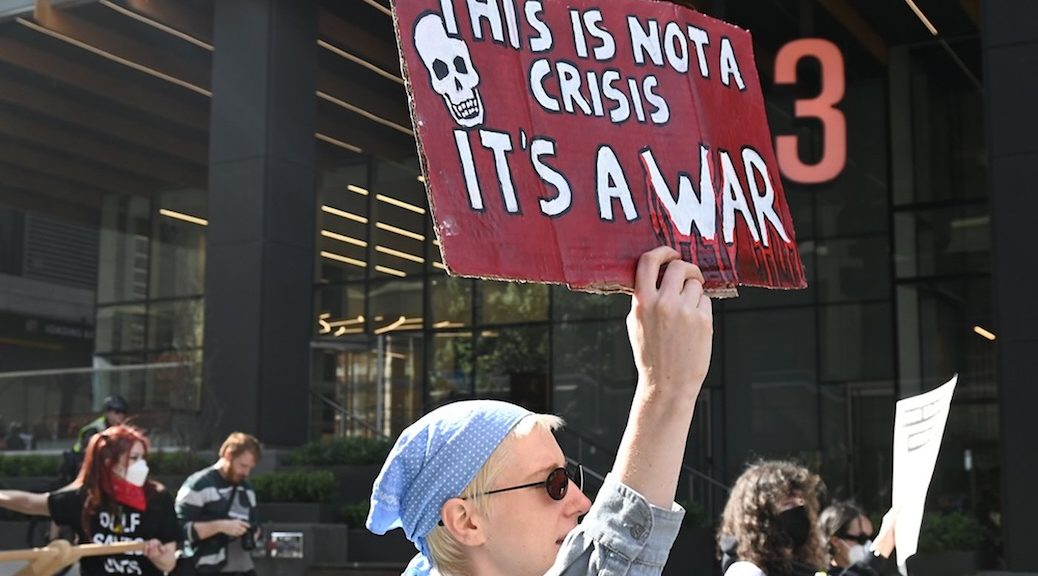
Top image credit: A protester marches in an April 2025 rally in Vancouver to mark nine years of BC being under a public health emergency. – Photo curtesy Michelle Gamage.

Sign-up for Cortes Currents email-out:
To receive an emailed catalogue of articles on Cortes Currents, send a (blank) email to subscribe to your desired frequency:
- Daily, (articles posted during the last 24 hours) – [email protected]
- Weekly Digest cortescurrents – [email protected]