

By Sonal Gupta, Canada’s National Observer, Local Journalism Initiative Reporter
Ottawa’s $412-million salmon recovery program offers a lifeline to BC’s struggling fisheries — but comes at the same time budget cuts are dismantling monitoring systems conservationists, experts and First Nations say are essential to protect them.
Aaron Hill, executive director of Watershed Watch Salmon Society, said he was relieved to see any federal investment in salmon recovery at a time when budgets are tightening across departments.
Federal department cuts totalling $500 million over four years will shrink programs, scale back monitoring and eliminate 551 full-time positions by 2028-29. Some of the changes already began last summer.
Dozens of streams went unmonitored during the spawning season as Fisheries and Oceans Canada (DFO) failed to renew contracts for seasonal “creek walkers” who count returning salmon across BC’s North and Central Coast, including major watersheds, such as the Skeena, Nass and Kitimat.
“This is like the backbone of the fisheries management system,” Hill said. “When the fish started returning, these people didn’t have contracts in place to go out and do their work. And so, a number of them were not out there counting fish right when they needed to be.”
Greg Knox, BC director for the Wild Salmon Center, said organizations and First Nations pressured the department into deploying staff to rivers. This monitoring tracks how many fish return to spawn, forming core data for setting fishing quotas and rebuilding stocks.
Without it, managers “fish blind,” risking overharvest or causing stocks to decline, he added.
First Nations members remain cautious about the new funding announcement. “Almost feels like this is an attempt to soften the blow for what might be coming,” said William Housty, director of the Heiltsuk integrated resource management department on BC’s central coast in Bella Bella, in an email response to Canada’s National Observer.
“While we are happy that these resources will continue to be available, we are also cautious that they are ‘dangling the bait,’ so to speak. Tough situation, and a typical move from a Government that is always scheming down the path of more money.”
The government’s broad goals — restoring vulnerable salmon populations and habitat while supporting sustainable fishing and building capacity with partners — sound positive on paper, Hill said.
But the announcement left key questions unanswered, including how the money will be spent and whether it will support the right priorities. “It’s good news — but we don’t know yet how good,” Hill said.
New funding can’t act as a “band-aid” to patch over weak regulations, especially with changes to laws like the federal Impact Assessment Act that speed up approvals and reduce environmental reviews, said Jonathan Moore, a SFU professor who studies salmon. “The real question is how this money will be used to drive long-term, substantial change,” he said.
In an emailed statement, DFO said it remains committed to protecting and rebuilding wild Pacific salmon while making sure public funds are used responsibly and effectively.
The department said the newly announced investment will support long-term efforts to restore salmon habitat, modernize hatcheries and strengthen conservation work across British Columbia and Yukon.
The federal Comprehensive Expenditure Review is meant to improve efficiency and ensure value for taxpayers and that it’s working to maintain essential services and limit any impacts on key monitoring and conservation programs, the department added.
Over the first phase of the Pacific Salmon Strategy Initiative (PSSI), the department said it has helped restore more than 15.7 million square metres of salmon habitat, supported 73 restoration projects through the BC Salmon Restoration and Innovation Fund, tested and evaluated six mark-selective fisheries, launched digital licensing through the Fishing BC app and introduced licensing reforms to make management more adaptable as conditions change.
Lessons from the first round
Experts say the first round of PSSI funding delivered uneven outcomes. “[It] was a real mixed bag in terms of how it actually benefitted salmon and the communities that depend on them,” Knox said.
The way money was spent was problematic, he noted — for example, it cost millions to retire commercial salmon licences no longer in use. And it remains uncertain how the hiring of numerous people on contract or temporarily advanced salmon recovery.
Hill said earlier funding often flowed into new staffing and internal projects that duplicated work rather than advancing long‑standing recovery obligations. “We can’t have them decrease funding for the most important programs, while increasing it for things that are good but not essential.” He said the government needs to put money and effort where it has already committed — developing rebuilding plans for endangered salmon populations under the 2005 Wild Salmon Policy published in 2000 and still not fully implemented) and obligations under the updated Fisheries Act and Species at Risk Act listings for dozens of populations. “We didn’t need a whole lot of bureaucratic process to do that,” Hill said.
But there were also successful efforts in the last round, Knox said. The first phase started five major salmon rebuilding projects, including efforts for Interior Fraser steelhead and Nass Chinook. It paid for habitat fixes, such as removing culverts and building side channels in rivers, including the Fraser and Skeena. DFO also updated hatchery rules to cut down stray rates and protect wild fish genes.
A large portion of earlier funding flowed through the BC Salmon Restoration and Innovation Fund, supporting vital habitat and science projects. Hill’s group used one grant to map blocked salmon habitats in the lower Fraser watershed, which later guided restoration work by local governments and First Nations.
Mass marking
The federal government also recently announced plans to mass-mark 90 per cent of hatchery Chinook salmon from DFO-operated hatcheries in southern BC by next year — up from about 40 per cent. The practice clips the small adipose fin so anglers can identify and distinguish hatchery fish from wild ones. Nearly all hatchery Chinook are already mass-marked in Washington, Alaska, Oregon and California.
Knox said the marking practice can be useful in Canada, but only in fisheries where people are not catching large numbers of wild fish.
Hatchery marking only works when fisheries are tightly targeted and supported by strong monitoring. Selective fisheries closer to river mouths or terminal areas are far more promising than broad ocean fisheries, where too many wild fish are caught and released before anglers find a marked hatchery fish.
“If you’re out in the middle of the strait or the ocean, you’re just catching fish randomly,” Hill said. “You’re going to kill a lot of wild fish to catch hatchery fish.”
Catch-and-release mortality can be high, sometimes 20 to 40 per cent, which means fisheries can still do harm even when only marked fish are retained, he added.
Looking ahead
Hill said the best use of the new funding would be to build a robust, province-wide network to monitor salmon spawners, track habitat health and watch for damaging activities. He said recovery plans should not just be developed but implemented for endangered populations, halting declines in most major stocks or even reversing them to restore abundance in streams and rivers.
He pointed to modernizing the fishery itself, moving away from mixed‑stock harvests toward “known‑stock” or selective fishing. Such a strategy is already working for the Lake Babine Nation’s commercial sockeye fishery, now the largest in the province — which catches salmon far upriver in Babine Lake, reducing pressure on depleted stocks downstream.
Other examples include Kitselas First Nation’s fish wheels near Terrace and Lax Kw’alaams Band’s experimental fish trap downriver, with vast potential for similar selective gear in Vancouver Island, Fraser and coastal systems.
In an email response to Canada’s National Observer, Pacific Salmon Foundation CEO Michael Meneer said DFO should continue to shift from leading salmon recovery to enabling First Nations and community leaders, directing a significant portion of new PSSI funds to on-the-ground groups developing and implementing watershed recovery plans instead of internal DFO capacity.
He said renewed funding would help turn recovery plans into action and substantially increase their scope. Critical momentum could be built by following initiatives, such as the Pacific Salmon Foundation and Upper Fraser Fisheries Conservation Alliance’s strategy for critically low Upper Fraser Chinook, alongside DFO’s recent recovery plans for the Thompson-Shuswap and Nicola watersheds.
“It’s going to take all of us working together to continue these efforts and ensure the progress made isn’t lost,” he said.
With the push to accelerate major resource projects developments, Hill said there is an urgent need for increased capacity to assess risks and monitor impacts.
“If the whole idea of carrying out these projects is to increase money coming into the region, we have to spend the money that’s required to make sure that these projects don’t cause undue harm to wild salmon and other things that are essential to our way of life in BC.”
Links of Interest:
- Budget includes ‘scale back’ for DFO, with $500M in cuts over four years – Ha-Shilth-Sa
- Articles about, or mentioning, fishing
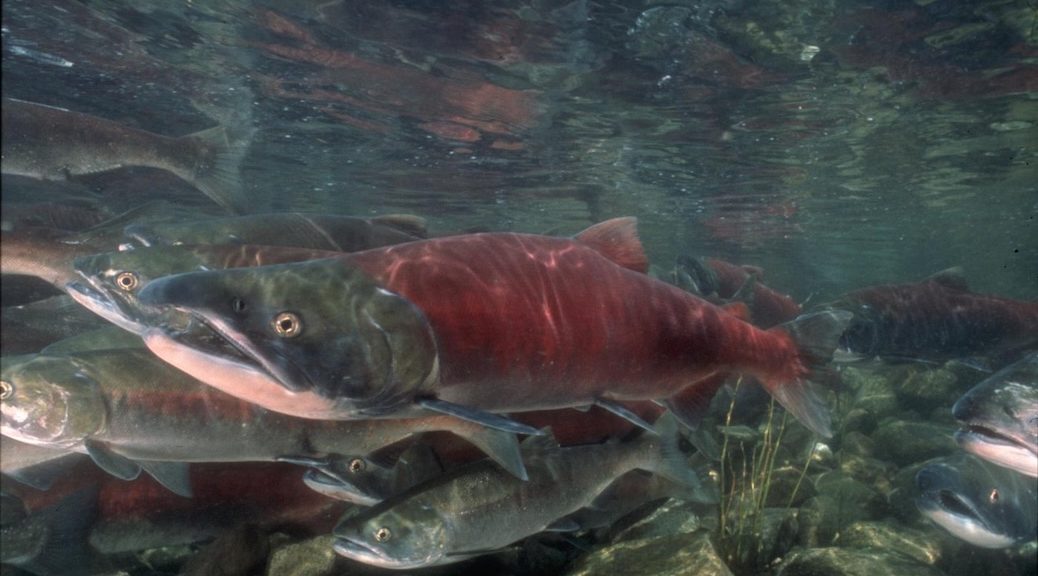
Top image credit: A sockeye salmon. – Photo by Barrie Kovish

Sign-up for Cortes Currents email-out:
To receive an emailed catalogue of articles on Cortes Currents, send a (blank) email to subscribe to your desired frequency:
- Daily, (articles posted during the last 24 hours) – [email protected]
- Weekly Digest cortescurrents – [email protected]