


Cortes Island author Carrie Saxifrage made a climate mitigation presentation at the May 22 SRD Board meeting. This is an abridged version of that talk.
She began with a simple admission, “This is my first time. Thank you so much for having me. If I were to do it again, I’d do it a little differently, but here we are. We’re going to whisk through some slides, and I’m going to emphasize what I think is most important.”
“I was raised in Southern California, in a household that was both scientific (my dad was a doctor) and had a deep Christian faith. I was just in the atmosphere of learning facts, and taking responsibility within our community to act on them.”


“I think my parents would really appreciate Dr. Katherine Hayhoe’s portrayal of the situation. The things that the local government does: affordable housing, health care, are all so important – but we’re putting these efforts into a bucket with a hole in it. That hole is climate change and without mending the hole, things are going to get worse for the people who we are trying to help.”
“I moved to Cortes in 1994, it is a great place to raise a child.”
“I’m a Canadian citizen, and I’d always wanted to be a Canadian citizen. It means a lot to me for the more communitarian central values.”

“I’ve given 30 years of community service to Cortes.”
She was speaking quickly and at that point, SRD Chair Mark Baker said, “Sorry, you can slow down if you like.”
Carrie Saxifrage: “I don’t really want this to be about me, so I’m rushing through this.”
Mark Baker: “Sixty slides, okay.”

Carrie Saxifrage: “I wrote a book and it was published in 2015. It’s called ‘The Big Swim.’ It was about swimming with some friends from Cortes Island to Quadra Island. That’s the title chapter, but it’s really a metaphor for being awake to climate change and trying to live in accordance with that knowledge.”

“The global context: the temperature is going up. If you see the climate modelling as a roller coaster, we’re off the track now. Every month for the past year has broken global temperature records. It’s also true of the sea temperature.”

“Apparently, it’s not due to El Nino, it’s due to human caused climate change. Meanwhile, the rate of CO2 emissions is accelerating.”

“Who is responsible? People who have a net worth of more than $126,000. Basically, if you own your house, you’re in the wealthiest 10% of the world that is responsible for 50% of the emissions.”


“Canada has also left the rails in terms of the advanced economies, increasing its emissions, while the others have decreased theirs – not by enough, but they’ve decreased them. And it’s really the western provinces, including BC, the eastern provinces have made the necessary changes.”

“72 percent of Canadians want governments to do more.”

“On Cortes Island, we still have a really high quality of life. So the challenges, in a way, are psychological. We’re terrified of wildfire. During the heat dome, you could smell the marine life rotting on the beaches below us. We’re worried about our wells. We’re worried about food security. We’re watching trees die, algae blooms in the lake, and we’re also losing our salmon because they can’t make it up the creeks due to autumn droughts.”

“The Strathcona Regional District has acted on this. I’m really impressed by the use of CO2 as an ice rink refrigerant, that’s way ahead of the curve. And also, Cortes Island has really appreciated the efforts of Shawn Koopman. What more could Strathcona Regional District do?”

“We need to electrify everything and wind down natural gas, that’s the simple story. Natural gas has been marketed to us as a transition fuel because it’s the cleanest fossil fuel at the point of ignition. It is also 80 percent more potent than CO2 in the 20 year time frame, that’s a real pinch point. It leaks from production to storage, and studies show that at best, it’s as bad as coal. It can be two and a half times worse.”

“The picture on the left is a methane tank and just looks fine. The picture on the right is using technology that shows the leak from it. The problem is that methane leaks at every stage from the wells during fracking, all the way to abandoned wells from storage during ventilation. It leaks. The leaks are greater than reported by industry.”
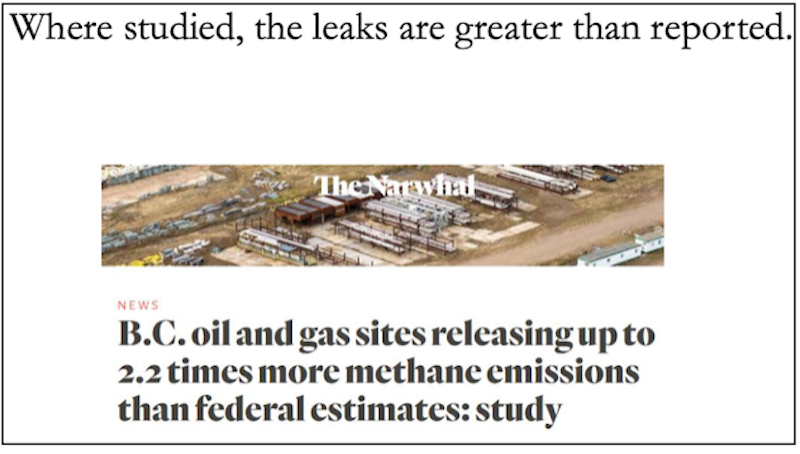
“It makes it hard to regulate and the new research finds greater and greater methane impacts. It’s responsible for a third of the climate warming, which is also an opportunity because if we can cut natural gas, we can make a big difference in the time frame that matters most.”


“Everybody knows that it’s bad for indoor air quality. Children get asthma. It may be other gas appliances in addition to stoves. Doctors are coming out against it for both climate and indoor air quality reasons.”

“The gas industry is under investigation for misleading claims. They say, we have renewable natural gas and that is a climate safe fuel. I wish it were, but it’s not a realistic claim.”

“Fortis buys renewable credits from other jurisdictions. These are not necessarily going to be available in the future, and they admit that it would only ever account for a small fraction of its future gas supply.”

“RNG (Renewable Natural Gas) and other biofuels are going to be used in the industries where they have to be used, which are those that require a molecular fuel, like shipping and aviation. Batteries, probably at least for a long time, won’t help us in those sectors.”
“So, super high cost, super high demand, production constrained by feedstock availability, and very high competition by all transport sectors.”
“Some new investments in natural gas are going to be expensive stranded assets and our future is electric.”

“Here’s some suggestions arising from that: Operationally, the SRD could wind down natural gas. It’s adopted the step code. It could accelerate it. It could prohibit new gas infrastructure and it could encourage BC Hydro to upgrade the grid.”

“Other jurisdictions are accelerating the step code: Nanaimo, Saanich, Victoria. It just makes sense, knowing that we need these more efficient buildings, to go ahead and take this proactive step.”

“Other jurisdictions are also banning new gas infrastructure. In the little packets that I gave you, the last pages are the way that Saanich is addressing the builders in its area. It’s prohibiting renewable natural gas.”
“The thing is, the zero carbon step code allows renewable natural gas infrastructure in its final step. For reasons stated, that’s not a good idea.”
“Over the lifetime of this infrastructure, people are going to save 25 percent on heat pumps over natural gas. That’s in the paper that I passed around from the Pembina Institute.”
“So I’m just going to read from their executive summary:
‘We caution that building code decisions that lock in the use of RNG for heating and cooling buildings can saddle building owners and operators with costly infrastructure expenditures for many years to come, and result in missed targets.’”
“It seems like there’s a wave moving up the island, and I think that we would be really well served in the future if the Strathcona Regional District was part of that wave.”

“I don’t know how the SRD encourages BC Hydro to give us a clean and resilient grid. When I spoke with Michelle Babchuk about the ferries, which could be made electric, she said that our grid is weak.”
“For our future, we need a strong grid, one that’s not vulnerable to heat domes and such.”
“BC Hydro says that it’s well positioned to add intermittent renewables, like wind and solar, because it has hydroelectric dams that act as batteries. I note that Campbell River has seismically upgraded hydro dams that could help facilitate intermittent renewables.”

“No miracles are needed. It looks like the future is wind, water and solar. A lot of the other technologies that are talked about are too expensive and they can’t be scaled soon enough.”
“BC Hydro is really encouraging collaborations with First Nations. Solar, I think, is probably the least expensive in the long term. There’s a lot of Vancouver Island companies that are doing grid tie-ins, which make for a very resilient grid.”


“There’s also a solar farm being built for the Ulkatcho First Nation. There’s been a successful tidal power trial in Blind Channel. The University of Victoria did that. Seems like there’s a big tidal flow here. There’s a wind power company that is considering proposals in both Sayward and Jordan River.”

“I think we have to look at renewable energy as having expensive upfront costs, which translates into just really good jobs in a growing industry. That’s something that Campbell River and the SRD want to be a part of and also, simply put, we can’t afford not to.”
“Last summer twice the amount of BC burned than any year before, and we just can’t afford endless wildfires. The fire season has already started.”

” We can’t afford regular atmospheric rivers. A lot of roads are built along rivers for obvious reasons, and it’s been super expensive.”

“We can’t afford annual heat domes, the cost to the grid and to human health is prohibitive. Right now we’re headed for more of this and worse.”

“We can’t afford unmitigated climate change. I think the number for 2021 in B. C. was between $10 and $17 billion in paying for all of the disasters that occurred. If you look at what renewable energy costs relative to that, it really changes the equation. We just can’t afford to go forward. I just read that the home insurance industry in the U. S. is buckling under natural disasters. Climate change might change our society by something as profound and undramatic as people not being able to insure their homes anymore.”
“We need serious climate action now.”
“I just want to thank you so much for your kind attention. I see you all as public servants who are really trying to do their best for their communities. It’s a very responsible calling and you have my full respect. I appreciate that, in this effort to mend the hole in the bucket through which all of our other efforts could flow.”
“I’m at your service and I hope to speak to you again sometime about other climate issues, maybe narrow in on some things more specifically.”
Cortes Island Director Mark Vonesch responded, “Thank you for coming in. I really appreciate another Cortesian making it all the way here to do a presentation. I know it’s a long way to come and your timing is really great.”
“One of the exciting things for me being on this board is that this is the first year that we’ve really put climate change into our strategic plan and this board has made a significant effort to make climate resiliency part of our focus. We’ve done a lot of work around mitigation and improving our fire service and emergency services. As you mentioned, the challenge is, can we take that long term view and can we make this shift?”
“I think one of the things that really was important for you in your presentation is that there’s opportunities here. This isn’t just about cost. By leading the way we can create new industries and create economics too. There’s actually economic value for us.”
“I heard two recommendations in your presentation. One was accelerating the step code. I think it’s a bit ironic that Cortes doesn’t have a building code. I don’t want to push anything on anybody, but that’s something I’m interested in looking at. How can we accelerate that?”
“And the other recommendation was …”
Carrie Saxifrage finished his sentence, “ … what prohibits renewed natural gas as part of the zero carbon step code.”
Mark Vonesch: “Okay, this is something we can adopt.”
Saxifrage: “That’s right: Saanich, Victoria, and a number of jurisdictions have done that. I think Courtenay has as well.”
Mark Vonesch: “The last one was just creating opportunities for tying into the grid using solar, tidal, wind. I didn’t know about the Sayward project. Thank you for coming in, I appreciate it.”
Carrie Saxifrage: “Thank you for hearing me out. I feel like I just downloaded a lot of information.”
Mayor Martin Davis, of Tahsis, replied, “Thank you Carrie, for your presentation. We’re definitely like minds in terms of this. I’m a real proponent of various kinds of electricity production.”
“Where I live in Tahsis, we have a potential hydro project that would generate five megawatts, but currently there’s no support from the provincial government for something that’s considered that small. It almost went through several years ago, but when the NDP government got in, they stopped subsidizing it.”
“It’s something that I have been advocating for with the government. I was actually thinking of bringing it up at the regional district here in terms of our meetings, because I think Vancouver Island imports somewhere between 30 and 35 percent of our electricity. It seems absurd when you think of all the hydro capacity we have here. Obviously it could get a little sketchy in future with less rainfalls, but I still think it is important. Tidal, solar, there are possibilities. Tidal I know is very cost intensive in order to make it work, but there are ways of doing it. There’s new technologies coming up. So I’m going to continue to advocate for that. Thank you for your presentation.”
Carrie Saxifrage: “You’re welcome. While preparing for this talk, I read that during the heat dome there was a bulge in the cable that comes to Vancouver Island providing the power. That’s why the peaker plant here in Campbell River was used. I do think that these distributed systems are going to prove resilient and in our favor in the future. Sounds like a good project.”
Mark Baker: “Thank you. Any additional questions? Director Mulwinney?”
Robyn Mawhinney: “I read your slides that were provided to the Directors. I actually have a question which isn’t something that you spoke to today, but I’m just curious because in your slides you mentioned health risks from natural gas. On Quadra Island, we don’t have natural gas, but a lot of people use propane. So I’m wondering if you know if that has similar health risks.”
Carrie Saxifrage: “I’m going to get back to you on that, Robyn, because I think it’s a really good question. A lot of people use propane on Cortes also, and I don’t see why it wouldn’t have similar health risks for use in stoves in particular, but I think that’s a great question.”
Mark Baker: “Any additional questions? Nope? Carrie, thank-you very much for coming out today.”
Carrie Saxifrage: “Thank you very much for having me.”
All images expect the podcast image courtesy Carrie Saxifrage’s presentation
Sign-up for Cortes Currents email-out:
To receive an emailed catalogue of articles on Cortes Currents, send a (blank) email to subscribe to your desired frequency:
- Daily, (articles posted during the last 24 hours) – cortescurrents-daily+subscribe@cortes.groups.io
- Weekly Digest cortescurrents – cortescurrents-weekly+subscribe@cortes.groups.io
Thank you so much Carrie, for all your efforts to forestall and be pro–active regarding climate change and subsequently our health and well-being !