


Conservation Officer Jillian Bjarnason came to Cortes on Saturday, January 13, 2024.
“I was invited over to do some public outreach, mostly pertaining to human-wildlife conflict. There’s a population of wolves on the island and sometimes there’s some encounters with people. I’m just really excited to be able to get to meet folks that live here, chat with them and provide education and how to co-exist,” she explained.
Cortes Currents sat down with her shortly before a meeting in the Lakeside Room at the Linnaea Education Centre.
CC: Tell us a little about yourself, where do you come from?
Jillian Bjarnason: “I grew up in Creston, in the Kootenays, and I moved to Vancouver Island for school. Then I worked in Squamish and Whistler. I’m back on the island now since 2021. I love it over here.”
CC: Where was your first posting on the island?
Jillian Bjarnason: “It was in Campbell River for a year, and now I work primarily out of Port McNeill.”
CC: How did you end up there?
Jillian Bjarnason: “They put out a certain number of spots where there’s vacancies, and sometimes we get a choice. In my case, I had four different spots that I could go to and Port McNeill was the top of my list anyway. It was an easy choice.”
CC: Why was it at the top of your list?
Jillian Bjarnason: “One of my brothers worked out of the North Island for a number of years. My family got to visit the North Island quite a few times to see him, and I just fell in love with the communities up there. The people are wonderful, it’s a wild place, and just the right choice for me personally.”
CC: What’s special about working for the Conservation Office?
Jillian Bjarnason: “Our primary mandate is to ensure that the public is safe. A lot of that pertains to human wildlife conflict, but we’re also out on the land base doing proactive work, and ensuring that our resources are being respected. So checking folks that are hunting and fishing and making sure that they’re doing that activity within laws and regulations. That’s why I love my job. I get to be out on the land base, chatting with people and providing a service.”
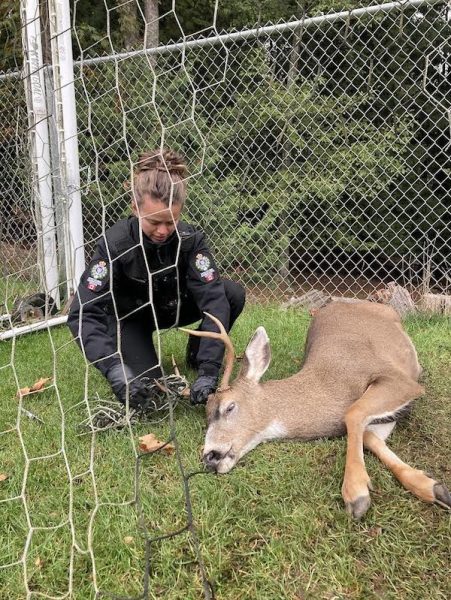
“We deal with all kinds of human wildlife conflict. It will range from anything from bears accessing garbage to cougars, bears or wolves accessing livestock or killing livestock. We often get calls of deer that are stuck in fences, or there was one time we had a deer that was swimming in a manure pit. Anytime we were able to rescue wildlife from a situation like that is very rewarding.”
“We very rarely have reports of predator attacks on people.”
“We do investigations into hunting issues as well. Anytime where we are able to successfully charge somebody, it goes through the courts and there’s a very good outcome. This can also be a really good feeling, because there’s lots of work that goes into those investigations. We’re able to hold people accountable for their actions.”
“My other favourite part of the job is being able to interact with people, and provide education to try and make a difference, especially with the human wildlife conflict side.”
CC: Do you have a message that you’re bringing to the people of Cortes this morning?
Jillian Bjarnason: “We’re just really wanting to put out there that it is possible for people and wildlife to live in the same area, but what’s most important is what people can do to make sure that they’re limiting their impact. So managing attractants, making sure that they don’t have anything out for bears, cougars or wolves to get into. If they’re going to be livestock owners, that they really take those necessary steps like implementing electric fencing and that they can mitigate or minimize and avoid conflict altogether with wildlife.”
“Sometimes we have bears come to a certain spot and they’ll get into a little bit of trouble and then we never hear from them again. In certain cities and towns, we have a couple reports of, say, a cougar sighting. Sometimes we have sightings that happen for a couple nights in a row, and then all of a sudden that cougar’s gone. They’re moving through, often following food sources.”
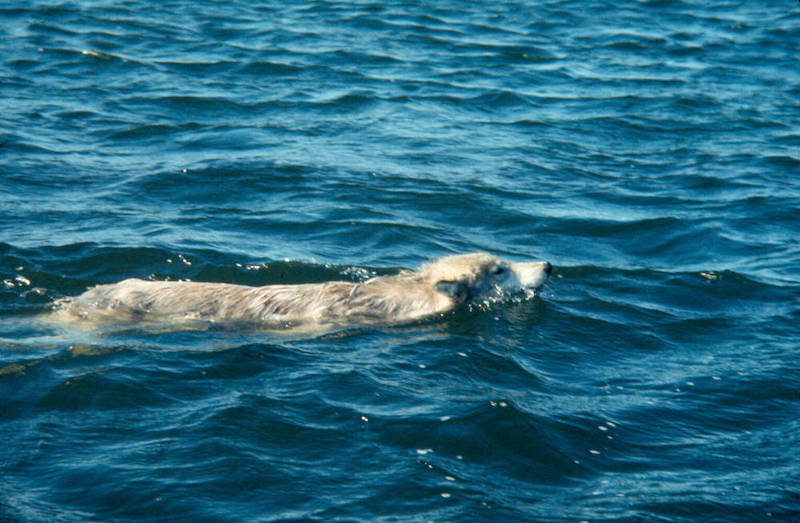

CC: Do you find that bears, wolves and cougars are swimming from island to island?
Jillian Bjarnason: “That is quite common. We have bears that swim over to Cortes every few years and access fish in Basil Creek. We had a grizzly bear swim over to Quadra not long ago, and we also have grizzly bears that swim to the North Island. We’ve had a couple reports in Telegraph Cove in recent years, or in Sayward. Island-hopping definitely does happen. They are probably following their nose, looking for a food source.”
“It’s important for folks to realize that if there is an animal in your area, and it’s starting to test the waters or it’s accessing a fruit tree or something like that, you need to do something about that attractant – so that the bear doesn’t hang around, or the cougar doesn’t hang around. Attractant management is the biggest and best way that people can make a difference for wildlife and for their own property safety.”
“When a bear’s behaviour is escalating to the point where it’s accessed enough attractants, it’s becoming more brazen and tolerant of people. It’s becoming habituated and food conditioned to non-natural food sources. They become a lot more persistent in finding that non natural food source.”
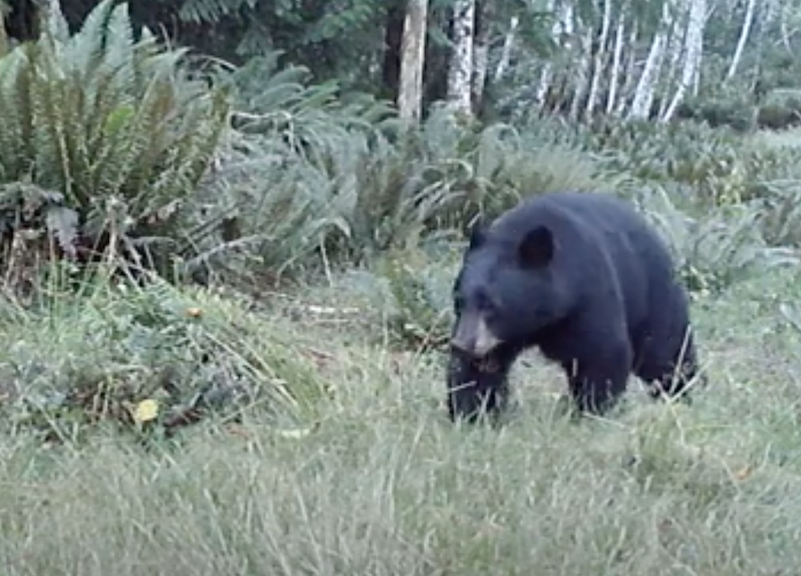
Cortes Currents told her about the Squirrel Cove Bear, which raided the fruit trees, garbage cans and compost piles in properties backing onto Basil Creek, in November 2020. At one point it even broke down the door to someone’s cellar and consumed most of the apples inside.
Jillian Bjarnason: “When you see bears breaking into sheds or clawing at windows or doors, that’s a bear that would be euthanized to protect people.”
CC: There appears to have been a happy ending in the case of the Squirrel Cove Bear. The Conservation Service was called in and everyone thought the bear was going to be put down, but they didn’t catch it.
The people living along Basil Creek became much more conscious of the attractants on their properties as a result of this incident.
There have been reports of bears in the Squirrel Cove area since then, but it is not certain it is the same bear, and there have been no more problems – at least not in Squirrel Cove.
Jillian Bjarnason: “It’s interesting that that bear would have disappeared altogether because usually it would just continue to get worse. Sometimes what happens too is folks take matters into their own hands. I don’t know if someone would have done that, or if that bear just decided it was time to move on.”
CC: I’d like to think the Squirrel Cove Bear got away. Maybe it swam to another island, or the Mainland. Of course it may have just become another community’s problem.
Cortes Currents left Linnaea Farm shortly after 1 PM. The doors to the Lakeview Room were open and there were already about 20 people inside. They were looking at displays, and speaking with both Jillian and local biologist Sabina Leader-Mense. The communities formal introduction to Jillian was scheduled to start at 1:30.
Top image credit: Jillian Bjarnason’s truck in the parking lot of Linnaea Farm – Roy L Hales photo
Correction: The words by the “Friends of Cortes Island” was removed from Gillian’s statement “I was invited over to do some public outreach ______, mostly pertaining to human-wildlife conflict,” in response to the comment at the bottom of this page.
Sign-up for Cortes Currents email-out:
To receive an emailed catalogue of articles on Cortes Currents, send a (blank) email to subscribe to your desired frequency:
- Daily, (articles posted during the last 24 hours) – cortescurrents-daily+subscribe@cortes.groups.io
- Weekly Digest cortescurrents – cortescurrents-weekly+subscribe@cortes.groups.io
As FOCI’s Administrative Assistant, I just want to make a correction: FOCI had nothing to do with Jillian Bjarnason’s visit to Cortes Island. We totally supported it, but we did not invite her here. That was all Sabina Leader-Mense, and the CCWP, Cortes Community Wolf Project. Again, FOCI supported the event, but had nothing to do with it.
There has been controversy concerning the Conservation Service’s zeal in putting down black bears that become a nuisance due to accessibility of food near human dwellings. I would have asked, had I been there, if they ever use more humane methods like deconditioning . Examples would be shooting them with non-lethal shotgun shells, or even using pepper spray and bear bangers. I do recognize that they do sometimes relocate bears .