


Green Party leader Elizabeth May claims it is safer to move bitumen by rail than through pipelines. She has mentioned this in the House of Commons, written about it in her blog, and told reporters.
Elizabeth May: “In a marine environment, diluted bitumen is impossible to clean up.”
Michael Lowry (Western Canada Marine Response Corporation): “The biggest spill we’ve ever cleaned up was a diluted bitumen spill.”
Elizabeth May: “It wasn’t dilbit.”
Podcast image: Oil spill on rocks – By Gore Lamar, U.S. Fish and Wildlife Service via Wikipedia (Public Domain)
Narrator: They were actually referring to two different products. Lowry’s company was cleaning up SynBit (synthetic bitumen), which is lighter, more likely to float, and thus easier to clean up than dilbit. They are both diluted bitumens that are shipped through pipelines, but SynBit is a 50/50 blend of bitumen and synthetic crude oil, whereas dilbit usually consists of approximately 70% bitumen and 30% diluent. (Lowry is the only one who means something other than dilbit when they mention diluted bitumen in this story.)
Elizabeth May: “Since it’s a solid, to put it in a pipe to get it to flow, they stir in fossil fuel condensate, naphtha, and butane. Imagine that they stir in lighter fluid—stir in anything they can to get this solid tar called bitumen to flow through a pipeline. But unlike upgrading, this is not a step in the process of getting to a refinable product. This is only about getting it to flow through a pipeline. At its ultimate destination, a refinery, the diluent has to be removed.”

Narrator: May isn’t endorsing the further expansion of Canada’s fossil fuel sector. Her position on that is quite clear:
Elizabeth May: “Don’t promote fossil fuel use. Don’t build fossil fuel infrastructure—full stop—because of the climate crisis.”
Narrator: However, if you are going to do it anyway:
Elizabeth May: “Our coastal waters are very, very much more at risk if we put bitumen in a pipeline.”

“When Alberta and federal fossil fuel supporters attempt to characterize British Columbia as a province—or British Columbians and First Nations as objectors to pipelines—they frame that objection as these people, these First Nations, these environmentalists, this provincial government, or whatever, are trying to stop Alberta from getting its resources to market.”
“That’s a quite familiar framing; it is completely false. Nobody would ever object to carrying solid bitumen to market; that’s not the issue. The issue isn’t keeping bitumen from going overseas.”

The case for Bitumen by Rail
“If you really want to get your product to market without getting British Columbians up in arms about destroying our ecosystems and threatening the 800 stream crossings between the Alberta border and the Burnaby Terminal—if you want to ship that bitumen to buyers elsewhere in the world—you can put it on a train. It can’t cause any damage. If it were to derail, the damage it would do would be limited to the physical damage of the train car derailing. It can’t spill because it’s a solid; it would lie there like a lump and it doesn’t catch fire. When you get to the Port of Vancouver, put it in a container ship. If your ship sinks in the open ocean, it can’t cause any damage.”
Cortes Currents: “What about cleaning up the ocean?”
Elizabeth May: “You wouldn’t even need to bother. It’s not going anywhere. It’s a big lump. If you want to get rid of it, you can, but I think ecologically it’s pretty benign because it just sits there, doesn’t move around, and doesn’t leak.”


Narrator: Aaron Gunn, the MP for North Island-Powell River, believes Canada must build a new pipeline.
Aaron Gunn: “Pipelines are the way to move oil over land. We’ve been moving oil and natural gas by pipelines for over 120 years. It’s the safest, most economical way to move hydrocarbons over land. The original Trans Mountain pipeline has been operating since the 1950s. We have a natural gas pipeline that crosses over from Texada to Vancouver Island. There are no issues.”
Some of the issues with pipelines
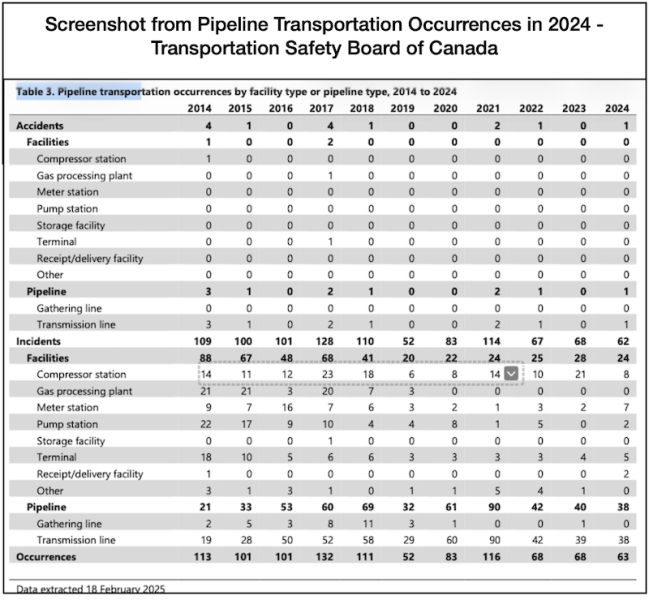


Narrator: The Canada Energy Regulator maintains a webpage dedicated to incidents on pipelines and facilities. There have been 1,978 ‘incidents’ reported since 2009. One reported substance release from an oil pipeline company occurred at Sherwood Park, Alberta. Equipment failure was cited as the cause of the Trans Mountain pipeline fire in the Westridge area of Burnaby, and equipment failure was also cited as the cause of an explosion in Zama City, Alberta.
Elizabeth May: “I don’t think you’d see an explosion in a dilbit pipeline. There are explosions at tank farms for sure.”
“The best educational piece on tank farms—I’m sure you’ve seen it—is Bob Bossin’s YouTube video, ‘Only One In A Hundred Bears Bite But They Don’t Come In Order.’ He put together a video which shows exactly how dangerous tank farm explosions are. No other country but Canada would ever have approved a tank farm and expanded it as they did at the foot of Burnaby Mountain. You’d absolutely strand SFU; you’d be so close to communities. That’s why the Burnaby firefighters were so desperately against allowing the Trans Mountain pipeline expansion to go ahead.”
Cortes Currents: “What about the oil spills in Burnaby?”
Elizabeth May: “There was a spill from the shoreline going out. It wasn’t dilbit; I cross-questioned Kinder Morgan on this point. It was from one of the oil sands facilities, but it was synthetic crude (SynBit).”
Dilbit Pipeline Spill at Kalamazoo


“So far, we have not had a dilbit spill in the ocean. We’ve only had the Kalamazoo River spill in a freshwater environment. With the Kalamazoo River, Enbridge was not alerted to the fact they had a pipeline spill by the numerous alarms, bells, and whistles that went off in the control room. They had one alarm ring nonstop for five minutes while the people in the control room for Enbridge ran around turning off all the noise; they did not believe the evidence of all their alarms that they had a break. They had shut it down earlier in the day for a pressure test and thought they just had minor glitches in restarting. The shift of workers that left the control room after all the alarms went off went home and never left a note for the incoming shift saying, ‘You might want to watch out; we had a lot of alarms going off.’ So the incoming shift started pumping more through the broken system, and they pumped the bulk of it straight into the Kalamazoo River.”
Narrator: A National Transportation Safety Board report filed more than two years later states: “The oil saturated the surrounding wetlands and flowed into the Talmage Creek and the Kalamazoo River. Local residents self-evacuated from their homes and the environment was negatively affected. Cleanup efforts continue, as of the adoption date of this report, with continuing costs exceeding $767 million. About 320 people reported symptoms consistent with benzene exposure. No fatalities were reported.”
By 2015, the clean-up cost reached $1.2 billion.

Can BC cope with a Major Dilbit Spill?
Elizabeth May: “The thing that makes it dangerous is diluting it with the diluent so that you can get it to flow through a pipeline. You have an inherently dangerous product that can’t be cleaned up.”
Narrator: Western Canada Marine Response Corporation (WCMRC) disputes this.
Cortes Currents: “Do you feel confident that you could handle a major spill?”

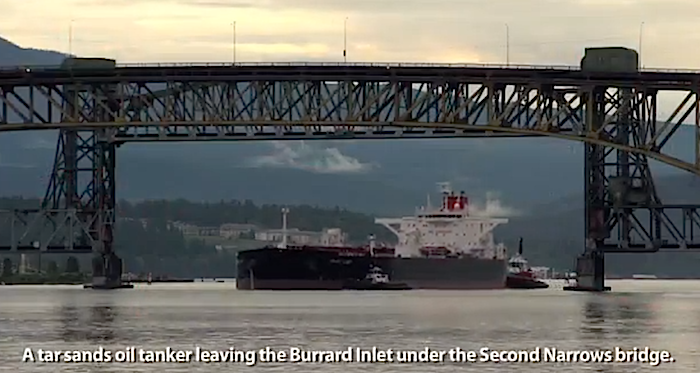
(Screenshot from the video ‘Save the Salish Sea’)
Michael Lowry: “Absolutely. That’s what we’re here for. That’s what we train for. Because of Trans Mountain, we’re actually increasing our capacity on the coast as well. To match that increase in tanker traffic, we’re going to be building six new bases along the shipping route. We’re going to be adding 40 new vessels to the fleet and 120 new personnel. Whenever there’s new risk on the coast, we’re going to grow to match that risk. So that’s what we’re doing for the Trans Mountain Project.”

2007 SynBit Spill in Burnaby
“The biggest spill we’ve ever cleaned up was a diluted bitumen spill. It happened in 2007 in Burrard Inlet. A backhoe hit a pipeline. It was on land, but it got into the storm drains and came down into Burrard Inlet. So it was about a thousand litres.”
Cortes Currents: “Would that be the famous Burnaby spill?”
Michael Lowry: “That was a diluted bitumen product, and we use different types of skimming systems on different kinds of products. For the heavier products like diluted bitumen or bunker oil, our brush skimmers are what we use, and they’re actually quite effective with diluted bitumen.”
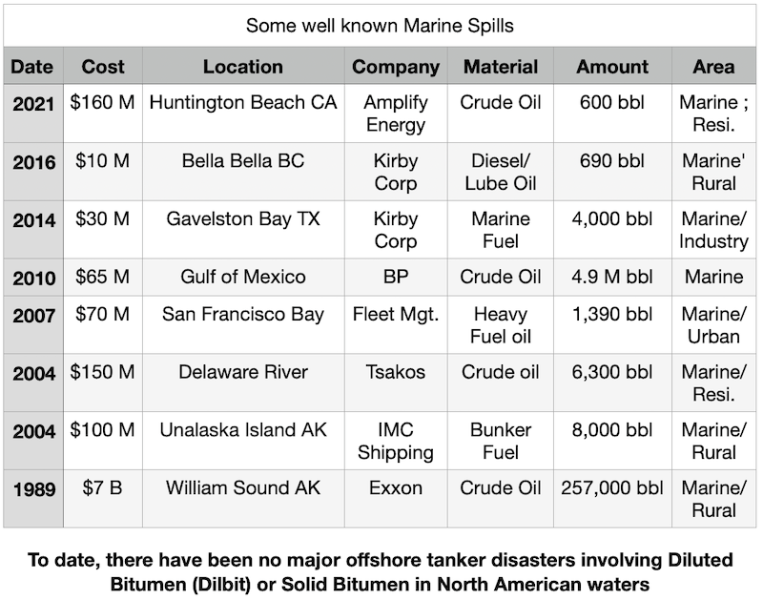
Cortes Currents: “Now, one thing that everybody on the West Coast is afraid of, especially when we start talking about increasing tanker traffic, is oil spills.”
Michael Lowry: “Absolutely.”
Cortes Currents: “What percentage were you able to clean up?”
Michael Lowry: “With the Burnaby spill, I believe the recovery rate was about 90%.”
Cortes Currents: “What happened to the other 10%?”
Michael Lowry: “Some of this product evaporates and some of it dissipates into the water column. It’s not like the 10% is sitting on a beach somewhere that we didn’t clean up. With any spill, there’s a number of players involved, including Environment Canada and the BC Ministry of Environment. When we’ve recovered all the product that we can find, environmentalists go out and look at the environment to see if they find any more product. If they find more product, we’re of course going to go clean that up. So, we’re not the ones that decide a spill response is finished. There are other people involved that make those decisions.”

“Maybe it’s useful to walk through how a spill response works. When you’re looking at a spill, the first thing you do is contain it. If it’s a vessel, you’re going to wrap that vessel with a boom to try to contain as much of that spill as possible (photo above), and then you’re also going to do shoreline protection. If you can identify certain sensitivities ahead of time and boom those off, you can protect them. Those are the first things you focus on.”
” The next piece is the on-water recovery. We want to get all the oil off the water as quickly as possible. Once that’s done, we turn to the beaches. One of the things that we do is called a shoreline flush. Basically, you take a giant sprinkler, put it on the foreshore, and flush the beach. Because the oil floats, you’re actually raising the water table back up. The oil comes back to the surface, and we use the wave action to flush it back out into the ocean where we’ve boomed off that particular area. Then it’s actually easier for us to recover it from the water. The idea with the beach clean is to flush the beach, push the oil back into the water, and recover it there.”
Narrator: On the company website, it states the shoreline cleanup continued for three months and WCMRC monitored the area for 18 months.
Cortes Currents wanted to know about the Burnaby spill’s residual effects. A number of residents decided to leave the area. Burnaby NOW interviewed one of the residents who expressed satisfaction with Kinder Morgan’s restoration efforts. She remembers it taking about 30 months to get her property back to its original state. A study commissioned by Kinder Morgan five years after the 2007 spill states that recovery endpoints for water, intertidal sediment, crabs, sub-tidal sediment, and brown algae have been met, but there are residual levels of contamination in mussels that have not yet met agreed-upon endpoint levels.

Narrator: The company website states they were cleaning up SynBit. Critics of WCMRC’s success in 2007 suggest the organization would’ve been no more effective than Enbridge was during the Kalamazoo River disaster three years later if the spill had been dilbit. They argue that the diluent would’ve evaporated, causing the heavy bitumen to sink to the bottom of the water where it is almost impossible to remediate.
Scientific Research
Lowry and May both cited scientific studies supporting their conclusions.
Michael Lowry: “They built specialized test tanks in Alberta to test this product. They simulate wave action and sediment, and even after four weeks of testing, this product has not sunk.”
Elizabeth May: “During the National Energy Board Environmental Assessment, I went through all their evidence as an intervenor. There was only one so-called study that said you could clean up bitumen diluent. In Gainford, Alberta, in a tank full of fresh water, they stirred in salt and then dribbled dilbit and said, ‘Oh, it’s just like regular oil. We can boom it.'”
“The Royal Society of Canada did a much more detailed study. Canada’s preeminent science body said it’s not at all clear you’d ever be able to clean this up. Bitumen will separate, form oil balls, and sink. The diluent will volatilize and enter the atmosphere. The worst outcome would be when the dilbit in the open ocean was churned enough to homogenize into a kind of toxic peanut butter that coated the coastline. We have no idea how to clean up a dilbit spill.”
Increased volume on Trans Mountain


Narrator: The volume of dilbit flowing through the Trans Mountain pipeline has increased significantly since the expansion project was completed in 2024. According to the Canada Energy Regulator, exports to countries other than the United States have more than tripled. We asked local leaders for their perspectives on using bitumen by rail.
Thoughts on Bitumen by Rail
Max Thaysen (Cortes Island Climate Action Network): “It sounds interesting in that it could take some of the impacts out because the rail lines are already established, so you won’t be impacting First Nations territory in new and different ways that are problematic.”
Jennifer Lash (Former Senior Policy Advisor): “We should be looking at all of our options. Alberta is dead set on it being a pipeline, but I would like to see the Minister of Natural Resources work with Alberta to look at the range of options. Let’s calculate that train approach because if you have more options of where to get the oil to, that might be economically more beneficial.”
“The challenge is that oil by rail is economic when pipelines are full; it’s not economic when there is capacity in the pipelines. You also need to look at what infrastructure is needed. You could ship it to Atlantic Canada because we have a train system already, but we would have to look at whether we have the port facilities to handle tankers.”
The Lac-Mégantic Disaster


Aaron Gunn: “I don’t know if Elizabeth May is thinking of some form of solid oil or something like that, but we’ve seen massive train derailments and infernos as a result of that. With Lac-Mégantic, dozens of people were literally incinerated from moving oil by rail.”
Jennifer Lash: “The minute we talk about trains, people envision Lac-Mégantic, where there was that absolute disaster of a train that exploded right in the community. People have visions of that happening, and I think we really need to be cognizant of that.”
Elizabeth May: “The argument shifted after Lac-Mégantic. Suddenly reporters, argumentative fossil fuel lobby people, and pro-pipeline people would say, ‘Well, so you’re in favour of putting it on a train where it’s so dangerous?’ I’d have these arguments with Justin Trudeau quite often and say, ‘Justin, you don’t understand.'”
“So, I’d have to go back to basics. It’s astonishing to me how many people have firm positions about shipping a product where they have zero knowledge of the properties of that product.”
“The product was Bakken shale—essentially fracked oil. You don’t put it on a train—ever—if you’re sensible.”
“Until Lac-Mégantic, the people shipping it by rail had no knowledge of how much more dangerous it was than other conventional products. They didn’t know the use of hand brakes on a freight train loaded with Bakken shale above the town of Lac-Mégantic created a circumstance where the brakes gave way. As everyone knows, the train barrelled into town and created a massive fireball that destroyed the centre of town. Forty-seven people were killed. It’s horrific, and some of the people’s bodies were never found.”

Additional Oil Pipeline Matters
Elizabeth May: “That’s Bakken shale. What are we shipping out of the oil sands? It’s nothing like Bakken shale; it’s bitumen, and bitumen is a solid. You can take a blowtorch to it, and you can’t get it to catch fire. About a third of what we’re shipping now through the Trans Mountain pipeline—which gets sold to China—ends up being used to pave roads.”
“What’s the point of the pipeline in the first place? Well, it’s cheaper—especially if someone else builds it for you. If you’re producing bitumen in the oil sands, you’ve got a product that’s inherently of low value. You can’t refine it. You have to upgrade it to synthetic crude to get it to be something that you can put in a refinery, and the upgrading process is very expensive. Most refineries don’t have upgraders.”
“People talk about Energy East and how we should be able to ship Alberta’s product by pipeline to the East Coast. Well, there are no refineries on the East Coast with upgraders. So it was, again, a nonsense argument without a business case.”
“One of the main motivations I had—and that most people fighting the Kinder Morgan pipeline and getting arrested trying to stop it, like me —was about the fact that the pipeline was going to be, and is, shipping diluted bitumen.”
The Cost Of Bitumen by Rail
Narrator: Everyone seems to agree that shipping oil through pipelines is cheaper than using the railway.
Elizabeth May: “It’s cheaper, especially if someone else builds it for you.”
Jennifer Lash: “Oil by rail is economic when the pipelines are full. It’s not economic when there’s capacity in the pipelines.”

Aaron Gunn: “When you take up finite rail space that’s meant for other Canadian goods like wheat, potash, or other goods that are going to market or within the country, you can drive up the price that everybody’s paying. The oil companies would start taking up a finite amount of space on the rail.”
“You can’t just raise prices; you’ll destroy the entire industry, which we’ve seen happen over and over again in Canada. You see it happening right now with forestry: government imposing costs on industries that have to remain globally competitive. They’ll just shut down and go somewhere else.”

Jennifer Lash: “Ultimately, it’s whether or not you have a proponent. For a pipeline, it’s one proponent, or a consortium of proponents, who will advance the pipeline. If it’s oil by rail, who is the proponent to bring that idea forward?”
“Is it a rail company that brings that forward? It’s a less clear pathway that I can see, but that shouldn’t rule it out. I think oil by rail will exist regardless because it is flexible, and if a pipeline were approved today, it would take years before it’s built and oil is going through it. There is a moment in time right now, going forward, where oil by rail will be trying to handle that extra capacity that’s needed.”
Environmental Concerns
“I just also want to note, because I’m sure some of your listeners are thinking about this, that the opposition to the pipelines is very much around concerns regarding the impacts on the ocean and the land from a spill. It’s also about the expansion of the oil sands, and so I just want to acknowledge that if you go to oil by rail, that increased capacity will still be there. So it won’t solve some of the issues that a lot of people have about emissions. It is something that we have to deal with. If there’s higher production out of Alberta, we have to find more ways to reduce those emissions.”

(from the top) The upper five layers layers in the chart above are Albertan product and correspond to C-5+Condensate; Heavy Crude Oil; Light Crude Oil; Dilbit (green) and SynBit (orange).

(Chart courtesy Pembina Institute)
Max Thaysen: “I don’t want to call Aaron Gunn a climate denier, but I don’t think that he understands the extent of the danger that we’re in and how fast we have to move to get back into anything resembling a tolerable level of impacts from pollution. What others say is that the world is going to keep using oil for some time to come, so it is better that it be our oil than some other oil that is produced in a less scrupulous way. There’s a claim about Alberta oil sands being cleaner oil than oil from somewhere like Saudi Arabia.”
“I find that to be a little bit silly because you have to ‘cook’ planet Earth in order to get the oil to flow out of the Alberta oil sands, and you burn fossil fuels in order to do that. There are other places in the world where you still put a pipe in the ground and oil comes out. It doesn’t take very much energy to do that, and therefore it doesn’t take very much pollution. The world cannot continue to burn fossil fuel for very long at all, and certainly not the wealthy world. We’ve exhausted our share of the global remaining safe carbon budget.”

“We’re seeing leaps and bounds by renewable energy. Solar plus batteries is the cheapest form of electricity generation in the world. Electric vehicles are cheaper to operate and cheaper in the long run, despite their higher investment costs, than gas cars. The world is waking up to the reality that in every single way, fossil fuel is a losing deal. So far, we’ve been able to fool too many people in Canada and America, but China has definitely woken up to this reality, and I think Europe is on track to electrify and go renewable.”
Elizabeth May: “If you’re going to be stupid enough to want to export bitumen, for heaven’s sake, the safest way to do it is to put it on a train. That’s it. It’s more expensive, and I don’t want bitumen going anywhere, but don’t dilute it, don’t put it in a pipeline, and don’t expect us to like it because it’s the most dangerous way to go.”
Links of Interest:
- Incidents at CER-Regulated Pipelines and Facilities – Canada Energy Regulator
- Pipeline transportation occurrences in 2024 – Transportation Board of Canada
- Will the Minister agree that shipping solid bitumen by train is without risk? – Elizabeth May in the House of Commons (Feb 13, 2018)
- Elizabeth May on Business of Supply (Sept 22, 2025) – Openparliament.ca
Top image credit: Bitumen – Photo by Daniel Tzvi (Own Work) via Wikimedia (Public Domain); undesignated charts contain data gleaned from the web by Roy L Hales; The interview with Michael Lowry took place at a trade show in 2019 and was originally published as The Big Spill.
Sign-up for Cortes Currents email-out:
To receive an emailed catalogue of articles on Cortes Currents, send a (blank) email to subscribe to your desired frequency:
- Daily, (articles posted during the last 24 hours) – [email protected]
- Weekly Digest cortescurrents – [email protected]