


At 9:30 AM on Dec 2, Regional Director Mark Vonesch will be joining the Cortes Housing Society to host a community forum in Mansons Hall.* In today’s interview, he gave a sampling of how a little government could help make housing more affordable
“We are in a housing crisis. Housing is expensive to build and we don’t have enough of it. What can we do as a community in Cortes to get more affordable housing done? Like a lot of issues, we have to approach this from multiple angles. There’s not one thing that’s going to solve the problem. It’s basically three things.”

“How do we finish the Rainbow Ridge project?”
Eight of the 24 units will be rented out at market rate prices to doctors, nurses and other professionals that we need on the island. The other 16 units are subsidized housing priced below market values.
Mark Vonesch: “On November 16th, five days ago, the Cortes Housing Society put in an application to the BC Government for some grant money, for some loan money and some long term subsidies to make them affordable. It’s in the BC government’s hands now.”
“We’ve got a strong housing society. We’ve had a lot of success already. Sadhu Johnstone has taken over the helm of it, and I’m really excited for the new energy and new mandate that he’s going to bring, and I’m expecting more progress there.”
“We’ve had quite a number of people step up to make Rainbow Ridge more viable for potential funders. We’ve had people on Cortes donate land. We’ve had people on Cortes donate money. We’re lucky to live on an island where the wealthier folks here really care about the island and are contributing and supporting and addressing the housing issue. That’s one thing we can do.”
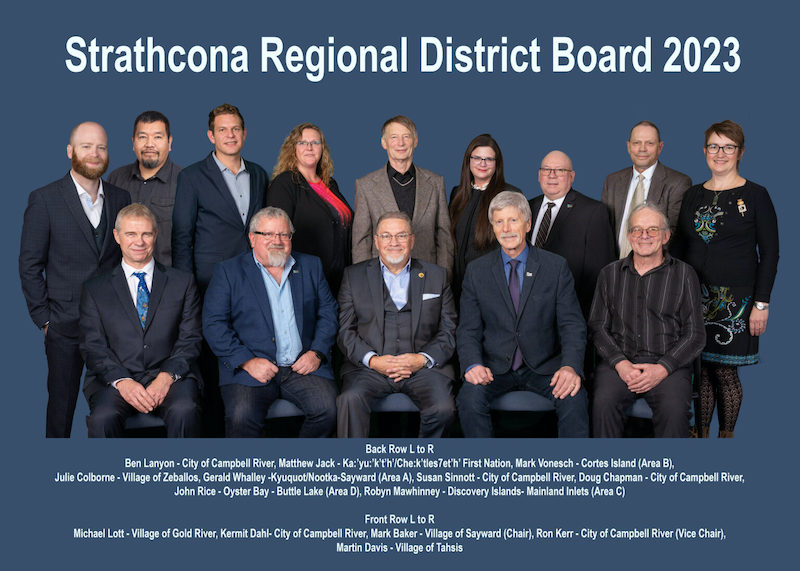
“The other thing which I’m really excited about is the Strathcona Regional District Board of which I am a part (one of 14 Directors), has moved forward on developing a new housing service.”
“Up until now, the Strathcona Regional District really hasn’t done anything for housing apart from approving subdivisions and changing zoning.”
“Now we have public funds at a Regional Level to address housing. So putting funds into getting housing built, which I’m really excited about.”
“The solution to affordable housing isn’t just rentals, it’s affordable land ownership. There’s a lot of people on Cortes that have been here for a long time, pay rent and would love to be able to purchase property, but they cannot compete with tourist prices. The last housing survey said the average land price on Cortes was $794,000. The average person on Cortes could afford $209,000, so a huge gap there.”
“I’ve come up with an idea that can help address this. There are up to $10 million worth of loans that the Regional District can borrow for housing development. I’ll just run through a potential project and what it could look like. These are obviously rough numbers which show how this model could work.”

“Let’s say the Regional District purchased 40 acres in Cortes for a million dollars, then subdivided that land into ten 4 acre lots. Now we’re looking at ten 4 acre lots that are valued at $100,000, as far as the loan is concerned, and then put $150,000 of services on each of them. Put in a $90,000ish tiny house that’s on a foundation. Put in another $60,000 into a well, power and road. So now they’ve put $250,000 into each of those lots. That’s 2.5 million and then we sell those lots to local people, to young families, to people that want to be able to buy land on Cortes that primarily are living here already. When people buy it, they can purchase it with a 5% down payment, which is often a barrier. When people are buying raw land, you usually have to put out 50%. So by putting a tiny house on the land and putting on a foundation, they can get a 5% mortgage to purchase it.”
“Sell it to them through a land trust structure because they’ll be purchasing it below market. So let’s say, we sell it for $250,000. A young couple on Cortes could afford that mortgage payment. When they sell it 10 years from now, because it’s being sold through a land trust structure, they can only sell it at the original cost plus a reasonable inflation. It bakes in that affordability of $250,000 from the start.”
“Let’s say the market value is $400,000. They’re getting affordable land ownership at the beginning, but when they sell it, that affordability will still be baked into it. So the next person that buys it will still be able to access that land in an affordable way.”
“So that’s one of my ideas that I think there’s a real opportunity to do it on Cortes. I want to start out with a 5 or 10 plot pilot project for it.”
“That’s one of the things that the new Regional District housing service could be used for. For this example, we brought $2.5 million through the housing service. The tax requisition that is part of the service would help pay for the loan until people buy the land at $250,000, then all that money goes back to pay back the loan. The idea is that we can do housing projects at the regional district level that are very close to cost neutral and we can move on to another place and do another affordable land ownership.”
“This is one way that the housing service could benefit Cortes. The other way is putting tax requisition money into government funding or other developments.”

“The housing service is going to the alternative approval process, which just started.”
If 10% of the Strathcona Regional District’s electorate (I.E.,- 3,456 people) notify the SRD that they’re opposed to this new service before 12 o’clock noon on Tuesday, January 2nd 2024, it will be considered defeated and the SRD would have to consider other ways of raising the money.
Mark Vonesch: “If that passes, it should get approved by the board on January 10th. We don’t automatically borrow $10 million, it just means that we can access up to $10 million. That would come into effect in the middle of February.”
“What I want to do is work with the Cortes Housing Society and put together a business plan, so that we can bring it to the Strathcona Regional District Board and say, ‘here, this is something that could really work. It’s going to pay for itself and it’s going to put affordable land ownership into the hands of Cortes.’”
“The other thing is, there’s a lot of excitement for a tiny house park where people can lease a plot of land and have some shared services and have a tiny house park similar to the trailer park concept.”
“What can we do in the free market to incentivize some more rentals to get built? Is there a way that we can look at the OCP, where there’s already a call for densification? We could potentially allow a third dwelling if it was going to be used for a long term rental, as opposed to an Airbnb or something?”
“Those are the three areas that I’m really focused on, as far as addressing housing on Cortes. Not one of them is going to solve it, and it’s not going to be an overnight solution, but I think if we can move forward with these things, we’re going to see some progress.”
Cortes Currents: The only opposition I can see to the SRD housing initiative is from people who don’t want to pay any more property taxes, so could you explain what the potential cost could be to individual property owners.
Mark Vonesch: The maximum amount of requisition is five cents per thousand dollars of property. I think the average property is somewhere around $600,000, so I’m just pulling out the calculator here. The average property on Cortes would pay $30. There are 804 properties on Cortes that pay taxes. So that would raise on Cortes $24,000 a year, if we chose to do the maximum. There might be years where we do a lot less, but the maximum would be the average of $30 a year. So it’s a very small amount, but when that gets added up across the whole district, it raises a lot of funds and allows us to leverage small amounts for all the different property owners and really have an impact.
Cortes Currents: What happens when that money gets paid back?
Mark Vonesch: “It would be seed money. We can do more projects. One of my ideas is to have these projects basically cost neutral. So to have some tax requisition at the beginning that helps pay for getting the project set up until they’re sold. Once they’re sold, that goes back to pay back the loan.”
“There’s obviously some administrative costs that are going to be in there throughout, but it basically gives us the opportunity to raise some money as a district and make a difference on housing, make a difference on rental housing, make a difference on workforce housing and the idea of affordable land ownership as well.”
Cortes Currents: What about Cortes Island’s Official Community Plan (OCP), which is at least 12 years old?
Mark Vonesch: “At the very least, we need to look into updating it. There’s enough of a big call to actually just do a new OCP.”
“Part of the new housing legislation that’s coming out of the BC government is asking that municipalities and regional districts have updated OCPs. They’re saying we should be updating it every five years. Cortes Island is long overdue for an OCP process and an official community plan process.”
“For those listeners that are wondering, an OCP is a large, big picture planning document that allows us to make decisions that are based on community will and what people in the community want to happen on Cortes. It gathers input from all aspects, including density and then that helps us make decisions around where a subdivision might happen, where a tiny house development might happen or where Rainbow Ridge, for example, is slated to happen.”

Cortes Currents: Are there any updates on the 3% tax on short term rentals? Has that gone into effect?
Mark Vonesch: “Like a lot of things in government, these things happen slowly, but as of July 1 this year all new bookings on Cortes Island at hotels and Airbnbs paid an extra 3%. That’s either collected through the Airbnb or VRBO platform, so people who are running those don’t even have to think about it. They do it automatically. They send it to provincial governments and then it gets passed on to the Cortes Housing Society.”
“Then for folks that are renting their short term rentals privately, and they’re making more than $2,500 a year, they need to charge that to their customers. If people are making less than $2,500, then they don’t need to charge that, but it’s an exciting move.”
“We got a lot of media around it. We probably had 20 headlines when that came in. We’re the first community in BC to make use of the MRDT tax and use it 100% for housing, which is really exciting. It’s not going to get Rainbow Ridge built, but it’s going to provide some secure revenue that looks good on the grant application that just went into BC housing.”
“It shows that we’re expecting revenue from that and there’s will in the community to really address and make a difference on getting rental housing built.”

“The last thing I want to say is that we’re doing a housing forum. I partnered up with the Cortes Housing Society and it will be on December 2nd from 9:30 till 12:00 PM at Manson’s Hall. This is really a chance for the community to come together, talk about the housing challenges we have, and the potential solutions. Where’s the direction that you would like the Cortes Housing Society and myself, as the Regional Director, to take and really create more of a unified voice around the changes we want to make.”
Cortes Currents: How can people stay in touch with you?
Mark Vonesch: “If you go on the Cortes Island Facebook group, or if you join my mailing list at Cortes Together dot com or the Cortes Housing Society’s mailing list, you’ll get information and we’re going to be doing a zoom option as well for folks that aren’t able to attend in person.”

“So far, this response has been great. We’re getting lots of people RSVPing. There seems to be a lot of interest. What I’m really hoping is that we get a diversity of people there. Not just people that are looking for housing, but people who own land and want to be part of the solution, people who are short term rental operators, people that have struggled with housing, people that want to purchase affordable land, people that have skin in the game personally, but also just want to contribute as a community member and be a part of the solution.”
*In the 8 AM broadcast of this program, Cortes Currents said this Saturday, which is incorrect – it is the Saturday Dec 2.
Image credit: Mark Vonesch, Regional Director of Cortes Island – submitted photo
Sign-up for Cortes Currents email-out:
To receive an emailed catalogue of articles on Cortes Currents, send a (blank) email to subscribe to your desired frequency:
- Daily, (articles posted during the last 24 hours) – [email protected]
- Weekly Digest cortescurrents – [email protected]