


According to Environment and Climate Change Canada, the oil and gas sector is a major contributor to Canada’s economy, employing 182,000 people and generating $209 billion in GDP during 2023, yet it is also the source of 31% of Canada’’s Greenhouse gas emissions.
“Demand for oil and gas is not going to go to zero tomorrow. It is a transition that takes decades to undergo. There will be a role for oil and gas as we move forward along that transition, but it is likely to be a cleaner oil and gas sector as the rest of the world stops buying the oil and gas products that Canada and other countries produce. Which, I think, really underlines the importance of investing in decarbonization now while we’re still using oil and gas to 2050 and a little bit beyond if we get on a net zero trajectory,” explained Janetta McKenzie from the Pembina Institute, a Canadian think tank and non-profit focused on energy.
She was responding to a new report from the Federal Parliamentary Budget Office.
Janetta McKenzie: “They were assuming that very little action was taken by oil sands firms in particular, to reduce emissions on site, and therefore they would be choosing to stop producing. Across the sector, there’s been a lot of commitments to slashing emissions by 2030. There’s billions of dollars on offer through federal and provincial tax incentive and grant programs. We think there is a path towards choosing to decarbonize, choosing to reduce emissions and not just choosing to shut in production. We think it’s a pretty narrow analysis that’s based on a very specific set of assumptions that doesn’t necessarily reflect the suite of options available to the sector.”

The oil sector has been promoting the idea of carbon capture for years. A group of oil companies put forward a $16.5-billion plan for a massive carbon capture and storage (CCS) network in northern Alberta, but has not implemented it.
Janetta McKenzie: “We have not seen a lot of movement from the oil sands Pathways Alliance carbon capture project. This was announced several years ago. We simply haven’t seen it move ahead. In the absence of news on that, it’s difficult to make the call on whether those big emissions reduction projects will be implemented anytime soon.”
According to Environment and Climate Change Canada, “New regulations to be finalized later this fall will ensure that the sector continues to cut methane emissions by at least 75% from 2012 levels by 2030. Carbon capture is also going to play an increasingly important role in reducing the emissions from oil and gas production and Canada is well placed to cement its position as a global leader in this critical technology. According to both the IPCC and the International Energy Agency, there’s no credible plan to carbon neutrality without carbon management technologies such as carbon capture and storage and their deployment must be rapid and immense, scaling up by nearly 200 times by 2050.”
Janetta McKenzie: “It’s difficult to say what is on the docket for these firms right now. I will say, with the combination of policy, like industrial carbon pricing, incentives, tax incentives like the carbon capture incentive tax credit from the federal government and provincial grants in particular for carbon capture, but also other emissions reductions technologies plus the possibility of doing a deal with the Canada Growth Fund, the conditions for the last couple of years have been quite good to get a pretty package to incentivize and encourage the industry to move forward with these things.”
A report commissioned by the government of Alberta last year concluded that “curtailing production would be a more cost-effective option compared with investing in CCS. Hence the most likely outcome is that producers would opt to curtail production if confronted with the proposed Cap in 2030.”
As a result between 2030 and 2040 an estimated 55,000 jobs would be lost in Alberta and 35,000 in the rest of Canada.
The Pembina Institute estimates, “with the policies already in place today to reduce emissions and encourage the growth of clean economic sectors, between 2025 and 2050 there are net gains across Canada of 766,000 jobs.”
A report from Clean Energy Canada added that, “419,000 of these jobs will be in Alberta, representing three jobs for every individual worker employed in Alberta’s upstream energy sector as of 2022.”
Also, neither the Alberta Government Report or Parliamentary Officer considered, “… the costs that would be felt by Canadians if nothing is done to mitigate oil and gas emissions. According to the Canadian Climate Institute, a typical storm or flood that cost roughly eight million dollars in the early 1970s, now costs more than 110, 000 dollars.”
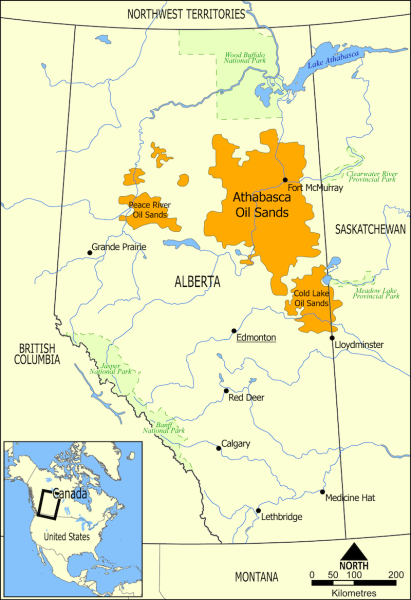
Cortes Currents: Are they still ramping up production in the oil sands?
Janetta McKenzie: “To an extent and part of that is because the Trans Mountain Pipeline opened last year after years of cost and construction overruns, that pipeline is now open. So production has increased to take advantage of the extra capacity there, but they’re not big new projects. It’s mostly small, marginal increases in production at existing facilities.”
“There have been innovations, but we haven’t seen a lot of movement when it comes to reducing emissions from the oil and gas sector, particularly the oil sands sector. We’ve seen production of oil sands go way up, and we’ve seen emissions go way up as well, but the emissions intensity improvements that we saw in the oil sands over the last 15 years have begun to stagnate a little bit. We’re really not seeing emissions intensity improvements to the extent that we need to.”

“In other types of oil and gas production, like conventional oil or natural gas, we are beginning to see emissions come down. Part of that is due to good methane regulations that are obligating those parts of the sector to begin plugging methane leaks or switching out equipment that leaks methane.”
“So we certainly have seen some innovation and some improvements from the sector, but the fact of the matter is this is still Canada’s highest emitting sector. We haven’t really seen emissions begin to come down from it in ways that we have in other sectors, for instance, electricity. So there’s obviously a role both from the firms themselves, as many have committed to slashing emissions, but also a role for regulation to obligate those emissions reductions actions.”
Links of Interest
- A Pivotal Moment– Clean Energy Canada, March 22, 2023
- Potential Economic Impact of the Proposed Federal Oil and Gas Emissions Cap – Deloitte, Prepared for the Alberta Treasury Board and Finance, March 27, 2024
- Oil and gas greenhouse gas pollution cap – Backgrounder to CGI Regulations, Environment and Climate Change Canada, November 4, 2024
- Impact Assessment of the Oil and Gas Emissions Cap, Nasreddine Ammar et al, Office of the Parliamentary Budget Officer, March 12, 2025
- New analysis of oil and gas emissions cap assumes industry does not follow through on its promises to Canadians – Janetta McKenzie, Program Director Oil and gas, the Pembina Institute, March 12, 2025
Top image credit: Alberta Oil Sands – courtesy the Pembina Institute
Sign-up for Cortes Currents email-out:
To receive an emailed catalogue of articles on Cortes Currents, send a (blank) email to subscribe to your desired frequency:
- Daily, (articles posted during the last 24 hours) – [email protected]
- Weekly Digest cortescurrents – [email protected]