
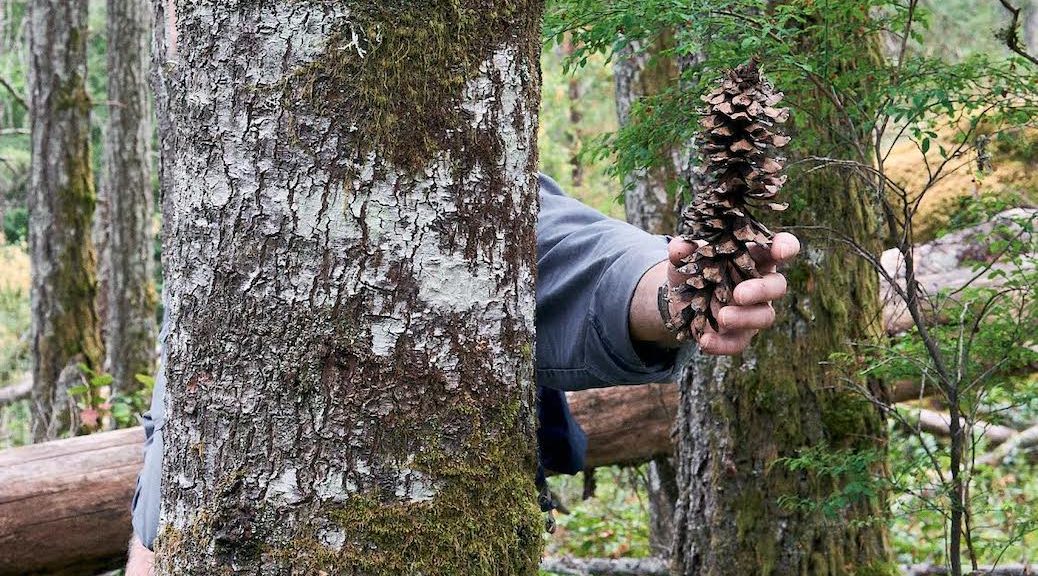

On Saturday Robert Bringhurst (RB) brings his own brand of literature, local history, science and humour to the stage of the Quadra Community Centre. He just gave Cortes Currents a taste in a rambling conversation that at one point went off topic to include remarks about Cortes Island, Campbell River and Whistler. Bringhurst started out by describing his intentions in the epic description of ‘the Ridge’ on Quadra Island where he lives.
RB: “I wanted to make good poetry out of, among other things, good science. I wanted to walk the ridge and relish it as one does without any thought of scientific measurement or accuracy, but I also wanted to think about it as a real place in historical time and to look at the species in relation to other species on the planet, and at the rocks in relation to other rocks. I began to wonder how much biology, geology, astronomy and climatology I could put in this poem without sinking it. The answer turned out to be quite a bit.”
“So unlike most poems, there could be a corrected second edition. There could be mistakes. It’s like a research paper. An interesting thing about science is that it purports to have the real answers to things, but the answers are always changing. The facts are changing. There could be numbers in the poem that need to be changed or updated, that’s a curious thought.”
“Anyway, I worked on this thing for probably eight years, this one poem, and in that time I learned a great deal, and some of what I learned kept changing. The climatological facts change rapidly it seems, the geological facts change more slowly.”
“It sort of restored my childhood faith in the possibility of science and the arts, science and literature coexisting happily. I hope other people might find some pleasure in that as well.”
“It’s also a meditation on the end of the world, and there’s very little pleasure to be found in that except the pleasure of admitting that things are as they are, not hiding from it.”
CC: How do you see the world ending?
RB: “Well, there’s a famous poem about that, I’m sure you know it:
Some say the world will end in fire,
some say in ice.
From what I’ve tasted of desire,
I hold with those who favor fire.
But if it had to perish twice.
I think that for destruction ice
is also great and would suffice’
– Robert Frost
“That poem does not need updating. It’s just as accurate now as it was almost a century ago, when Frost wrote it. How exactly it will happen, of course, no one knows. How slowly or quickly, no one knows. How completely or incompletely it will end, no one knows. But all things are mortal. The planet is mortal. The Earth is mortal.”

CC: There’s also a personal side to this story. How long have you been living on Heriot Ridge?
RB: “20 years, more or less. If the ridge starts at sea level, I’m about halfway up on the eastern slope.”
“When I came here, I spent most of the year driving up and down the coast when I had a day free looking for a place that I might be able to afford. At that time I was living in a rented house on a horse farm, south of Nanaimo, very pleasant place in some respects, but I’d been living in Vancouver and I’d been living on Bowen Island and I’d been living in Vancouver again.”
“I wanted to get farther away from the city. I didn’t have a lot of money, so when I wandered up to Quadra Island, it looked promising. There was a not very old house, about 15 years old, that had never been finished, but was a bit of a wreck on five acres of forest.”
“I liked the forest. I didn’t think much of the house, but it had a roof and it would keep me out of the rain. I walked up a trail onto the upper part of the ridge. I met some nesting nighthawks. I met, of course, ravens, and woodpeckers, and other creatures who live around here. I got rained on, and the sun came out and dried me off. By the time I came down off that little afternoon hike, I was converted. I wanted to stay here.”
“So the house with its pink carpet and other disadvantages would have to do. I could live in it while I tore it apart and rebuilt it. I didn’t have the guts to just buy a bare piece of land and build a house from scratch. I couldn’t imagine how I would ever find enough money to do that. So the wrecked house was what I needed and I’ve been here ever since.”
CC: What’s special about the ridge?
RB: “Nothing and everything.”
“It’s unusual here because it’s made out of pillow basalt, the product of a volcanic eruption a long time ago and a long way away that finally ended up here on the coast of Canada and up above sea level. The soil is very thin. The forest is remarkably varied, little micro systems and micro climates all over the place. It’s so rugged, it’s so rumply, even though it’s not very high (it’s only a few hundred meters), it’s never been developed. It’s never been logged much. Areas of the lower slopes that were logged severely, of course, but most of it is just too inhospitable to that kind of assault. It’s survived semi-intact.”
“It’s a very modest size. It’s not exotic particularly. There are a lot of old trees by Quadra standards. There was a huge forest fire on Quadra in 1925 that burned something like half the island and a lot of the trees that survived that fire are here on the ridge. They are survivors. They were badly injured. They haven’t grown much in the last hundred years, but here they are, twisted and blackened and they’re pretty good company for an old guy like me.”
CC: Are any of them old growth?
RB: “Well, there are some that are probably 800 years old. There are more that are sort of 400 years old. So, they’re old enough.”
CC: Can you read us a little segment of the poem?
Here’s a little section, not too far in from the beginning, after the subject of the fire has been introduced.
Does it matter what happened?
It does, it does, it does, because what’s happened,
each and everything that’s happened
is what is in fact the case.
But does it matter who’s to blame?
How could that alter or affect what is the case?
What is the case is that this nameless valley burned?
What is the case is that this forest has been burning,
then replanting itself and burning
for about six thousand years.
What is the case is that this kind of forest does that
Once at least each thousand years it burns.
Something else that is the case.
One species, the one that uses fire,
is remarkably like fire,
insatiable, thus dangerous to everything and lethal to itself.
Is it insatiable by nature?
Hard to know. But certainly by culture
in the ways in which its nature has been worked
and turned in certain times and places
and is now worked everywhere it goes.
It is insatiable, in other words, by choice.
No, not by everybody’s choice,
but now no deeper, less incendiary culture has a land in which to flourish, nor a forest in which to hide.
So one more time, does it matter who’s to blame?
Dick or Jane or Tom or Harry?
Not to me, but possibly to them.
If one or more of them is guilty, doesn’t that become, for them, the essence of the case?
But if it’s humans, gods, or streptococci,
can a species or a culture or a tribe or a society be guilty?
Is moral knowledge more than just a luxury some have and others lack? This knowledge, for example,
that forests have been burning somewhere on the earth almost without letup for at least 360 million years?
That when the big trees and the grasslands had been burning for a hundred million years,
there was an interval,
no fire to be found for several millions.
And that this was the great Permian extinction,
a long moment when all life nearly died,
and that when life dies, fire necessarily dies with it.
It did so in this instance, when all the life still living could not make sufficient oxygen and fuel to kindle a small flame.
– from the Ridge
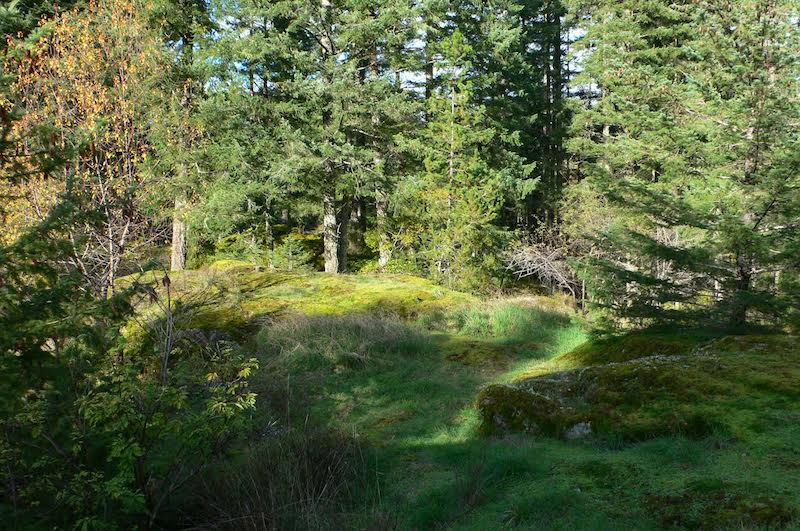
“It’s a very cheerful poem, as you can see, and a lot of it is meditating on the distant past, the maybe not so distant future and a lot of it is just walking around the ridge and looking at the things that live here: mosses, and lichens, and trees, and so on.”
CC: In the press releases, it talks about Indigenous history on the ridge.
RB: “We don’t know very much about the Indigenous history of any place in North America, especially British Columbia, but we know that Quadra was contested territory. It was K’omocks speaking territory, and the Kwakʼwala, the Wakashan language family people, were moving in.”
“So when the Europeans first arrived and began asking questions, Quadra was in a transitional state. There were a lot of families in which one parent spoke Kwakwala or Lik’wala, the local dialect of Kwak’wala, and the other parent spoke Komox. A lot of kids grew up bilingual.”
“Of course that came crashing down like all other Indigenous cultural institutions in this part of the world as the Europeans moved in and the missionaries moved in and so on.”
“There are no village sites on the ridge, but there are shelters that have evidence of human presence going back at least 6,000 years. These are not places where people lived, these are places where people stopped for lunch, or maybe camped for the night, natural shelters where you can get out of the rain. There is one within a five minute walk of my house.”
CC: Was there anything more you wanted to say about the history of the ridge?
RB: “I wish I knew more about the history of the ridge. I wish I knew a lot more about the history of everything on this coast, but it’s just a little benignly neglected part of a small, insufficiently neglected island on this coast that has drawn so many gold diggers and get rich quick artists and is still doing so.
CC: What’s special about Quadra?
RB: “As I said before, nothing and everything. It’s just this little neglected semi-forgotten place, the island that a lot of people cross in order to get to Cortes. The island that a great many more people pass by, without ever knowing that it’s here, as they drive up and down Vancouver Island or sail up and down the Strait of Georgia, the Inside Passage. It’s a place to hang out, there are no huge developments here.”
“I was just in Whistler a few days ago. I used to go climbing in the mountains behind Whistler. Forty years ago, there was a one story general store, bus stop and service station, and there were a few cabins in the woods. Now there’s this enormous fantasy land there.”
“As fantasy lands go, it’s all very nice. It’s like a really clean Disneyland and it’s beautiful. I love that subalpine environment, but if I had tried to settle in there, I’d have been bulldozed by the developers. I’d be living in a little tiny shack with 10, 000 other little tiny shacks right on top of me.”
“There’s no Disneyland here. It’s just people living their mostly laid back lives.”
CC: Do you have any reflections on the surrounding area, like Campbell River, or Read, or Cortes.
RB: “I haven’t spent a great deal of time on Cortes. I’ve been to Hollyhock three or four times, and of course that’s very pleasant, but I don’t know the island at all well. I’ve sailed around Quadra all of once. I’ve never gone all the way around Cortes.”
“I don’t know very well what Campbell River is. It was once the salmon capital of the world, according to the advertising. It’s a place that was ruined by aggressive forestry, ruined by a pulp mill, ruined by attempts to turn a nice salmon river into a great tourist destination and it is now a wreck, something like the old house here that I bought 20 years ago. Still, because there are more people there than here, there are some things that one can get in Campbell River that one can’t buy on Quadra. Automobiles, for example, and other things that it’s a little bit difficult to live without these days. So I go there when I have to, don’t stay any longer than I have to and I’m glad to come home again.”
CC: You’ve written a lot of books, is that how you make your living?
RB: “I do make a living as a writer, but I don’t make a living as a poet. I don’t know anybody who makes a living as a poet, but I write prose as well and that more or less pays the bills.”
C: You’re an officer in the Order of Canada, have been given two honorary doctorates, won the Lieutenant Governor’s Award for Literary Excellence and are a former Guggenheim Fellow in poetry.
RB: “Well, the awards are all very nice, but you can’t live off those things either. I guess you can live off the Nobel Prize or something like that, but that’s irrelevant to me. If I didn’t write prose, I would have to drive a cab or do something else.”
CC: Do you have any final thoughts that you’d like to say?
“I don’t have any final thoughts, no. I’m only 77, and I’m just getting started!”
Robert Bringhurst will be reading his 60 page epic poem, the Ridge, at the Quadra Community Centre at 7:30 on Saturday, Oct 21, 2023. His books are either at, or can be ordered through, local bookstores.

Some of the books that Robert Bringhurst wrote, co-wrote, translated or edited
- Deuteronomy (Delta, B.C.: Sono Nis Press, 1974).
- Pythagoras (San Francisco and Vancouver: Kanchenjunga Press, 1974).
- Bergschrund (Delta, B.C.: Sono Nis Press, 1975).
- Eight Objects. Kanchenjunga Chapbook 4 (San Francisco and Vancouver: Kanchenjunga Press, 1975).
- Death by Water: Poem (Vancouver: University of British Columbia Library, 1977).
- Jacob Singing (Kanchenjunga Chapbook 8. San Francisco and Vancouver: Kanchenjunga Press, 1977).
- The Knife in the Measure: Variation on a Theme from Li Shang-yin (Mission, B.C.: Barbarian Press, 1980).
- The Beauty of the Weapons: Selected Poems, 1972-82 (Toronto: McClelland and Stewart, 1982).
- Tzuhalem’s Mountain: A Sonata in Three Movements (Lantzville, B.C.: Oolichan Books, 1982).
- Visions: Contemporary Art in Canada (Douglas & McIntyre, 1983). Co-editor.
- Bringhurst Robert & Bill Reid. Raven Steals The Light (Douglas & McIntyre, 1984, 1996).
- Ocean/Paper/Stone (Vancouver: William Hoffer, 1984).
- Tending the Fire: an Unparable of the Relations of Rabbits & Dogs & Old Women, & c. Alcuin Chapbook 6 (Vancouver: Alcuin Society, 1985).
- The Blue Roofs of Japan: A Score for Interpreting Voices (Mission, B.C.: Barbarian Press, 1986).
- Pieces of Map, Pieces of Music (McClelland and Stewart, 1986).
- Shovels, Shoes and the Slow Rotation of Letters: a Feuilleton in Honour of John Dreyfus. Alcuin Society Keepsake (Alcuin Society, 1986).
- Conversations with a Toad (Vancouver: éditions Lucie Lambert, 1987).
- Bringhurst, Robert & Catharine McClellan. Part of the Land, Part of the Water: A History of the Yukon Indians (Douglas & McIntyre, 1987).
- Pebble Pond Errata Slip: A Codicil to Ocean Paper Stone (Vancouver: Benwell-Atkins, 1987).
- A Short History of the Printed Word (Hartley & Marks, 1990) by William Chappell. Revised edition, updated by Bringhurst.
- Bringhurst, Robert & Ulli Steltzer. The Black Canoe: Bill Reid and the Spirit of Haida Gwai (Douglas & McIntyre, 1991).
- The Calling: Selected Poems, 1970-1995 (McClelland and Stewart, 1995).
- Boats is Saintlier than Captains: Thirteen Ways of Looking at Morality, Language and Design (New York: Edition Rhino, 1997).
- A Story as Sharp as a Knife: The Classical Haida Mythtellers and Their World (Douglas & McIntyre, 1999). Bringhurst, Robert (translator).
- Bill Reid. Solitary Raven: Selected Writings (D&M, 2000). Bringhurst, Robert (editor).
- Nine Visits to the Mythworld: Ghandl of the Qayahl Llaanas (Douglas & McIntyre, 2000). Bringhurst, Robert (translator).
- Being in Being: The Collected Works of a Master Haida Mythteller, Skaay of the Qquuna Qiighawaay (Douglas & McIntyre, 2001). Bringhurst, Robert (translator).
- Ursa Major: A Polyphonic Masque for Speakers & Dancers (Gaspereau Press, 2003, 2008).
- The Solid Form of Language: An Essay on Writing and Meaning (Gaspereau Press, 2004).
- The Tree of Meaning: Thirteen Essays (Gaspereau 2006).
- Everywhere Being is Dancing: Twenty Pieces of Thinking (Gaspereau 2007).
- The Surface of Meaning: Books and Book Design in Canada (Raincoast / The Atkins Library, CCSP Press 2008). $60. 978-0-9738727-2-9
- Selected Poems (Gaspereau, 2009). $27.95 9781554470686
- Stopping By, long poem (Hirundo Press: Hamburg 2012) letterpress edition
- Learning to Die (U of Regina) $19.95 978-0-8897-7563-3. Co-Writer Jan Zwicky
- The Ridge (Harbour Publishing, 2023) $22.95 9781990776250
Top photo credit: Robert Bringhurst’s hand sticking out from behind the truck of the last white pine still living on Heriot Ridge – Photo by by Carl Gladish
Sign-up for Cortes Currents email-out:
To receive an emailed catalogue of articles on Cortes Currents, send a (blank) email to subscribe to your desired frequency:
- Daily, (articles posted during the last 24 hours) – [email protected]
- Weekly Digest cortescurrents – [email protected]